
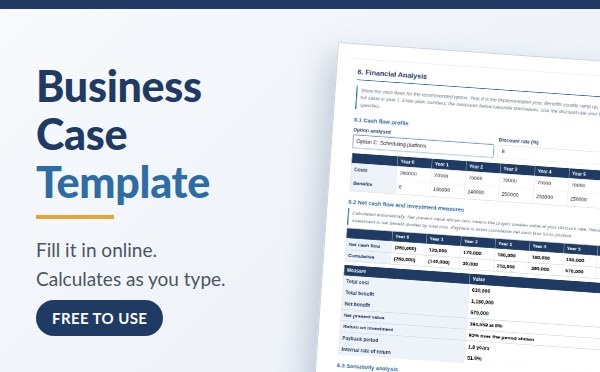
This Business Case Template helps you justify an investment before the money is committed. It compares every realistic option against doing nothing, scores them side by side, and works out net present value, return on investment and payback for you. Fill it in below, free, with no sign-up. Your answers save automatically as you type. See all 50+ PM Templates.
- Custom version ($)
- Word template ($)
- How to use the templates
- What is inside
- What is a business case?
Loading the interactive form. If this message stays on screen, JavaScript is switched off or blocked in this browser.
Your answers are stored in this browser only and are not sent anywhere. Clearing your browsing data, or using a different device or a private window, will start a blank form.
What is inside the template
The business case follows the path an investment committee takes to a decision, from the need, through the alternatives, to the numbers and the commitment:
- Executive summary. The decision requested and the case at a glance, for the approver who reads nothing else.
- Strategic context. The business drivers, the objectives this project serves, and the evidence behind them.
- Problem or opportunity. Root causes, impact, timing, and the cost of doing nothing.
- Options considered. A summary of every option, the ones screened out, and a full panel for each serious contender: description, benefits, costs split into capital and operating, feasibility ratings, scored risks, issues and assumptions.
- Options appraisal. Weighted criteria agreed with the sponsor, with the scores calculated for you.
- Financial analysis. A five-year cash flow, net present value, return on investment, payback, internal rate of return, a sensitivity test and the funding source.
- Recommendation. The chosen option, why it wins, why the others lose, and any conditions.
- Benefits realisation. Each benefit with a measure, baseline, target, date and named owner, plus the dis-benefits.
- Implementation and governance. Delivery approach, milestones, management approach, roles and tolerances.
- Compliance, and the approval block. Data privacy, security, artificial intelligence, sustainability and accessibility, then the decision itself.
What is a business case?
A business case is the document that justifies spending money on a project. It shows there is a problem or opportunity worth acting on, compares the realistic ways of acting on it, and recommends the one that gives the best return for the risk involved.
Its defining feature is comparison. A business case that presents a single solution is a sales pitch. One that sets that solution against the alternatives, including doing nothing, and shows the costs, benefits, risks and feasibility of each on the same basis, is evidence. Approvers can tell the difference, and they fund evidence.
The questions it has to answer are specific. What happens if we do nothing, and what does that cost? Which option gives the best value, and by how much? Are the costs complete, including running costs after go live? Do the benefits have baselines and owners, or are they hopes? And does the case still hold if the estimates turn out to be wrong?
Proposal, business case, or charter?
These three documents are often confused, and writing the wrong one wastes weeks.
- The proposal comes first. It establishes that the problem is worth solving and that a project is the right response.
- The business case follows. It justifies the chosen solution in depth, with detailed costings, a full financial appraisal and a benefits model.
- The project charter comes after approval of the business case. It defines scope, authority and governance, and formally authorises the project manager to spend.
On smaller projects the proposal and business case are often merged. On anything large, regulated or funded from a shared investment pool, keep them separate, because the business case needs a level of financial detail that would bury a proposal. You can start with our Project Proposal Template.
When to write one
Write the business case once the proposal has been accepted and before any money is committed to delivery. It is the document the budget holder signs.
You need a business case when:
- The spend exceeds a manager’s delegated authority and needs a funding decision
- Several options could solve the problem and the choice is not obvious
- The investment competes with other initiatives for the same budget
- Finance or an investment committee requires net present value, payback or return on investment
- Benefits must be tracked and reported after the project closes
A business case is not written once and filed. Revisit it at every stage gate and compare the actual costs, benefits and risks with what it promised. If the case no longer holds, the right decision is to change the project or stop it. After closure, the post-implementation review measures delivered benefits against the ones set out here, which is why every benefit needs a baseline and a named owner from the start.