

Agile teams move fast. That’s the advantage. But speed without clarity leads to building features users never asked for and rarely use. Personas exist to prevent that waste. They bring structure to user understanding and give teams a shared reference point when writing user stories, designing interfaces, and prioritizing backlog items. When done properly, agile personas add depth to product decisions without slowing delivery.
Below is a structured and practical breakdown of how to use them effectively, along with three reliable persona template options your team can adopt immediately.
Agile Teams & the Customer-Centric Approach
Agile promises iterative delivery and continuous improvement, but without a strong customer focus, it simply accelerates poor decisions. A customer-centric approach forces teams to align every sprint with real user value. Personas help translate abstract “users” into tangible, relatable profiles that guide everyday development choices.
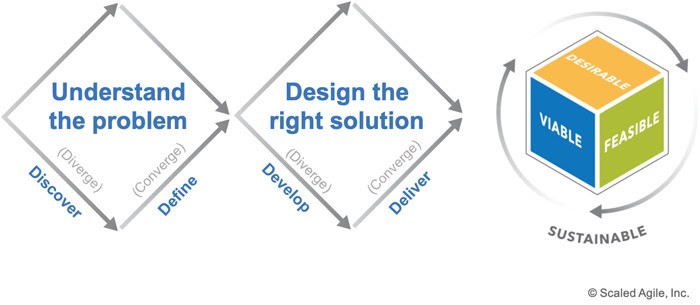
When personas are missing, teams often default to internal assumptions. Developers design for technical elegance. Product owners prioritize based on stakeholder pressure. Designers optimize for aesthetics rather than usability. The result is misalignment and rework. When personas are actively used, they provide:
- Clarity During Sprint Planning: Teams can evaluate whether backlog items directly serve a real user goal instead of vague business ambitions.
- Focus During Feature Debates: Instead of arguing opinions, teams can ask which option best serves the persona’s needs.
- Consistency Across Releases: Personas prevent the product from drifting away from its intended audience over time.
A clear persona anchors decision-making and keeps development practical and grounded.
What Is an Agile Persona?
An agile persona is a lightweight, research-informed representation of a specific user segment. Unlike heavy marketing personas that may span dozens of pages, agile personas are concise and actionable. They are designed to support sprint-level decisions and improve user story quality without creating unnecessary documentation overhead.
An effective agile persona includes structured information such as:
- Role and Context of Use: Defines where and how the product fits into the user’s daily workflow, which influences feature prioritization.
- Goals and Motivations: Identifies what success looks like for the user and what outcomes truly matter to them.
- Pain Points and Frustrations: Highlights barriers that your product must eliminate or reduce to deliver meaningful value.
- Skills and Constraints: Clarifies technical ability, device limitations, or environmental challenges that affect usability.
This deeper context transforms generic user stories into targeted development work.
Expanding a Basic User Story with Persona Context
A standard user story format, commonly used in frameworks like Scrum, follows a simple structure:
As a [role]
I want to [goal]
So that [benefit]
This format is efficient, but it lacks nuance unless supported by persona detail. Adding context changes how teams interpret and implement the story.
Consider this example:
As a customer service agent
I want to find customers who received gifts last year
So that I can send gifts to those who didn’t
Now expand it with persona insight:
Persona Snapshot
- Age: 25
- Location: Asia
- Education: High School
- Skills: Excel, CRM systems
- Work Environment: Remote
- Challenge: Limited system permissions and repetitive manual reporting
With this added context, the team recognizes:
- The user is comfortable working with CSV files and spreadsheets.
- The task may be occasional rather than daily.
- Simplicity and speed matter more than feature richness.
Instead of building complex filtering tools and external API integrations immediately, the team might test whether exporting a structured dataset solves the problem. That decision can save weeks of development effort.
3 Easy-to-Use Agile Persona Templates
1. Persona Canvas (Product-Focused Template)
The persona canvas approach, popularized by product thinkers such as Roman Pichler, emphasizes clarity and alignment with product strategy. It avoids fluff and focuses only on information that directly influences development and prioritization decisions.
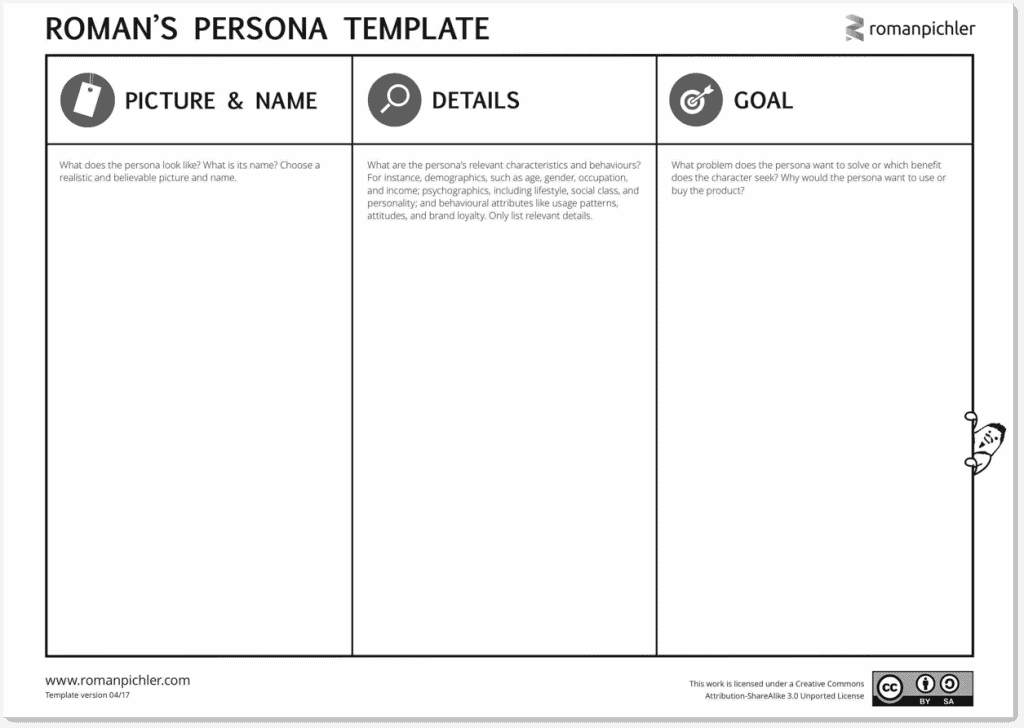
The Persona Template | Roman Pichler
A strong persona canvas includes the following sections:
Basic Profile
This section establishes a realistic identity. It includes role, age range, work environment, and context of product usage. The purpose is not demographic profiling for its own sake, but to frame how the product fits into daily responsibilities and constraints.
Goals
Goals define what the persona is trying to accomplish. These should focus on outcomes, not features. For example, “reduce reporting time by 50%” is clearer and more actionable than “generate reports faster.” Outcome clarity drives better feature design.
Needs
Needs translate goals into functional expectations. This might include real-time data access, export functionality, automation, or mobile compatibility. Needs should directly influence backlog priorities and sprint objectives.
Pain Points
Pain points identify friction areas that create inefficiency or frustration. These may include manual data entry, system lag, poor search functionality, or unclear dashboards. Addressing pain points often creates immediate, measurable impact.
Skills & Environment
Understanding technical proficiency and work context prevents overengineering. A highly technical persona may expect customization, while a non-technical persona needs intuitive workflows and minimal configuration.
2. Google Docs Lightweight Persona Template
Not every team requires a visual canvas. Sometimes a structured document works better, especially for distributed teams. A shared document ensures accessibility, version control, and easy updates without additional tooling.
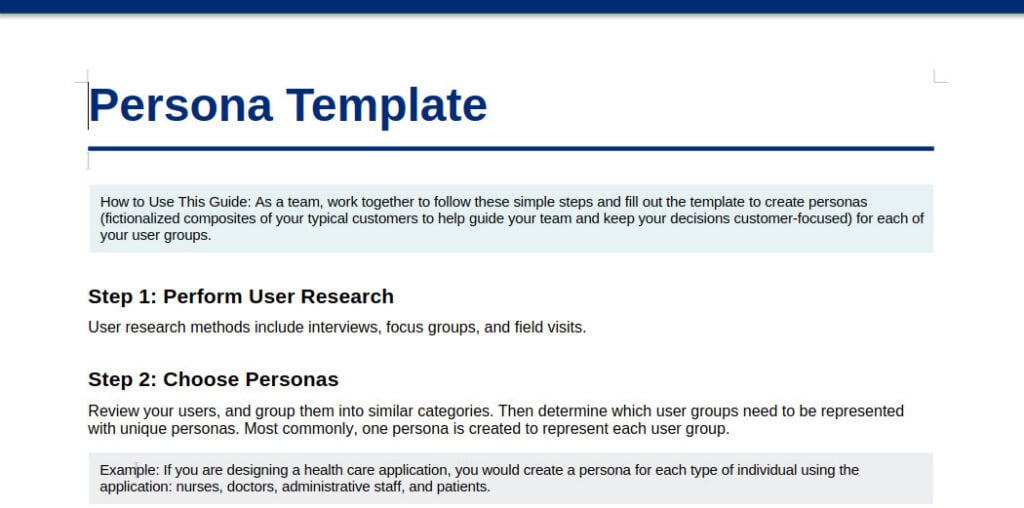
An effective lightweight template includes:
Background & Responsibilities
Describe what the persona does daily, what they are accountable for, and how performance is measured. This grounds feature discussions in practical job expectations rather than theoretical assumptions.
Objectives
Outline both immediate tasks and broader career goals. Short-term objectives may influence usability improvements, while long-term aspirations may inform feature expansion or product roadmap decisions.
Frustrations & Barriers
Document recurring obstacles in current workflows. These insights often surface from customer interviews, support tickets, or user testing. Eliminating these barriers typically delivers high perceived value.
Behaviors & Workarounds
Users often create unofficial solutions when tools fall short. Understanding these behaviors reveals unmet needs and opportunities for simplification or automation. This template works well because it remains practical, collaborative, and easy to revise quarterly.
3. AI-Generated Persona (Data-Driven Model)
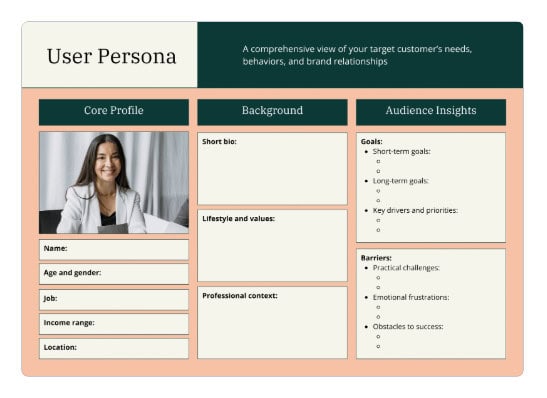
Artificial intelligence has introduced new ways to build and refine personas using real behavioral data rather than relying solely on interviews or assumptions. AI systems can analyze structured and unstructured inputs to identify patterns across large datasets.
Data sources may include:
- Customer Surveys: Reveal preference trends and satisfaction drivers.
- Product Usage Analytics: Show behavioral flows and friction points.
- Support Tickets and Reviews: Highlight recurring complaints and unmet expectations.
- Social Media Discussions: Provide emotional and contextual insight into user attitudes.
AI-generated personas can uncover hidden segments, behavioral clusters, and emotional triggers that traditional research may overlook. However, human validation remains critical. Data informs direction; teams must still interpret and prioritize strategically.
Costs & Benefits of User Personas for Agile Teams
Developing strong personas requires time, structured workshops, and ongoing research updates. Agile teams must gather feedback, analyze data, and revisit assumptions periodically. Some organizations underestimate this investment and allow personas to become outdated.
However, the benefits often outweigh the costs when personas are actively maintained:
- Improved Feature Prioritization: Backlogs become outcome-driven rather than stakeholder-driven.
- Reduced Development Waste: Teams avoid building features that do not serve core user needs.
- Stronger Cross-Functional Alignment: Design, engineering, and product teams operate from a shared understanding.
- Faster Validation Cycles: Clear persona expectations make usability testing more focused and measurable.
Teams that revisit personas quarterly often see stronger product-market alignment than those who update them every few years.
Integrating Personas into the Agile Development Process
The agile development process typically includes defining, designing, building, testing, releasing, and iterating. Personas should not exist separately from these stages; they should influence each one directly.
- During the definition, personas clarify which problems are worth solving.
- During design, they guide interface decisions and complexity levels.
- During build, they influence scope control.
- During testing, they shape validation criteria.
- During iteration, they evolve based on real usage data.
Without personas, teams debate opinions. With personas, they evaluate alignment against clearly defined user expectations. This shift reduces ambiguity and accelerates confident decision-making.
Empathy Maps as an Alternative or Complement
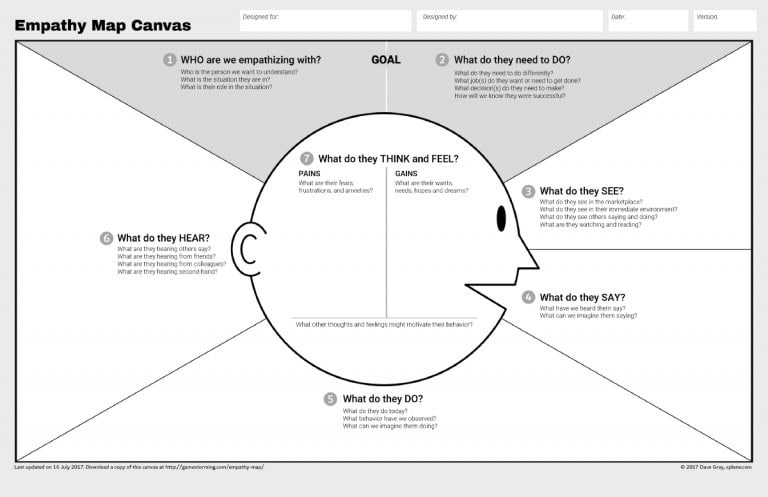
While personas emphasize identity and context, empathy maps focus primarily on emotional and psychological drivers. They are particularly useful during early discovery phases when understanding motivations matters more than demographic details.
An empathy map typically examines:
- What the user thinks
- What the user feels
- What the user says
- What the user does
Personas answer “who” and “what.” Empathy maps answer “why.” Combining both tools produces deeper insight, ensuring that features address not only functional needs but also emotional drivers that influence adoption and satisfaction.
Video About Personal Templates
Final Takeaway
Agile personas are not paperwork exercises; they are operational tools that sharpen product judgment. When teams clearly define who they are building for, feature decisions become simpler, trade-offs become logical, and sprint goals become outcome-driven rather than assumption-led. The key is discipline. Keep personas lean, grounded in evidence, and closely tied to backlog refinement and sprint planning. Review them regularly as user behavior, markets, and technology evolve.
When personas are treated as living assets instead of static documents, they reduce waste, improve usability, and strengthen product-market alignment. Agile works best when speed is matched with clarity, and personas provide that clarity.
FAQs About Agile Personas
What is agile?
Agile is an iterative approach to product development that focuses on delivering value in small, incremental releases. Instead of long, rigid project phases, agile teams work in short cycles, gather feedback quickly, and adapt based on real user input. This reduces risk, improves flexibility, and accelerates learning.
What are personas?
Personas are research-informed, fictional representations of key user segments. They describe user goals, behaviors, motivations, frustrations, and constraints. In agile environments, personas help teams design and prioritize features based on real user needs rather than assumptions or internal preferences.
How many personas should an agile team have?
Most agile teams operate effectively with two to five primary personas. Fewer than that may oversimplify your audience, while too many can create confusion and dilute focus. The objective is clarity. Identify the core user groups that drive the majority of product value and prioritize them.
How often should personas be updated?
Personas should be reviewed at least quarterly in fast-changing markets. User behavior, technology, and business priorities evolve quickly. Regular updates ensure your product decisions reflect current realities instead of outdated assumptions that no longer represent your active user base.
Who should be involved in creating personas?
Persona development should involve cross-functional collaboration. Product managers, designers, developers, sales teams, and customer support all bring unique insights. Including multiple perspectives ensures the persona reflects real-world user interactions, challenges, and expectations rather than a single department’s viewpoint.
Suggested articles:
- 10 Team Personality Assessment Tools for Project Teams
- 7 x Free User Story Template on Google, Excel, Powerpoint
- 93 Agile Self-Assessments to Accompany Agile Team Charters

Shane Drumm, holding certifications in PMP®, PMI-ACP®, CSM, and LPM, is the author behind numerous articles featured here. Hailing from County Cork, Ireland, his expertise lies in implementing Agile methodologies with geographically dispersed teams for software development projects. In his leisure, he dedicates time to web development and Ironman triathlon training. Find out more about Shane on shanedrumm.com and please reach out and connect with Shane on LinkedIn.