
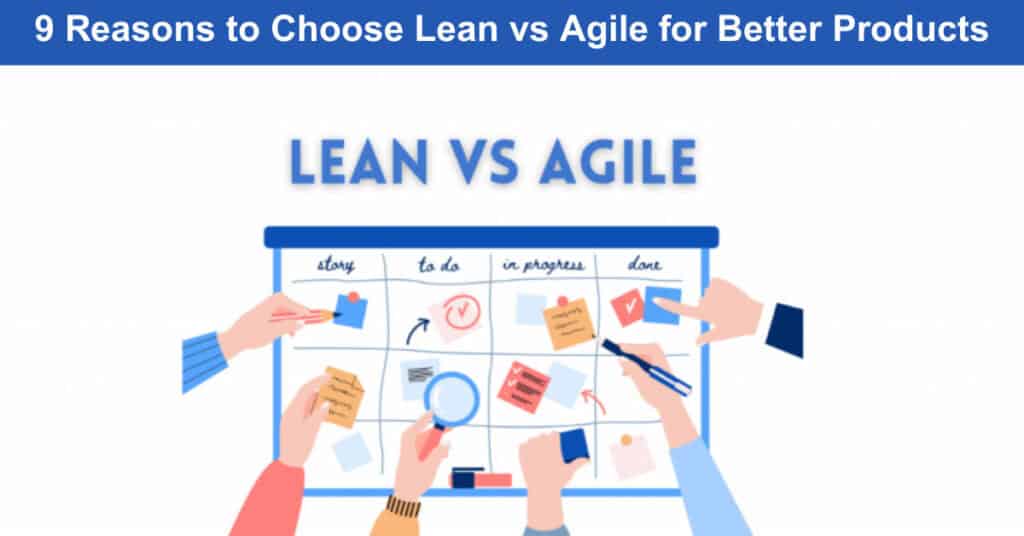
The real question isn’t Lean vs Agile—it’s how Lean compares to Agile methodologies like Scrum or XP. In my view, Lean embodies what Agile originally set out to achieve: delivering true customer value while eliminating waste. At its heart, Lean is product management in its purest form, focused on solving real user problems rather than building features no one needs. Agile frameworks often emphasize process and iteration, but Lean goes further by aligning the entire team around learning, experimentation, and continuous improvement.
For product managers, adopting Lean practices means prioritizing validated outcomes over outputs, empowering teams to make data-driven decisions, and ensuring every effort contributes directly to customer satisfaction and business success.
1. Outcomes vs Outputs
As a business owner or product manager, your primary goal is to consistently deliver value to your customers. The focus should be on achieving meaningful outcomes rather than simply producing outputs or following engineering processes for their own sake. The IT department plays a vital role in driving business success. Your investment in technology should directly support strategic objectives and revenue growth. To achieve this, IT must be fully integrated with core business functions through cross-functional product teams.
Lean is most effective when your development team is deeply aligned with the mission of serving customers. Instead of handing them detailed requirements, share the problems that need solving. Empowering teams to discover and deliver the best solutions fosters innovation, accountability, and superior results focused on outcomes rather than tasks.
- Lean focuses on delivering outcomes
You should consider using Scrum or other Agile frameworks when your software development is outsourced. Be aware, however, that outsourcing can easily turn the process into a staggered waterfall rather than true Agile. Scrum often becomes an exercise in following ceremonies instead of delivering customer value. If your IT organization is operating primarily as a cost center, read LeanEssays: The Cost Center Trap for insight on changing that mindset.
- Scrum focuses on delivering outputs
2. Lean vs. Agile Have Same Principles
Lean is arguably the most inherently Agile methodology when you compare underlying principles. Below, I map Lean principles to Agile ones and show where they overlap. I prefer Lean because it explicitly acknowledges that waste exists within Agile practices and focuses on reducing it. Lean emphasizes delivering customer value faster by identifying and eliminating waste and by shortening lead times through value-stream optimization.
Its primary goal is waste reduction; Scrum, by contrast, emphasizes user-centered product delivery. In Lean product development, we commonly identify seven types of waste that undermine flow and value. For example, you may not need an estimation session every week while maintaining a long backlog of story points for the next 18 months. That kind of routine can let Agile frameworks become mechanical — a cover for a staggered-waterfall approach — rather than a true agile way of delivering outcomes.
Lean prevents that by prioritizing validated learning and continuous improvement over ceremony and output metrics.
- Scrum: An Agile Framework process with ceremonies around small incremental “sprints” of 2-3 work weeks.
- Kanban: An Agile Framework that uses a Kanban board to visualize and limit Work in Progress to deliver more quickly.
- Extreme Programming: An Agile framework that encourages feedback, but focuses on improving software development practices.
- DevOps: Continuous Integration and Continuous Deployment of development work.
DevOps is mainly geared towards the first 3 principles of Agile:
- Principle 1: Our highest priority is to satisfy the customer through early and continuous delivery of valuable software.
- Principle 2: Welcome changing requirements, even late in development. Agile processes harness change for the customer’s competitive advantage.
- Principle 3: Deliver working software frequently, from a couple of weeks to a couple of months, with a preference to the shorter timescale.
3. Lean vs Agile Scrum
Lean project management was first crafted by Mary and Tom Poppendieck by taking lean manufacturing techniques and using them for software. They wrote the book “Lean Software Development”, which utilized Lean values, practices, and principles in the software industry. Scrum is the Agile methodology of choice used by large enterprises. They are utilizing Scrum as a hybrid project management as a staged project management vs staying true to Agile principles. Methodologies such as SAFE and LeSS are a high contributing factor to this.
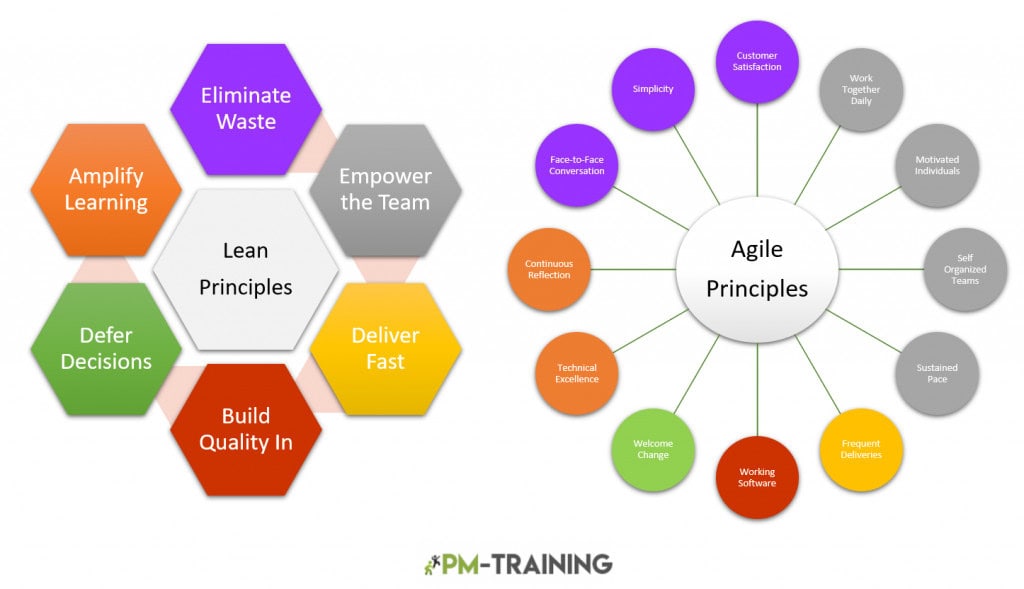
The core idea of Scrum was to release small increments of value to the customers. This works well in small companies. Unfortunately, in large companies, it’s not so easy when you have multiple layers of people acting as the customer. You are reporting and gathering feedback from managers, and there is a large disconnect in the entire process.
Scrum has clearly defined ceremonies to enable these 9 principles from Daily stand-ups, planning, sprints, estimation, refinement, and retrospectives, but these are numbers 4 to 12 in the 12 Agile Principles. A lot of these software development processes, such as daily stand-ups, are great to increase communication. Having retrospectives and review sessions are essential forum to gather feedback and improve as a team.
A couple of issues I found with Scrum, which I personally found anti-agile, were:
- Project managers are only interested in the sprint completion dates.
- Scrum masters see the ceremonies as rules that can’t be broken.
- Businesses see burndown charts as the source of truth.
- The development team only cares about a feature up to the end of a sprint.
- Operations aren’t included in the planning of sprints.
- POs have to reject bugs for at least 3 weeks till next sprint.
The Product Owner role is a key pain point in many Scrum implementations. Intended as the linchpin between business and development, the role often becomes overloaded with conflicting expectations: the business treats the Product Owner as a project manager who reports status, while the team expects a business analyst who produces fully detailed stories and specifications. Mary Poppendieck has described this mismatch clearly and offers practical guidance for resolving it.
The Product Owner Problem
In an essay published on Mary’s blog, she highlights the problem with Product Owners. “There was serious confusion about the Scrum role of Product Owner and its fit with the classic role of Product Manager. In addition to business responsibility, the Scrum Product Owner has the team-facing responsibility of managing the detailed product requirements.”
She addressed this by pointing to highly successful vertical-market teams that operated without a dedicated Product Owner preparing and prioritizing stories. Instead, the Product Manager maintained regular high-level conversations with the development team about desirable capabilities for the next two to three months.
They assessed feasibility, estimated potential outcomes, and built a real-time dashboard that displayed live web analytics for several key metrics the Product Manager had linked to revenue growth. The team then focused on developing the capabilities most likely to move those metrics in the desired direction, observed the results, and adjusted their development plans accordingly.
Mary Poppendieck
4. Lean Avoids Feature Factories
On the surface, these teams may appear to be following Agile principles, but in practice, they end up creating endless backlogs and “feature factories.” John Cutler coined that term after observing organisations that measured success by completed story points rather than by learning what users actually need. The result is teams that behave like assembly-line workers — churning out features without reflecting on how those features contribute real value to the product.
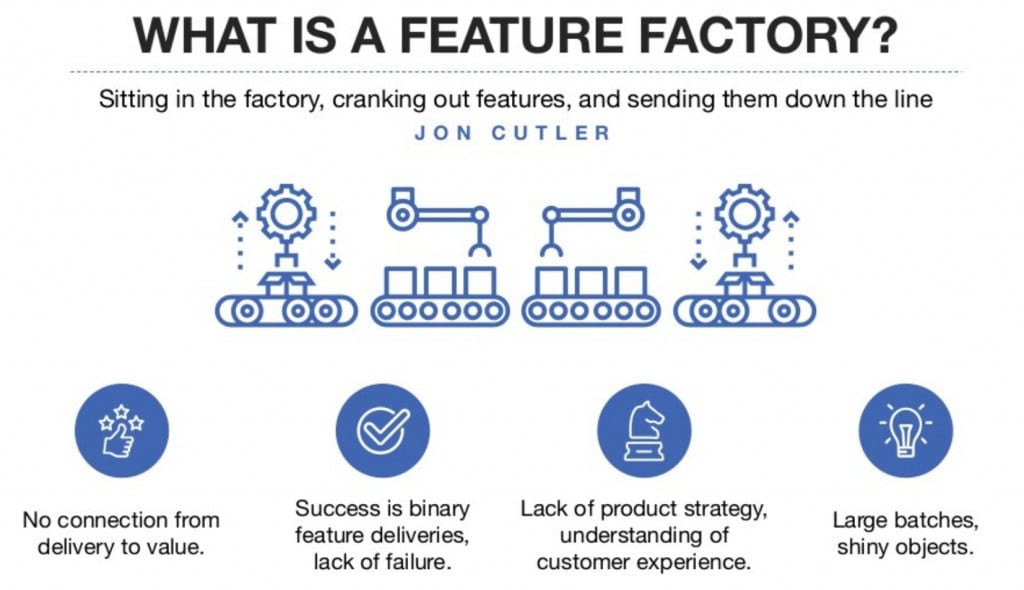
“Moving From a Feature Factory to User Value Creation Organization” by Michael Rutledge
I share John’s concern: team leaders often focus more on burndown charts and meeting sprint commitments than on the actual business outcomes those efforts should enable. When success is measured primarily by velocity or sprint completion, organizations risk becoming delivery-oriented rather than value-driven. This tendency is especially common in Agile methodologies, such as Scrum, that center on development processes.
To avoid this, teams must connect sprint goals to measurable customer and business impact and make outcome-based metrics part of how success is judged. Although most companies I’ve worked with have adopted Scrum—some more effectively than others—there is often a persistent disconnect between completing sprint work and actually releasing that work to customers. Reading The Phoenix Project helped me see these challenges from the operations perspective rather than the feature-team perspective.
A feature “released” from a sprint is not necessarily live in production. I underestimated the complexity of deploying code across environments and didn’t fully appreciate the operational constraints and risks that teams face when pushing changes to production. The Phoenix Project emphasizes W. Edwards Deming’s “appreciation for the system,” highlighting the need for fast, predictable, and uninterrupted flow of planned work that delivers business value while minimizing the impact of unplanned work.
This approach supports stable, secure, and reliable IT services. Ultimately, Lean project management reinforces a customer-first mindset by aligning development, operations, and product goals around continuous delivery of measurable value.
5. Kanban vs Lean Project Management is Based on Toyota’s Success
The term “Lean Project Management” originates from lean manufacturing and emphasizes the elimination of waste. Lean manufacturing techniques were developed by Toyota through studies of supermarket stocking processes, where shelves were replenished with just enough inventory to satisfy customer demand while keeping stock levels efficient for store owners.
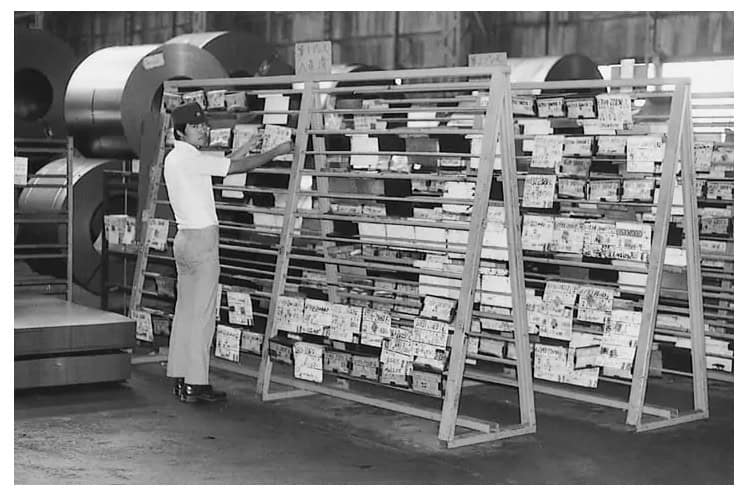
When Toyota introduced the system on the factory floor, workers passed a card — a “kanban” — to signal they had the capacity to pull more materials. Toyota tasked engineer Taiichi Ohno with implementing and refining this approach, which evolved into what we now call lean manufacturing. The Japanese word “kanban” literally means “signboard.”
In contrast, startups typically avoid the handoff inefficiencies of traditional manufacturing by organizing small, cross-functional teams with end-to-end accountability for delivering business outcomes. Product and engineering teams in these environments continuously review data and customer feedback to make faster, outcome-focused decisions.
Lean Product Development Explained
Product management is critical to developing the right thing at the right time for the right people. Lean product development is an approach that places continuous learning, rapid experimentation, and customer value at the center of how products are discovered and delivered. Instead of assuming that a long list of features equals success, Lean emphasizes understanding real customer problems, testing hypotheses with quick, low-cost experiments, and using validated learning to drive decisions.
Key elements of Lean product development include:
- Customer Discovery and Problem Validation: Constantly engage with real users to surface their needs, pains, and desired outcomes. Use interviews, analytics, and observational research to create evidence-based problem statements.
- Outcome Over Output: Define success in terms of measurable customer and business outcomes (e.g., increased retention, reduced time-to-complete, higher conversion) rather than the number of features shipped or story points completed.
- Rapid Experimentation: Use prototypes, A/B tests, smoke tests, and minimum viable products (MVPs) to test riskiest assumptions early. Prefer fast feedback loops that minimize time and cost before committing to large investments.
- Cross-Functional Teams: Organize small, empowered teams that include product management, design, engineering, QA, and operations. Give these teams end-to-end responsibility for outcomes so they can iterate quickly and remove handoff delays.
- Flow and Waste Reduction: Map the value stream to identify wait times, handoffs, rework, and other sources of waste. Apply Kanban, WIP limits, and continuous improvement rituals to shorten cycle time and increase throughput.
- Metrics and Telemetry: Instrument products to collect actionable data. Use metrics that tie to business goals and customer value (e.g., activation rate, task success rate, customer lifetime value) and avoid vanity metrics that obscure learning.
- Learning Culture and PDCA: Encourage a culture of hypothesis-driven development and regular retrospection. Use Plan-Do-Check-Act (A3 thinking) to iterate on both product and process improvements.
- Lightweight Governance and Fast Delivery: Favor lightweight approval processes and automation (CI/CD) to reduce delays and risk in shipping changes to users. Invest in observability and automated testing to maintain quality while increasing release frequency.
By adopting Lean product development, organizations align day-to-day decisions with customer needs and business outcomes. The result is less wasted effort, faster discovery of product-market fit, and higher confidence that delivered work creates measurable value for users and stakeholders.
6. Lean Recognizes 7 Types of Waste
The seven types of waste in Lean product management include task switching, defects, waiting, unnecessary processes, excess inventory (unfinished work), and overproduction.
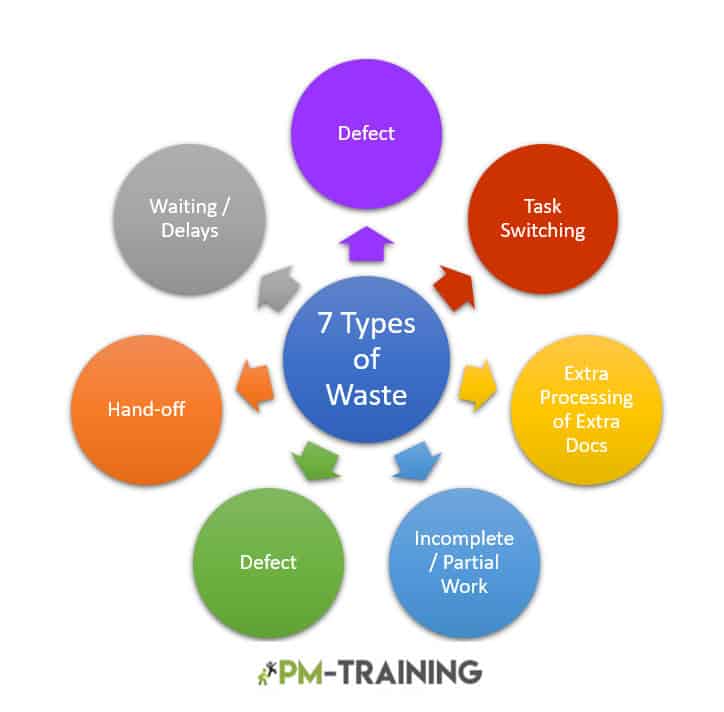
I believe Lean is the ideal Agile approach for organizations that want to be user-centered. At its core, Lean is about delivering real value to end users. Its primary tools—Kanban boards, value-stream mapping, A3 (Plan–Do–Check–Act) thinking, and DevOps practices applied to software development—embody Lean principles and help teams focus on flow, waste reduction, and rapid learning.
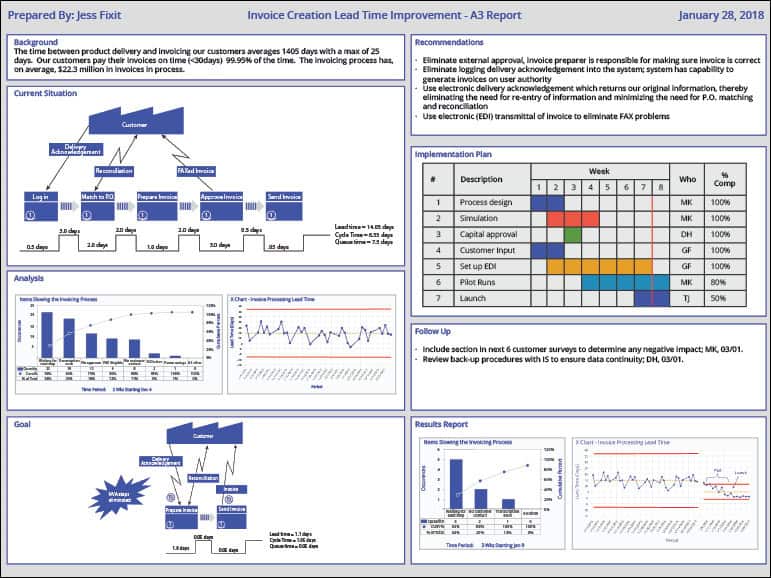
7. A3 for Easy Planning and Analysis
A3 is a structured problem‑solving and continuous‑improvement tool used to explore a dilemma, analyze root causes, and evaluate options for improvement. Typically captured on a single A3‑sized report, it can include value‑stream maps, clear problem statements, proposed countermeasures, implementation plans, and measures for tracking results.
8. Kanban Framework for Improved Ways of Working
The core principles of Lean Product Management—popularized by Mary and Tom Poppendieck—are rooted in lean manufacturing practices, such as Toyota’s kanban system. Kanban is a lightweight framework for managing the flow of work and matching the amount of work in progress to a team’s capacity. It provides flexible planning, faster delivery, and greater visibility across the development cycle.
The primary Kanban tool is the Kanban board, which complements a traditional iteration backlog by visualizing each step in the delivery process and enforcing work‑in‑progress (WIP) limits for each queue. This prevents overload, enables smoother handoffs, and helps teams identify and remove bottlenecks. Kanban also works well for small or ad hoc tasks that don’t warrant full user stories, and it’s commonly adopted by organizations new to Agile because it can be introduced incrementally without major changes to existing processes.
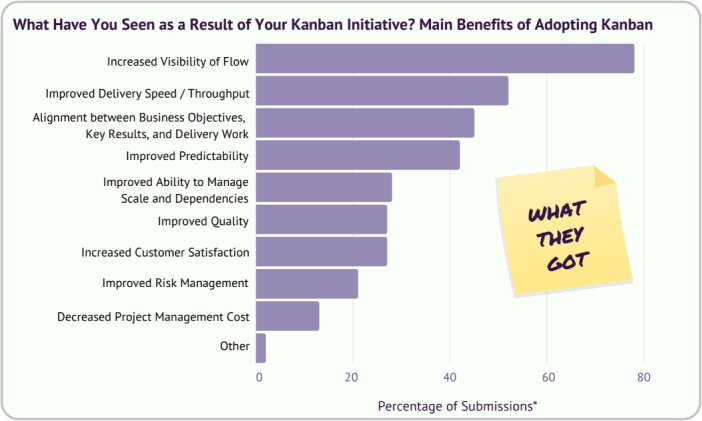
Most projects can be viewed as processes designed to achieve specific outcomes. Kanban is a practical tool for managing those processes and optimizing the flow of work across a project. To implement Kanban effectively, follow the three core rules:
Rule #1: Visual Workflow
A clear visual representation of the workflow is essential—especially for complex processes. Begin by mapping the sequence of tasks required to complete the project. For software development, a simple example workflow might be:
- Analyse -> Design -> Develop -> Test -> Release
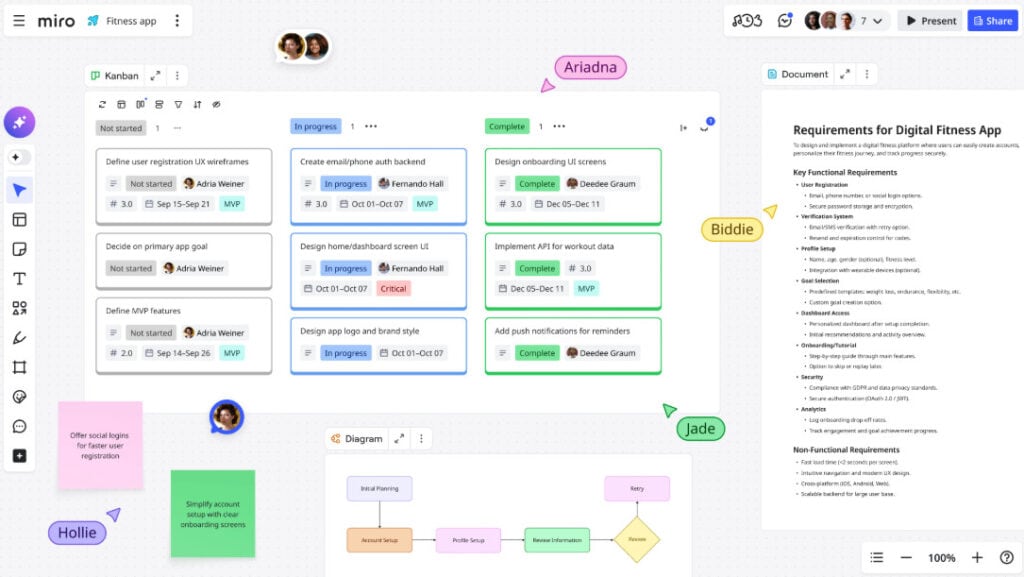
These should each become separate columns on the Kanban board. After you create the board, set clear Work-in-Progress (WIP) limits for every column to prevent overload, surface bottlenecks, and improve flow.
Rule #2: Limit Work in Process (WIP)
Work‑In‑Process (WIP) sets the maximum number of tasks allowed in each column. It reflects the reality that teams can only focus on a limited number of items at once and do them well. Every team and context has an optimal WIP level; too much WIP creates congestion and slows flow, while too little can hide problems and reduce learning opportunities. Setting moderate Work‑In‑Process (WIP) limits strikes a practical balance: it exposes bottlenecks and process weaknesses quickly while giving the team enough work to maintain momentum and adapt to the new approach.
Rule #3: Measure and Improve
Like other Agile methodologies, process improvement is continuous and driven by metrics. In Kanban, the primary metric is Work‑In‑Progress (WIP); managers should focus on finding the optimal WIP level that allows the team to perform at its best. Cycle time—the time it takes to complete a task—is another key metric surfaced by Kanban boards, and managers should actively work to reduce it to improve flow and delivery speed.
9. DevOps for Frequent Software Releases & Quicker Feedback
The goal of DevOps is to shorten software delivery cycles while improving the stability, reliability, and safety of deployments.
The Agile Admin’s popular blog post, What is DevOps? notes:
“DevOps is the practice of operations and development engineers participating together in the entire service lifecycle, from design through the development process to production support.”
Defining DevOps is chronicled in The DevOps Handbook, which notes that:
“DevOps is the outcome of applying the most trusted principles from the domain of physical manufacturing and leadership to the IT value stream. DevOps relies on bodies of knowledge from Lean, Theory of Constraints, the Toyota Production System, resilience engineering, learning organizations, safety culture, human factors, and many others. Other valuable contexts that DevOps draws from include high-trust management cultures, servant leadership, and organizational change management. The result is world-class reliability, stability, and security at ever lower cost and effort; and accelerated flow and reliability through the technology value stream, including Product Management, Development, QA, IT Operations, and Infosec.”
What may appear to be a break from process is actually an ongoing refinement of it. Key management practices for Lean monitoring and control include:
- Lightweight Change Approval Processes: “Teams that reported no approval process or used peer review achieved higher software delivery performance…teams that required approval by an external body achieved lower performance.” (Accelerate)
- Monitoring: Use data from monitoring tools used for applications and infrastructure to inform daily decision-making.
- Work in Progress (WIP) Limits: Keep teams efficient and focused, increasing throughput, by minimizing the number of different projects in process for a particular team at a given time.
- Visualizing Work: Make use of a Kanban board or similar method to show work moving through development stages.
As I’m just getting started with DevOps, I don’t have the strong dislikes I developed for Scrum. Scrum does, however, do a good job of building teams, and when paired with DevOps’ emphasis on continuous integration and delivery, it can be a powerful combination. I’ve long favored a Scrumban-style approach — a pragmatic middle ground that blends Scrum’s team structure with Kanban’s flow control — and I think Scrumban combined with a mature CI/CD pipeline could be an ideal solution moving forward.
Conclusion
Lean and Agile both offer powerful tools for building better products, but Lean’s emphasis on outcome-driven discovery, waste reduction, and continuous learning makes it especially well-suited for product teams seeking measurable customer value. By prioritizing validated experiments, cross-functional ownership, and flow optimization (via Kanban, A3 thinking, and DevOps), Lean helps teams avoid feature factories and focus on real user problems.
Agile frameworks like Scrum remain valuable for team structure and iteration cadence, and a pragmatic blend—Scrumban with strong CI/CD—often delivers the best results. Ultimately, choose the practices that align your organization around delivering validated outcomes, shortening feedback loops, and continuously improving both product and process.
FAQs
What is the main difference between Lean and Agile?
Lean focuses on eliminating waste and delivering validated outcomes; Agile emphasizes iterative development and adaptive planning. Lean places stronger emphasis on flow and value-stream optimization.
Can Scrum and Lean be used together?
Yes. Combining Scrum’s team structure with Lean practices (e.g., Kanban, WIP limits, outcome metrics) — often called Scrumban — leverages the strengths of both.
How does Kanban support Lean product development?
Kanban visualizes workflow, limits WIP, and highlights bottlenecks, enabling faster cycle times and continuous improvement aligned with Lean principles.
When should an organization prefer Lean over Agile?
Prefer Lean when the priority is reducing waste, shortening lead times, and focusing teams on measurable customer outcomes rather than output metrics.
What role does DevOps play in Lean product management?
DevOps accelerates delivery and feedback through CI/CD, automation, and monitoring, enabling Lean teams to safely and frequently validate hypotheses in production.
Suggested articles:
- Agile Project Management Guide (Skills & Methodologies)
- Digital Walks vs. Gemba Walks: A Guide for Lean Managers on the Transition
- How to Optimize Business Processes Through Lean Management

Shane Drumm, holding certifications in PMP®, PMI-ACP®, CSM, and LPM, is the author behind numerous articles featured here. Hailing from County Cork, Ireland, his expertise lies in implementing Agile methodologies with geographically dispersed teams for software development projects. In his leisure, he dedicates time to web development and Ironman triathlon training. Find out more about Shane on shanedrumm.com and please reach out and connect with Shane on LinkedIn.