
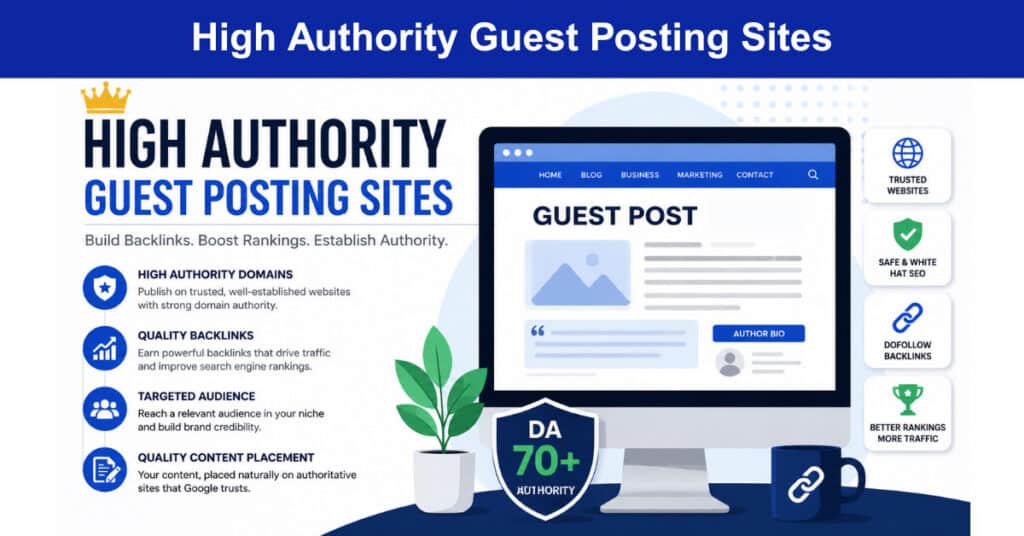
Guest posting sites publish content written by outside contributors in exchange for a byline and, usually, a backlink to the contributor’s website. For businesses building a content marketing strategy, these placements offer a direct way to reach a new audience while adding a credible link to a backlink profile. The practice has existed since the earliest days of search optimization, though the rules keep shifting.
Today, guest posting works only when the content genuinely serves the host site’s readers first, not just the contributor’s link goals. Google has spent recent years tightening enforcement against manipulative link placements, and sites treating guest posts as advertising space now carry real ranking risk. This guide covers why guest posting still matters, how to do it correctly, and where to find sites worth pitching.
★ Submit a guest post on ProjectManagers.net
The table below uses the Domain Rating (DR) notation by Ahrefs to rate the sites. If you want to update your listing, please contact us. If you want to add your site to this list, fill out the form below the table.
Why is Guest Posting Important?
Guest posting remains one of the more reliable ways to build a stronger backlink profile, provided the placement happens on a site that actually fits your industry and audience. A relevant, editorially reviewed guest post signals to search engines that other publishers find your expertise worth featuring, which over time can support better, more durable rankings.
The value goes beyond links. A well-placed guest post puts your name and your thinking in front of an audience that may never have found your site otherwise, and it gives you a chance to demonstrate real expertise on a subject before you ever ask the reader for a sale, a signup, or a subscription.
Here are several key reasons why guest posting still earns a spot in most content strategies:
- Reaching New Audiences: Publishing on a site with an established readership puts your name and ideas in front of people who would never have discovered you through your own channels alone.
- Creating Awareness and Trust: A guest article on a respected industry site signals to readers that other publishers vouch for your expertise, which builds credibility faster than self-published content typically can.
- Boosting Site Authority: A link from an established, topically relevant domain passes along a measure of that site’s trust, which can support your own site’s rankings when the placement is genuinely earned.
How to Succeed in Guest Posting
Succeeding at guest posting takes more than firing off pitches to any site that accepts outside writers. Editors at established publications receive far more submissions than they can use, so a pitch needs to show specific, original value before it gets a second look. The steps below outline the full guest blogging process, from initial research through final publication.
Follow this sequence to give your pitch the best chance of acceptance:
- Find Relevant Websites: Start by identifying sites that cover your industry or adjacent topics, then check whether they have a history of publishing outside contributors.
- Outreach to Webmasters: Locate the editor’s or site owner’s contact details, usually through a contributor guidelines page, and send a short, specific pitch rather than a generic request.
- Communicate Professionally: Keep the message focused on what the content offers its readers, not on what you want from the link, since editors respond better to pitches framed around audience value.
- Create High-Quality Content: Once accepted, write to the site’s specific guidelines, citing original data or firsthand experience where possible, since generic advice articles rarely clear editorial review anymore.
Benefits of Guest Blogging
Guest blogging delivers a mix of SEO and reputational benefits, though the size of the payoff depends heavily on the quality of the site and the content itself. A single well-placed post on a respected, relevant domain often does more for a brand than a dozen placements on low-authority sites that accept nearly any submission without review.
The list below summarizes what a well-executed guest blogging campaign can realistically deliver:
- High-Quality Backlinks: Editorial links from reputable, niche-relevant sites carry more weight with search engines than links bought in bulk from directories with little oversight.
- Increased Organic Traffic: A guest post on a site with engaged readers can send direct referral visitors to your site, independent of any SEO benefit the link provides.
- Improved SERP Ranking: A backlink profile built from relevant, authoritative sources supports stronger rankings over time, particularly when paired with strong on-site content.
- Wider Audience Reach: Publishing where your target customers already read content extends your reach into communities your own marketing might not otherwise touch.
- Enhanced Writing Skills: Writing to meet varied editorial standards across different publications sharpens a contributor’s ability to adapt tone, structure, and argument for different audiences.
These benefits compound when the guest content is genuinely useful, and the host site has a real, engaged readership rather than a paid placement business.
How to Find Niche-Relevant Guest Blogging Sites
Finding sites that fit your niche takes more effort than running a single search query, but several methods consistently produce useful results. Combining two or three of these approaches tends to surface a stronger, more reliable list than relying on any single method alone, especially in competitive industries where the obvious sites are already flooded with pitches.
Consider these methods when building a list of guest posting targets:
- Guest Blogging Site Lists: Obtain lists from websites like ProjectManagers.net, which provides over 100+ premium and free guest posting sites categorized by niche. These lists save time and effort by offering a curated selection of relevant sites.
- Guest Blogging Tools: Use tools that allow filtering by Domain Authority (DA), Domain Rating (DR), or Page Authority (PA) to find specific sites that match your criteria. These tools provide detailed lists of guest posting sites, including DA, DR, PA, and contact information.
- Competitor Backlinks or Referring Domains: Analyze the referring domains or backlinks of your competitors to find relevant guest post sites. Tools like Ahrefs can generate lists of referring domains linked to your competitors, which are likely relevant to your niche. Reach out to the admins of these sites for guest posting opportunities to match your competitors’ backlink profiles.
- Guest Post Directories: Use guest post directories, which list websites that accept guest posts, along with details like accepted content types, DA, PA, traffic metrics, guidelines, and contact information.
- Google Search Operators: Utilize Google search operators to discover niche-relevant guest blogging sites. Some effective search queries include: “guest post”, “write for us”, “guest article”, “contributing writer”, “submit blog post”, “submit content”, “guest blogger”, “submit post”.
By employing these methods, you can efficiently locate guest blogging sites relevant to your niche, improving your outreach and backlink strategies.
How to Identify the Best Guest Post Sites for Your Niche
Not every site that accepts guest content is worth the time it takes to pitch and write for it. A site with a high authority score but declining traffic, for instance, may already be losing favor with search engines, even if its metrics look strong on paper. The checks below help filter out sites that look appealing but carry hidden risk.
Run through these checks before committing time to any outreach:
- Determine Site Niche Relevancy: Ensure the guest blogging website covers topics relevant to your site. If the site’s content aligns with your niche, it’s a good match. If you plan to insert a guest post link into existing content, verify that the specific webpage is highly relevant to your topic.
- Check the DR and DA of the Site: Domain Authority (DA) and Page Authority (PA) are important SEO metrics that indicate a website’s authority. Assess these scores using tools like a DA or PA Checker. Opt for sites with higher DA and PA scores.
- Monitor Previous Traffic Trends: Review the site’s traffic trends from the previous months. A stable or upward traffic trend indicates credibility and good standing with search engines. Avoid sites with declining traffic trends, as this may indicate a recent penalty from search engines. Use tools like Semrush to analyze the traffic graph of potential guest post sites over the past years.
- Review Outbound Link Patterns: Check a handful of recent articles on the site to see whether outbound links go to relevant, reputable sources or to unrelated commercial pages, since the latter is a red flag.
Evaluating sites against all four checks, rather than relying on a single metric, gives a far more accurate picture of whether a placement is worth pursuing.
How to Write Guest Post Content that Ranks Well in Google SERP
Getting accepted by a site is only half the work. The content itself needs to perform once it is live, both for the host site’s readers and for search visibility. Google’s current ranking systems place heavy weight on demonstrated experience and expertise, which means generic, surface-level advice articles increasingly struggle to rank, regardless of where they are published.
Apply these practices when drafting quality guest post content:
- Perform Thorough Research on the Topic: Conduct in-depth research on the topic you plan to write about. This helps you gather the latest information and understand what others have discussed. Identify gaps in existing content and determine how to provide unique value to rank higher.
- Write Engaging and Readable Content: Start writing content that is both readable and engaging. This ensures visitors understand your message and spend more time on the page. Use tools like a free paraphrasing tool to enhance readability and engagement without altering the original meaning.
- Add Keywords and Visuals: Incorporate relevant, high-volume keywords to increase search visibility, but avoid keyword stuffing, as it’s an illegal SEO practice. Enhance your content with visuals like pictures, videos, graphs, and charts. Ensure these visuals add valuable information for visitors.
- Proofread and Edit: Proofread the guest post to ensure it is error-free and covers all necessary details. Use a grammar checker to eliminate grammatical errors. Verify the content is free from plagiarism using a plagiarism checker, as plagiarized content will be rejected by site admins.
A guest post that clears all five of these checks has a meaningfully better chance of both editorial acceptance and strong search performance once published.
What Has Changed in Guest Posting Standards
Guest posting today operates under stricter scrutiny than it did even a few years ago, largely because Google has built out specific policies aimed at the weakest parts of the practice. Understanding these changes matters as much as understanding the basic mechanics of outreach and content creation, since a strategy built on outdated assumptions can do more harm than good.
The shifts below have had the most direct impact on how guest posting works in practice:
- Site Reputation Abuse Enforcement: Google now treats third-party content published purely to exploit a host site’s ranking signals as a policy violation, regardless of how much editorial oversight the host site claims to apply.
- Algorithmic Detection of Link Networks: Automated systems increasingly catch large-scale guest post networks and bulk-purchased placements, which makes mass outreach campaigns riskier than a smaller number of genuinely earned placements.
- Greater Weight on Experience and Expertise: Search systems now favor content that demonstrates firsthand knowledge over generic advice, which pushes guest contributors toward original insight rather than recycled tips.
- Scrutiny of Paid Link Arrangements: Paying specifically for a placement in exchange for a link, as opposed to paying an editorial fee for content review, continues to carry direct risk of a manual ranking penalty.
These changes do not eliminate guest posting as a strategy. They simply raise the bar for what counts as a placement worth pursuing.
Conclusion
Guest posting still earns its place in any serious content strategy, but only when it follows the standards that now govern the practice closely. A handful of well-researched placements on genuinely relevant, actively maintained sites will outperform a large volume of low-quality links every time, both for search rankings and for actual, lasting audience reach.
The sites worth pursuing are the ones where your content would add real value even without a link attached. Vet each opportunity against niche relevance, traffic trends, and editorial standards before investing the time to pitch, write, and follow up, and treat every placement as a long-term reputational asset rather than a quick ranking shortcut.
Frequently Asked Questions About Guest Posting
Is guest posting still effective for SEO?
Yes, when the placement happens on a site that is genuinely relevant to your industry and maintains real editorial standards. High-quality, niche-relevant guest posts continue to support backlink profiles and search visibility, while bulk or low-quality placements carry a growing risk of penalties.
How many guest posts does a site need before seeing results?
No fixed number applies across every site or industry. A handful of placements on well-regarded, relevant domains typically does more for rankings and traffic than dozens of posts spread across low-authority sites with little real readership.
Should a business pay for guest post placements?
Paying specifically for a link placement violates search engine guidelines and risks a manual penalty. Some sites charge a legitimate editorial fee for reviewing and formatting submissions, which is a separate practice from paying purely for the link itself.
How long does it take to see SEO results from guest posting?
Most practitioners report meaningful ranking movement within two to four months of a placement going live, though the timeline depends on the target keyword’s competitiveness and the host site’s authority. Results tend to build gradually rather than arriving immediately.
What makes a guest post site worth pitching?
A worthwhile site covers topics genuinely related to your industry, shows stable or growing traffic over time, and applies real editorial review to submissions rather than publishing anything submitted. Checking a site’s recent outbound link patterns is one of the fastest ways to spot which sites meet that bar.
Suggested articles:
- Link Exchange and Guest Post (GP) Exchange Explained
- How Link Building is a Hidden Growth Engine for Agencies
- 6 Best SaaS Link Building Services

Daniel Raymond, a project manager with over 20 years of experience, is the former CEO of a successful software company called Websystems. With a strong background in managing complex projects, he applied his expertise to develop AceProject.com and Bridge24.com, innovative project management tools designed to streamline processes and improve productivity. Throughout his career, Daniel has consistently demonstrated a commitment to excellence and a passion for empowering teams to achieve their goals.