
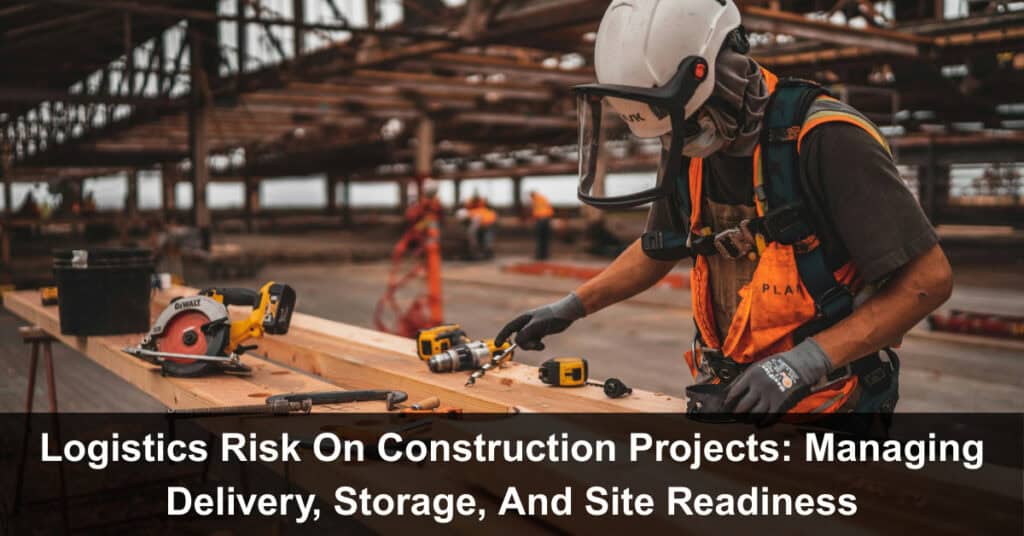
Construction programs slip when the crew is mobilised, but the site can’t actually receive and use what’s been ordered. A delivery turns into downtime if there’s no laydown area, no protected storage, no clear access route, or no confirmed lifting plan. Materials left exposed can be damaged before they’re installed, and missing permits or late approvals can stop work even when everything “looks ready” on the schedule—that’s logistics risk: the gap between purchased items and install-ready resources.
Effective project managers treat logistics with the same rigor as any critical workstream—establishing clear approval gates, assigning specific accountability, and implementing measurable site-readiness criteria—ensuring that progress reflects actual capability rather than optimistic assumptions.
Delivery Planning and Access: Control the Moment the Truck Arrives
Assuming delivery equals progress is how you buy delays. For modular packages, access and unloading determine whether “arrival” becomes “installation.” Start by aligning your plan to the supplier’s delivery assumptions, then validate your site constraints: approach route, turning space, ground bearing, overhead clearance, and where the load will physically land. If any one of those fails, the schedule becomes wishful thinking.
Run a delivery readiness gate before you lock in a date: confirm the laydown area is cleared and marked, the unloading method is agreed (forklift, crane, tilt tray, or manual), and the receiving party is on site with authority to accept or reject. Document your move triggers—weather, access, permits, safety controls—so rescheduling is automatic and consistent.
Real-Life Examples
- Wide Span Homes is a useful reference point for kit homes QLD planning because its Queensland kit-home page positions QLD supply and kit delivery as part of the proposition, making site access, unloading, and staging prerequisites to real progress.
- EcoPortables outlines land access requirements that explicitly cover truck access, crane use, and site preparation—handy as a delivery-gate checklist template.
- Summit Homes lists site access for escort vehicles, delivery trucks, and cranes as essential, plus delivery method considerations—good prompts for “can the truck actually get in and out?”
- Ecoliv notes modular delivery may require reversing space or cranes depending on access—reinforcing that logistics should be designed from the site constraints backward, not from an ideal delivery date.
Sequencing and Laydown: Deliver in the Order You Can Install
“Store it somewhere” is code for double-handling and hidden damage. As part of the construction project management process, build a delivery sequence that mirrors installation: siteworks and temporary services first, then structural packages, then weatherproofing, then internal trades and finishes. Pair it with a laydown plan that assigns zones by time window and trade, and mark exclusion zones. When the site gets tight, control should get stricter, not looser.
Operate a two-week logistics lookahead next to your build lookahead. For each delivery, state: where it lands, what protects it, who receives it, and which prerequisites must be green before it arrives.
Real-Life Examples
- Select Kit Homes says wall frames and roof trusses can arrive pre-assembled and ready to stand, raising the cost of poor laydown and protection.
- Wide Span Homes notes it supplies kits rather than providing builders, so trade coordination and sequencing sit with the project team.
- Modscape’s process includes early site analysis, reinforcing that site constraints should shape logistics decisions before fabrication and transport.

Storage and Security: Protect Value When Nobody is Watching
Logistics failures aren’t always dramatic. They’re wet plasterboard, warped timbers, fixings, finishes, and missing fittings. Storage discipline keeps the schedule honest: raised pallets for moisture-sensitive goods, covered zones for finishes, segregation for hazardous materials, and labels tied to work packages so components don’t “walk.” Where possible, store sensitive items in lockable containers and use simple colour codes so every trade knows which zone is theirs at a glance.
Security needs layers and records. NetSuite recommends perimeter measures, lighting, surveillance, and logging deliveries, while Procore discusses theft risk and securing equipment on site. Turn that into routine: daily lock-up, spot checks, and controlled access for high-value items.
Real-Life Examples
- Procore notes tactics and realities around securing valuable equipment and materials on construction sites.
- NetSuite highlights layered security and inventory visibility (receiving logs and updated records).
- Priority First frames theft, vandalism, and unauthorised access as risks to actively assess, matching a site security risk register.
Site Readiness For Lifts and Installs: Treat Cranes as a Project Within the Project
Many construction logistics plans collapse at the lift. The crane day is not one activity; it’s a chain: stable ground, correct setup, competent rigging, and controlled exclusion zones. Safe Work Australia’s crane guide calls out exclusion zones and restricting access to people directly involved during lifting. Schedule those controls like tasks, not “common sense.”
Site readiness also means earthworks and services. If levels, drainage, or underground services aren’t confirmed, delivered packages become expensive storage. Build a readiness checklist with non-negotiable holds: geotech/soil confirmation, erosion controls, temporary power/water, and inspection sign-offs.
Real-Life Examples
- Fox Modular explains that earthworks and siteworks unlock crucial information about land and orientation—inputs that change logistics decisions.
- EcoPortables links smooth delivery to correct site preparation and access, reinforcing readiness gates.
- Summit Homes flags slope and soil type as factors that can affect foundations and delivery feasibility.
Receiving, Verification, and Handover: Close the Loop at the Gate
If parts are “missing” on install day, your process failed earlier. Treat receiving as QA: assign a receiver, check against the bill of materials, photograph packaging and labels, and quarantine anything damaged before it contaminates the plan. Log what arrived, where it’s stored, and when it’s released to the trade that needs it.
Then protect completed work as a logistics task, not an afterthought. For handover, bundle the artifacts that prevent disputes: delivery records, defect notes, as-built updates, and warranties.
Real-Life Examples
- Expandable Housing publishes delivery and site preparation guidance for Queensland, a reminder to translate supplier assumptions into verifiable site gates.
- Wide Span Homes’ local pages highlight steel framing and warranty claims, increasing the importance of traceable receiving and handover documentation.
- Outback Portable Buildings frames modular deployment as planning plus compliance, reinforcing that logistics is central to prefab outcomes.

Endnote
Logistics risk is manageable when it’s designed into the plan: verify access before booking trucks, sequence deliveries to installation, protect materials with disciplined storage and security, treat lifts and siteworks as gated prerequisites, and close the loop with documented receiving and handover. Make it a routine, and the delivery day becomes predictable.
Suggested articles:
- The Benefits of Project Management in Construction for SMBs
- The Strategic Edge: Why Logistics Intelligence Matters in Project Investment Decisions
- Strategies to Streamline Construction Projects for Maximum Efficiency

Daniel Raymond, a project manager with over 20 years of experience, is the former CEO of a successful software company called Websystems. With a strong background in managing complex projects, he applied his expertise to develop AceProject.com and Bridge24.com, innovative project management tools designed to streamline processes and improve productivity. Throughout his career, Daniel has consistently demonstrated a commitment to excellence and a passion for empowering teams to achieve their goals.