
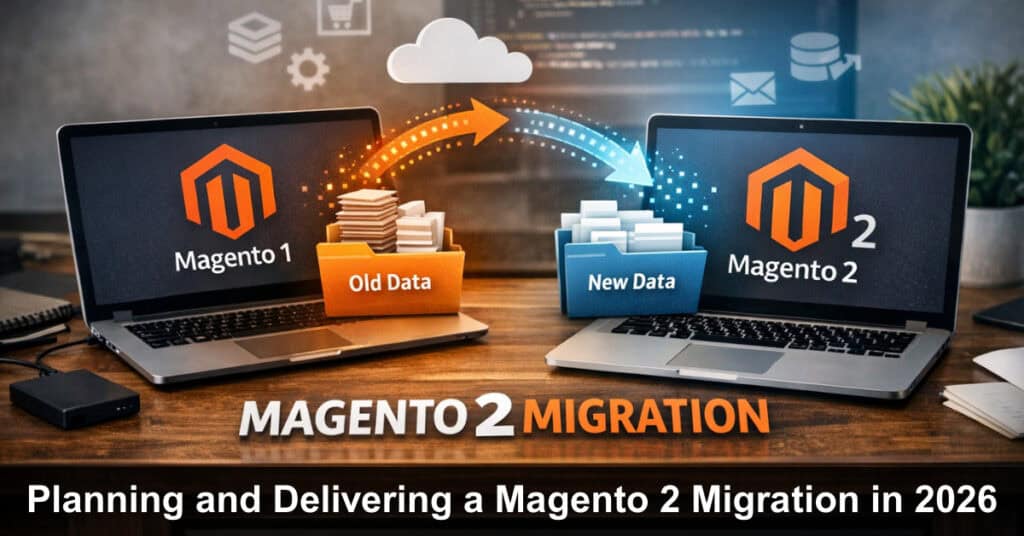
There is continuous and rapid change in the world of e-commerce, and whilst this happens, Magento 2 manages to stay one of the top flexible and powerful platforms available to online businesses. In the year 2026, e-commerce performance, security, scalability, and customer experience will be of the highest value. In regard to businesses still using Magento 1, outdated Magento 2 versions, or other e-commerce platforms, those businesses will require a thoroughly planned migration to Magento 2 in order to remain competitive.
Migration is more than just a simple technical upgrade. It is a true business strategy, and one that needs to be planned, executed, and optimized after the fact. In 2026, a Magento 2 migration is more than a simple data transfer. It is about aligning business objectives with technical strategies, modern integrations, and minimizing downtime/revenue loss. The end goal is to streamline the entire e-commerce operation of the business and optimize it for sustained growth.
In order to achieve a seamless and hassle-free migration, many businesses choose to utilize the Magento 2 migration services offered by Whidegroup. By using these services, businesses are able to create a migration plan that accommodates time and resource constraints, while also allowing them to build a Magento 2 store that is able to adapt to and overcome any potential pitfalls.
The Importance of Migrating to Magento 2 in 2026
The e-commerce ecosystem has had and will continue to have rapid growth in 2026. E-commerce customers have more expectations and requirements than ever before. Consumers require instantaneous website load speeds and seamless fluidity across all mobile platforms. Customers also require personal content to be given and secure payment processing to be offered. Older versions of Magento and poorly optimized versions of Magento will not be able to cope with these expectations.
Key benefits of Magento 2 include:
- More improved performance and scalability
- Regular updates with better security features
- Enhanced responsiveness with a better checkout experience
- Modern APIs compatibility with headless commerce
- Better and more usable admin interfaces for employees
Upgrading to Magento 2 allows your organization to modernize your e-commerce systems and technology.
Determining the Goals and the Scope of Migration
Starting an efficient migration process for Magento 2 means knowing the goals of the process. Without knowing the scope of the goals, the process will lose its efficiency and be delayed.
The following questions must be answered:
- Is your migration starting from an older Magento version, another system, or Magento 1?
- Is it an entirely new design or will the old design be adapted to modern standards?
- Will all the data about products, customers, orders, CMS pages, and reviews be migrated, and which ones will be migrated?
- Will there be new developments to the system that are not a part of the original scope, new functionalities, or new integrations?
These questions bring clarity to the stakeholders and help set the expectations, and serve as a guiding map for the process from a technical perspective, as well as from the business perspective, for the entire migration process.
Pre-Migration Planning Overview
A complete e-commerce store audit is imperative when moving any data. This stage identifies threats, technical debt, and areas for improvement.
A complete audit entails:
- Current site performance and challenges
- Add-ons and external service providers
- Custom code along with theme design
- Quality of data and intricacy of databases
- SEO, URLs, and redirect strategy
During this phase, teams can determine what to migrate, replace, or eliminate. This evaluation is even more urgent as many legacy extensions won’t be compatible come 2026.
Strategy for Data Migration
Out of all of the services that come with a Magento 2 migration, data migration is the most critical. Customer trust, order history, and business reporting can all be affected by missteps.
The following items are commonly included when migrating data:
- Product listings and details
- Customer information, including passwords
- Order history along with invoices
- CMS data, including reviews and ratings
A staggered migration approach is frequently used. Test migrations are meant to ensure the data is accurate and complete prior to performing a live migration. This helps to ensure the new store is accurate when it goes live.
Improving Theme and User Experience
2026 is the next time Magento 2 goes through a migration, and it provides a chance to improve the overall experience. Usability is enhanced by modern templates that prioritize speed, design, and accessibility, along with a mobile-first approach.
Key UX considerations include:
- Improvement of page loading
- Reduction of steps required for navigation and search
- Simplification of the checkout process
- Responsiveness across mobile and tablet devices
- Compliance with accessibility requirements
Rather than copying an outdated design, many businesses choose to rebuild their storefront using modern UI frameworks or headless architectures that integrate Magento 2 as the backend.
Extension and Integration Management
Extensions are the main contributors to Magento’s flexibility, but they are often the root cause of performance and security issues.
During migration, you should:
- Delete any outdated or unused extensions
- Substitute unsupported extensions with their Magento 2-compatible counterparts
- Ensure your integrations with payment processors, ERPs like NetSuite magento, CRMs, and shippers are properly working
Clean architecture and API-first integrations will be essential for 2026. Eliminating needless dependencies will increase performance and ease future upgrades.
SEO Preservation and Performance Optimization
Perhaps the most commonly cited concern surrounding any migration is the issues that usually arise with SEO. Any migration that is done incorrectly or without considering SEO will result in a loss of traffic and a decrease in the site’s ranking.
Best practices include:
- Keeping URL structures the same
- Using 301 redirects when necessary
- Preserving meta and structured data
- Improving page speed and the elements that make up Core Web Vitals
When correctly configured, Magento 2 can improve its caching, indexing, and performance features, all of which improve search visibility.
Testing, Quality Assurance, and Security
Before launching, we will pinpoint any potential problems before launching your Magenta 2 store.
Testing will include:
- The functionality of all core components
- Payment and order completion processing
- Compatibility across all devices and browsers
- Performance and load capabilities
- Security assessments
By 2026, consumer protection and security will be a highly sensitive area of concern. Your store’s customer data and payment security will be managed by Magenta 2’s built-in security protections, so they need to be configured properly.
Launch and Post-Migration Support
To eliminate downtime and interruption to your customers, your launch plan needs to be detailed. The majority of teams choose off-peak hours to do the final data migration and DNS updates.
Additionally, post-launch support is just as critical:
- Prepare to keep a close watch on the system to capture any performance and error logs
- Be ready to troubleshoot any problems that come up and are out of your control
- Prepare to train your personnel on the admin portal and surroundings
- Be ready to make your systems more efficient based on the analytics that user interactions yield
Magento 2 migration is the beginning of the process. You will be laying the groundwork for a continuous cycle of advances and enhancements.
Final Thought
As in all other fields, the more business-oriented and structured the approach to the migration, the more successful it will be. There are numerous factors to assess, and each must be designed and managed in a way to fulfill the defined end goals: from system auditing, business goal definition, design, data, SEO, and security jurisdiction. Considered from all angles, a successful migration to Magento 2 is an opportunity to enhance operational efficiency, customer satisfaction, and scalable growth. Businesses equipped with sufficient planning and expertise will be able to manage the transition to Magento 2 with certainty.
Suggested articles:
- How Small E-Commerce Stores Can Avoid Hosting Bottlenecks During Peak Traffic
- The Future of E-commerce: Key Insights for Success
- 10 Best Tech Solutions for Your E-Commerce Startup

Daniel Raymond, a project manager with over 20 years of experience, is the former CEO of a successful software company called Websystems. With a strong background in managing complex projects, he applied his expertise to develop AceProject.com and Bridge24.com, innovative project management tools designed to streamline processes and improve productivity. Throughout his career, Daniel has consistently demonstrated a commitment to excellence and a passion for empowering teams to achieve their goals.