
Many organizations suffer from a painful “disconnect” between the boardroom and the breakroom. Leadership spends months crafting a visionary ten-year plan, while project teams spend their daily lives putting out small operational fires that have nothing to do with that vision. Without a bridge between these two worlds, companies waste immense amounts of time, money, and human talent.
Strategic planning is that essential bridge. It ensures that every hour of work contributed by an employee moves the needle toward the company’s ultimate destination. When projects are aligned with big-picture goals, an organization stops running in circles and starts moving forward with a clear, unified purpose.
Why Strategic Planning Matters for Organizational Alignment
Alignment is a fundamental survival mechanism. According to recent industry data, roughly 67% of well-formulated strategies fail due to poor execution or a lack of alignment between departments. When people do not understand how their specific tasks fit into the larger puzzle, engagement drops and efficiency plummets.
This gap often exists because the high-level strategy feels too abstract for the person managing a database or designing a marketing flyer. Strategic planning closes this gap by creating a direct line of sight from the CEO’s desk to the entry-level workstation.
Connecting Vision and Mission to Project Execution
The vision of a company is the “where,” the mission is the “why,” and project execution is the “how.” Strategic planning forces leadership to map these elements together systematically. If a company’s mission is to become the most sustainable brand in its industry, but its project portfolio is filled with high-waste manufacturing initiatives focused solely on short-term cost-cutting, there is a fundamental and dangerous disconnect.
Strategic planning acts as a filter to remove projects that do not fit the identity of the organization. A project that delivers a high financial ROI but violates your core mission is actually a net loss for the brand’s long-term health.
As Jeffrey Zhou, CEO of Fig Loans, notes, “When projects contradict your mission, the damage is rarely immediate, but it compounds over time. Alignment ensures that every investment strengthens both performance and identity.”
Alignment acts as both a moral and an operational compass that keeps the ship from drifting into profitable but destructive waters. By vetting projects through the lens of the mission, companies ensure they are building a legacy that matches their stated values.
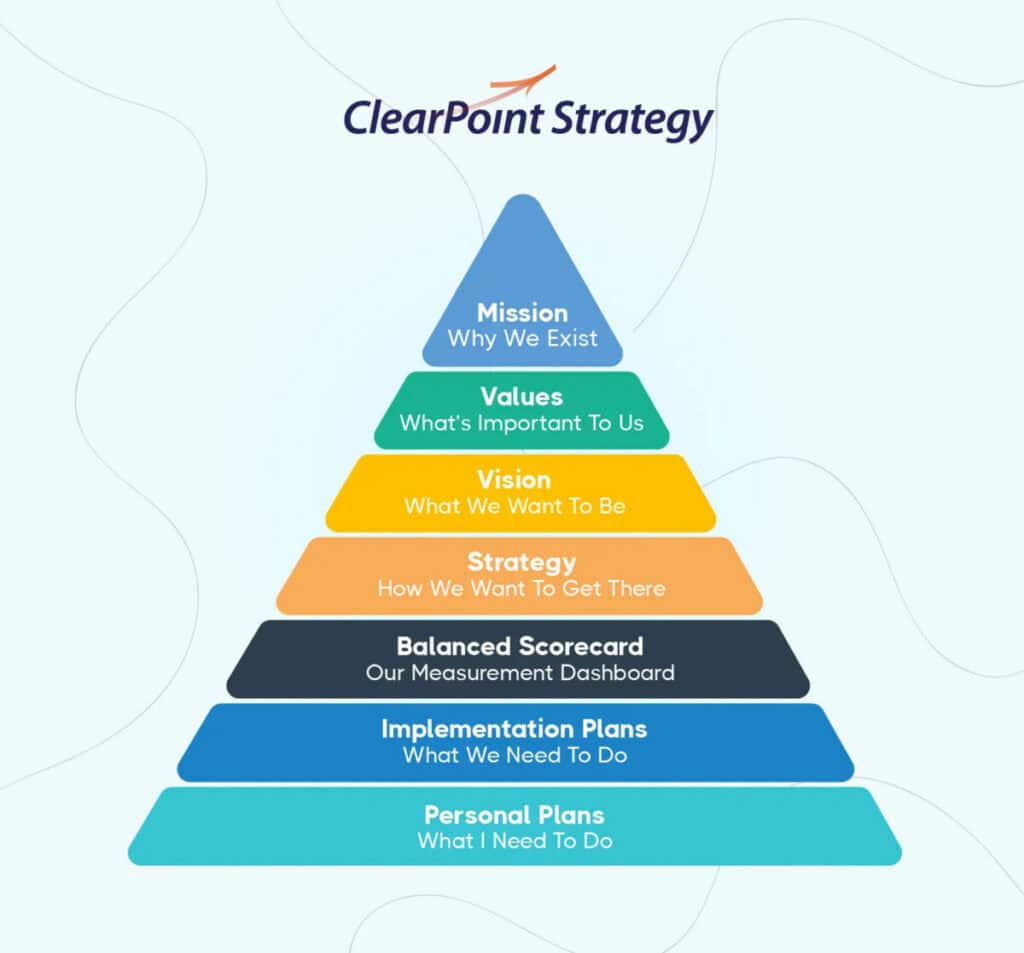
Source: ClearPointStrategy
Translating Long-Term Goals into Measurable Objectives
Big goals like “achieve market leadership” or “revolutionize customer service” are too vague for a software developer or a marketing specialist to act upon in their daily routine. Strategic planning takes these giant ideas and translates them into bite-sized, measurable objectives.
For example, if a regional bank decides its long-term goal is to increase market share by 15% within three years, the strategic plan might translate this into specific objectives like launching three new mobile banking features by the third quarter or expanding physical branch footprints into the European market.
Preventing Resource Misalignment and Scope Drift
One of the biggest killers of organizational success is scope drift. This is the tendency for projects to grow in complexity and cost without adding equivalent value to the original goal. Strategic planning sets firm boundaries. When a project has a clear strategic mandate, it becomes much easier for project managers to say no to extra features or tasks that do not serve the primary objective.
As Sharon Amos, Director at Air Ambulance 1, explains, “Scope expands when strategy is vague. When the end goal is clearly defined and tied to measurable business impact, it gives project leaders the confidence to protect resources and push back on distractions.”
Companies with highly aligned projects see 32% more successful project outcomes than those without a formal alignment process. By keeping resources focused on what truly matters, organizations avoid the trap of spreading their budget too thin across too many initiatives that stay alive for years but never actually contribute to the bottom line or the strategic vision. It is better to have five projects that move the company forward than fifty projects that simply keep people occupied while the budget drains away.
Cascading Big-Picture Goals into Project-Level Actions
The process of moving from a high-level idea to a ground-level task is known as cascading. This ensures that the strategy is not just a document sitting on a dusty shelf in the executive suite but a living influence on daily work. To make this work, the organization must be able to break down a five-year dream into a five-day task list.
Breaking Strategic Objectives into Initiatives
Once a strategic objective is set, it must be converted into actionable initiatives. Consider a retail company that identifies a major strategic objective to reduce customer churn by 10% over the next fiscal year. Instead of just telling the staff to “work harder,” the strategic plan cascades this goal into several distinct projects.
One project might focus on upgrading the mobile app interface to make shopping easier; another might involve launching a data-driven loyalty rewards program. This clarity ensures that every dollar spent on training or software development is an investment in that 10% reduction goal.
Setting Clear KPIs and Success Metrics
You cannot manage what you cannot measure. Every project born from a strategic plan needs Key Performance Indicators (KPIs). However, these should not just measure project health, such as whether the team stayed under budget or met a deadline, but also the strategic impact. If a project is finished perfectly on time but fails to move the specific strategic KPI it was designed for, then, from a strategic standpoint, the project was not a success.
As Beni Avni, Founder of New York Gates, puts it, “Execution metrics tell you if the project was delivered. Strategic metrics tell you if it mattered. Organizations that confuse the two often celebrate activity instead of impact.”
True alignment happens when teams clearly understand which business-level metric their work is meant to influence, whether that is revenue growth, customer retention, cost efficiency, or market expansion. When success is defined at both the operational and strategic levels, project management becomes a direct driver of corporate progress rather than just a delivery function.
Prioritizing Projects Based on Strategic Impact
Not all projects are created equal. Some offer high value with relatively low effort, while others are vanity projects that consume massive resources for very little gain. Strategic planning provides the necessary framework for prioritization. Leadership can rank potential projects based on how much they contribute to the big-picture goals compared to the resources they require.
Tal Holtzer, CEO of VPSServer, puts it simply: “If a project does not strengthen scalability, performance, or customer value, it is not a priority.”
This ensures that the most impactful work gets the best talent, while less relevant or lower-impact tasks are back-burnered or cancelled entirely. Without this prioritization, the loudest voices in the company often get their projects funded first, regardless of whether those projects actually help the company reach its long-term destination.
Governance and Decision-Making Frameworks
Governance is essentially the rules of the game. It is the structure that ensures that as projects progress, they stay aligned with the strategy even when market conditions change or internal leadership shifts. Strong governance acts as a safety net that catches projects before they fall out of alignment.
Portfolio Management for Strategic Fit
Project Portfolio Management is the practice of looking at all company projects as a single investment group. Just like a financial advisor balances a stock portfolio to manage risk and reward, a business leader must balance the project portfolio. A healthy portfolio includes a mix of “Run the Business” projects, which keep current operations smooth, and “Change the Business” projects, which focus on innovation and future growth.
Strategic planning dictates the specific ratio of this mix. For example, if an organization is in an aggressive growth phase, 70% of the portfolio might be dedicated to innovation and new market entry. Conversely, a company in a volatile market might shift its portfolio toward efficiency and risk mitigation.
Julia Rueschemeyer, Divorce Mediator & Divorce Lawyer at Amherst Divorce, notes, “In both law and business, balance protects long-term stability. Overinvesting in one direction often creates risk somewhere else.”
This high-level view prevents the company from investing too much in the future while the present crumbles.
Stage-Gate Reviews and Performance Checkpoints
A project should not just be funded once at the start of the year and then forgotten until it is finished. Stage-Gate reviews are formal checkpoints where a project’s progress is evaluated against its original strategic intent.
At each gate, leadership asks: “Does this project still make sense given our current strategy?” If the market has changed, perhaps a competitor launched a similar product or a new regulation was passed, the gate should close, and the project should be stopped.
This prevents companies from continuing to pour money into a failing or irrelevant project simply because they have already invested so much. Stopping a project that no longer fits the strategy is not a failure. It is a strategic victory because it frees up those resources for something that actually matters.
Leadership Accountability and Ownership
Alignment requires a champion at the executive level for every major initiative. When a C-suite leader is directly tied to a project’s success, the likelihood of that project receiving the necessary resources and attention increases exponentially.
If a project does not have an executive owner who is willing to stake their quarterly performance review on its success, it probably is not a true strategic priority. Alignment starts at the top of the organizational chart, not the bottom.
As David Lee, Managing Director at Functional Skills, explains, “Strategy only becomes real when someone at the top is personally accountable for the outcome. Without ownership, initiatives drift. With ownership, they move with urgency and clarity.”
This ownership ensures that when roadblocks appear, as they always do in complex projects, there is someone with enough authority to clear them and keep the project moving toward its strategic goal.
Communication and Cross-Functional Alignment
Strategy often fails because it is whispered in boardrooms but never shouted in the hallways. Communication is the glue that holds the execution together. Without it, even the best-planned strategy will die in a vacuum.
Creating a Shared Strategic Narrative
People work much harder when they feel they are part of a compelling story. A strategic narrative explains where the company came from, where it is currently going, and why that journey matters. When employees understand this narrative, they can make better independent decisions without needing constant supervision.
Aligning Departments Around Common Outcomes
Internal silos are the ultimate enemy of strategic alignment. Often, the Marketing department is working toward one goal, like increasing website traffic, while the IT department is working toward another, like increasing server security, and they accidentally sabotage each other in the process. Strategic planning requires cross-functional workshops where different departments agree on shared outcomes rather than just departmental goals.
Consider a retail company that wants to launch a massive new e-commerce platform. The Marketing team might want the site to be visually stunning with high-resolution video and heavy images, while the IT team needs it to be lightning-fast and minimalist to handle high traffic.
Strategic planning forces these two departments to sit down and compromise on a “User Experience” goal that satisfies both. By aligning around the customer outcome rather than their own department’s preferences, they ensure the project serves the company’s ultimate goal of increasing online sales.
Feedback Loops Between Strategy and Execution
The road from strategy to execution is not a one-way street. The people doing the work on the ground often have insights and data that the executives in the boardroom lack. Effective organizations create “Feedback Loops” where information flows in both directions.
If a project team realizes halfway through development that a specific strategic objective is technically impossible or that customers no longer want a certain feature, that information must flow back up to the planners immediately. This allows the strategy to be adjusted in real-time. A strategy that cannot change based on reality is a fantasy.
“Strategy is often a hypothesis, while execution is the experiment that proves or disproves it. Without a robust feedback loop, leadership is effectively flying a plane without a dashboard. You need the ground-level data to tell you if your high-level assumptions are actually landing,” says Raphael Yu, CMO at ChinaSource.
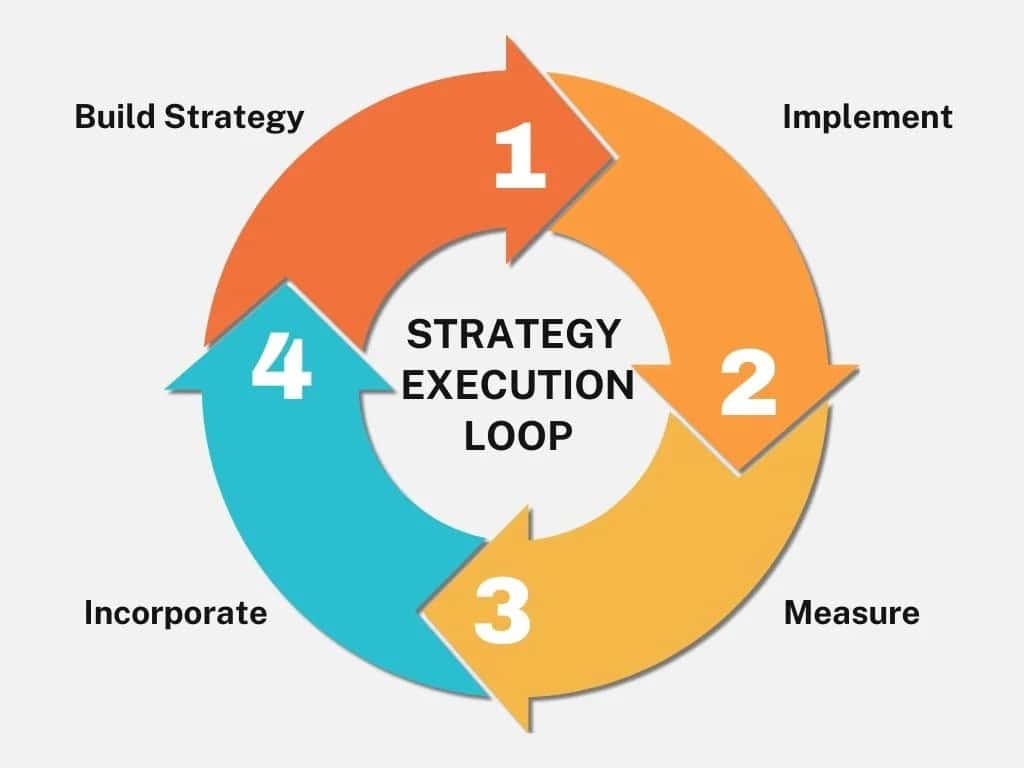
Source: Ikana Business Review
Measuring and Sustaining Strategic Alignment
The final and perhaps most difficult phase of alignment is ensuring it lasts over months and years. It is not a “set it and forget it” process; it requires constant monitoring, honest assessment, and the courage to change course.
Tracking Outcomes vs. Strategic Intent
It is very easy to track outputs, like we built the software, we hired the staff, and we opened the office. It is much harder, but far more important, to track “outcomes. This refers to the software increasing productivity, the staff improved sales, and the office expanded our market reach. Strategic alignment focuses almost entirely on the latter.
Adapting Plans Based on Performance Data
In a fast-moving global economy, a three-year plan can become obsolete in six months due to technological shifts or economic changes. Strategic agility is the ability to pivot without losing momentum. If the performance data shows that a project is failing to meet its KPIs, the organization must be brave enough to reallocate those resources.
As Rachel Sinclair, Acquisitions Director at US Gold and Coin, puts it: “The best strategic plans are written in pencil, not ink. You have to be able to erase and redraw as the market shifts. If you stay aligned with a goal that no longer exists because the world moved on, you are being stubborn.” This agility allows a company to stay relevant even when its original plan hits a dead end.
Continuous Improvement and Strategic Agility
Finally, alignment should be woven into the very fabric of the organizational culture. Every project wrap-up meeting should include a discussion on how the project helped (or didn’t help) the big-picture goals. Think of a tech startup that realized after a full year of intensive development that their main software feature wasn’t actually being used by their target audience.
Because they had a “fail fast” strategic alignment model, they didn’t keep digging the hole. They were able to pivot their entire development team to a new, more relevant feature within two weeks.
Bottom Line
When an organization masters strategic alignment, the benefits extend far beyond financial metrics. A profound cultural transformation occurs within the workforce. Employees who see their projects directly contributing to meaningful goals experience heightened morale and engagement. This sense of purpose cultivates ownership and pride in organizational success. Teams transition from merely completing tasks to driving impact.
The psychological shift is measurable: aligned organizations report higher retention, increased productivity, and stronger innovation pipelines. Strategic alignment transforms the workplace from a collection of disconnected activities into a unified force moving toward shared success. The question is no longer whether alignment matters, but rather, can your organization afford to operate without it?
Suggested articles:
- Strategic Planning for Digital Transformation Projects
- How Product Teams Can Reduce Release Risks Through Strategic QA Planning
- Goals and Objectives: Strategic Framework for Project Success

Daniel Raymond, a project manager with over 20 years of experience, is the former CEO of a successful software company called Websystems. With a strong background in managing complex projects, he applied his expertise to develop AceProject.com and Bridge24.com, innovative project management tools designed to streamline processes and improve productivity. Throughout his career, Daniel has consistently demonstrated a commitment to excellence and a passion for empowering teams to achieve their goals.