
The race for talent is the single thread that runs through every technology roadmap in 2026. AI keeps rewriting job descriptions, product cycles have shrunk to quarters, and compliance rules multiply with every new jurisdiction. Under that pressure, more project managers and CTOs lean on outstaffing as the most flexible way to grow teams without slowing delivery. Unlike classic outsourcing, outstaffing lets you keep the steering wheel while a partner supplies and pays the engineers. Done well, it feels almost the same as hiring next door – except payroll, legal, and retention headaches are quietly handled in the background.
Below you’ll find the current market context, a deeper-than-usual guide to spotting value, a decision framework with a new comparison table, and a close look at five IT outstaffing companies that have earned attention in 2026.
The 2026 Outstaffing Reality: Speed, AI, and New Compliance Headwinds
Outstaffing used to be a blunt cost-cutting tool. Today, IT outstaffing services revolve around speed, access to rare skills, and risk sharing. Three forces are shaping the shift in 2026. The first is the demand spike for generative-AI skills. LinkedIn’s AI Labor Market Update for September 2025 says that hiring for AI engineers grew by more than 25% from one year to the next. AI-related job postings make up almost 7% of all tech job postings, even though AI talent makes up less than 1% of members.
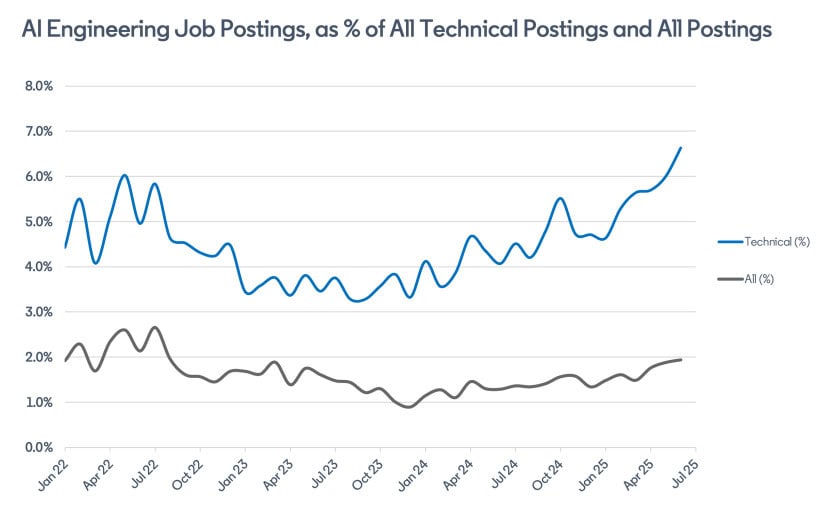
This shows that demand is much higher than supply. Internal recruiters simply cannot fill prompt-engineering or vector-database roles at the pace product teams need them. The second driver is regulatory sprawl. Near-real-time data rules such as the EU AI Act and multiple U.S. state privacy bills add operational drag. It’s no longer enough to find a coder; you also need partners who can supply compliance documentation, secure laptop policies, and ongoing background checks.
A third headwind comes from finance. CFOs have grown allergic to opaque rate cards. They now demand transparent, SaaS-style pricing that links spend to measurable throughput. The best IT outstaffing services meet this demand with flat monthly rates, dashboards, and contractual service-level guarantees instead of vague “best effort” language.
How to Separate Hype From Help in IT Staffing Services
Evaluating IT vendors often starts with a slick slide deck, but only a fraction of outstaffing providers can back up the marketing. Below is a sharper filter you can run before anyone reaches your shortlist. By expanding each checkpoint, we’ll move beyond surface questions and dig into the evidence that really predicts success.
Skill Depth That Matches Tomorrow’s Roadmap
A database boasting “50,000 developers” sounds impressive. Yet the metric that matters is overlap with the tech stack you will need six months from now. Request anonymized résumés from recent placements in Go, Rust, or whichever framework your backlog leans on. Then check how many were promoted or renewed after six months. Renewal rates reveal whether those talents truly worked out or quietly rolled off.
Red flags to watch for:
- Résumés that show a single two-month project stacked across multiple clients
- An over-reliance on WordPress or PHP when your roadmap is built on micro-services
- “Available tomorrow” claims for niche roles that normally take weeks
Retention Engineering as a Built-In Feature
Attrition kills velocity faster than any Gantt chart slippage. A vendor who treats developers like transient gig workers will bleed talent just when releases heat up. Look for structural evidence: continuing-education budgets, hackathons, line-manager ratios under 1:12, and an employee net-promoter score north of 60. Newxel’s 98% retention rate shows what “sticky” looks like in the real world.
It’s worth asking the following:
- How many voluntary departures occurred in each of the last four quarters?
- What is the average tenure per seniority band?
- Which benefits are exclusive to long-serving engineers?
Operational Hand-Offs That Feel Boring (and That’s Good)
The smoother the basics, the less you’ll talk about them, and that is exactly the point. Onboarding flows, equipment logistics, and payroll compliance should disappear into the background so product teams can stay focused on story points. Ask each vendor to walk you through their device provisioning and return procedures, including how they wipe disks when an engineer leaves the project.
Transparent Business Alignment
Finally, peel back the numbers. If a provider’s revenue model depends on churn, always swapping one engineer for another, their incentives clash with your need for stable momentum. The strongest partnerships rely on flat retainers and margin only when an engineer remains on the team. Putting all four filters together paints a holistic scorecard. A vendor that clears every bar will almost always deliver engineers who merge pull requests without drama and stay long enough to own the code they wrote.
Five IT Outstaffing Companies Worth Your 2026 Shortlist
Before diving into individual profiles, keep two things in mind. First, the list below is not a ranking; each firm suits different use cases. Second, every name here passed the checkpoints above to a degree that impressed both their clients and independent analysts.
1. Newxel
Founded in 2017, Newxel has turned Eastern Europe into an extension of its clients’ engineering floors. With eight hiring hubs across Poland, Ukraine, Romania, and Bulgaria, the company gives mid-market and enterprise teams immediate access to a highly vetted talent pool. What strikes many CTOs is Newxel’s four-step vetting process: 85% of candidates presented are accepted, shrinking interview cycles from months to weeks.
The model goes beyond simple staff augmentation. Newxel sets up full R&D centers, complete with security policies, equipment, and an HR business partner assigned to every engineer. That human layer is a big reason the firm maintains a 98% retention rate and an average developer tenure of 3.5 years, rare numbers in the outstaffing world. Pricing is a flat monthly rate per engineer, with no one-time placement or buyout fees lurking in the contract.
For product leaders who want to add 10-50 engineers in the next quarter and keep them for the life of the platform, Newxel is one of the best IT outstaffing services available today.
2. Mphasis

Enterprises that need both scale and deep domain consulting often land on Mphasis. The Indian-headquartered firm employs more than 30,000 professionals and posted $1.73 billion in revenue in 2025. Yet its value to CIOs goes beyond size. The proprietary Front2Back™ framework blends cloud migration, AI tooling, and design thinking into a repeatable delivery engine.
In practice, that means a U.S. bank can spin up a 40-developer squad skilled in COBOL modernization, AWS refactoring, and data-mesh governance under one roof. The launch of the Mphasis.ai unit in 2023 sharpened that focus: generative-AI accelerators, advisory workshops, and production pilots all feed into the outstaffing arm, letting clients keep pace with cutting-edge tech without separate vendor searches.
When board-level risk management requires a globally proven partner, Mphasis offers enterprise-grade muscle wrapped in outstaffing flexibility. It is, simply, one of the most reliable IT outstaffing companies for Fortune 1000 transformation programs.
3. OnHires
OnHires, based in the U.S. with global reach, excels at speed and niche tech placement. Its internal database of 130,000 engineers specializes in Web3, blockchain, DeFi, and AI – domains where traditional recruiters still struggle. The first batch of candidates typically lands in a client’s inbox within five days, and the average role closes in just three weeks.
A standout feature is the subscription recruitment model. Instead of paying per hire, companies subscribe to an OnHires recruiter-plus-sourcer duo that works exclusively on their openings. Costs drop by as much as 90% versus building an in-house talent team, and KPIs such as a 97.8% probation pass rate back the quality claim. Beyond recruitment, OnHires offers HR audits and employer-branding services that help younger startups look attractive in fiercely competitive talent circles.
If you are scaling a Web3 product or launching a DeFi wallet and need rare, vetted engineers yesterday, OnHires can be your fastest path. For those scenarios, it clearly sits among the best IT outstaffing services on the market.
4. Jobsity

Jobsity began in Ecuador more than a decade ago and now operates from New York as well as multiple Latin American hubs. The formula is straightforward: nearshore engineers working in the same or adjacent time zones to U.S. clients, integrated through Slack and stand-ups as if they were direct hires. The first candidate reviews arrive within 72 hours, followed by a 15-day risk-free trial.
Under the hood, Jobsity handles equipment, payroll, and employment-law compliance across 20+ LATAM countries. That coverage matters because local hiring laws in places such as Brazil or Argentina can trip up internal HR teams. Technology coverage spans full-stack development, QA automation, data science, and AI. Big-brand references like Disney, Dell, and Apple show the model scales from mid-market to enterprise.
For product owners who want to sync daily stand-ups at 10 a.m. Eastern Time without cultural friction, Jobsity is one of the seasoned IT outstaffing companies worth betting on.
5. Parallel Staff
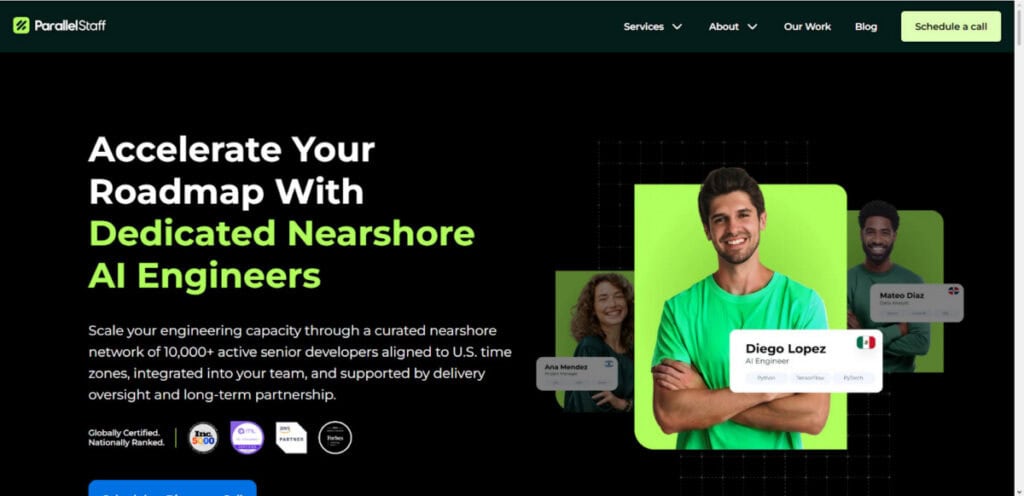
Parallel Staff focuses on senior engineers from Mexico, Colombia, and Brazil, priding itself on a five-to-ten-day hiring cycle. A curated network of 10,000+ developers feeds its roster, and clients receive a shortlist of pre-vetted candidates within five days. Pricing is transparent, saving 30-50% compared with U.S. salaries, and a Lifetime Fit Guarantee lets clients swap talent if needs change.
What sets Parallel Staff apart is its delivery mindset. The company tracks velocity, defect rates, and business outcomes rather than merely filling seats. AWS partner accreditation and repeat appearances on the Inc. 5000 hint at operational maturity. For teams that value ownership, predictable outcomes, and true collaboration rather than throw-over-the-wall contracting, Parallel Staff sits high among contemporary outstaffing providers.
Add in the time-zone alignment, and you get one of the best IT outstaffing services for U.S. startups that cannot afford to slow sprint velocity while hunting for senior talent.
Choosing Between Outstaffing Providers: A Decision Framework
After three vendor calls, the jargon starts to blur. Use the plain-spoken framework below to cut through the noise and focus on fit, not flash. We’ll also add a side-by-side table to anchor your final debate.
Match Urgency to Geography
Short lead times reward providers whose engineers work in your daily rhythm. A U.S. fintech sprinting toward a SOC 2 audit next quarter may favor LATAM specialists such as Jobsity or Parallel Staff. If the timeline stretches toward an enterprise platform rewrite, Eastern Europe’s depth through Newxel could unlock broader skill ranges at stable rates. When latency and compliance matter more than clock overlap – say, for EU user data – hosting engineers inside the European Economic Area may trump anything else.
Align Vendor Maturity With Project Complexity
Modernizing a core-banking platform invites audits, multi-region DR drills, and multi-cloud policies. A globally certified partner like Mphasis checks those boxes. Building a token-gated Web3 game, by contrast, rewards nimble, crypto-fluent squads; that’s OnHires’ turf. The goal is to avoid forcing a heavyweight provider into a prototype context or asking a lean boutique to pass a Big Four compliance test.
Interrogate Retention Economics
Interview cycles cost time; ramp-ups burn velocity. Ask for 12-month attrition rate stats, developer tenure, and buy-out clauses. Then trace how each metric rolls into your budget forecast. Excess churn balloons onboarding and knowledge-transfer hours, hidden costs that rarely make it onto a slide.
Validate Cultural Chemistry
Beyond hard skills, culture drives daily flow. Meet with the delivery lead and listen for genuine curiosity about your products, not boilerplate. Check whether sprint ceremonies, coding standards, and conflict-resolution playbooks align. When a Saturday rollback happens, you’ll want engineers who feel comfortable speaking up, not disappearing behind a ticket queue.
To visualize these variables, scan the quick-reference table below. It won’t pick your partner, but it will clarify what you value most before negotiating terms.
| Provider | Ideal Use Case | Primary Regions | Avg. Ramp-Up | Retention Highlight | Pricing Model |
| Newxel | Long-term product evolution requires large squads | Eastern Europe | 2-4 weeks | 98% dev retention | Flat monthly per engineer |
| Mphasis | Regulated-industry transformations, AI-led refactors | Global/India HQ | 4-6 weeks | Enterprise SLAs | Managed service or seat-based |
| OnHires | Web3, DeFi, crypto, AI prototypes | Global/U.S. HQ | ≤3 weeks | 97.8% probation success | Subscription recruiter model |
| Jobsity | Near-shore agile delivery for U.S. time zones | Latin America | 72 hours for CVs | 15-day risk-free trial | Flat monthly, no placement fee |
| Parallel Staff | Fast scale-ups needing senior LATAM talent | Latin America | 5-10 days | Lifetime Fit Guarantee | Transparent hourly or monthly |
Lists of key evaluation cues crop up everywhere online, but grounding choices in tangible rows and columns can save hours of debate. Once you weigh each factor – regulation, velocity, time zone, and cost – the strongest option usually surfaces with surprising clarity.
Common Pitfalls and How to Avoid Them
Even world-class partners can stumble if expectations diverge. Three traps show up the most, each followed by antidotes you can bake into the master services agreement (MSA).
Shadow Process Debt
External engineers who lack a seat in retros lose feedback cycles, and code rot sneaks in. Guard against this by naming them explicitly in Scrum ceremonies and giving them merge authority in repositories.
Hidden Cost Creep
Some vendors quote low headline rates but tack on onboarding, hardware, or early-termination fees. Lock all variable charges inside a single schedule, cap annual increases, and trigger price reviews only after mutually agreed milestones.
Jurisdiction Gaps
You may sign a contract with an EU entity while engineers work elsewhere, violating data-residency promises. Map each professional’s legal employer and ensure DPAs match those paths.
The Bottom Line
The talent shortage will not ease soon. Multiple labor-market reports forecast a substantial shortfall in ICT and software roles, with some estimates projecting up to 85 million unfilled positions by 2030, potentially resulting in trillions in unrealized economic output. At the same time, AI adoption is accelerating rapidly: Gartner predicts that around 40% of enterprise applications will embed task-specific AI agents by the end of 2026, up from a very small share today.
Outstaffing is no longer a fringe tactic but a core pillar that lets engineering leaders respond to product volatility without ballooning HR overhead. Yet only a handful of IT outstaffing companies combine rigorous vetting, retention engineering, transparent pricing, and cultural alignment. Newxel, Mphasis, OnHires, Jobsity, and Parallel Staff each distinctly solve the puzzle: enterprise AI programs, near-shore velocity, or niche Web3 skill sets.
Stack our expanded decision framework against your roadmap, run the hype-to-help checklist, and sign with the partner whose strengths overlay your biggest risks. When the pager goes off at midnight, you’ll be glad the engineer on call feels like part of your own crew, and that is the quiet magic of choosing the right outstaffing providers.
Suggested articles:
- Why Is IT Asset Management Important?
- How to Choose a Reliable IT Outsourcing Partner: 7 Expert Criteria
- How IT Outsourcing Shapes a Company’s Flexibility and Scalability

Daniel Raymond, a project manager with over 20 years of experience, is the former CEO of a successful software company called Websystems. With a strong background in managing complex projects, he applied his expertise to develop AceProject.com and Bridge24.com, innovative project management tools designed to streamline processes and improve productivity. Throughout his career, Daniel has consistently demonstrated a commitment to excellence and a passion for empowering teams to achieve their goals.