
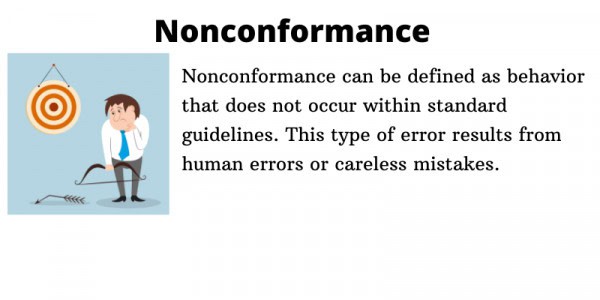
Nonconformance refers to any behaviour or outcome that falls outside established standard guidelines. Such deviations typically arise from human error or oversight and are most commonly attributed to insufficient standards, unclear instructions, or inadequate guidance provided to individuals within a project, job assignment, or task group.
From a quality management perspective, the costs of nonconformance emerge when an action is not properly planned, executed, or completed to the desired level of reliability. These costs can be measured by evaluating the frequency of incidents occurring within a production line or workflow, using data-driven analysis of defects and nonconformities to identify systemic issues.
While the primary responsibility for nonconformance lies with the manufacturer, any party involved with a nonconforming component bears an obligation to investigate the root cause and implement corrective measures to prevent recurrence. It is worth noting that remediation costs are often comparable to — or may even exceed — the cost of sourcing a fully compliant replacement part that meets all specified requirements.
Types of Cost of Nonconformance
For any organization, the ability to accurately measure and understand the costs of nonconformance is critical. Proactively identifying and planning for these costs can prevent significantly greater financial and operational impacts down the line.
Internal Failure Costs
Internal failure costs are the expenses incurred when defects or process breakdowns are detected and corrected within the organization before products or services reach customers. These costs cover wasted labor and materials, retraining, rework, and lost productivity, and typically increase when quality controls, training, or process design are inadequate or inconsistent.
Typical internal failure costs include:
- Human resource expenditures associated with employee turnover, recruitment, onboarding, and training programs.
- Productivity losses resulting from the time required to retrain employees on revised processes or newly implemented systems.
- Remediation expenses related to the repair, rework, or replacement of defective products or substandard services.
- Revenue and reputational losses stemming from diminished customer confidence in the organization’s capacity to consistently deliver quality products or services.
External Failure Costs
External failure costs arise when nonconforming products or services reach customers and cause harm, dissatisfaction, or regulatory exposure. These costs include recalls, warranty claims, legal fees, and lost sales, and they often have broader consequences such as damaged reputation, reduced market share, and increased scrutiny from regulators and partners.
Common examples of external failure costs are:
- Product recalls and safety remediation costs incurred when a product is withdrawn from the market due to safety or quality concerns, even if the company is not the original manufacturer.
- Regulatory and compliance penalties arising from failure to meet industry standards or legal requirements following a product or service deficiency.
- Customer compensation and warranty claims resulting from defective products or services that did not meet agreed-upon specifications.
- Reputational damage and loss of market share caused by diminished customer trust and negative publicity following an external product or service failure.
Cost Conformance Examples
The following sections break down the critical ways in which non-conformance—failing to meet established quality standards or project commitments—can drain an organization’s resources and reputation.
Organization Fails to Meet Commitment
When an organization fails to deliver on its promises, the fallout extends far beyond a single missed deadline. It triggers a chain reaction of financial and professional consequences:
- Erosion of Trust: Non-conformity destroys customer credibility. This doesn’t just lose one sale; it creates negative word-of-mouth that can deter dozens of potential leads.
- Legal Exposure: Failure to meet contractual obligations can lead to expensive lawsuits, mediation costs, or regulatory penalties that far exceed the cost of the original project.
- Leadership and Workforce Risk: Beyond business survival, failures put the livelihoods of employees at risk. Chronic failure creates a toxic work environment where the best talent leaves to protect their own professional reputations.
Inadequate Employee Training
Training is a primary prevention cost. Skimping on this investment leads to high non-conformance costs in the long run:
- Exploitation Vulnerability: Poorly trained staff are more likely to be manipulated by competitors or provide “off-script” concessions to customers that the company cannot afford.
- Operational Waste: Inadequacy costs the company time through rework and money through the need for heavy management oversight.
- Policy Alignment: Well-trained employees understand their duties under company policy. This ensures that when a problem arises, they act as a “first line of defense” rather than adding to the confusion.
Develop a Website
Consider a project to build a business website. This scenario illustrates how a lack of initial conformance to a design plan leads to a “cycle of rework“:
- The Rework Loop: Because the final version was missing elements from the initial plan, the project entered a cycle of multiple revisions. Each round of “submission-rejection-revision” represents significant internal failure costs in the form of unbilled labor.
- Contractual Friction: Reaching a signed contract after three iterations suggests a breakdown in communication or requirement gathering—both are failures of the “appraisal” phase.
- Performance Penalties: As a direct result of failing to provide a finished product according to the original plan, the organization may suffer “point” deductions or financial clawbacks that affect the total profit margin.
Delay in Resourcing
Calculating the cost of non-conformance requires specific data regarding the duration and impact of delays. Without this data, the true financial drain remains invisible to leadership.
- Identifying Resource Loss: You must identify which resources were consumed due to production delays. For example, a single day lost to a machine or system failure is a direct hit to productivity that cannot be recovered.
- Compounding Costs: Lost productivity isn’t just about “waiting.” It includes:
- Overtime Pay: Paying premium rates to meet a deadline that was delayed by an upstream department.
- External vs. Internal Failure:
- External: High-visibility costs like product recalls or brand damage.
- Internal: “Quiet” costs like losing clients or losing talent because employees are frustrated by inefficient standards.
Cost of Conformance vs. Nonconformance
The cost of conformance is the investment made to prevent defects and verify quality. It consists of prevention (training, design reviews, process controls) and appraisal (inspections, testing, audits). Nonconformance costs are the penalties paid when quality fails; they are internal (rework, scrap, downtime) or external (warranty claims, recalls, customer churn, legal fees).
Strategically, organizations should compare marginal prevention costs to expected nonconformance costs. Invest in prevention when its cost is less than the reduction in expected failure costs; stop investing when the marginal prevention cost exceeds the marginal benefit.
Practical Calculation: Simple Worked Example
Estimate annual nonconformance cost for a small product line:
- Rework Labor: 200 hours/year at $50 fully burdened = $10,000
- Scrap Materials: $4,000/year
- Customer Returns & Handling: $3,000/year
- Warranty and Legal Exposure Reserve: $5,000/year
Total annual nonconformance cost = $22,000
If a proposed prevention program (training + improved inspection) costs $8,000/year and is expected to cut failures by 60%, expected savings = 0.6 * $22,000 = $13,200. Net benefit = $13,200 − $8,000 = $5,200 annual. That justifies the prevention spend.
Use this template: quantify internal and external failure costs, estimate prevention/appraisal costs, calculate expected reduction from preventive measures, and compare net benefit.
Practical Steps on How to Avoid Nonconformance
- Define Success Precisely: Use measurable acceptance criteria for deliverables and role-level competency standards.
- Capture Requirements and Confirm Them: Record assumptions, dependencies, and sign-offs before work starts.
- Use Objective Acceptance Tests: Convert subjective requirements into pass/fail checks.
- Implement Early Appraisal Activities: Prototypes, design reviews, and pilot runs catch defects when they are cheapest to fix.
- Monitor Key Indicators: Defect rate, rework hours, customer complaint volume, and on-time delivery rate.
- Apply Structured Corrective Action: Root-cause analysis (5 Whys, fishbone), systemic fixes, and follow-up audits.
These steps prioritize prevention and enable targeted appraisal where it provides the most value.
Video About Non-Conformances – Construction Quality Management
This short video walks through common non-conformance issues on construction sites, how they arise, and practical steps teams can take to prevent them. Watch for real-world examples of defects, quick inspection techniques you can adopt on-site, and a simple checklist to reduce rework and claims. Ideal for site supervisors, QA inspectors, and project managers looking to cut costs and protect schedule and reputation.
Conclusion
Effective cost-conformance management balances deliberate investment in prevention and appraisal with a clear-eyed accounting of failure costs. By quantifying internal and external nonconformance, rework, scrap, downtime, returns, and legal exposure, teams can evaluate the true ROI of training, inspections, and process improvements. Use simple models (lost hours × fully burdened rates, plus material and escalation costs) to estimate annual failure costs, then compare expected savings from preventive measures against their price.
Monitor defect rates, rework hours, and customer complaints to verify assumptions and adjust spending where marginal prevention no longer delivers net benefit. Clear acceptance criteria, early appraisal activities, and a defined RACI for quality ownership make prevention practical. Taken together, these steps reduce total cost, protect reputation, and improve long-term project and product performance.
FAQs
What are the costs of nonconformance?
Nonconformance costs include direct repair and replacement, internal rework and scrap, warranty claims, recalls, customer support costs, regulatory fines, and indirect costs such as lost sales, higher acquisition costs, and damaged brand value. Distinguish immediate accounting costs from longer-term strategic costs (customer lifetime value lost, weakened market position).
What are the four costs of quality?
- Prevention: Process design, training, preventive maintenance, and supplier qualification. Investments here reduce failure probability.
- Appraisal: Inspections, testing, acceptance activities, and audits. These detect defects before release.
- Internal Failure: Defects found before delivery — rework, scrap, delays, and the labor cost to correct.
- External Failure: Defects found after delivery — returns, refunds, legal claims, recalls, and reputational damage.
A healthy quality program balances prevention and appraisal to minimize total cost (prevention + appraisal + internal failure + external failure), not any single category alone.
Who is responsible for nonconformance?
Responsibility depends on where the failure originates. Suppliers and contractors are accountable for component quality, purchasing, and incoming inspection, own supplier qualification, production and engineering own process controls, and project managers own requirements and change control. Senior management owns the quality policy and resource allocation. Clear RACI mapping (Responsible, Accountable, Consulted, Informed) for quality activities reduces ambiguity and speeds corrective action.
Suggested articles:
- 4 Types Of Cost Of Quality In Project Management
- 5 Incredible Examples Cost of Quality in Project Management
- 7 x Appraisal Cost Examples in Quality Management

Shane Drumm, holding certifications in PMP®, PMI-ACP®, CSM, and LPM, is the author behind numerous articles featured here. Hailing from County Cork, Ireland, his expertise lies in implementing Agile methodologies with geographically dispersed teams for software development projects. In his leisure, he dedicates time to web development and Ironman triathlon training. Find out more about Shane on shanedrumm.com and please reach out and connect with Shane on LinkedIn.