

In any organization, the unwritten rules governing how people work together can determine whether a team thrives or struggles. Team norms are the agreed-upon standards that guide how team members communicate, collaborate, and resolve conflict. They create cohesion, establish accountability, and provide a shared framework that helps teams operate efficiently from day one.
Understanding what team norms are is the first step toward using them effectively. These are not vague cultural ideals but specific, actionable agreements that a group commits to upholding. They can address communication frequency, meeting conduct, decision-making processes, or how disagreements are handled.
Team Norms in Project Management
Team norms are especially critical in a project management context, where misaligned expectations can derail timelines and erode trust. When a team agrees on how it will function before work begins, it removes ambiguity and allows members to focus on outcomes rather than interpersonal friction. Establishing norms early gives any project a strong operational foundation.
In Agile environments, norms take on additional importance because the methodology relies on continuous collaboration, rapid iteration, and open feedback. Common touchpoints like daily stand-ups, sprint retrospectives, and goal-setting sessions all benefit from agreed-upon behavioral standards. Without these norms, even well-structured Agile processes can break down under the weight of inconsistent expectations.
3 Reasons Why Your Organization Needs Team Norms
Team norms offer tangible advantages that go beyond keeping the peace. They directly influence how well a team performs and how sustainably it operates over time. The three most significant reasons to invest in them are:
- Improved Communication: When teams agree on how and when to communicate, information flows more reliably. Members spend less time chasing updates and more time acting on them, which reduces delays and miscommunication across the project.
- Greater Accountability: Norms create a shared standard against which behavior can be measured. When expectations are explicit and collectively agreed upon, team members are more likely to hold themselves and each other to them without conflict.
- Increased Productivity: Teams with clear norms waste fewer cycles on procedural uncertainty. When everyone understands how decisions are made and how work gets prioritized, execution becomes faster and more focused.
4 Team Norms Examples
In a project management setting, team norms often address the most common sources of friction: ownership, collaboration, trust, and adaptability. While every team’s norms will differ, the following examples reflect principles that apply broadly:
- Shared Ownership: All team members are equally responsible for the team’s success or failure. This norm discourages finger-pointing and encourages collective problem-solving, regardless of individual role or seniority.
- Mutual Support: All team members must be willing to help one another when capacity allows. This creates a culture where no one feels isolated with a difficult task, and bottlenecks are addressed collaboratively.
- Role Flexibility: Team members should be open to taking on new tasks or responsibilities as project needs evolve. In dynamic environments, rigid role boundaries can slow progress and undermine team resilience.
- Established Trust: The team commits to relying on each other’s judgment and follow-through. Trust is foundational to effective collaboration and is built through consistent behavior aligned with shared norms.
4 Best Practices for Team Norms
Creating norms is not simply a matter of listing rules and circulating them. The process itself matters. Following established best practices increases the likelihood that norms will be adopted, respected, and sustained over time:
- Specific and Actionable Language: Norms should describe concrete behaviors rather than abstract values. “Respond to messages within 24 hours” is more useful than “communicate well” because it gives team members a clear standard to meet.
- Documented Accessibility: Norms should be written down and stored somewhere that every team member can access. Keeping them visible, such as in a shared project workspace, reinforces their relevance beyond the initial conversation.
- Inclusive Creation: Norms developed with input from the full team carry more legitimacy than those handed down from leadership. When people contribute to the process, they are far more likely to respect the outcome.
- Consistent Accountability: Norms only work if they are enforced consistently. Teams should agree on how they will address situations where norms are not being followed, whether through direct conversation or structured retrospectives.
5 Steps to Establish Team Norms
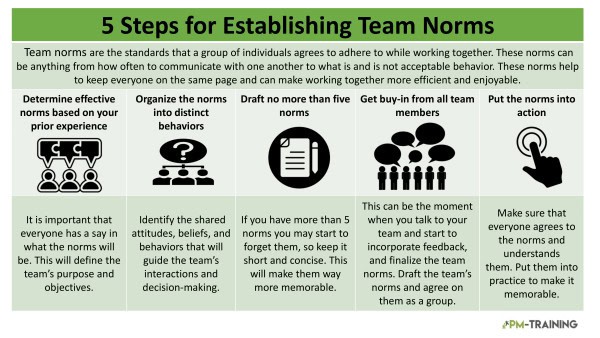
Step 1: Determine Effective Norms Based on Prior Experience
Begin by gathering input from every team member. Draw on past experiences, both positive and negative, to identify what has worked and what has created friction in previous collaborations. This step defines the team’s priorities and surfaces the behaviors most worth codifying. The goal is not to compile an exhaustive list but to surface the norms that will have the greatest impact on how the team functions day to day.
Step 2: Organize the Norms Into Distinct Behaviors
Once you have a pool of suggestions, group them into categories and identify themes. Look for overlapping ideas that can be consolidated into a single, clearly stated norm. This step transforms raw input into organized, actionable language that the team can evaluate and refine. Distinct behaviors are easier to remember, communicate, and hold each other to.
Step 3: Draft No More Than Five Norms
Fewer norms are more effective than many. When a team tries to govern every scenario with a written rule, the list becomes unmanageable and largely ignored. Limiting the list to five forces prioritization and ensures that the norms you establish are genuinely important. Concise, memorable norms are far more likely to shape daily behavior than a comprehensive document that no one reads.
Step 4: Get Buy-In from All Team Members
Present the drafted norms to the team and open the floor for feedback. This is not a formality. Genuine buy-in requires that team members feel heard and that their concerns are addressed before the norms are finalized. Walk through each norm, discuss its intent, and refine the language where necessary. Norms that are agreed upon rather than imposed are significantly more durable.
Step 5: Put the Norms Into Action
Once finalized, distribute the norms in writing and make sure every team member has a copy. Reference them during onboarding, retrospectives, and team meetings to keep them present in the team’s culture. Revisit and update them as the team evolves. Norms that are actively applied, rather than filed away, become part of how the team naturally operates.
4 Benefits of Team Norms
The value of team norms extends well beyond the initial exercise of creating them. Teams that maintain clear, shared standards consistently outperform those that do not, across communication, trust, and adaptability:
- Clarity of Intentions: When behavioral expectations are explicit, team members spend less time second-guessing each other’s motives. This clarity reduces interpersonal friction and allows energy to be directed toward the work itself.
- Stronger Trust: Norms create predictability, and predictability builds trust. When team members consistently behave in alignment with agreed standards, confidence in one another grows over time and becomes a competitive advantage.
- Time and Effort Savings: Teams with established norms avoid many of the recurring conversations and conflicts that consume time in less structured groups. Decisions about process and conduct have already been made, freeing up capacity for higher-value work.
- Openness to Change: A team grounded in shared norms is more resilient when circumstances shift. Because the relational foundation is secure, members are more willing to experiment, adapt their approaches, and accept feedback without feeling threatened.
Video About Team Norms
Want to see team norms in action? This short video breaks down what team norms are, why they matter, and how to establish them effectively. Watch to gain a clearer picture of how shared standards can transform the way your team communicates and collaborates.
Conclusion
Team norms are one of the most practical tools available to any team leader or project manager. When developed collaboratively, kept concise, and applied consistently, they reduce friction, build trust, and create the conditions for sustained high performance. The five-step process outlined here provides a straightforward path to establishing norms that actually shape how a team works, rather than simply existing on paper.
Organizations that invest in defining how their teams will operate, not just what they will deliver, position themselves for better outcomes across every project. As teams grow or evolve, revisiting and refreshing these norms ensures they remain relevant and effective. The effort required to establish them is small compared to the alignment and clarity they create.
FAQs
What are good team norms?
Good team norms are specific, realistic, and relevant to how your team actually works. They should address the behaviors most likely to affect communication, trust, and performance. The best norms are ones that team members genuinely commit to because they were involved in creating them, rather than norms that were imposed without input.
How do you write team norms?
Start by defining the purpose of the norms and gathering input from all team members. Draft a short list of clear, behavioral statements, ideally no more than five, and then review them as a group. Incorporate feedback, finalize the language, and communicate the agreed norms to the entire team in writing.
What are the main benefits of team norming?
Team norms help teams function more effectively by establishing clear expectations around communication, decision-making, and collaboration. They reduce conflict, build accountability, and save time that would otherwise be spent resolving procedural disagreements. Over time, consistent norms also strengthen the trust and cohesion that underpin high-performing teams.
Why are team norms important in project management?
In project management, unclear expectations are one of the most common causes of delays and team friction. Norms provide the behavioral guidelines that allow a team to work together predictably and efficiently. Establishing them at the start of a project helps prevent many of the interpersonal and process issues that arise when teams operate without agreed-upon standards.
How often should team norms be revisited?
Team norms should be treated as living agreements rather than fixed rules. It is good practice to revisit them during retrospectives or whenever the team composition changes significantly. As projects evolve and teams grow, some norms may need to be updated or replaced to reflect new ways of working or emerging challenges.
Suggested articles:
- 5 Ways to Build Cultural Accountability in Your Team
- The Pros and Cons of Teamwork
- Top 5 Advantages of Employer of Record Services for Remote Project Teams

Daniel Raymond, a project manager with over 20 years of experience, is the former CEO of a successful software company called Websystems. With a strong background in managing complex projects, he applied his expertise to develop AceProject.com and Bridge24.com, innovative project management tools designed to streamline processes and improve productivity. Throughout his career, Daniel has consistently demonstrated a commitment to excellence and a passion for empowering teams to achieve their goals.