
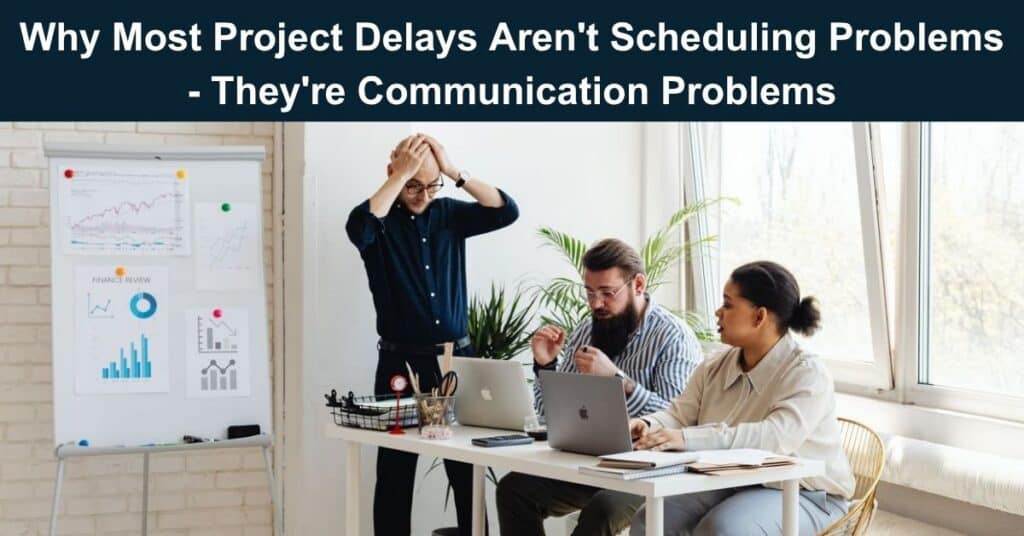
Ask a room full of project managers what kills timelines, and you’ll get a predictable list: scope creep, unrealistic estimates, resource conflicts, a vendor that missed a deadline. All real, all worth guarding against. But spend enough time in post-mortems and a quieter, less flattering pattern starts to show up again and again: the schedule wasn’t actually the problem. The information about the schedule never reached the people who needed it, in a form they could act on, at the moment it mattered.
This is an uncomfortable thing to admit, because it doesn’t fit neatly into a Gantt chart. A missed dependency is easy to diagnose after the fact — you can point to the task, the date, the resource that wasn’t available. A communication failure is messier. It usually looks, in hindsight, like a status update that got sent but not read, a risk that was mentioned once in a meeting nobody minuted, or a stakeholder who found out about a slip two weeks after the team already knew.
The Illusion of “We Communicated That”
Every project manager has said some version of “we communicated that” in a post-mortem, and every project manager has, at some point, been technically right and practically wrong. An email went out. A Slack message was posted. A line item appeared in a status report nobody opened past the subject line. Communication happened, in the narrow sense of information leaving one person’s hands. It didn’t happen in the sense that matters, which is information landing somewhere a decision could be made from it.
The gap between those two things is where a huge number of preventable project delays actually live. A sponsor who doesn’t know a risk has moved from “possible” to “likely” can’t help mitigate it. A dependent team that doesn’t know their upstream task slipped keeps planning against a date that’s already gone. None of this shows up as a scheduling failure in the tool. It shows up as a surprise, three weeks later, that could have been a Tuesday afternoon conversation.
Why Status Reporting Quietly Becomes the First Casualty
Status reporting is almost always the first thing to degrade when a PM gets busy — and it degrades exactly when it’s needed most. Early on, updates are thorough: clear risk sections, honest RAG statuses, context for anyone who wasn’t in the room. Six weeks in, under pressure, that same report shrinks to three rushed bullets typed between meetings. That shift isn’t a discipline failure — it’s a predictable resource allocation problem.
Here’s why it happens so consistently:
- The Cognitive Cost Is Real: Writing a genuinely useful update takes real drafting effort — explaining why something is red, not just that it is — and that effort is the first thing sacrificed when time runs short.
- PMs Deprioritize Their Own Calendars: PMs are trained to solve resource allocation problems everywhere except in their own schedules, so status writing gets treated as optional in a way scheduling itself never would.
- Louder Tasks Win the Time Budget: Under deadline pressure, drafting time routinely loses out to whatever task has an angrier stakeholder attached to it, regardless of long-term impact.
- The Mechanical Step Gets Cut First: Turning raw status points into a structured, readable draft takes time that’s easy to skip entirely once the calendar gets tight.
That mechanical step, though, is increasingly easy to offload. Tools like Writecream can take a rough list of updates, risks, and blockers and turn them into an organized first draft in minutes, which a PM then edits for accuracy and tone rather than writing from a blank page under time pressure. The judgment, including what’s actually worth flagging, how bluntly to phrase a risk, which stakeholder needs more context than another, still has to come from the PM. But the drafting step, the one most likely to vanish entirely when time is short, becomes cheap enough that it stops being the thing that gets cut.
The Cadence Problem Nobody Schedules For
There’s a second, related failure that has nothing to do with the quality of any single update and everything to do with consistency. A project team that gets a sharp, useful status report in week one and then nothing in week two isn’t just missing an update — it’s teaching stakeholders not to trust the next one when it does arrive, because the cadence itself has become unreliable. Consistency is a genuinely different problem from quality, and it’s solved differently.
A single excellent report written once is a writing problem. A reliable weekly report sent to the right five people, on the right day, in the right format for each channel, like a a shorter version for a Slack channel, a fuller version for email, or a summary slide for a steering committee, is a logistics problem, and it’s exactly the kind of repetitive, format-specific work that’s easy to let slide under pressure because none of it feels urgent in the moment it’s being neglected.
What Actually Prevents the Surprise
None of this is really about writing tools or scheduling tools. It comes down to recognizing that “we sent the update” and “the right person understood it in time to act” are two different claims — and most post-mortems quietly conflate them. Here’s what actually separates a manageable slip from a full-blown crisis:
- Clear, Early Communication Buys Time: A schedule slip that’s flagged early and clearly lets sponsors adjust, and dependent teams replan, so nobody downstream gets blindsided by news that’s already old.
- Compression Turns Slips Into Crises: The exact same slip, discovered late because the flag got buried in an unreadable bullet or skipped that week, escalates into a genuine crisis.
- Cadence Is Treated as a Deliverable: PMs who avoid these project blowups treat communication clarity and cadence as a deliverable with its own deadline, not something that happens automatically.
- Protection Applies to the Whole Chain: They protect both the time it takes to write a useful update and the reliability of the schedule it goes out on, with the same seriousness as any critical path item.
Conclusion
In the end, a project rarely fails because the work itself was impossible. Deadlines slip, scope shifts, and resources fall through — these are ordinary hazards every PM plans around. What actually derails a project is quieter: the people who needed to know something didn’t know it in time to do anything useful with it, and nobody noticed the gap until it was already too late to close cheaply.
That gap is almost always closeable, but only if it’s treated as a real risk with its own owner and deadline, not an afterthought that gets handled whenever things calm down. Communication discipline isn’t a soft skill sitting beside the schedule — it’s part of what makes the schedule trustworthy in the first place.
Suggested articles:
- Project Communication: Your Guide to Effective Project Management
- How AI Can Reduce Project Delays by Connecting CRM, Tasks, and Calendars
- Closing the Visibility Gap: Understanding Where Your Project Team’s Time Really Goes

Daniel Raymond, a project manager with over 20 years of experience, is the former CEO of a successful software company called Websystems. With a strong background in managing complex projects, he applied his expertise to develop AceProject.com and Bridge24.com, innovative project management tools designed to streamline processes and improve productivity. Throughout his career, Daniel has consistently demonstrated a commitment to excellence and a passion for empowering teams to achieve their goals.