
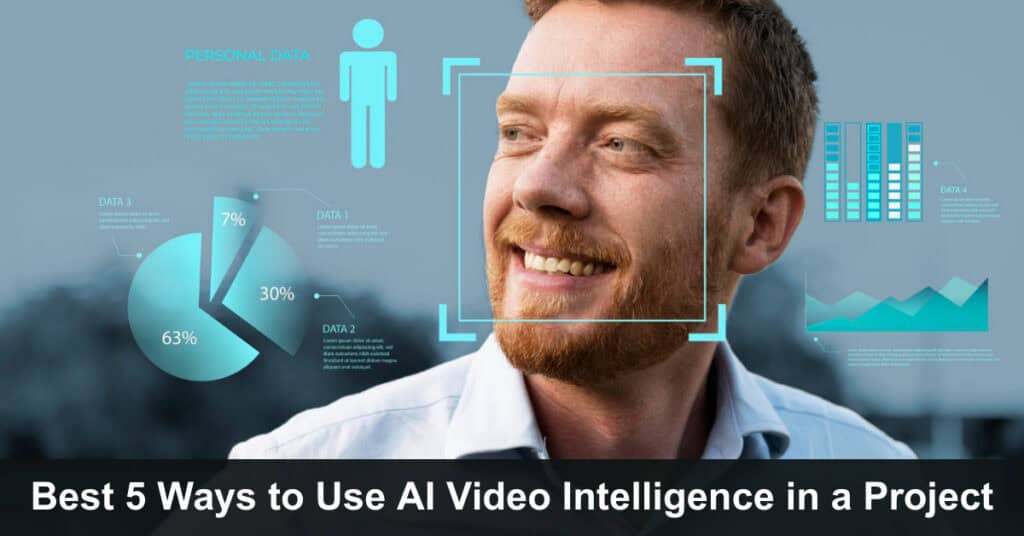
AI video intelligence is moving from niche capability to core infrastructure. What used to sit with security teams is now landing on the project manager’s desk. Across construction, logistics, finance, and public infrastructure, projects increasingly involve systems that don’t just record footage; they interpret it. These platforms analyze live video in real time, detecting objects, recognizing faces, reading license plates, and flagging unusual behavior without constant human monitoring.
The scale is already massive, with over a billion cameras deployed globally, and market growth continues to accelerate. This is no longer experimental technology. It’s operational, expected, and often business-critical. The challenge isn’t whether to use it — it’s how to plan, deploy, and manage it properly within a project environment.
Why Project Managers Should Be Thinking About AI Video Intelligence
Security and monitoring infrastructure used to be someone else’s problem – a facilities team concern, an IT department purchase, a compliance checkbox. That is changing fast. Today, project managers across industries, from construction and logistics to finance and public infrastructure, are being asked to evaluate, procure, and oversee deployments of AI video intelligence systems. These platforms go far beyond traditional CCTV. They interpret live video feeds in real time, detecting objects, recognizing faces, reading license plates, flagging behavioral anomalies, and generating instant alerts – all without human eyes constantly on a monitor.
The global AI video surveillance market was valued at $6.5 billion in 2024 and is projected to reach nearly $29 billion by 2030, growing at over 30% annually. More than one billion cameras are now estimated to be deployed worldwide. The technology is no longer experimental; it is an active infrastructure in airports, hospitals, transit hubs, financial institutions, and smart cities. But implementing it successfully requires careful project planning. Here are the five most effective ways project managers can integrate AI video intelligence into their projects.
1. Replace Reactive Security with Real-Time Threat Detection
The most immediate use case for AI video intelligence in any security-focused project is shifting from reactive to proactive monitoring. Traditional security setups rely on operators watching live feeds or reviewing footage after an incident. Both approaches have a fundamental weakness: human attention is finite, inconsistent, and expensive at scale.
AI video intelligence platforms process video continuously, detecting threats the moment they appear and triggering alerts in real time. This changes security from something that reacts after the fact into something that intervenes as events unfold. To implement this effectively, project managers should focus on the following:
- Continuous Threat Detection: AI systems monitor video feeds 24/7, identifying risks such as firearms, unattended objects, or unusual crowd behavior instantly.
- Real-Time Alerts and Response: Alerts are sent immediately to the appropriate personnel, removing delays caused by manual monitoring.
- Defined Detection and Alert Thresholds: Project managers must clearly define what the system needs to detect, what qualifies as an alert, and who receives notifications.
- Reduced Operator Fatigue and False Positives: A well-configured system ensures human operators are only engaged when necessary, improving both efficiency and accuracy.
Among the companies developing vision AI for safety and identity applications, ROC.ai has built a platform organized around several operational pillars – you can explore the full range of services on their website. One product built specifically for continuous monitoring environments such as venues, transit hubs, and critical infrastructure is ROC Watch – you can read about it here – a dedicated video intelligence service that replaces the unreliable patchwork of human monitoring shifts with a consistent machine-driven layer.
2. Use Visitor and Access Management to Control Who Enters Your Project Sites
Many projects – particularly in construction, government, and regulated industries – require tight control over who is present on site at any given time. AI video intelligence makes this level of control practical at scale by automating identity tracking and access decisions. Modern systems combine multiple technologies to monitor and manage access in real time, reducing reliance on manual checks and improving consistency across entry points.
To make this work in a project environment, focus on these core areas:
- Real-Time Identity Tracking: Facial recognition, license plate reading, and visitor databases are used to monitor who enters and exits a site.
- Automated Access Control Decisions: When integrated with physical infrastructure such as gates, doors, and turnstiles, systems can grant or deny access based on pre-approved credentials.
- Integration Across Systems: AI video intelligence connects with HR systems, visitor pre-registration platforms, ID databases, and access hardware — making early integration planning critical.
- Multimodal Biometric Security: Combining face, fingerprint, and iris recognition allows different security levels across zones depending on sensitivity.
- Procurement Based on Proven Benchmarks: Independent evaluations, such as those conducted by NIST, provide a reliable standard for assessing system performance.
3. Accelerate Digital Onboarding and Identity Verification Workflows
Not every AI video intelligence use case is tied to physical environments. For project managers working in financial services, healthcare, government programs, or any industry with KYC or age verification requirements, remote identity verification is a major application. These systems combine multiple layers of verification to ensure accuracy, compliance, and scalability in digital onboarding processes.
To structure these workflows effectively, break them down into the following components:
- ID Document Authentication: Systems verify passports, driver’s licenses, and national IDs to confirm authenticity.
- Facial Comparison: A user’s live face is matched against their document photo to confirm identity.
- Liveness Detection: Ensures the individual is physically present and not using a static image or recorded video.
- Scalable Remote Onboarding: Enables organizations to onboard users quickly and securely without requiring physical presence.
- Regulatory and Accuracy Requirements: Project managers should prioritize vendors with strong accuracy across diverse demographics and documented benchmark performance.

4. Deploy at the Edge for Speed-Critical Applications
One of the most important architectural decisions in an AI video intelligence project is where video processing takes place: in the cloud or at the edge. This decision directly impacts speed, cost, and data control. Cloud-based systems send video to remote servers for processing, which introduces latency. While acceptable for some use cases, this delay becomes a problem in time-sensitive scenarios.
To choose the right architecture, evaluate the following factors:
- Cloud Processing and Latency Trade-Offs: Suitable for analytics, reporting, and non-critical workflows where slight delays are acceptable.
- Edge-Based Processing for Instant Response: AI runs directly on local hardware near the camera, enabling near-instant detection and action.
- Low-Latency Threat Detection: Critical for security applications where threats must be identified and acted on within milliseconds.
- Reduced Bandwidth Requirements: Only alerts and relevant metadata are transmitted, rather than continuous video streams.
- Improved Data Governance: Keeping data on-premises helps meet privacy and compliance requirements.
- Infrastructure and Cost Considerations: Edge deployments require specialized hardware such as GPUs or AI accelerators, increasing both cost and maintenance complexity.
5. Plan for Governance, Compliance, and Stakeholder Trust from Day One
The most overlooked aspect of AI video intelligence projects is governance – and it is consistently where deployments run into trouble after launch. AI video systems operating in public or civic contexts face a complex and uneven regulatory landscape. Illinois requires written consent before biometric data can be collected. The EU’s AI Act imposes restrictions on real-time facial recognition in public spaces. In the United States, no unified federal framework exists – organizations operate under a patchwork of state and local rules that create real compliance risk and legal exposure.
Research published in Frontiers in Big Data in 2024 found that existing legislative frameworks in most countries fall short of what is needed to govern facial recognition at scale, particularly regarding consent, purpose limitation, and cross-border data sharing. A 2024 survey found that while 46% of American adults support law enforcement use of facial recognition for public safety, significant discomfort remains around its use in general public spaces.
For project managers, this means governance cannot be retrofitted after a system goes live. Build it into the project plan from the start:
- Define Data Retention Policies: How long footage is stored, who has access to it, and how it is securely archived or deleted in line with regulatory and organizational requirements.
- Establish Consent and Disclosure Protocols: How individuals are informed about data collection, what consent mechanisms are required, and how usage is communicated in public-facing environments.
- Assign Oversight Responsibilities: Who is accountable for monitoring alerts, investigating incidents, auditing system performance, and handling complaints or disputes?
- Document Accuracy Requirements: What levels of false positives and false negatives are acceptable, how accuracy is tested, and how performance is monitored and improved over time.
- Map Jurisdiction-Specific Requirements: What legal and regulatory obligations apply across different regions, and how compliance is maintained when projects operate across multiple states or countries.
The companies building reliable AI video intelligence infrastructure understand that trust is as important as accuracy. Choosing a vendor with transparent benchmarking, clear data governance documentation, and a track record of responsible deployment is a project risk decision, not just a technical one.
Key Takeaways for Project Managers
| Application | Primary benefit | Key planning consideration |
|---|---|---|
| Real-time threat detection | Proactive security, reduced operator fatigue | Alert thresholds and escalation workflows |
| Access and visitor management | Automated site control at scale | System integration with existing access hardware |
| Identity verification and KYC | Compliant remote onboarding | Vendor accuracy benchmarks and regulatory coverage |
| Edge deployment | Low-latency response for critical applications | Hardware costs and on-site maintenance |
| Governance and compliance | Legal protection and stakeholder trust | Jurisdiction mapping and data retention policies |
Conclusion
AI video intelligence is no longer a niche capability reserved for defense and intelligence agencies. It is becoming standard infrastructure across a wide range of industries – and project managers who understand how to plan, integrate, and govern these deployments will be better positioned to deliver them successfully. The technology exists and is mature enough for broad deployment. The question is whether the project planning around it is equally rigorous.
Suggested articles:
- The Strategic Edge: Why Logistics Intelligence Matters in Project Investment Decisions
- How Competitive Intelligence Leads to Wise Business Decisions
- Cybersecurity Strategies in Threat Intelligence Software

Daniel Raymond, a project manager with over 20 years of experience, is the former CEO of a successful software company called Websystems. With a strong background in managing complex projects, he applied his expertise to develop AceProject.com and Bridge24.com, innovative project management tools designed to streamline processes and improve productivity. Throughout his career, Daniel has consistently demonstrated a commitment to excellence and a passion for empowering teams to achieve their goals.