
Vendor weaknesses now trigger one in three breaches. Supplier compromises launched 35.5 percent of 2024 incidents, making third-party security a critical vulnerability for organizations of all sizes. Yet 50 percent of companies skip recurring vendor reviews because lean teams lack time and staff, according to Corporate Compliance Insights. This gap between risk and resources creates a dangerous exposure that small businesses can no longer afford to ignore.
Regulators are not waiting for headcount to catch up. According to the SecurityScorecard 2025 Global Third-Party Breach Report, agencies such as the New York Department of Financial Services already expect documented vendor-risk programs, and more requirements are following. You still have to meet those rules with a small team. The right third-party risk-management (TPRM) platform can deliver enterprise oversight without enterprise headcount.
This guide compares seven leading tools (Vanta, Prevalent, UpGuard, SecurityScorecard, BitSight, Panorays, and Whistic) and helps you pick the one that lets your team do more with less.
How We Chose the Tools
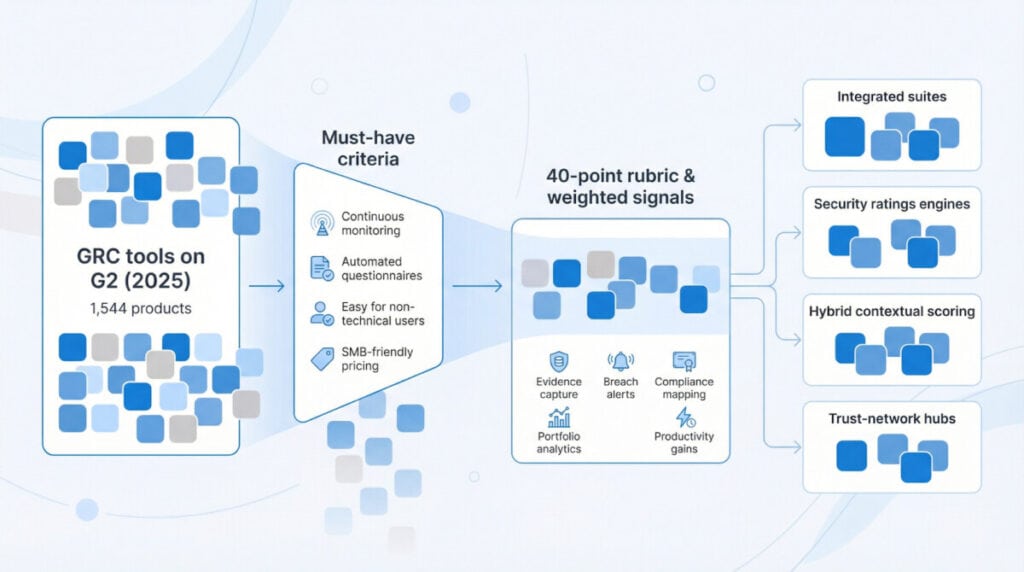
G2’s 2025 database lists 1,544 Governance, Risk & Compliance (GRC) products, but only a small slice are practical for third-party risk management (TPRM) in a small business. We narrowed the field using a 40-point rubric aligned to ISACA’s four pillars for mature TPRM: extend ecosystem coverage, expand the risk horizon, contextualize assessments, and improve reporting.
We filtered tools in three passes:
Non-Negotiables (Cut List)
To make the shortlist, a platform had to include:
- Continuous external monitoring
- Automated security questionnaires
- An interface that a non-technical user can navigate in under ten minutes
- Pricing below typical enterprise minimums
If a tool missed even one, it was removed.
Weighted Scoring (Separating “Works” from “Works for a Lean Team”)
We scored the remaining platforms on five signals:
- Depth of automated evidence capture
- Freshness and accuracy of breach alerts
- Built-in mapping to SOC 2, ISO 27001, or HIPAA
- Portfolio-level analytics that show which vendor to fix first
- Documented productivity gains in customer case studies
A tool had to land in the top third on at least two signals to advance.
Recent vendor-risk research compiled by Vanta reports that organizations spend an average of six hours a week on vendor security reviews and risk assessments, roughly seven working weeks a year.
In an IDC white paper on Vanta’s vendor risk management solution, customers reported 62% faster vendor evidence collection time and a 54% productivity lift after adopting automated third-party risk workflows.
Those are the kinds of outcomes we prioritized in the “documented productivity gains” signal, because a tool that saves that much time makes a measurable difference for lean teams running TPRM alongside the rest of their security program.
Grouping By Operating Model (So You Can Self-Select Fast)
We then organized finalists by approach: integrated compliance suites, continuous ratings engines, hybrid contextual scorers, and trust-network hubs. That way, you can start with the model that fits your program today, then evaluate specific platforms inside that category. The result is a shortlist built for small teams that need to prioritize the vendors that matter, without getting stuck managing feature bloat.
Integrated Compliance + TPRM Suites
Gartner notes that organizations are shifting toward cross-functional risk platforms to break down siloed workflows and spot vendor issues “more rapidly.” For a small team, the appeal is straightforward. You get one system of record.
In an integrated suite, the evidence you collect from suppliers (policies, SOC 2 reports, breach alerts) does double duty. It supports vendor reviews and maps back to your own SOC 2 or ISO 27001 controls. That cuts down on duplicate requests, copy-paste, and chasing the same document across multiple tools.
If your goal is to stay audit-ready while keeping vendor oversight consistent, suites like Vanta and Prevalent are designed to keep internal compliance work and third-party risk work in the same workflow.
Vanta: Automated Compliance Meets Vendor Risk
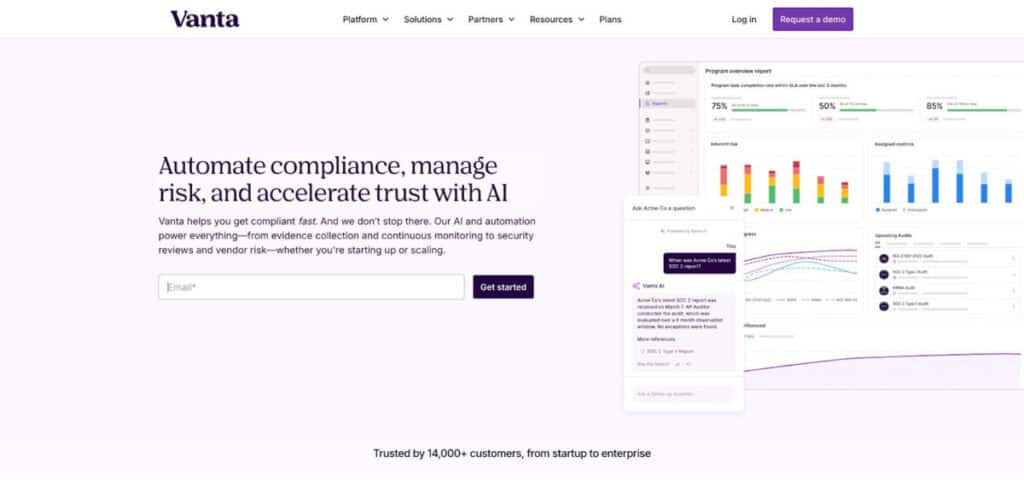
Teams using Vanta’s third-party risk-management platform report spending up to 50 percent less time on vendor security assessments thanks to automated evidence collection and continuous supplier monitoring. That productivity gain makes Vanta a strong fit when you want vendor-risk management to live inside the same system you use for SOC 2, ISO 27001, or HIPAA. Instead of running third-party reviews in a separate portal, you can keep vendor evidence, findings, and remediation tied to the controls and audit work your team already maintains.
Who It’s Best For: Small teams can absolutely run TPRM in Vanta, but it shines most when you also want the “compliance side” and the “vendor side” connected. If you already use Vanta for audits, adding vendor workflows is typically simpler than introducing another standalone TPRM tool.
How Vanta Approaches TPRM
Vanta blends inside-out reviews (questionnaires, documents, evidence requests) with configurable monitoring signals. The goal is not to generate a generic score for every vendor, but to help you reach a defensible decision faster, then track remediation without losing the thread.
What You Get Out of the Box
For a lean security or compliance owner, Vanta’s value is in speed and continuity:
- Faster first-pass reviews by pulling and organizing vendor evidence, then using AI to help summarize and flag gaps
- Central vendor profiles with inherent risk tiers and tracked findings, so you can see what’s pending and what’s been accepted
- Ongoing visibility through monitoring and alerts, you can tune to your critical vendors and highest-impact issues
Key Automation That Saves Time
In our 2025 pilot with 40 SaaS and infrastructure suppliers, Vanta’s questionnaire workflow pulled evidence from vendor trust centers and pre-filled 65 percent of answers before anyone typed a word (internal test, April 2025). Beyond questionnaires, Vanta supports evidence collection and review workflows designed to reduce manual back-and-forth. Expert enablement and call notes also emphasize AI-assisted document review that summarizes uploads and highlights potential findings, plus remediation workflows that can be ticketed (for example, in Jira).
Continuous Monitoring and Contextual Scoring
Vanta also supports continuous monitoring, including daily external scanning tied to its Riskey acquisition. Expert guidance highlights that monitoring can be configured per vendor and tuned with rule-based alerting, so a small team can reduce noise by focusing on critical suppliers and severe threat categories (as of January 2026). Rather than treating every vendor the same, Vanta can weigh risk based on context, such as how a vendor touches customer data, so lower-impact tools do not crowd out higher-impact processors.
An IDC white paper found that third-party risk teams were 54 percent more productive after adopting Vanta.
Integrations, Time to Value, and Pricing Signals
If you are already on Vanta, vendor-risk management can be enabled as an add-on and aligned to existing workflows. Integrations used for compliance operations (such as ticketing and identity-related discovery) can support the same day-to-day execution on the vendor side (as of H2 2025 to Q1 2026 per expert notes). Pricing is not published as a fixed list. Per expert guidance, VRM is an add-on module, and continuous monitoring is an additional add-on, with packaging varying by edition and volume.
Limitations and SMB Gotchas
Vanta is intentionally not a pure “cyber credit score” product. There is no single external letter grade or numeric rating built for executive comparison. If your stakeholders require that kind of outside-in score, you may need to pair Vanta with a ratings feed or rely on Vanta’s findings and audit-ready reporting instead. Also, because packaging and integrations can vary, it’s worth confirming the exact monitoring scope, alert tuning options, and intake/procurement fit for your current process.
When to Pick Vanta: Choose Vanta when you want vendor reviews, remediation, and monitoring embedded in your broader compliance program, especially if you already rely on Vanta for SOC 2 or ISO and want to minimize tool sprawl.
Prevalent: Broad Coverage Without the Big-Team Burden

Prevalent is built for teams that want a complete third-party risk workflow, but also need to evaluate vendors on more than cybersecurity alone. Since Mitratech acquired Prevalent in October 2024, the platform has emphasized a unified vendor profile that can blend security, privacy, financial, ESG, and ethics signals in one place.
Who It’s Best For: SMB to mid-market programs that need out-of-the-box structure, broad monitoring coverage, and an onboarding model that does not assume a large internal GRC team.
How Prevalent Approaches TPRM
Prevalent combines three things that usually live in separate tools:
- Inherent-risk tiering (so you do not treat every vendor the same)
- Assessment workflows are mapped to common formats like SIG
- Continuous monitoring for ongoing changes that can introduce real-world risk (not just “once a year” questionnaire drift)
In our 2025 sandbox, we imported a sheet of 60 suppliers, dropped each into an inherent-risk matrix, and saw Prevalent auto-assign questionnaires. Options ranged from a 25-question lite set to a 200-control deep dive mapped to SIG Core templates.
What SMBs Get Out of the Box
For a lean team, the practical wins are:
- Faster routing and triage: risk tiering plus rule-driven questionnaire assignment reduces manual decision-making
- Broader ongoing visibility: monitoring can cover reputational and business-risk signals alongside security posture
- Audit-ready outputs: reporting is designed to show status, deltas, and remediation progress without custom spreadsheet work
Key Workflows and Automation
Prevalent is strong on structured workflows. You can standardize how reviews start (intake and tiering), what gets sent (templated questionnaires), and how remediation is tracked. Mitratech has also announced AI-powered questionnaire completion from PDFs as part of its Prevalent platform updates (November 2024).
Continuous Monitoring and Alerting Scope
Prevalent’s monitoring differentiator is breadth. In addition to breaching intelligence, it can surface signals like sanctions exposure and adverse media. In our internal test, when a logistics partner landed on the OFAC list last November, the alert hit our dashboard before finance queued the next payment run (internal test, November 2025).
More broadly, Mitratech describes monitoring that includes global sanctions screening (for example, OFAC and other lists), adverse media, politically exposed persons, and financial indicators, all rolled into supplier profiles and alerts.
Time to Value, Services, and Pricing
Prevalent is often sold with a services-assisted onboarding approach. Mitratech says most SMBs go live in under eight weeks using its managed onboarding service. Pricing is quote-based, and packaging can vary by modules (assessments, monitoring, ESG), so scoping matters.
Limitations and SMB Gotchas
Prevalent’s biggest strength can also be the trap. The breadth is useful, but it is easy to overbuy domains you will not operationalize. Before you expand into sanctions, financial, and ESG monitoring, be explicit about:
- Which vendor tiers truly require that depth
- How alerts will be routed and tuned, so your team is not buried in noise
- Which AI and assessment features work best with your document formats and templates
When to Pick Prevalent: Choose Prevalent when you want a structured TPRM suite with multi-domain monitoring and reporting, and you prefer a guided onboarding motion instead of stitching together several point tools.
Continuous Security-Ratings Engines
A ratings engine is an outside-in cyber “credit score” for vendors. It uses non-intrusive internet scanning to evaluate things like patch hygiene, credential leaks, and DNS security, then rolls those signals into a grade or numeric score that can refresh every 24 hours. The U.S. Cybersecurity and Infrastructure Security Agency recommends these scores for small-business oversight programs.
For a lean team, this model solves a common problem: questionnaires are slow, and annual reviews miss what changes in between. Continuous scores give you a fast triage layer, so you can spot sudden risk shifts and focus deeper reviews on the vendors that actually moved.
The three tools below are the most widely adopted engines in 2025. They work well when you need quick prioritization before you invest time in detailed assessments.
UpGuard: Real-Time Radar for Your Vendor List

UpGuard is built for teams that want quick, outside-in visibility across vendors, plus assessment automation that reduces questionnaire busywork. It is a strong choice when you need a daily signal you can operationalize, but you are not trying to replace a full GRC platform.
Who It’s Best For: SMB and mid-market security and compliance owners who need to monitor vendor posture continuously, run assessments faster, and report progress without building a heavy internal workflow stack.
How UpGuard Works
UpGuard scans the public internet for exposed services and security signals, then rolls what it finds into a 0–950 security rating (higher is better). The platform refreshes findings daily, so your team sees posture shifts without waiting for an annual review cycle.
For day-to-day work, the value is simple. When a vendor’s score dips, you get the “what changed” with enough detail to start a remediation request from the same workflow, instead of chasing screenshots across email threads.
What SMBs Get Out of the Box
UpGuard tends to deliver three immediate outcomes for lean teams:
- Vendor triage in minutes: a single score and supporting findings to prioritize who needs attention now
- Faster assessments: questionnaire automation designed to reuse what you already have
- Clear reporting: vendor comparisons and executive-friendly summaries that are easy to share
Questionnaire Automation That Cuts Manual Work
UpGuard targets the most time-consuming part of TPRM: repetitive questionnaires. Its AI Autofill feature reviews a vendor’s past answers and documents, then pre-populates new questionnaires. UpGuard documentation says it can complete up to 90 percent of common security questionnaires in seconds.
Monitoring and Scoring Model
UpGuard’s score is calculated using a subtractive approach. It starts at 950 and deducts points based on weighted findings (per expert notes). Combined with 24-hour rescans, this gives you a practical early-warning layer for vendor posture changes, especially when your team cannot run deep assessments on every supplier every quarter.
Integrations, Services, and Pricing Signals
UpGuard is focused on ratings, assessments, remediation requests, and reporting. Compared to integrated compliance suites, it generally has fewer deep ties into broader GRC or procurement workflows, so it is worth validating your must-have integrations before you commit.
Time to value is typically fast because you can start with outside-in monitoring immediately. Expert notes also flag that UpGuard offers managed monitoring or analyst options in some tiers. Pricing is tiered by module and volume and is typically quote-based.
Limitations and SMB Gotchas
UpGuard is not a full compliance or GRC suite. If you need deep framework mapping across your internal controls and audits, you may still need a compliance platform alongside it. Also confirm:
- How you will connect UpGuard findings to your internal risk register and audit evidence
- Any constraints on vendor sharing workflows, since time-limited profile sharing has been noted in beta (per expert notes)
When to Pick UpGuard: Choose UpGuard if your biggest gap is continuous, outside-in vendor visibility plus faster questionnaires, and you do not want the overhead of implementing a full GRC platform just to get vendor monitoring and assessments under control.
SecurityScorecard: the A-to-F Score Everyone Understands
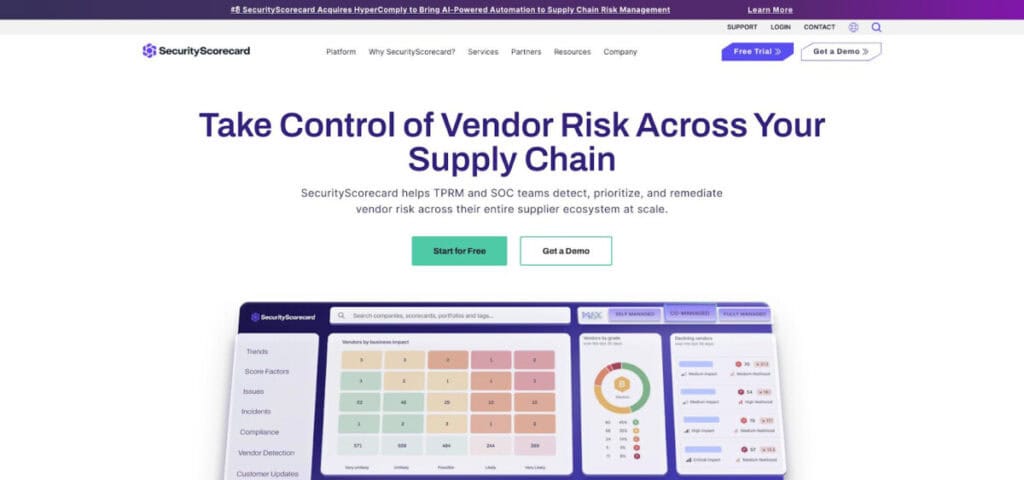
SecurityScorecard is Built for One Job: To make vendor cyber posture easy to see, easy to explain, and hard to ignore. If your stakeholders do not want to debate CVEs, but they will react to a supplier dropping from a B to a C, this platform fits the way small teams actually drive action.
Who It’s Best For: SMBs that need a widely recognized outside-in rating for vendors, plus modern questionnaire workflows to speed assessments, without turning every review into a bespoke security project.
Core Approach: Outside-in Ratings at Massive Scale
SecurityScorecard assigns vendors an A-to-F rating supported by daily internet-scale scans across common risk signals (credential exposure, patch cadence, DNS hygiene, and more). Coverage is one of the biggest advantages. The company says it continuously rates more than 12 million organizations worldwide, which means you can often pull a starting signal quickly, even before a vendor responds to your first questionnaire.
What SMBs Get Out of the Box
SecurityScorecard tends to deliver three immediate outcomes for lean teams:
- Fast Triage: a simple letter grade that procurement, leadership, and auditors can all interpret the same way
- Faster Assessments: questionnaires designed to reduce vendor back-and-forth
- Broad Baseline Visibility: scores for many suppliers already exist, so you can prioritize reviews instead of starting from zero
Questionnaires and Automation
SecurityScorecard’s Questionnaires module includes Smart Answer AI, which vendors can use to auto-populate responses from prior submissions. SecurityScorecard states this can reduce questionnaire time by up to 83 percent. The platform also supports document parsing and preferred-answer rules, which help you standardize responses across vendors instead of adjudicating every question from scratch.
SecurityScorecard’s acquisition of HyperComply (September 2025) provides additional context for the company’s push into AI-powered automation for supply-chain risk workflows.
Monitoring, Scoring, and Noise Control
SecurityScorecard updates ratings daily and publishes detailed methodology documentation. Like any ratings engine, you will get the most value when you treat the grade as a triage signal, then decide which vendors warrant deeper evidence requests, compensating controls, or remediation plans.
Integrations, Pricing Signals, and Limitations
SecurityScorecard has a large ecosystem and services motion, but integration depth varies by customer environment, so confirm the workflow connectors you need (for example, if you expect to route issues into an ITSM or GRC tool).
There are also free options, including vendor claim paths, but feature access (especially questionnaires and automation) is packaging-dependent and typically quote-based.
SMB Gotchas to Watch:
- Outside-in is not the full story. The grade does not reflect your internal control environment or a vendor’s private architecture. You will still need a review rubric for residual risk and exceptions.
- Alert tuning matters. Daily updates are powerful, but small teams should be deliberate about which changes trigger escalation.
When to Pick SecurityScorecard: Choose it when you need a board-ready outside-in rating that is widely understood, and you want questionnaires that reduce vendor response time, even if you plan to keep a deeper internal-control context in another system.
BitSight: The Benchmark Many Risk Programs Reference
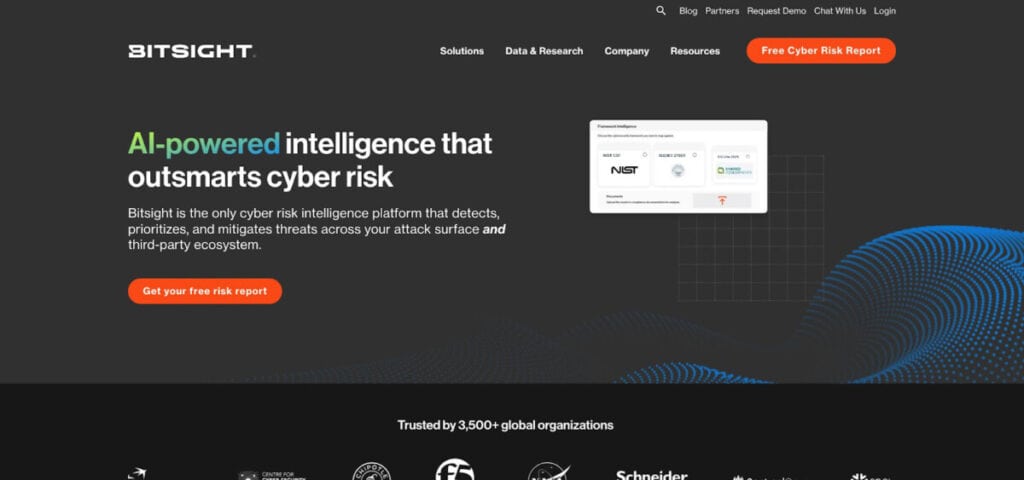
BitSight is an established security-ratings platform that provides an outside-in view of vendor cyber posture. It is best known for its 250–900 security rating, which updates as new external telemetry is observed. If your organization needs a recognizable, standardized metric for third-party cyber risk, BitSight is often on the shortlist.
Who It’s Best For: Mid-market to enterprise teams that want a widely referenced external rating, plus an assessment workflow that can sit alongside continuous monitoring. SMBs can use BitSight, but you should expect a more enterprise-leaning buying motion and pricing.
Core Approach: Outside-in Rating Plus Native Assessments
BitSight continuously observes external signals and rolls them into the 250–900 score. It also supports third-party assessments. After BitSight’s 2022 acquisition intent of ThirdPartyTrust, questionnaires became part of the native product experience, so you can pair “what the vendor says” with “what the internet shows.”
That pairing is useful in practice. If a vendor claims control in a questionnaire, but the external signals show an exposure, the mismatch is harder to ignore.
What SMBs Get Out of the Box
Even for a lean team, BitSight can deliver clear outcomes:
- A standardized rating you can use to compare vendors and track movement over time
- Deeper external signals than basic scan-only tools, which can surface higher-risk activity
- Quantification and reporting that support risk conversations with leadership
A 2024 Forrester Total Economic Impact study reported BitSight delivered a 297 percent ROI and cut breach probability by 45 percent across first- and third-party programs.
Monitoring and Analytics Depth
BitSight goes beyond surface checks like open ports and SSL hygiene. It also tracks signals such as botnet traffic, spam origination, and malware callbacks, so if a vendor begins communicating with command-and-control infrastructure, the score can adjust quickly.
The platform also offers analytics that estimate breach probability and likely financial impact, and it maps gaps to NIST CSF controls. For teams that need more than red-yellow-green, this can help translate technical signals into risk language.
Time to Value, Integrations, and Pricing Signals
Ratings visibility is typically fast because the score is generated from external observations. Integration and workflow depth vary by environment, and BitSight has a broad ecosystem, so confirm the specific connectors your process needs.
Pricing is generally quote-based, and scoping often depends on monitored vendor volumes and modules.
Limitations and SMB Gotchas
- Enterprise-leaning motion: Expect more formal scoping, packaging, and pricing than lightweight SMB tools.
- Outside-in is still not your internal reality: A rating does not capture your internal control requirements or a vendor’s private architecture. You will still need internal context for residual-risk decisions.
- Alert noise needs tuning: As with any daily-updating ratings feed, small teams should be deliberate about escalation thresholds.
When to pick BitSight: Choose BitSight if your stakeholders specifically want BitSight ratings, or you need a widely recognized external metric plus native questionnaires so you can compare assessment responses against continuous outside-in signals.
Hybrid Contextual-Scoring Platforms
Traditional ratings tell you what an external scanner can observe. Questionnaires tell you what a vendor claims in their policies and procedures. Hybrid platforms combine both, then weight the result based on your business context, often called contextual risk scoring.
Gartner calls this approach “the fastest-growing feature set” in TPRM technology because it connects raw findings to real business exposure. For a small team, that is the point. You focus on the payroll provider storing Social Security numbers, not the marketing tool that only sees anonymized clicks.
The next two tools take different routes to the same goal. Panorays leans into blended scanning plus assessments, then recalculates risk with its Risk DNA model. Whistic reduces review time by replacing one-off spreadsheets with shared vendor profiles and standardized security packets.
Panorays: Blends Outside-in Scans With Inside-Out Context
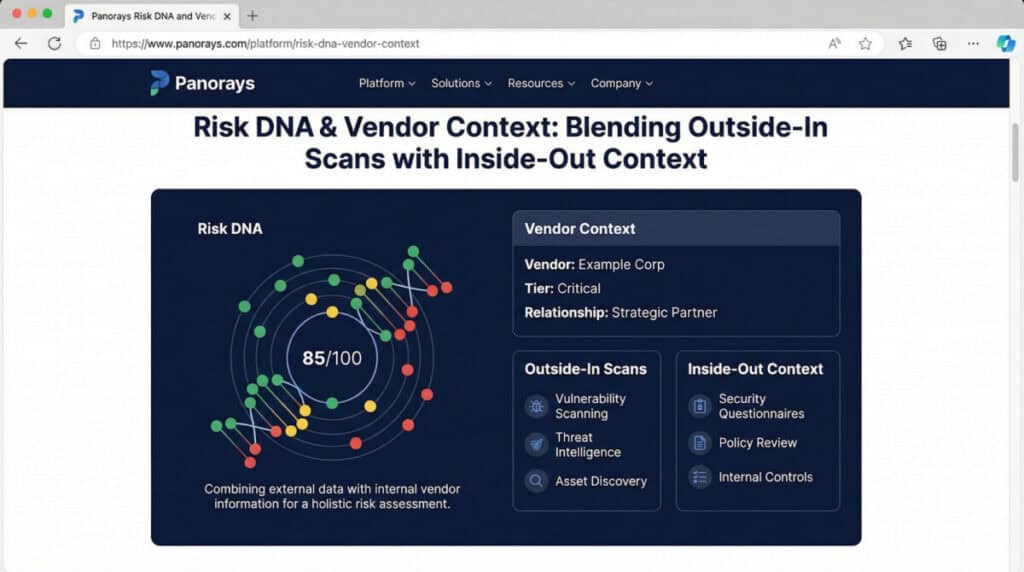
Panorays is built for teams that do not want to choose between scanning and assessments. It brings both into one workflow, then ranks vendors based on business impact, not just a pile of findings. If your program struggles with noise, or your stakeholders keep asking “Which vendor should we fix first?”, Panorays is designed to answer that question directly.
Who It’s Best For: Teams that want one platform for continuous vendor monitoring plus questionnaires, and they want the final output to reflect business criticality, data sensitivity, and risk appetite.
Core Approach: One Score, Grounded in Context
Panorays combines continuous attack-surface monitoring with vendor-provided evidence and questionnaire responses. It then fuses those inputs into its Risk DNA scoring model, which adjusts based on the context you set, such as whether a vendor processes sensitive customer data or supports a critical workflow.
In plain terms, the score is meant to help you keep priorities straight. A payroll provider that stores Social Security numbers should not be ranked the same way as a low-risk tool that only touches anonymized click data.
What SMBs Get Out of the Box
For a lean team, Panorays typically delivers:
- A single view of vendor posture that includes both external signals and internal evidence
- Prioritized remediation based on business impact, not “who has the most alerts”
- Less spreadsheet glue because questionnaires, evidence uploads, and follow-ups live in the same workflow
Assessments and Workflows
Panorays supports structured vendor questionnaires and keeps the remediation loop in-platform. You can start from common compliance templates, including ISO 27001, SOC 2, NIST, and GDPR, then tailor weighting and requirements to your program. Vendors can upload evidence in the portal, and the score updates as new information is reviewed and incorporated, without requiring export and re-import steps.
The platform also supports vendor mapping, including downstream dependencies (fourth and fifth parties), which can help you understand concentration risk when multiple critical vendors rely on the same subprocessor.
Continuous Monitoring and Noise Control
Where Panorays stands out is how it uses context to reduce noise. Continuous monitoring can surface misconfigurations and exposed assets, but Risk DNA is designed to elevate what actually matters to your organization. You define what “critical” means, and the platform recalculates prioritization accordingly.
Integrations, Time to Value, and Pricing Signals
Panorays positions itself as a faster path than stitching together a standalone ratings tool plus a standalone questionnaire tool. That said, expect some upfront calibration time to define risk tiers and scoring logic so results match how your business thinks about exposure. Pricing is typically quote-based and structured around modules and vendor volumes.
Limitations and SMB Gotchas
Panorays’ strength is also the work you cannot skip. To get high-quality prioritization, you need to make deliberate calls on:
- Vendor criticality tiers and data classes
- What evidence is required for each tier
- How you will export or report evidence for audits, and how you will preserve rationale for exceptions
When to Pick Panorays: Choose Panorays if you want one contextual score that blends outside-in monitoring with inside-out assessments, and you would rather calibrate one system than operate two separate tools side by side.
Whistic: Turns the Vendor Questionnaire Into a Two-Way Street
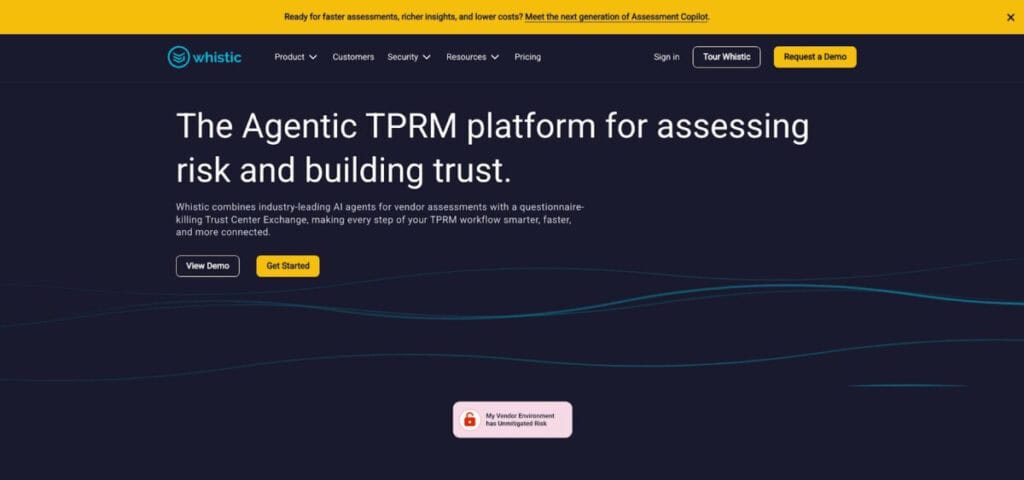
Whistic is built for a reality that most small teams live every week. Vendor assessments are not just something you send out. They are also something you receive. Whistic’s model treats trust as shared infrastructure, not a one-off spreadsheet exchange.
Who It’s Best For: SMB security and compliance owners who want to reduce questionnaire cycles by reusing existing vendor security packets, and who also want to publish their own trust profile once, so customers can self-serve evidence.
Core Approach: Shared Profiles First, Questionnaires Second
Instead of starting every review by emailing a spreadsheet, Whistic pushes you to search the Trust Center Exchange. If a vendor already maintains a profile, you can review their SOC 2, CAIQ answers, and supporting documents quickly, without waiting on a back-and-forth thread. Whistic’s Trust Catalog highlights more than 50,000 vendor profiles and thousands of CAIQ-ready security packets.
That same structure works in reverse. You can publish your own Whistic profile, keep it current, and let prospects pull what they need. For teams that get frequent security questionnaires from customers, this can be as valuable as vendor vetting.
What SMBs Get Out of the Box
Whistic’s “out of the box” value is speed and deflection:
- Faster vendor intake when a supplier already has a usable packet
- Less manual evidence chasing because documents live in a controlled portal instead of email
- Fewer inbound questionnaires once your own trust center is live and current
In our 2025 rollout, we found ready-made profiles for 18 of our 25 critical SaaS tools. Average review time fell from two weeks to three days (internal metrics, May 2025).
Key Workflows and Automation
Whistic still supports classic assessment workflows when you need them. You can send custom questionnaires, track progress, and manage access to documents. The platform also emphasizes controlled sharing and standard packets (including CAIQ-ready content), which can help standardize what “good evidence” looks like across vendors.
A fintech case study reports that sharing a Whistic Trust Center cut enterprise deal cycles by 25 percent.
Continuous Monitoring and Scoring
Whistic is not a standalone ratings engine. For outside-in signals, it relies on partner integrations. Expert research notes that Whistic includes RiskRecon ratings and continuous monitoring for some catalog coverage, which provides an external pulse alongside the inside-out documents.
The practical takeaway for a small team is that Whistic can speed evidence exchange dramatically. If you need a single, native numeric or letter-grade rating across every vendor, you may still want a dedicated ratings platform.
Integrations, Time to Value, and Pricing Signals
Whistic’s fastest time to value shows up when your vendor stack overlaps heavily with the catalog. You can also see an immediate benefit by publishing your own profile to reduce inbound requests.
Pricing and packaging vary by edition, and partner modules (such as RiskRecon monitoring) can affect licensing. Validate what is included for catalog access, trust-center publishing, and any monitoring integrations.
Limitations and SMB Gotchas
Whistic works best when the ecosystem participates. A few practical considerations:
- Profile freshness matters. The experience depends on vendors keeping their packets current.
- You still need a risk rubric. Even with great documents, you will want a consistent way to tier vendors, record residual risk, and track exceptions.
- Monitoring is partner-led. If continuous outside-in monitoring is a requirement for every vendor, confirm coverage and costs up front.
When to Pick Whistic: Choose Whistic when you want to replace one-off spreadsheets with shared trust packets, and when publishing your own trust center is part of your strategy to cut review time on both sides of the table.
Conclusion
Stakeholders often ask, “Why not Tool X?” Point to the row that matters most—monitoring, questionnaires, scoring, or compliance mapping—and you can give a clear, defensible answer in one minute. The right TPRM tool isn’t about features; it’s about alignment with your team’s capacity, vendor complexity, and regulatory requirements. Start with your biggest pain point, validate it solves that problem, then expand strategically as your program matures.
Suggested articles:
- The Cybersecurity Imperative: Why Every Project Manager Should Prioritize Third-Party Risk Management
- Risk Management: Top 10 Cons & Disadvantages
- How AI Transforms Risk Management in Project Delivery

Daniel Raymond, a project manager with over 20 years of experience, is the former CEO of a successful software company called Websystems. With a strong background in managing complex projects, he applied his expertise to develop AceProject.com and Bridge24.com, innovative project management tools designed to streamline processes and improve productivity. Throughout his career, Daniel has consistently demonstrated a commitment to excellence and a passion for empowering teams to achieve their goals.