
This Project Charter Template formally starts your project once the business case has been approved. It sets out the scope, objectives and deliverables, names the project manager, defines their authority, tolerances and governance, and calculates the budget totals and the schedule float for you. Fill it in below, free, with no sign-up. Your answers save automatically as you type. See all 50+ PM Templates.
- Custom version ($)
- Word template ($)
- How to use the templates
- What is inside
- What is a project charter?
Loading the interactive form. If this message stays on screen, JavaScript is switched off or blocked in this browser.
Your answers are stored in this browser only and are not sent anywhere. Clearing your browsing data, or using a different device or a private window, will start a blank form.
What is inside the template
The charter follows the order in which a sponsor needs to agree the project, from what it must achieve, through who runs it and with what authority, to the money, the dates and the sign-off:
- Executive summary. The purpose, the approved option, the scope, the budget, the key dates, the project manager and the decision requested, on one page.
- Project definition. The background and the approval it rests on, the vision, SMART objectives with a measure, baseline, target and date, and the criteria for judging the project a success.
- Scope and deliverables. What is in and out of scope for each area, and every deliverable with its components, acceptance criteria and who accepts it.
- Project organisation. Customers, stakeholders, roles and time commitments, responsibilities, and the organisation structure.
- Authority and governance. What the project manager may decide alone, the tolerances that trigger escalation, and the meetings and reports that keep the project under control.
- Approach and schedule. The delivery approach by phase, phases and milestones with the duration and float calculated for you, dependencies, and how each management area will be handled.
- Resources and budget. The resource plan, the approved costs with category totals, contingency and headroom within the funding envelope calculated for you, and how the money is released.
- Risks, issues, assumptions and constraints carried forward from the business case.
- Supporting documentation, and the approval block that appoints the project manager.
What is a project charter?
A project charter is the document that formally starts a project. It confirms what the project will deliver and why, names the project manager and gives them the authority to use the organisation’s people and money, and sets out the scope, budget, schedule and governance they will work within. Once the sponsor signs it, the project exists.
The business case has already answered “should we spend the money?”. The charter answers a different question: who will deliver it, with what authority, and within what limits? It does not argue the investment again. It turns the approved option into a mandate the whole organisation can see. Some organisations call it terms of reference, a project initiation document or a project definition report.
Its defining feature is authority. A charter that lists objectives and a budget but says nothing about what the project manager can decide, or when they must escalate, leaves the hardest conversations for later, when they are more expensive. The tolerances in section 5, for example plus or minus 10% on cost and 2 weeks on any milestone, are what let a project manager act quickly without going back to the sponsor for every decision.
Who does what
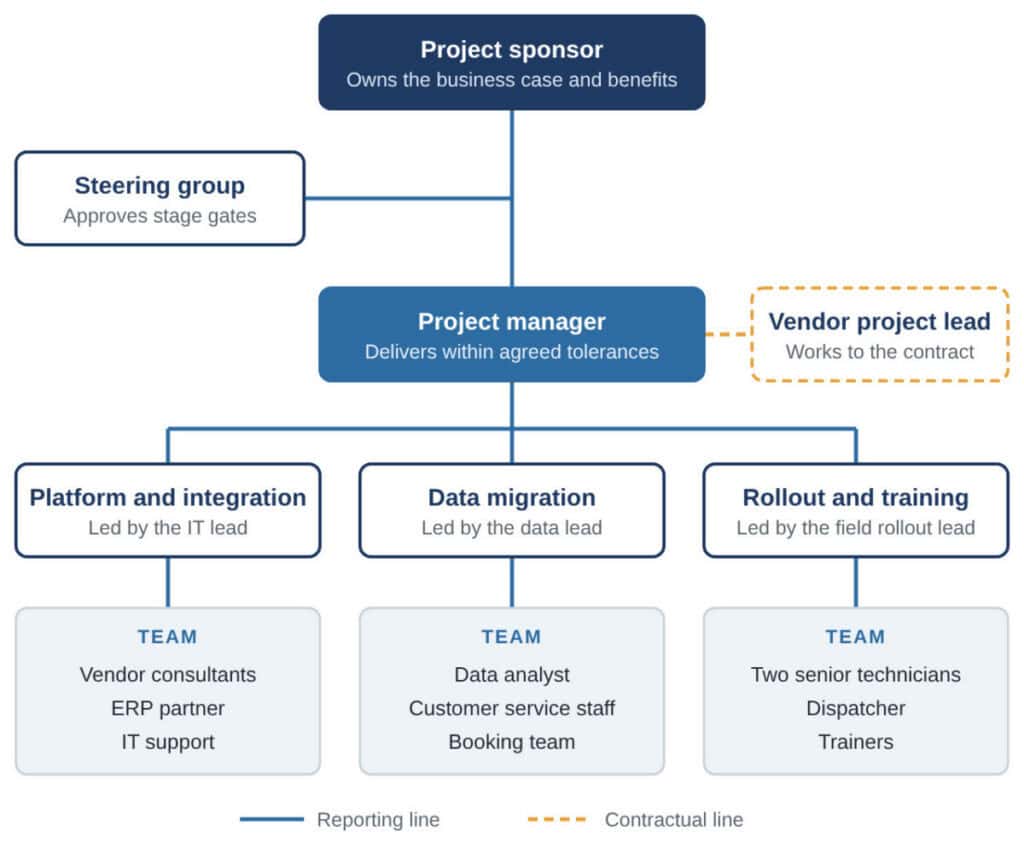
Section 4 records the people, and section 5 records how they make decisions. In the worked example, the sponsor owns the business case and the benefits, the steering group approves stage gates and exceptions, and the project manager runs three workstreams and manages the platform vendor under its contract.
From approval to handover
The charter fixes the phases, the milestones and any date that cannot move. The form works out the duration of each phase and the float against every must-finish month, so a plan that misses a deadline shows up before anyone signs.
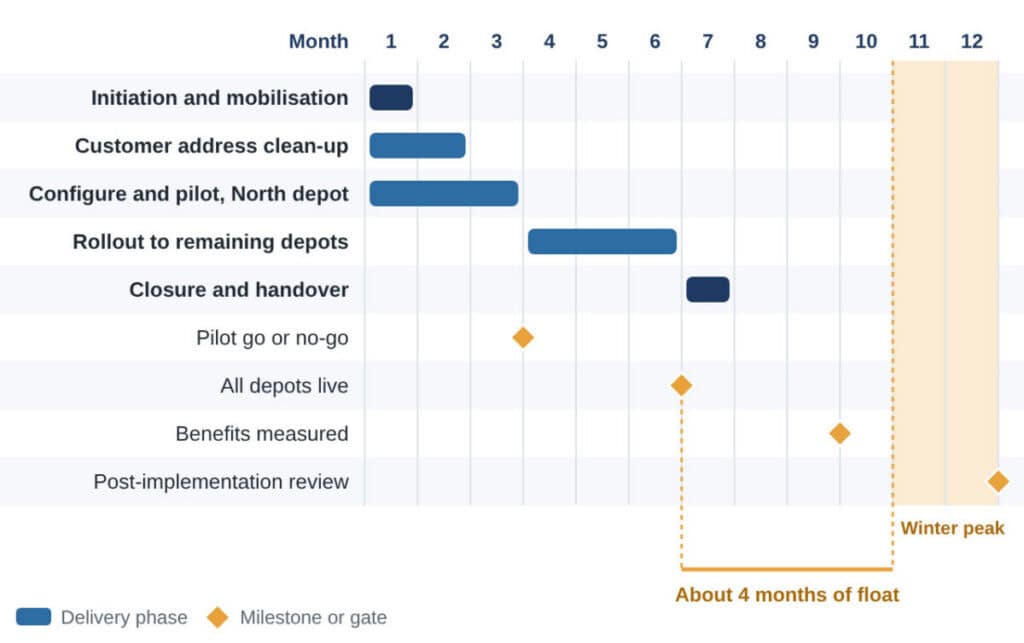
In the example, all depots are live by month 6, about four months before the November winter peak. The pilot gate in month 3 has no float at all, because the business case made full rollout conditional on the pilot reaching 4.5 jobs per technician per day. Benefits are measured in month 9 and reviewed in month 12, after the project has closed.
Where the charter fits
The charter is the last of the initiation documents. Each one answers a different question, and each takes its figures from the one before.
- The proposal comes first. It establishes that the problem is worth solving and secures agreement to investigate solutions.
- The feasibility study follows. It tests whether each candidate solution can realistically be delivered.
- The business case comes next. It justifies the preferred option financially and secures the funding.
- The project charter is written once the business case is approved. It formally starts the project, appoints the project manager and defines scope, authority and governance.
- The project management plan follows the charter.
- Within the limits the charter sets, the project manager plans the work in detail.
See our Project Proposal Template, Feasibility Study Template and Business Case Template. The worked examples in all four follow the same fictional project, Northfield Home Services, so you can see how the figures carry through: the 260,000 one-off and 70,000 per year approved in the business case become the charter’s budget, and the risks and assumptions from the feasibility study become the first entries in the project’s risk register.
When to write one
Write the charter as soon as funding is approved, and before any work or spending begins. You need one when:
- A project manager is being appointed and needs authority that others will respect
- Several teams, departments or suppliers have to work together on the same project
- The business case approval came with conditions the project must meet
- A fixed date, such as a seasonal peak or a regulatory deadline, leaves little room in the schedule
- Scope is likely to be challenged, and the team needs an agreed boundary to point to
Keep it short. The charter sets the boundaries; the project management plan fills in the detail. A charter that tries to be the plan takes weeks to agree and delays the start it was meant to authorise.