
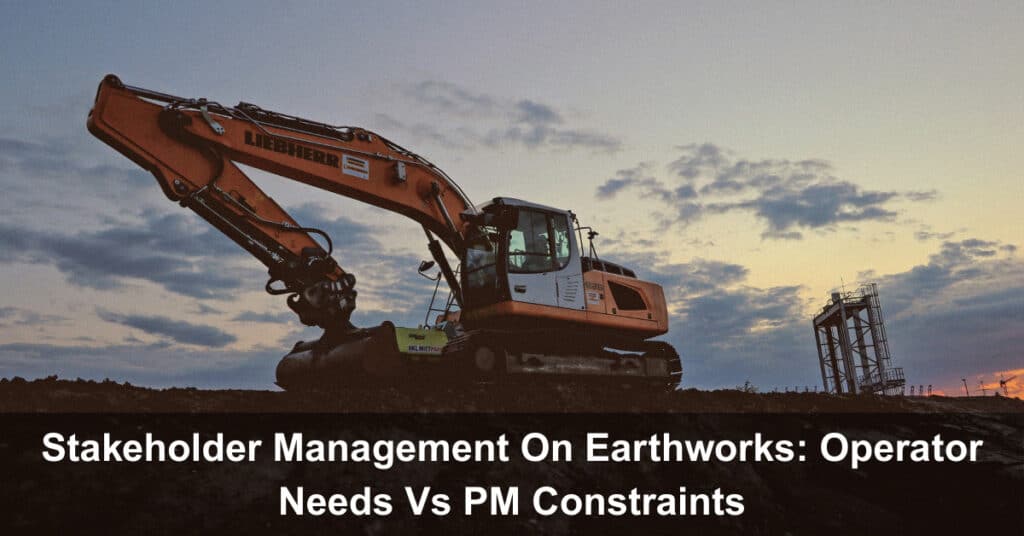
Earthworks is where “the plan” collides with physics: ground conditions, access, services, weather, and machine capability. Stakeholder management here isn’t about soft skills—it’s about aligning people who measure success differently. Operators care about safe, efficient production and the right setup. PMs care about program, cost, compliance, and interfaces with other trades. If you don’t reconcile those needs early, you get the classic outcomes: idle plant, rework, near-misses, and schedule compression that spills into the rest of the project.
The following sections break down the five critical areas where operator needs and PM constraints must be reconciled before problems compound: plant selection, safety obligations, underground services, productivity management, and change control. Get these right, and you create alignment. Get them wrong, and you’re managing conflict instead of earthworks.
Plant Selection and Scope Clarity: Agree on What “Right Machine” Means
The fastest way to create conflict is to book a plant based on availability rather than the actual task. You’re not just choosing a machine—you’re locking in constraints around reach, bucket/attachment compatibility, ground pressure, transport logistics, and whether grade-control is needed. If those constraints aren’t agreed up front, operators inherit an inefficient setup, and PMs inherit delays and cost blowouts.
PM move: turn the hire request into a one-page scope artifact. Include dig volumes, trench dimensions, target tolerances, spoil/disposal plan, access limits, lift points, and interfaces (survey set-out, services exposure, traffic control). Capture operator needs too: safe working radius, exclusion zones, and a realistic production rate based on material type and trucking plan.
Real-Life Examples
- Porter Hire (NZ) is a practical reference when sourcing excavators for hire because it breaks hire down by application and machine category (including mini/heavy options) and highlights attachments and GPS/grade-control options.
- Coates (AU) lists excavators alongside attachments such as digging buckets, hydraulic grabs, rippers, and augers—useful proof that “machine only” thinking is incomplete.
- Kennards Hire (AU) structures excavators as a dedicated earthmoving hire category—helpful when standardising internal plant selection by class/size.
- Sunbelt Rentals (US) describes coverage from compact to large excavators for trenching, grading, and demolition—good framing for capability-based selection rather than availability-based choice.
Safety Obligations: The PM Constraint That Protects Operators (and the Program)
Earthworks has hard regulatory gravity. Safe Work Australia’s Excavation Work Code of Practice warns excavation collapses can occur quickly and have severe consequences, and it also flags that excavation connected with a trench/shaft deeper than 1.5m is “high-risk construction work” requiring a Safe Work Method Statement (SWMS).
Operator needs here are predictable: stable edges, safe access/egress, spotters where required, clear exclusion zones, and no last-minute “just do it quickly” changes. PM constraints are equally real: permit conditions, principal contractor obligations, consultation, and coordination with multiple duty holders. When PMs treat these as paperwork, operators experience it as disrespect—and you lose buy-in.
Real-Life Examples
- Safe Work Australia (Model Code of Practice: Excavation work) sets out why collapses are dangerous and when excavation becomes high-risk work (SWMS).
- The same Code emphasises consultation duties and coordination with other duty holders as part of managing excavation risk.
- WorkSafe ACT references the Excavation Work Code of Practice approval framework for excavation/trenching safety measures.

Underground Services and Unknowns: Align on “Stop Rules” Before the Bucket Hits Dirt
Utilities are a stakeholder, whether they show up or not. The UK HSE explicitly advises getting plans and, where cables are nearby, having someone accurately locate them; it also recommends experienced people and suitable detection equipment for locating underground cables. In Australia, Before You Dig Australia (BYDA) is positioned as a single point of contact to request information about underground (and overhead) infrastructure at a planned work site.
- Operator Needs: Clarity on what’s been checked, what’s been marked, and what the stop conditions are.
- PM Constraint: You can’t “schedule your way” out of a service strike—cost, time, safety, and liability consequences land on the project.
The stakeholder management move is to formalise the unknowns: agreed potholing method, who has authority to pause work, and how the team escalates and re-plans without blame.
Real-Life Examples
- BYDA provides a single-point process to request underground asset information—ideal for embedding a “utilities check” gate in your earthworks plan.
- HSE (UK) stresses plans and accurate locating where services are suspected—useful for justifying time spent on locating before excavation.
- HSE HSG47 summarises a safe system of work around underground services: planning, locating/identifying, and safe excavation.
Productivity Vs Disruption: The Negotiation Between “Get It Done” and “Don’t Break the Site”
Operators are judged by output—meters, loads, levels. PMs are judged by impacts—traffic, neighbours, environmental controls, interface clashes, and downtime of other trades. You manage the tension by making constraints visible before mobilisation: working hours, noise restrictions, haul routes, tip access, washdown requirements, dust suppression, and weather triggers.
A strong tactic is to hold a 15-minute “operator kickoff” that the PM actually attends. The agenda is simple: what success looks like today, what must not happen, and what will cause a stop or change. This meeting prevents the classic failure where operators discover the real constraints only after the machine is on the ground.
Real-Life Examples
- United Rentals positions excavators as multi-purpose for digging/backfilling/clearing/trenching across a range of operating weights—helpful when matching production expectations to machine class and site constraints.
- United Rentals also shows how attachments (e.g., buckets) expand capability—important when stakeholders disagree on “what the excavator should be able to do.”
- Sunbelt Rentals markets hydraulic breakers/demolition attachments to extend excavator capability—useful when the constraint is material hardness or demolition interfaces.
Change Control On Earthworks: Treat Every “Small Request” as a Scope and Risk Event
Earthworks is where scope creep hides: “just take another 200mm,” “just widen it a bit,” “just stockpile it over there.” Operators see this as a safety and efficiency issue; PMs see it as a budget/schedule threat. The fix is micro change control: rapid capture, fast decision, documented outcome.
Use a simple rule: if it changes volume, depth, location, disposal method, or exposes services—log it, re-brief it, and update the day’s plan. This isn’t bureaucracy. It’s protecting both operator safety and PM predictability.
Real-Life Examples
- Coates reinforces that attachments are part of earthmoving delivery (not an afterthought), which is where many “small changes” quietly become “new scope.”
- Kennards presents earthmoving as a range (not a single machine), supporting the idea that scope changes may require re-selection rather than forcing the wrong plant to do the job.
Endnote
The core lesson: on earthworks, stakeholder management is operational design. Operators need the right machine, safe conditions, and stable instructions. PMs need compliance, cost control, and clean interfaces. When you convert those needs into gates (plant-fit, safety/SWMS, utilities, access/traffic, and micro change control), you stop arguing in the trench and start delivering predictable production on the surface.
Suggested articles:
- Operational Readiness For Mobile Teams: The ‘Field Kit’ Checklist That Prevents Expensive Surprises
- Site Access + Delivery Windows: A PM Checklist For Plant Arrivals
- Logistics Risk On Construction Projects: Managing Delivery, Storage, And Site Readiness

Daniel Raymond, a project manager with over 20 years of experience, is the former CEO of a successful software company called Websystems. With a strong background in managing complex projects, he applied his expertise to develop AceProject.com and Bridge24.com, innovative project management tools designed to streamline processes and improve productivity. Throughout his career, Daniel has consistently demonstrated a commitment to excellence and a passion for empowering teams to achieve their goals.