
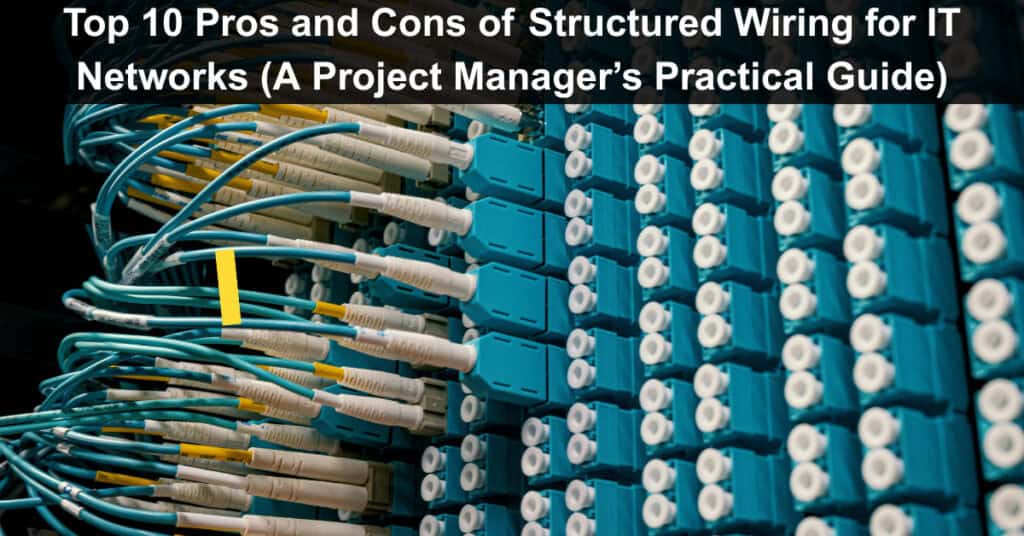
Picture this: your team is gearing up for a major product launch. Marketing is ready, sales teams have their scripts, leadership is on standby… and then the network dies. No Wi-Fi. No VoIP. No access to cloud tools. Your “go-live” becomes “go-home.” More often than we’d like, the root cause isn’t an exotic cyberattack—it’s something much less glamorous: messy, outdated cabling. Uptime Institute’s recent outage analyses show that network connectivity issues account for roughly a third of major IT service disruptions, putting them right up there with power failures as a leading cause of downtime.
For project managers, that makes structured wiring for IT networks far more than an IT detail; it’s a strategic risk and cost lever. In this article, we’ll walk through the top 10 pros and cons of structured wiring, specifically from a project manager’s perspective—what it means for your schedule, budget, stakeholders, and long-term ROI.
What Is Structured Wiring for IT Networks?
At its simplest, structured wiring (or structured cabling) is a standardized, organized approach to connecting every device in your environment—laptops, IP phones, Wi-Fi access points, cameras, badge readers, sensors—to your network. Instead of running one-off cables for each new device, structured cabling uses:
- Defined subsystems (entrance facility, backbone/vertical cabling, horizontal cabling, telecom rooms, work areas).
- Standards-based design, like ANSI/TIA-568 and ISO/IEC 11801, to ensure performance and interoperability.
- Clear labeling and documentation so anyone can understand what’s connected where.
Done well, it behaves like the building’s nervous system—stable, predictable, and ready to support whatever new “organs” you add later.
The 10 Biggest Advantages (Pros) of Structured Wiring
Pro #1: More Predictable Uptime and Performance
As a project manager, you’re judged on delivery and stability. Nothing erodes stakeholder trust faster than a shiny new system that keeps dropping connections. Structured wiring helps by:
- Reducing interference and signal loss through controlled cable lengths, routes, and separation from power.
- Using certified components (Cat6/Cat6A, fiber, patch panels) tested against industry standards.
- Making capacity and performance predictable, because the underlying cabling is no longer a collection of random runs behind walls and under floors.
Combined with good network design, this becomes a very strong argument in your business case: lower risk of outages, smoother user experience, and fewer “war rooms” after go-live.
Pro #2: Faster Troubleshooting and MACs (Moves, Adds, and Changes)
Most projects don’t end at deployment. You’ll be dealing with:
- New floors or departments coming online
- Office reconfigurations
- Technology refreshes and expansions
With structured wiring, every cable path is planned and labeled. Technicians can identify a faulty run, port, or patch panel in minutes—not hours—because:
- Outlets and ports follow a consistent naming convention (e.g., TIA-606 labeling).
- Documentation maps each port to a patch panel slot, switch, and VLAN.
- Patch cords and cross-connects are neatly organized rather than forming a “spaghetti monster.”
From a schedule standpoint, this directly reduces mean time to repair (MTTR) and shrinks the time you spend fighting fires instead of moving your roadmap forward.
Pro #3: Built-in Scalability for Cloud, Wi-Fi, and IoT
Almost every multi-year roadmap now includes:
- Higher bandwidth (Gigabit, 10GbE, and beyond)
- Denser Wi-Fi deployments
- More IP-based devices (cameras, access control, sensors, digital signage, IoT)
Standards like ANSI/TIA-568 and ISO/IEC 11801 explicitly define cabling categories (Cat5e to Cat8) and design rules that support these high-throughput, low-latency applications.
For you, that means:
- You can justify investment as future-proofing rather than a one-off cost.
- You’re not ripping out cables every time the business rolls out new software or hardware.
- IT can scale capacity by upgrading switches and optics while reusing the same cabling plant, as long as it was designed with headroom.
This makes structured wiring a strong enabler for any digital transformation program.
Pro #4: Cleaner Governance, Documentation, and Compliance
Projects involving regulated data (finance, healthcare, government, etc.) often require:
- Clear separation of networks (e.g., guest vs internal, OT vs IT).
- Demonstrable controls over access, monitoring, and changes.
- Intelligible documentation that auditors can review.
Structured wiring supports this by:
- Making it easier to segregate traffic via structured patching and VLANs.
- Using standards-based layouts and labeling that any qualified engineer can understand.
- Providing physical evidence that the network was designed and installed to recognized best practices.
As a PM, this gives you confidence during audits or post-implementation reviews: you can point to standards, diagrams, and test reports, not just “trust us, it works.”
Pro #5: Better Total Cost of Ownership (TCO)
Yes, structured cabling is more expensive upfront than ad-hoc wiring. But over a 10–15-year lifespan, it often wins on TCO.
You:
- Spend less on emergency troubleshooting and rework.
- Avoid repeated re-cabling during office moves or technology upgrades.
- Reduce downtime risk, which can be brutally expensive.
When you factor that into your cost-benefit analysis, a well-designed, structured wiring project becomes much easier to defend to finance and leadership.
Pro #6: Better Safety and Code Compliance
Structured wiring projects are usually designed with fire codes, building codes, and safety standards in mind:
- Plenum-rated cable where required
- Proper firestopping and penetration sealing
- Reduced trip hazards and ad-hoc patch cords running along floors
This reduces the risk of safety violations, failed inspections, or costly remediation work down the line. It also makes it easier to demonstrate that your environment meets the necessary local and industry codes.
Pro #7: Stronger Support for Wireless and Hybrid Work
Modern workplaces rely heavily on Wi-Fi and hybrid work patterns. Structured wiring lets you:
- Place Wi-Fi access points according to a design, not wherever you can find a free jack
- Deliver PoE to phones, APs, cameras, and IoT devices reliably
- Support hot-desking and flexible seating without scrambling for extra connections
From a project perspective, that means fewer escalations about “dead zones,” and smoother rollouts of collaboration tools that depend on stable connectivity.
Pro #8: Easier Integration of Security, AV, and OT Systems
Most organizations now run multiple systems over the same physical network: CCTV, access control, building management systems (BMS), digital signage, POS devices, and more.
A structured wiring design lets you:
- Use common standards and pathways instead of bespoke cabling for each system
- Segment traffic logically for security and performance
- Scale or swap systems without ripping out everything behind the walls
This is especially valuable on multi-year roadmaps where physical security and smart-building projects roll out alongside IT initiatives.
Pro #9: Better Visibility and Capacity Planning
When every cable is labeled and documented, you gain a much clearer picture of:
- Current port utilization and spare capacity
- Which areas are approaching their limits
- Where future expansion will be easiest or most cost-effective
That visibility helps you make smarter investment decisions and avoid surprise bottlenecks when new projects demand more bandwidth or more devices.
Pro #10: Increased Asset Value for Facilities
A building with a modern, standards-based structured cabling system is simply more attractive to tenants and buyers:
- Faster time-to-value for any new occupant
- Lower upfront costs for move-in and IT setup
- Easier compliance and tech upgrades over time
For organizations that own their facilities—or for landlords investing in multi-tenant spaces—this can be a tangible boost to the overall asset value.
The 10 Key Drawbacks and Risks (Cons) to Watch
Of course, this isn’t a free lunch. There are real trade-offs project managers need to anticipate.
Con #1: Significant Upfront Capital Cost
Compared to “just pull a few Cat6 cables when we need them,” a full structured wiring deployment can feel expensive:
- Higher material costs (quality cable, fiber, racks, patch panels, labeling systems).
- More time spent on design and detailed planning.
- Professional installers and certification testing.
If stakeholders only see the short-term budget hit, they may push back. Your job is to clearly articulate the long-term savings and risk reduction to secure buy-in.
Con #2: Construction Disruption and Scheduling Risk
Structured cabling is easiest during new construction or major renovations, when ceilings and walls are open, and you can coordinate with electrical and HVAC work.
In live, occupied environments, you’re dealing with:
- Night or weekend work windows
- Access constraints (secure areas, production floors)
- Noise and dust restrictions
- Greater risk of surprise obstacles in existing pathways
From a PM standpoint, that means:
- More dependencies and coordination with facilities, landlords, and other trades
- Higher risk of schedule slippage
- The need for clear communication plans to keep departments informed about the disruption
Con #3: Skills Gap and Vendor Dependence
Structured wiring isn’t a “hand it to any electrician” type of project. You typically need:
- Installers trained and certified in relevant standards and testing tools.
- Network engineers who can design topologies, VLANs, and redundancy to match business needs.
- Security and compliance input, especially in regulated sectors.
If you choose the wrong vendor—or try to run cabling in-house without the skillset—your “structured” system can end up only slightly better than the mess you started with.
This creates a vendor selection risk you must manage: due diligence, references, clear SLAs, and well-defined acceptance criteria.
Con #4: Complex Design Decisions and the Risk of Guessing Wrong
In any structured wiring project, you’ll face a series of choices:
- Cat6 vs Cat6A vs fiber for horizontals
- How many drops per workstation, meeting room, lab, or access point
- Backbone capacity between floors and buildings
- Placement and density of telecom rooms and consolidation points
Over-specify, and you inflate costs. Under-specify, and you’ll be back in a few years with a “Phase 2” cabling project to fix bottlenecks.
Good requirements gathering and capacity planning are critical here—this is where project managers shine. You’ll want to tie every major design choice back to:
- Clear demand forecasts (users, devices, bandwidth-heavy apps)
- Strategic plans (cloud adoption, IoT, new sites)
- Standards guidance on limits and best practices
Con #5: Documentation Debt if You Don’t Enforce Discipline
Even a beautifully designed cabling system can degrade over time if:
- Moves, adds, and changes aren’t recorded
- Labels aren’t updated
- Patch panels slowly drift into chaos as quick fixes accumulate
Standards like ANSI/TIA-606 emphasize administration and labeling for a reason: without them, your structured cabling regresses towards spaghetti.
For project managers, that means building documentation discipline into your handover and governance:
- Require updated diagrams, port maps, and test results at project close.
- Ensure change management processes include cabling records.
- Assign clear ownership (IT operations, network team) for keeping everything current.
Con #6: Risk of Over-Engineering (and Overspending)
Because structured cabling is positioned as “future-proof,” it can be tempting to dramatically over-specify:
- More drops than you’ll reasonably use
- Higher cable categories in low-demand areas
- Extra telecom rooms or pathways that won’t see traffic for years
This can bloat budgets and slow approvals. As a PM, you need to balance future readiness with realistic forecasts and prioritize high-growth or high-risk areas for the most generous specs.
Con #7: Dependency on a Fixed Physical Layout
Once pathways, risers, and telecom rooms are in place, they’re not trivial to move. If the building’s use changes significantly—say, from open-plan offices to labs or manufacturing—your existing structured wiring may no longer be an ideal fit.
That can lead to:
- Expensive rework during future renovations
- Underutilized cabling in some areas and shortages in others
- Pressure to fall back into ad-hoc cabling to “patch” around the original design
Good discovery and long-term planning reduce this risk, but they don’t eliminate it.
Con #8: Ongoing Maintenance and Small, Hidden Costs
Even with a solid design, structured cabling has continuing costs:
- Replacing worn or damaged patch cords
- Periodic testing or recertification in sensitive environments
- Label updates and documentation maintenance
Individually, these are small, but over the years, they add up. If they’re not budgeted and assigned, the system’s quality can slowly erode.
Con #9: Complexity in Multi-Site Standardization
For organizations with many sites—offices, warehouses, branches—it’s challenging to keep structured wiring standards consistent:
- Different landlords and construction partners
- Varying local codes and building constraints
- Multiple vendors over time
Without strong governance, you end up with a patchwork of cabling quality and designs, making centralized support and monitoring harder.
Con #10: Hard to “Sell” Because it’s Invisible
Finally, one of the biggest challenges is political, not technical: structured wiring is largely invisible once it’s installed. Stakeholders may prefer to fund visible projects—new apps, dashboards, or devices—over what looks like “just cables.”
This means you’ll need to invest extra effort in storytelling and business casing to show how structured cabling underpins all those visible initiatives, and how neglecting it creates real, measurable risk. Keeping everything current.
How Project Managers Can Make Structured Wiring Projects Succeed
So how do you translate all this into a successful project—not just a technically sound one?
1. Start With Business Outcomes, Not Cables
Frame the project around:
- Reduced downtime and incident frequency
- Support for specific initiatives (new CRM, cloud migration, hybrid work, IoT)
- Compliance, security, or audit requirements
This is how you earn executive sponsorship and budget approval.
2. Involve the Right Stakeholders Early
At minimum, you’ll want:
- Network/infrastructure architects
- Facilities or real estate
- Security and compliance
- Key business unit leaders (heavy users of connectivity)
Use familiar project management techniques—workshops, RACI charts, stakeholder registers—to keep everyone aligned on goals and constraints.
3. Map Dependencies and Constraints
Structured wiring touches:
- Construction schedules and building access
- Power and HVAC layouts
- Fire and building codes
- Existing legacy cabling and network gear
Turn these into explicit tasks and risks in your project plan instead of “unknown unknowns” that surprise you mid-install.
4. Build a Clear Risk Register
Common risks include:
- Delays in material delivery (especially specialized cable or fiber)
- Access issues to risers, ceilings, or secure areas
- Changes in floor plans or furniture layouts
- Scope creep from “just one more drop here…”
For each, define Mitigation Actions (e.g., early site surveys, buffer time, change control thresholds).
5. Choose Vendors Like You’re Hiring a Core Team Member
Evaluate structured cabling vendors on:
- Experience with similar environments (offices, warehouses, hospitals, schools, data centers)
- Certifications and adherence to standards
- Testing and documentation practices
- References and case studies
- Willingness to collaborate with your internal network team
Treat vendor selection as a mini-project with clear evaluation criteria—not a last-minute procurement tick box.
6. Define Acceptance Criteria Up Front
Before any cable is pulled, agree on:
- Applicable standards (e.g., ANSI/TIA-568, ISO/IEC 11801)
- Test requirements (certification for each link, fiber OTDR results, etc.)
- Labeling and documentation formats
- As-built deliverables (drawings, port maps, reports)
That way, “done” isn’t just “lights are on”—it’s fully traceable and auditable.
7. Plan for Handover and Ongoing Governance
Finally, treat the end of the project as the start of a lifecycle:
- Train operations staff on the cabling standards, labeling, and documentation.
- Integrate cabling changes into your change management process.
- Schedule periodic reviews of documentation and patch panel hygiene.
This prevents the slow drift back into chaos that undermines long-term value.
Bringing It All Together: Turning Structured Wiring into a Strategic Advantage
For project managers, structured wiring is the kind of initiative that rarely grabs headlines—but quietly determines whether your headline projects succeed.
Done right, it delivers:
- More resilient, higher-performing networks
- Faster troubleshooting and change management
- A cleaner governance and compliance story
- A compelling long-term cost profile
Done poorly—or postponed indefinitely—it turns into a constant hidden tax on every digital project you run.
If your organization is planning major upgrades, cloud migrations, or new facilities, now is the time to treat structured wiring for IT networks as a strategic project in its own right. Approach it with the same rigor you’d apply to any critical initiative, and your future self (and your outage dashboards) will thank you.
Suggested articles:
- Why Is IT Asset Management Important?
- Understanding Backup Servers for Modern Businesses
- Dell Rack Servers: The Key To Improving Your PM

Daniel Raymond, a project manager with over 20 years of experience, is the former CEO of a successful software company called Websystems. With a strong background in managing complex projects, he applied his expertise to develop AceProject.com and Bridge24.com, innovative project management tools designed to streamline processes and improve productivity. Throughout his career, Daniel has consistently demonstrated a commitment to excellence and a passion for empowering teams to achieve their goals.