
The ability to effectively convey thoughts and ideas to others is at the heart of communication competence. For project managers, this skill is especially consequential because it shapes how teams are led, how goals are pursued, and how conflicts are resolved. Improving communication competence means developing a deeper awareness of language, tone, nonverbal signals, and social context, and knowing how to apply these elements in different situations.
This article defines communication competence, outlines its four types, explains its importance for project management, and provides practical techniques and tips for continuous improvement.
What Is Communication Competence?
Communication competence encompasses an understanding of grammar, syntax, and nonverbal cues, as well as the judgment to deploy them appropriately across different social contexts. It is not a fixed trait but a learnable skill, developed by observing others and applying those observations in real interactions. Personality and individual tendencies can influence the process, but deliberate practice remains the most reliable path to improvement.
Consider a project manager who is uncomfortable speaking in front of groups. That individual may communicate effectively in one-on-one settings but struggle when addressing a room. Over time, as they build familiarity with group dynamics and accumulate experience in public communication, that discomfort diminishes, and competence grows.
Types of Communication Competence
Communication competence develops in stages, and understanding where you currently stand is the first step toward meaningful growth. Researchers have identified four distinct types that reflect a person’s level of awareness and skill. Each stage builds on the previous one, and most people will move through all four at different points in their personal and professional development.
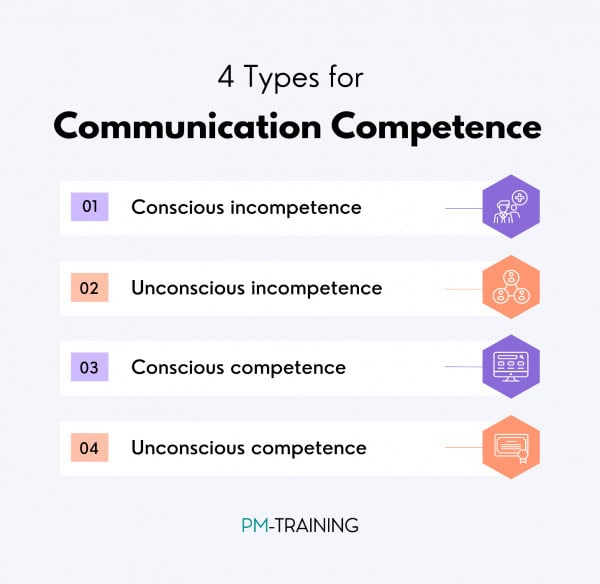
1. Conscious Incompetence
Conscious incompetence describes the stage where a person understands the principles of effective communication but has not yet consistently applied them in real social situations. You are aware of what good communication looks like, but you recognise that your current habits fall short of that standard. This awareness is actually a significant asset. Without it, there is no motivation to change. For project managers, this stage often surfaces after receiving feedback from a team member, completing a course, or reflecting honestly on how a difficult conversation was handled.
Understanding this stage more deeply reveals several practical insights worth keeping in mind as you work through it:
- Awareness as a Catalyst: Recognising the gap between your current communication habits and the standard you want to reach is not a weakness. It is the precise condition required for deliberate improvement to begin, and most high-performing communicators can point to a moment of conscious incompetence as the turning point in their development.
- Feedback as a Mirror: At this stage, external input is especially valuable. Seeking honest feedback from colleagues or a mentor helps you see blind spots that self-assessment alone tends to miss, accelerating the transition to the next stage.
- Patience with the Process: Progress from conscious incompetence rarely feels linear. Expecting some inconsistency in your communication during this stage is realistic, and treating each stumble as data rather than failure keeps momentum going in the right direction.
2. Unconscious Incompetence
At this stage, a person lacks the skills needed to communicate effectively and is entirely unaware that a problem exists. There is no recognition of the gap between their current approach and what effective communication actually requires. Because there is no internal signal that something needs to change, growth is unlikely without external feedback or an experience that forces reflection. This is arguably the most challenging stage to move past, because the person cannot self-diagnose what they cannot perceive. A trusted mentor, structured assessment, or candid peer feedback is often what provides the necessary wake-up call.
Several key insights help explain why this stage is both common and consequential for project managers:
- The Confidence Trap: People operating at this stage often appear confident because they are unaware of their communication gaps. That confidence, while not inherently problematic, can prevent them from seeking input or questioning whether their approach is actually landing as intended.
- The Role of Environment: Teams and organisations that do not foster psychological safety rarely surface unconscious incompetence. When people feel safe enough to offer honest, constructive observations, communication blind spots are far more likely to be identified and addressed early.
- Intervention Points: Structured opportunities such as 360-degree feedback reviews, communication workshops, or even informal post-project retrospectives can create the conditions for someone at this stage to become aware of their gaps without feeling publicly criticised or singled out.
3. Conscious Competence
Here, the individual recognises that they are communicating effectively and is deliberately applying what they have learned. The skill is present, but it still requires conscious effort and attention to execute well. Each positive interaction reinforces the behaviour, and these experiences serve as a reliable foundation for future social situations. For project managers, this stage is often associated with a growing sense of confidence in high-stakes settings such as client presentations, performance conversations, or cross-functional meetings where clear communication is critical.
The following insights capture what makes this stage particularly important in the overall journey toward communication mastery:
- Repetition as the Engine of Growth: At this stage, consistent practice is what converts deliberate effort into durable skill. The more frequently a project manager puts themselves in communication-intensive situations, the faster conscious competence solidifies into something more instinctive.
- Reflection After Interactions: Taking a few minutes after a significant conversation or presentation to assess what worked and what could be improved is especially powerful here. This habit of structured self-review compounds over time and meaningfully shortens the path to unconscious competence.
- Building a Personal Toolkit: Project managers at this stage benefit from identifying the specific techniques that consistently produce good results for them, whether that is a particular way of framing difficult feedback, a habit of summarising key points at the end of meetings, or a preferred approach to opening high-stakes conversations.
4. Unconscious Competence
At this advanced stage, effective communication becomes second nature. The person no longer needs to consciously think through each choice. Tone, vocabulary, body language, and timing all align naturally with the demands of the situation. This fluency frees up cognitive bandwidth that can be redirected toward the substance of the conversation rather than the mechanics of delivering it. For experienced project managers, unconscious competence often manifests as an instinctive ability to read a room, adjust their messaging in real time, and build rapport with very little deliberate effort.
Reaching this stage brings its own set of considerations that experienced communicators should be aware of:
- The Risk of Complacency: Unconscious competence can create a false sense that there is nothing left to learn. Communication norms, team dynamics, and stakeholder expectations evolve constantly, and even highly skilled communicators benefit from periodic reflection and recalibration to ensure their instincts remain well-aligned with current realities.
- Mentoring as a Multiplier: Project managers who have reached this stage are exceptionally well-placed to coach others. Articulating what you do intuitively and helping less experienced communicators understand the reasoning behind effective choices is one of the most high-value contributions a skilled communicator can make to their organisation.
- Sustaining the Standard: Maintaining unconscious competence over the long term requires continued exposure to diverse and challenging communication contexts. Seeking out new types of interactions, whether across cultures, seniority levels, or professional disciplines, keeps the skill set sharp and prevents gradual drift back toward less effective habits.
As communicators progress through these stages, they also gain the flexibility to adapt their style to fit the context. The way a project manager communicates at an informal team lunch will reasonably differ from how they present a project update to senior leadership. Recognising these contextual differences and responding accordingly is itself a mark of high communication competence.
Importance of Communication Competence
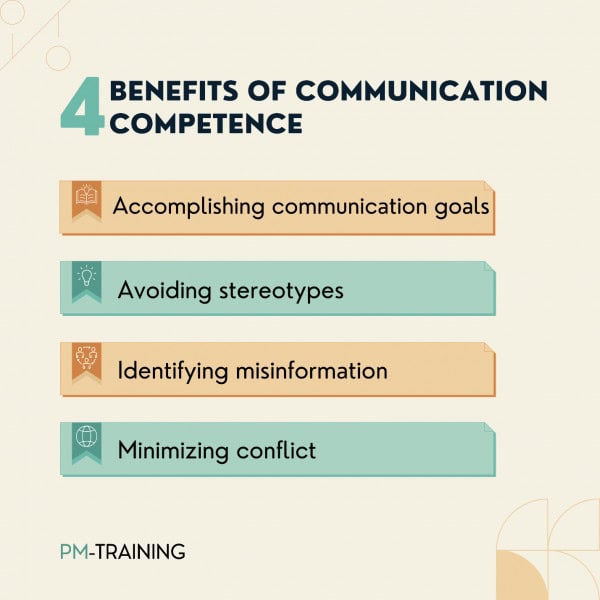
Strong communication competence creates tangible advantages for project managers across every dimension of their work. Understanding those benefits helps clarify why investing in this skill set is worth sustained effort.
Accomplishing Communication Goals
One of the clearest benefits of communication competence is the ability to achieve specific communication objectives. Project managers typically pursue three categories of goals simultaneously.
- Self-Presentation Goals: These goals relate to how project managers establish their identity and credibility in interactions. Projecting competence, authority, and trustworthiness through deliberate word choices and confident body language helps set the tone for productive working relationships.
- Instrumental Goals: These goals involve influencing outcomes, whether by persuading stakeholders, resolving disagreements, or guiding a team toward a decision. A project manager who communicates with clarity and intention is far better positioned to achieve these outcomes consistently.
- Relational Goals: These goals concern the ongoing quality of professional relationships. How a project manager handles difficult conversations, acknowledges contributions, and navigates tension directly shapes the trust and cohesion within the team over time.
Avoiding Stereotypes and Inclusive Language
Communication competence also enables project managers to choose language that is respectful, inclusive, and appropriate to the audience. Eliminating stereotypes and outdated expressions from both verbal and written communication signals professionalism and creates an environment where team members feel safe and valued. This reflects not only a wide vocabulary but also a genuine awareness of the impact words have on people.
Identifying Misinformation
Skilled communicators are better equipped to detect when something they are hearing is inaccurate or misleading. Context cues, shifts in a speaker’s body language, and sudden changes in tone can all signal that information may be unreliable. When uncertainty arises, a competent communicator knows how to seek clarification, request supporting evidence, or make a note to verify the facts independently, without escalating tension or creating conflict in the moment.
Minimizing Conflict
Communication competence equips project managers with practical tools for de-escalating tension before it becomes a lasting problem. This might involve shifting the focus of a conversation, acknowledging a colleague’s perspective to demonstrate respect, or proposing a compromise that allows both parties to move forward. In situations where a clean resolution is not possible, agreeing to disagree is itself a valid outcome, provided it prevents further damage to the working relationship.
How to Improve Communication Competence
Improvement in this area is both deliberate and cumulative. The following techniques offer project managers a structured path toward stronger communication skills.
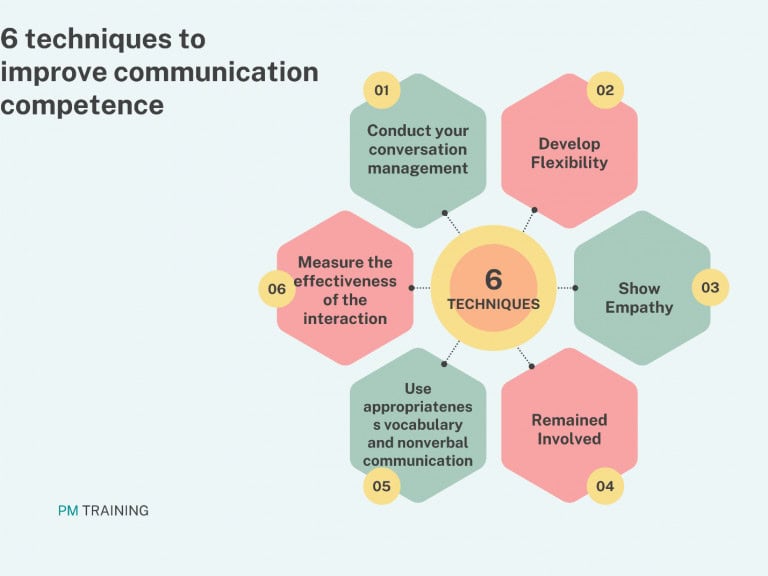
Manage Your Conversations Actively
Conversation management refers to the ability to navigate topic shifts, adapt to changing environments, and maintain clarity across the arc of an exchange. A project manager who can steer a meeting that has gone off course, or re-engage a distracted participant without embarrassing them, is demonstrating a high level of conversational control. Exposure to a wide variety of social situations accelerates the development of this skill.
Develop Flexibility Through Six Criteria
Adapting communication style to fit the context is one of the most important dimensions of competence. Six criteria can guide this flexibility.
- Composure: Being aware of your emotional state during a conversation and managing your responses accordingly. Remaining calm under pressure improves how your message is received and keeps the conversation productive.
- Confirmation: Actively acknowledging what others are saying through gestures such as nodding, asking clarifying questions, or offering a relevant response after they have finished. This signals engagement and respect.
- Experience: Drawing on past social interactions to inform current ones. Reflecting on what has worked well in previous conversations provides a practical template for approaching new situations with greater confidence.
- Articulation: Expressing thoughts with precision and structure. Clear vocabulary, logical sentence construction, and purposeful nonverbal cues all contribute to how well your message lands with the other person.
- Disclosure: Being intentional about what information you share and how much detail is appropriate. In presentations or complex discussions, starting with a broad overview before adding specifics helps audiences stay oriented.
- Wit: Using well-judged humor to ease tension when a conversation becomes strained. Adapting your style of humor to fit the social context, rather than defaulting to a fixed approach, keeps the interaction comfortable and human.
Show Empathy
Empathy is the capacity to understand and acknowledge what another person is feeling. In a conversation, this means listening attentively and reading nonverbal cues rather than rushing toward solutions or advice. Demonstrating that you have genuinely understood someone’s perspective, before responding, builds trust and strengthens the relationship over time.
Remain Actively Involved
Self-awareness during conversations is a key driver of improvement. Project managers who pay attention to how they are coming across in real time can make adjustments on the fly. Three dimensions are worth monitoring consistently.
- Perception: Considering how the other person is likely interpreting you, and whether that matches the impression you intend to give. Small adjustments to posture, tone, or word choice can make a significant difference in how you are received.
- Response: Thinking carefully about what you say and how you say it in the moment. A thoughtful, measured reply usually leaves a stronger impression than an immediate, unconsidered one.
- Attention: Directing your focus fully to what the other person is communicating. Active listening, rather than waiting for your turn to speak, is the foundation of meaningful dialogue.
Use Appropriate Vocabulary and Nonverbal Communication
The appropriateness of your communication style should be assessed during the conversation and reflected upon afterward. The vocabulary you use, the facial expressions you display, and the body language you adopt all send signals that either reinforce or undermine your message. Context matters enormously here. Language that is perfectly appropriate in an informal team setting may come across as too casual in a stakeholder presentation or too formal in a one-on-one mentoring conversation.
Measure the Effectiveness of Your Interactions
After a conversation ends, it is worth taking a moment to assess how it went. Did both parties achieve their objectives? Were there moments of misalignment that could be handled differently next time? Regularly reflecting on your interactions helps you identify patterns, recognize what is working, and address what is not. Over time, this habit of structured reflection significantly accelerates the development of communication competence.
Tips and Best Practices
Beyond the core techniques, the following practical habits will help project managers sustain growth in communication competence.
- Educate Yourself Continuously: Reading about communication theory, enrolling in relevant workshops, or taking structured courses provides a conceptual foundation that makes practical improvement faster and more deliberate.
- Communicate Ideas Clearly: Practice expressing your thoughts in both written and spoken form with precision and brevity. This makes it easier for others to understand your intent without needing additional clarification.
- Listen Actively and Attentively: Focused listening demonstrates that you value the other person’s contribution and enables you to respond in a way that genuinely addresses what they have said, rather than what you assumed they would say.
- Request Feedback Regularly: Asking trusted colleagues, team members, or mentors for honest input on how you communicate gives you an outside perspective that self-assessment of your communication style alone cannot provide. This feedback, when acted upon, accelerates growth in measurable ways.
Video About Communication Competence
Watch the video below for a concise overview of communication competence and how self-monitoring plays a key role in becoming a more effective communicator.
Conclusion
Communication competence is not a single skill but a layered capability that develops across time, experience, and deliberate reflection. For project managers, it determines how effectively goals are communicated, how confidently teams are led, and how gracefully challenges are navigated. The four types of competence provide a useful map, and the techniques covered here offer a practical path toward reaching the highest levels of that progression.
The most effective project managers treat communication as an ongoing discipline rather than a baseline assumption. By combining structured techniques with regular self-assessment and a genuine commitment to growth, any project manager can build the kind of communication competence that strengthens teams, advances projects, and earns lasting professional credibility.
FAQs
What is communication competence in simple terms?
Communication competence is the ability to convey your thoughts clearly, listen effectively, and adapt your communication style to suit different people and social contexts. It includes both verbal skills and nonverbal awareness, such as body language and tone.
Why is communication competence important for project managers?
Project managers rely on communication to align teams, manage stakeholder expectations, and resolve conflicts. Strong communication competence helps them achieve all three of these goals more consistently and with less friction.
What is the difference between conscious competence and unconscious competence?
Conscious competence means you are communicating effectively but still thinking deliberately about how you do it. Unconscious competence means effective communication has become instinctive, requiring little conscious effort because the skills are deeply embedded through practice.
How can a project manager start improving communication competence today?
A good starting point is to reflect on a recent conversation and identify one thing that went well and one thing that could have been handled differently. Combining this habit of reflection with active listening practice and seeking regular feedback creates a strong foundation for rapid improvement.
Can communication competence be learned, or is it an innate trait?
While personality and individual tendencies can influence communication style, competence itself is largely learned. Exposure to diverse social situations, deliberate practice, and structured reflection all contribute to measurable improvement over time, regardless of a person’s natural disposition.
Suggested articles:
- Understanding the 4 Types of Communication Styles in the Workplace
- Communicating in Project Management: The Interactive Model of Communication
- A Quick Overview of Basic Communication Model For Project Managers

Shane Drumm, holding certifications in PMP®, PMI-ACP®, CSM, and LPM, is the author behind numerous articles featured here. Hailing from County Cork, Ireland, his expertise lies in implementing Agile methodologies with geographically dispersed teams for software development projects. In his leisure, he dedicates time to web development and Ironman triathlon training. Find out more about Shane on shanedrumm.com and please reach out and connect with Shane on LinkedIn.