
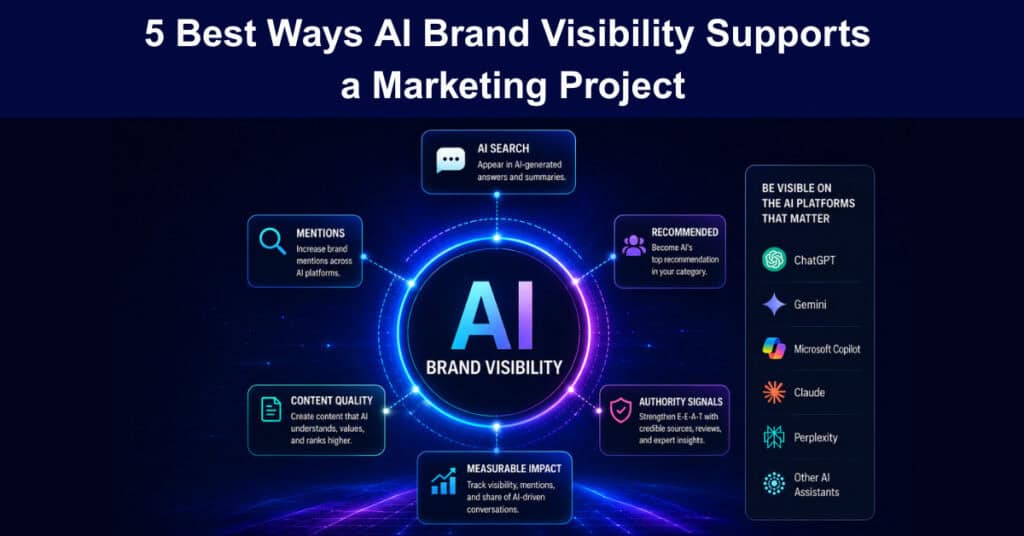
Marketing projects used to be measured mostly by rankings, traffic, and click-through rates. That is no longer the full picture. People now read Google AI Overviews, ask ChatGPT, compare answers in Gemini, check Perplexity, and use other tools before they ever land on a website. If a brand is missing from those answers, a marketing project can hit every traditional metric and still lose ground where buyers are actually forming their first impression.
AI systems do not include a brand just because a project brief says it should be there. They need enough clear, consistent information to understand the company, compare it with others, and connect it to the right questions. Building AI brand visibility into a marketing project gives the team a second layer of insight that traditional SEO reporting does not cover on its own.
How To Show Up In AI Search Results
1. It Gives The Project A Real Starting Point
Before a marketing project sets goals, it helps to know what AI systems already say about the brand. Searching the company name, product category, service type, and comparison terms across Google, ChatGPT, Gemini, Perplexity, and Claude shows three things: whether the brand appears, how it is described, and which competitors show up instead.
An AI brand visibility check is useful here because it separates branded visibility from category visibility. A brand can look fine when someone searches its own name and still be invisible when the same person asks for “best software for small law firms” or “top accounting tools for ecommerce.” A marketing project that starts from this gap has a clearer target than one built on assumptions.
2. It Sharpens Content Priorities Instead Of Content Volume
Once a project team knows where the brand is missing, AI visibility work pushes content planning toward clarity instead of quantity. A page that tries to cover five topics at once is harder for an AI system to summarize or match to a query, and it is often just as confusing for a human reader.
This reshapes how a marketing project scopes its content: one page, one primary question, supported by details, examples, and next steps. A pricing page should state what affects the price early on. A comparison page should show the difference against the background. A guide should lead with the first step, not the theory. Structuring priorities this way tends to improve both AI Overview visibility and normal on-page usability, so the project gets two benefits from one editorial standard.
3. It Strengthens The Proof And Trust Signals Behind Every Campaign
AI systems weigh claims differently than a landing page does. A page full of statements but no evidence is weaker than one with examples, dates, methodology, client types, and clear sourcing. “We help brands grow” carries little weight. “We reduced wasted ad spend by auditing query-level performance and rebuilding campaign structure” gives an AI system and a reader something concrete to work with.
Folding this into a marketing project means asking a simple question of every major page: what sits beside the claim? A before-and-after, a client review, a short breakdown of the process. Google’s own guidance on AI features in Search keeps the emphasis on crawlable, helpful, reliable pages rather than shortcuts, which lines up with what most marketing projects already aim for. AI visibility work simply makes that standard explicit and easier to check.
4. It Keeps Entity Signals Consistent Across The Whole Brand Footprint
A marketing project rarely lives on one page. Between the website, LinkedIn, directory listings, author bios, and partner pages, a brand can end up looking like several slightly different companies. AI tools have less to work with when the name, category, location, services, and leadership details do not match from one source to the next.
Bringing AI visibility into project planning means auditing that footprint on purpose: the same company description everywhere, an About page that says what the company does and who it works with, and mentions on third-party pages that tell the same story as the website. This kind of consistency work is easy to overlook inside a single campaign, but it is exactly what helps a brand hold together in AI-generated answers.
5. It Points The Project Toward Category And Comparison Coverage
Many marketing projects lean heavily on branded search and campaign-specific landing pages. That is too narrow once AI tools enter the picture, because buyers often ask for options before they know which company to pick: “best CRM for agencies,” “top payroll software for startups,” “alternatives to HubSpot.”
AI visibility work flags where a brand has no presence in that kind of neutral, comparison-driven search. Adding category pages that explain the buyer’s problem, the options they weigh, and where the product does or does not fit gives AI systems something usable when a question is not brand-specific. A project built only on pitch pages has nothing to offer that kind of query; a project that includes honest comparison content has a real shot at being part of the answer.
What Your Team Gains by Prioritizing AI Visibility
Seeing how these five areas impact a brand is one thing, but seeing how they actually change the daily workflow of a marketing team is another. When a project embraces this AI visibility approach from day one, it unlocks five new, practical benefits that traditional marketing frameworks miss:
- Clarity on Real Competitors: Teams quickly discover who they are actually fighting against in AI prompts, which is often completely different from the competitors listed in the original project brief.
- Less Content, Better Traffic: Focus shifts from churning out endless blog posts to perfecting high-value pages that give LLMs exactly what they need to summarize your value.
- Built-In Conversion Proof: Because AI requires hard evidence to back up claims, landing pages naturally become more persuasive for human buyers who are tired of marketing fluff.
- Cleaner Digital Footprints: The process forces a long-overdue cleanup of old directory listings, social profiles, and partner pages, giving the brand a cohesive voice everywhere.
- Early Access to Undecided Buyers: By showing up in neutral “top 10” and comparison queries, the brand gets introduced to prospects before they have even narrowed down their shortlist.
Building AI Visibility Into The Project, Not Around It
AI search visibility is not the result of a single tactic. It functions most effectively as a strategic lens applied across the entire project: beginning with a thorough starting audit, establishing sharper content priorities, reinforcing every page with stronger proof points, maintaining a consistent brand footprint, and ensuring comprehensive coverage of category and comparison searches.
Teams that treat AI visibility as just another reporting metric will inevitably find themselves chasing results after the fact. Those that integrate it from the initial project brief will produce content that AI systems can confidently surface and buyers can genuinely trust — eliminating the need for a costly, time-consuming remediation pass down the line.
Suggested articles:
- Marketing Your Franchise: Strategies to Boost Visibility and Drive Growth
- Top 6 Strategies for Boosting Your Website Visibility
- Embracing the Future of Online Visibility for Small Businesses

Daniel Raymond, a project manager with over 20 years of experience, is the former CEO of a successful software company called Websystems. With a strong background in managing complex projects, he applied his expertise to develop AceProject.com and Bridge24.com, innovative project management tools designed to streamline processes and improve productivity. Throughout his career, Daniel has consistently demonstrated a commitment to excellence and a passion for empowering teams to achieve their goals.