

The 9/80 work schedule is a flexible arrangement that consists of nine-hour workdays, an eight-hour day, and one day off over two weeks. This schedule compresses the standard 80 working hours across nine days instead of the typical ten days—hence the designation “9/80.” While employees maintain the same 80-hour biweekly commitment, they gain an additional day off every two weeks. This arrangement is designed to enhance employee engagement and productivity while promoting a healthier work-life balance.
The adoption of flexible work schedules has gained significant momentum in recent years, with modern employees increasingly prioritizing companies that offer such arrangements. Notable organizations, including Microsoft Japan, have successfully implemented four-day work weeks, demonstrating measurable improvements in productivity. The benefits of flexible scheduling extend beyond employee satisfaction, offering substantial advantages to employers as well—prompting widespread adoption across industries.
9/80 Work Schedule Example and Benefits
A typical work schedule operates from 8:00 AM to 5:00 PM, Monday through Thursday (9 hours per day), and 8:00 AM to 4:00 PM on Friday (8 hours) during the first week. In the second week, employees work nine-hour days from Monday through Thursday, with Friday off. When incorporating a one-hour lunch break, the schedule extends from 8:00 AM to 6:00 PM, Monday through Thursday, and 8:00 AM to 5:00 PM on Friday during the first week.
Some organizations prefer an alternative schedule beginning at 7:00 AM and concluding at 5:00 PM. Regardless of the specific timing, the total working hours remain consistent at 80 hours over nine working days. Organizations can utilize a 9/80 work schedule calculator to accurately determine the distribution of hours and appropriately schedule lunch breaks.

9/80 Work Schedule Example
Working Hours
- Week one 9+9+9+9+8=44 hours
- Week two 9+9+9+9=36 hours
- Total working hours for two weeks: 44+36=80 hours
- Total number of working days 5+4=9
- Hence, 9 days/80 hours= 9/80 work schedule
9/80 Work Schedule Advantages
The 9/80 work schedule allows employees to work 80 hours over nine days instead of the traditional ten, typically earning one extra day off every two weeks. When structured properly, this model can improve morale, strengthen productivity, and make a company more attractive to serious talent without increasing salary expenses.
- More Flexibility: Employees gain an additional day off every two weeks, giving them more control over appointments, family time, travel, or personal responsibilities. This added breathing room helps reduce scheduling stress and allows employees to manage life outside work more effectively.
- Great Work-Life Balance for Employees: An extended weekend every other week helps employees recharge mentally and physically. With more time to rest and handle personal matters, they return to work more focused, less burned out, and better equipped to maintain long-term performance.
- An Incentive for Potential Employees: A 9/80 schedule can serve as a competitive advantage in recruitment. Skilled professionals increasingly value time flexibility, and offering structured extended weekends can attract motivated candidates without increasing payroll or offering unsustainable perks.
- Increased Employee Engagement and Productivity: Knowing they are working toward a long weekend often motivates employees to stay focused and organized. This structured rhythm can create urgency, improve accountability, and drive stronger output during working hours.
- Fewer Interruptions: Longer workdays allow for extended blocks of focused time. Employees can dive deeper into complex projects without constantly resetting their workflow, which supports higher-quality results and improved concentration.
- Timely Task Completion: With clearly structured longer days, teams may complete deliverables more efficiently. The compressed schedule encourages better planning and prioritization, reducing procrastination and minimizing unfinished weekly tasks.
- Less Commuting: Working one less day every two weeks reduces commuting time and expenses. Employees save money on fuel or transport while experiencing less travel-related fatigue and stress.
- Reduced Operating Costs: If offices close every other Friday, businesses can lower electricity, water, and facility-related expenses. Over time, these small savings can compound into meaningful operational cost reductions.
- Better Rest for Employees: The additional day off provides genuine recovery time. Employees can rest properly rather than squeezing personal obligations into evenings, which helps sustain energy and long-term performance.
9/80 Work Schedule Disadvantages
While the 9/80 model can improve flexibility, it also introduces structural and operational challenges. Longer days, payroll complexity, and coverage gaps can strain teams if leadership does not plan carefully. For some industries, especially those requiring constant availability, the drawbacks may outweigh the benefits.
- Issues of Overtime: For non-exempt employees, overtime rules can become complicated depending on labor laws. If the schedule is not structured correctly, businesses may face unexpected overtime costs and increased payroll administration.
- Long and Tiring Working Days: Nine-hour shifts can feel manageable at first, but over time, they may cause mental and physical fatigue. Employees in demanding roles may struggle to maintain energy and focus throughout extended days.
- Poor Performance: Productivity can dip toward the end of longer workdays. Reduced concentration and decision fatigue may lead to mistakes, slower output, and a decline in overall work quality.
- Scheduling Is Challenging: Coordinating meetings, deadlines, and team availability becomes more complex when employees rotate off days. Without tight planning, communication gaps and workflow disruptions can occur.
- Loss of One Hour on Leave Days: When employees take vacation or sick leave on a nine-hour day, the company effectively pays for an extra hour compared to a standard eight-hour schedule, slightly increasing paid time costs.
- Fixed Work Schedule Limitations: The rigid structure of a 9/80 schedule makes last-minute changes harder to manage. Urgent business needs or sudden adjustments may disrupt the planned rotation system.
- Less Ideal for Small Teams: Smaller companies with limited staff may struggle to maintain consistent coverage. Rotating extended weekends can create service gaps, especially in customer-facing or time-sensitive operations.
9 80 Work Schedule Calculators
A good work schedule is a trade-off between employees doing their work and having more resting time. The main goal is to maximize profits through maximizing customer satisfaction. Employees are the most significant determinants of customer satisfaction. One of the ways to motivate employees to promote productivity, greater engagement, and loyalty is by giving them a work-life balance.
This is possible using the 9/80 work schedule. Like other people, employees want time with their loved ones, run errands, and get their things done; hence a greater need for work-life balance now than ever.

Online Hours Calculator: Timesheets Calculator | QuickBooks Time, Formerly TSheets (intuit.com)
9/80 Work Schedule Alternatives
4/10 Work Schedule
From its name, the plan consists of 10 hours a day, 4 working days a week. Employees here get three days off every week. Sometimes it is called a compressed workweek or four-day workweek. With this schedule, employees are working longer hours each working day.
4/10 Work Schedule Pros
The 4/10 work schedule allows employees to work four 10-hour days each week instead of five 8-hour days, typically earning a three-day weekend. When implemented correctly, this structure can improve morale, reduce commuting time, and create a more focused and efficient work rhythm.
- Boosts Employees’ Productivity: Longer workdays often encourage deeper focus and fewer weekly start-stop disruptions. Employees may complete tasks more efficiently by reducing transitional downtime between five separate workdays.
- More Rest Days, Hence a Happy and Less Stressed Workforce: A consistent three-day weekend provides additional recovery time. Employees return to work refreshed, which can improve morale, reduce stress levels, and support long-term job satisfaction.
- More Work-Life Balance: Having one extra day off each week allows employees to manage personal commitments, appointments, and family time without sacrificing income or career progress.
- Reduced Commuting: Working four days instead of five lowers transportation costs and commuting stress. Employees save time and money while reducing travel fatigue.
4/10 Work Schedule Cons
While the 4/10 model offers attractive benefits, it is not a universal solution. Longer shifts and operational demands can strain, particularly in industries that require continuous coverage or high physical output.
- It Is Not Suitable for All Industries: Certain industries, such as customer service or healthcare, require daily availability. In these environments, compressed schedules may disrupt service consistency or operational flow.
- Staffing Challenges: Ensuring full coverage across all business hours can become complex. Employers may need staggered schedules or additional coordination to prevent service gaps.
- Employee Fatigue: Ten-hour workdays can be physically and mentally demanding. Over time, extended shifts may reduce energy levels, focus, and overall performance, particularly in high-intensity roles.
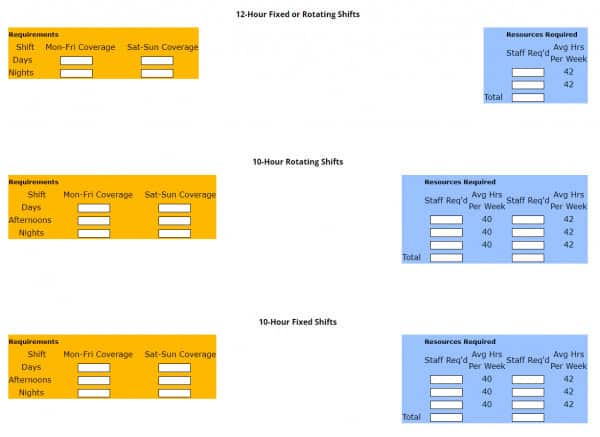
Shift Schedule Staffing Calculator (shift-schedule-design.com)
5/40 Work Schedule
5/40 or simply a 40-hour work week is another form of compressed work schedule that you can use as a manager as an alternative to the 9/80 plan. The traditional work schedule is five days, 40 hours a week. In this compressed schedule, an employee works 8 hours a day from Monday to Friday for a total of 40 hours.
5/40 Work Schedule vs 980 Work Schedule
For two weeks, both work schedules consist of 80 working hours
9/80 work schedule:
- 9 hours for every working day and eight hours for Friday of the first week
- One day off every two weeks
- An hour is lost, a sick day falls on the 9-hour days
- It is a two-week period compressed work schedule
- Consists of 44 hours for the first week and 36 hours for the second week
5/40 work schedule:
- 8 hours every workday
- No day off except on weekends
- No extra hour is lost
- Scheduling is done for one week
- Every work consists of 40 hours
9/80 Work Schedule Google Sheet Template
The billion-dollar question is, ‘Why is it that everyone is not using it?’ You may be asking yourself why everyone is not jumping on board if it is as good as it seems. Many would like to implement flex scheduling; it is very challenging. Consumers want 24/7 customer service and availability, while employees want flexibility. For this reason, many businesses are using a 9/80 work schedule for flex scheduling. You can use our work schedule template for your employees to fill in.
Conclusion
The 9/80 work schedule represents a compelling alternative to traditional work arrangements, offering organizations a pathway to enhance employee satisfaction while maintaining productivity. By compressing 80 hours into nine days, this model provides workers with valuable additional time off while preserving operational efficiency. However, success requires careful implementation—businesses must consider industry requirements, staffing capabilities, and payroll complexities before adoption.
While the 9/80 schedule may not suit every organization, particularly those requiring continuous coverage, companies willing to invest in proper planning can reap significant rewards through improved employee engagement, reduced operational costs, and enhanced recruitment appeal. Ultimately, the 9/80 schedule exemplifies how flexible work arrangements can create win-win scenarios for both employers and employees in today’s evolving workplace landscape.
9/80 Work Schedule FAQs
Is a 9/80 schedule worth it?
Yes, when you properly implement this schedule, it can prove very worthwhile to your organization. In Microsoft Japan, the schedule improved employee productivity by 60%. In the US, this schedule has improved the quality of employees’ work by 60% and productivity by 70%. The 9/80 work schedule is also a powerful tool for employee recruitment.
Are 10-hour shifts better than 8?
Each shift has two sides of the coin, the advantages and disadvantages. Generally, 10-hour work shifts have an increased risk of health and relationship issues for employees. 60% of employees working for 10 hours a day have had cardiovascular problems. Working long hours does not mean high productivity in an intuitive sense.
What does a 9/80 schedule look like?
Week One
- Monday 8 am to 5 pm- 9 hours
- Tuesday 8 am to 5 pm- 9 hours
- Wednesday 8 am to 5 pm- 9 hours
- Thursday 8 am to 5 pm- 9 hours
- Friday 8 am to 4 pm- 8 hours
Week Two
- Monday 8 am to 5 pm- 9 hours
- Tuesday 8 am to 5 pm- 9 hours
- Wednesday 8 am to 5 pm- 9 hours
- Thursday 8 am to 5 pm- 9 hours
- Friday- Day off
- Total hours- 80 hours
Does 9/80 include lunch?
The 9/80 work schedule must include a mandatory lunch break of 30 minutes to one hour, similar to any other standard work schedule, to ensure employees have adequate rest and meal time during their extended workday.
Suggested articles:
- Are Monetary Incentives Enough To Motivate A Workforce?
- Top 10 Ways to Recognize Remote Employees and Boost Morale
- 10 Reasons a Company Store Benefits Employers and Employees

Shane Drumm, holding certifications in PMP®, PMI-ACP®, CSM, and LPM, is the author behind numerous articles featured here. Hailing from County Cork, Ireland, his expertise lies in implementing Agile methodologies with geographically dispersed teams for software development projects. In his leisure, he dedicates time to web development and Ironman triathlon training. Find out more about Shane on shanedrumm.com and please reach out and connect with Shane on LinkedIn.