

Remote and hybrid project teams deliver a lot of work that nobody sees. A developer fixes a build at 11 p.m. in another time zone, a business analyst rewrites a confusing requirement before it causes rework, a site coordinator calms an angry client on a video call. In an office, someone would notice and say thanks. On a distributed project, that moment often passes in silence, and silence slowly turns into disengagement. Gallup’s 2026 State of the Global Workplace report found that only 20% of employees worldwide were engaged in 2025, the lowest level since 2020. For project managers, recognition is one of the cheapest and fastest ways to push back against that trend.
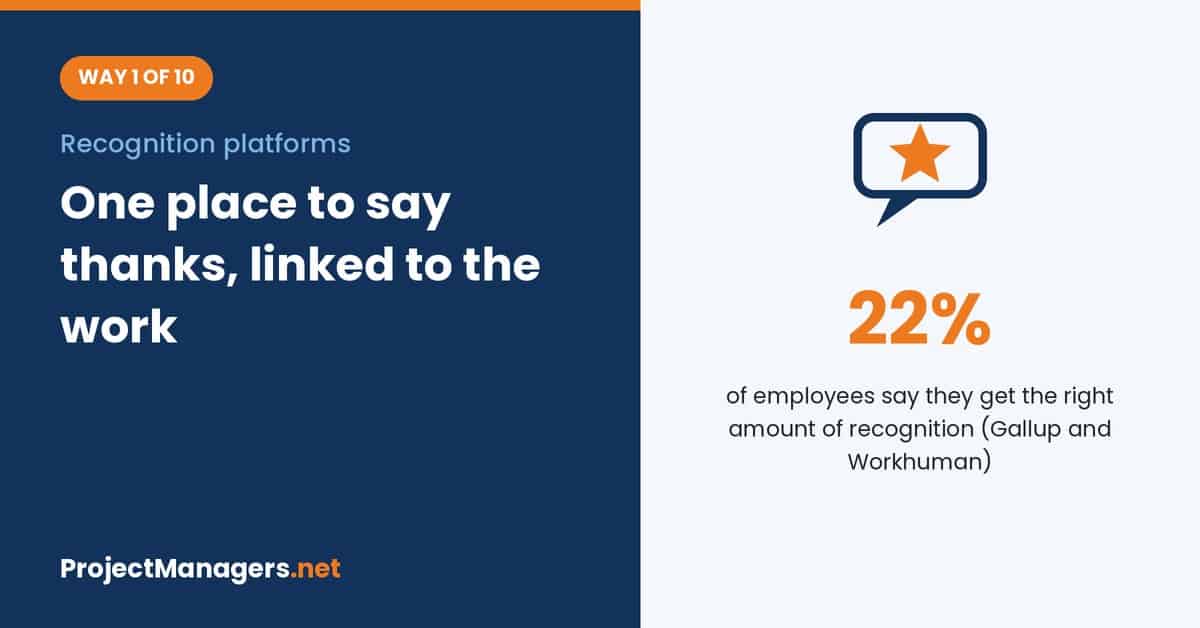
- Only 22% of employees say they get the right amount of recognition, and well-recognized employees are 45% less likely to leave within two years (Gallup and Workhuman).
- On remote projects, recognition has to be planned. Put it in your project rhythm: sprint reviews, milestones, stand-ups and one-on-ones.
- Mix the 10 ways: public and private praise, peer recognition, small surprises, growth opportunities, wellbeing support and visible thanks from leaders.
- Use the free Recognition Plan Builder to create a week-by-week recognition calendar that covers every team member and fits your budget.
This guide covers 10 proven ways to recognize remote employees, rewritten for project managers who lead distributed teams. Each way includes practical steps you can use on your next project, a real company example, current statistics and a tip for project managers. You can also use the free Recognition Plan Builder below to turn these ideas into a week-by-week recognition calendar for your own project team.
Free Recognition Plan Builder for Project Managers
The Recognition Plan Builder turns the 10 ways in this article into a recognition calendar for your project. It opens with a sample distributed software team so you can see a complete plan right away. Replace the example with your own team and project details.
- Describe your project: team size, length in weeks, meeting rhythm, time zones and budget per person.
- Add your team members and how each person prefers to be recognized (public, private, small gift, growth or time off).
- Add your milestones with the week each one is due, then choose which of the 10 ways you want to use.
- Review the plan: the week-by-week calendar, budget split and plan check. Copy or print it and add the actions to your project schedule.
Recognition Plan Builder
A week-by-week recognition calendar for your remote or hybrid project team
Ways to include in the plan
Your plan is saved only in this browser. Nothing is sent anywhere. Gift and reward tax rules vary by country; check with your payroll team before giving anything with a cash value.
Want more free tools like this one? Browse the Free Project Management Toolkit for templates, calculators and builders for every phase of your project.
Why Recognition Matters More on Remote Project Teams
Recognition answers a basic question every team member asks: does my work matter to this project? In a shared office, the answer comes from small signals, a nod in a meeting, a thank you at the coffee machine, a manager stopping by a desk. Remote work removes most of those signals. Gallup’s research on the remote work paradox found that fully remote workers are the most engaged group (31%), yet they are less likely to be thriving in their overall lives (36%) than hybrid workers (42%) and report more stress, sadness and loneliness. They care about the work, but they often feel alone doing it.
That is why recognition on a distributed project cannot be left to chance. Project managers already plan scope, schedule, cost and risk. Recognition deserves the same planning: who will be recognized, when, how and by whom. The good news is that most of it costs little or nothing. Gallup notes that recognition can be as small as a personal note, as long as it is honest, specific and fits how the person likes to be recognized. Even a digital e-card birthday signed by the whole project team can make a remote colleague feel part of the group.
The 10 ways below are ordered roughly from team-wide systems to personal gestures. You do not need all 10 on every project. A small four-person team might use five of them; a 40-person program across three continents will probably need all 10 and a dedicated recognition channel.
1. Personalized Digital Recognition Platforms
A recognition platform gives your distributed project team one place to say thank you, so appreciation does not depend on who happens to be online at the same time as the project manager. It can be a dedicated tool, a module in your HR system or a well-run channel in Slack or Microsoft Teams. What matters is that recognition is easy to give, visible to the team and linked to the work.
Personalization is what separates a useful platform from a badge factory. Tie each recognition to a specific deliverable, a project value or a customer outcome, and let people add a personal touch such as thoughtful employee appreciation cards or a short video. Generic praise like “great job, team” is easy to ignore; “your test plan caught the payment bug two days before launch” is not.
How project managers can apply it:
- Pick one place for recognition and connect it to the tools your team already uses every day.
- Agree on two or three project values (for example: quality, helping others, client focus) and tag each recognition with one of them.
- Ask every team member to give at least one recognition per sprint or per month.
- Review the recognition data each month to spot people who are rarely mentioned.
Real-life example
JetBlue's Lift program
JetBlue rolled out its Lift social recognition program, built with Globoforce (now Workhuman), to unite about 14,500 crewmembers spread across airports and aircraft. Within three months, an internal JetBlue survey showed an 88% increase in crewmember satisfaction with rewards and recognition.
- 22%of employees say they get the right amount of recognition for their work.Gallup and Workhuman, 2024
- 2.9xas likely to be engaged when recognition meets even one of the five pillars of strategic recognition.Gallup and Workhuman, 2024
- 55%of U.S. employees get no recognition, or recognition that meets none of the five pillars.Gallup and Workhuman, 2024
2. Virtual Celebration Events That Work

A virtual celebration is a meeting with one purpose: to celebrate what the project team achieved. It is not a status meeting with a cake emoji at the end. Project milestones are natural moments for these events: the end of a phase, a successful go-live, a passed audit or the last day of a difficult release.
Standard video calls often feel flat, so plan the event like a small project. Send a celebration kit in advance, run a short trivia game built from project moments, show a before and after of the deliverable, and give each person a specific thank you. If your team spans many time zones, run two short sessions or record the highlights.
How project managers can apply it:
- Schedule a 30 to 45 minute celebration in the project plan for each major milestone.
- Name one or two contributions per person; prepare them before the call.
- Invite the project sponsor or a client representative to say thank you in person.
- Record the event and share the highlights for anyone who could not attend live.
Real-life example
GitLab's Virtual Contribute
GitLab, one of the largest all-remote companies, brings its team together each year at an event called Contribute. When the 2020 edition in Prague had to be canceled because of Covid-19, GitLab moved it online in April 2020: team members and investors joined from around the world for keynotes, workshops and speed coffee chats. The company had about 1,250 team members at the time.
Source: GitLab Handbook, Previous GitLab Contributes and Summits
- 31%of fully remote workers are engaged, the highest of any group, but they report more loneliness and stress.Gallup, Remote Work Paradox
- 66%less likely to feel lonely when recognition meets four or more pillars.Gallup and Workhuman, via CXM
- 20%of employees worldwide were engaged in 2025, the lowest level since 2020.Gallup, State of the Global Workplace 2026
3. Meaningful Digital Rewards That Empower Choice
Rewards turn words into something tangible. For remote employees, the best rewards are the ones they choose themselves, because one size never fits a distributed team. A team member in Lisbon and one in Toronto will value very different things, and a reward that cannot be shipped or used locally is not a reward at all.
Offer a menu instead of a single item: experiences, books, learning credits, charitable donations in the person’s name or a small gift. Remote employee recognition becomes much more meaningful when the reward reflects the person’s interests. Keep amounts modest and fair across the team, and be transparent about how rewards are earned.
How project managers can apply it:
- Create a short reward menu with five to eight options that work in every country where your team members live.
- Ask each team member, at onboarding, which kinds of rewards they prefer.
- Link rewards to clear project behaviors, not only to hitting dates.
- Check local tax rules before choosing gift cards (see the Facts Worth Checking table below).
Real-life example
Buffer's "any book, no questions asked" perk
Buffer, a fully remote company, gives each teammate and one dependent unlimited Kindle and Audible books, with no approval needed. New U.S. teammates receive a Kindle Paperwhite in their first 45 days, and international teammates can expense one. The value is small, but the choice belongs entirely to the employee.
Source: Buffer, How We Do Team Benefits As a Remote and International Company
“The most effective recognition is honest, authentic and individualized to how each employee wants to be recognized.”
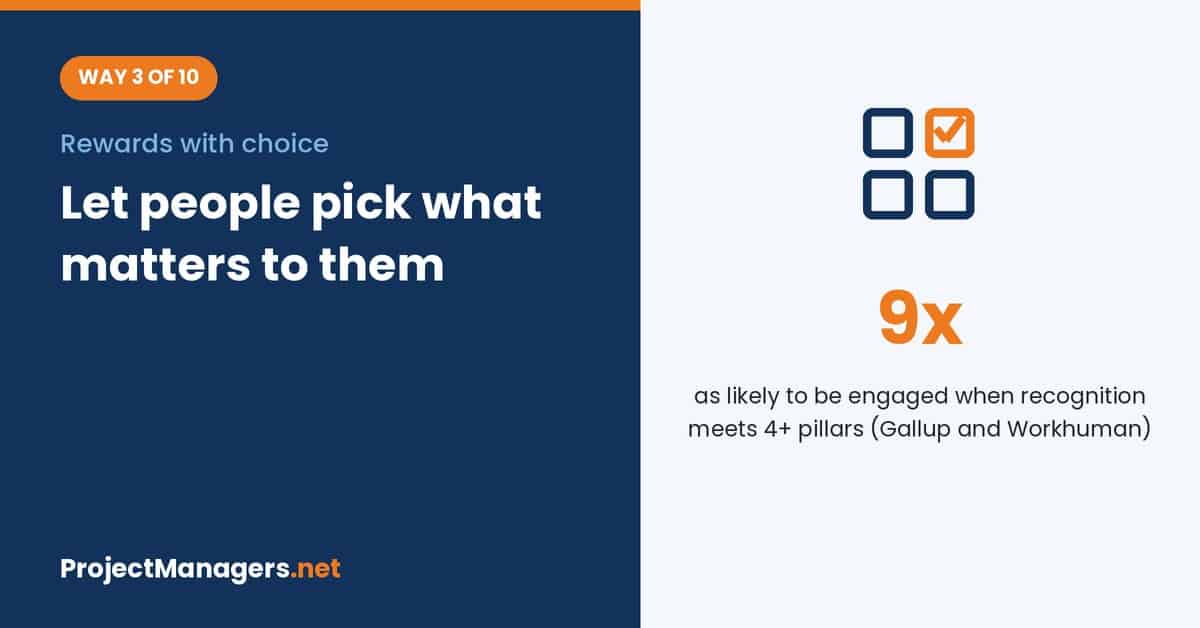
- 9xas likely to be engaged when recognition meets at least four of the five pillars.Gallup and Workhuman, 2024
- 65%less likely to be looking for another job when employees receive high-quality recognition.Gallup and Workhuman, 2024
- 1 in 3U.S. workers strongly agree they were recognized or praised for good work in the last seven days.Gallup
4. Surprise Personalized Gifts

A physical gift that arrives at the door says something a chat message cannot: someone took time to think about me. Personalized gifts work best when they connect to the person or the project, for example a custom-engraved desk item like a branded leather mousepad, a monogrammed notebook for the team member who keeps the best meeting notes, or a care package after a hard release.
Distributed teams add logistics. Many services now handle customs paperwork and tracking, so the surprise stays intact even when shipping internationally. In some cases, local vendors near each team member deliver faster, support regional businesses and can adapt the gift to local tastes and customs.
How project managers can apply it:
- Collect shipping addresses and gift preferences (allergies, dietary choices, no alcohol) with consent at onboarding.
- Budget a small amount per person per quarter and track it in your project budget.
- Time surprises to project moments: after a crunch, at go-live or on a work anniversary.
- Add a handwritten or video note; the message is often remembered longer than the gift.
Real-life example
BTS Software Solutions' "QBOX"
When its 75-person team was suddenly working from home in 2020, BTS Software Solutions adapted its birthday-box tradition into a "QBOX" (quarantine box): a work-from-home survival kit with a funny coffee mug, candy, a Nerf gun, playing cards and Groucho glasses, sent to support isolated employees.
Source: Technical.ly, June 2020
“We wanted to do something unique and unusual.”
- $500a year in non-cash gifts and awards can be tax-free for an employee in Canada, if CRA conditions are met.Canada Revenue Agency
- $0is the tax-free amount for gift cards in the U.S.: cash equivalents are always taxable wages.IRS Publication 15-B
- 28%of employees say their most memorable recognition came from their manager.Gallup
5. Peer-Led Recognition Programs That Build Community
Peer recognition programs spread appreciation across the whole project team instead of relying on the project manager alone. Peers see work that managers miss: the developer who reviewed three pull requests on a Friday, the tester who paired with a new hire, the analyst who answered a client question at midnight.
On remote teams this matters even more, because the project manager’s view is limited to meetings and tools. Make peer nominations fast and simple, connect them to your project values and celebrate them openly. When everyone becomes a recognition ambassador, engagement stops depending on one person.
How project managers can apply it:
- Open each retrospective or stand-up once a week with a two-minute “wins and thanks” round.
- Give everyone a small monthly budget of points or nominations they can send to any teammate.
- Let people nominate across teams and vendors, not only inside their own group.
- Share peer nominations with each person’s manager so they count in performance reviews.
Real-life example
Google's peer bonus
In his book Work Rules!, former Google people operations head Laszlo Bock describes gThanks, an internal tool that makes it easy to recognize colleagues, including a peer bonus: any Googler can give another a $175 cash award to thank them for great work.
Source: Laszlo Bock, Work Rules! (2015), summarized by Bonusly
“Simple, public recognition is one of the most effective and most underutilized management tools.”
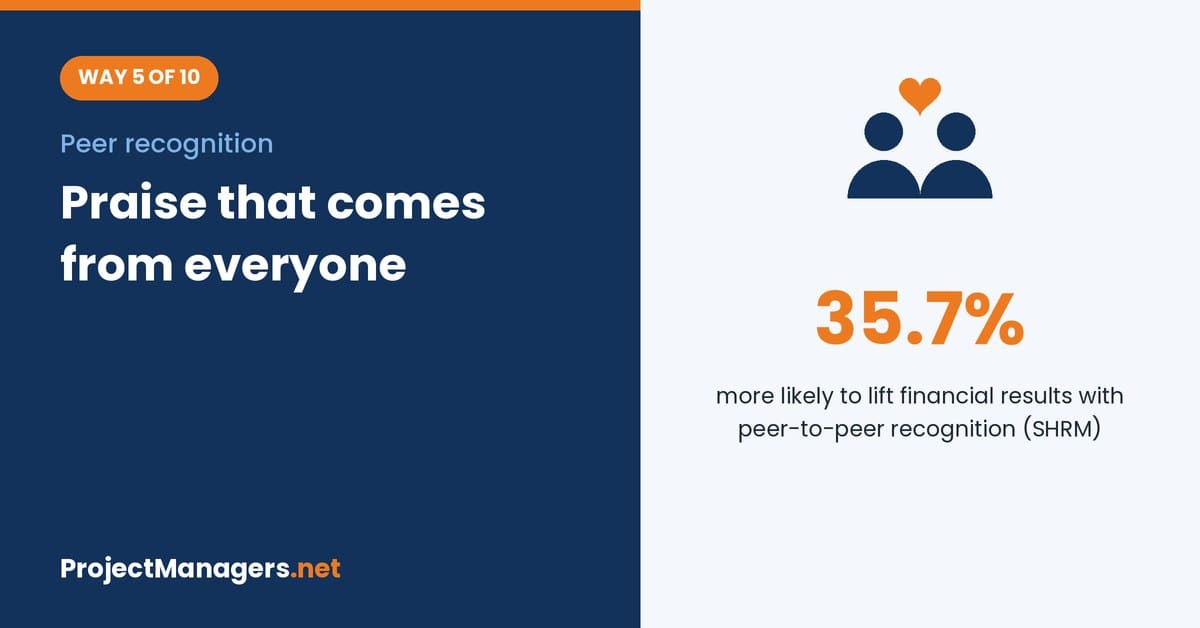
- 35.7%more likely to have a positive impact on financial results when companies promote peer-to-peer recognition.SHRM and Globoforce, 2012
- 41%of companies using peer-to-peer recognition saw an increase in customer satisfaction.SHRM and Globoforce, 2012
- 9%of employees say their most memorable recognition came from peers, so peers need encouragement.Gallup
6. Virtual Recognition Walls and Public Appreciation Channels

A recognition wall is a permanent, public place where achievements stay visible. It can be a channel, a page in your project wiki or a board in your project management software. Over time it becomes one of your project’s cultural artifacts: a record of what the team values and how it works together.
Chat messages scroll away in hours. A wall keeps the story of the project. Add photos, screenshots of the finished work, short videos and client feedback, and review it at the end of each phase. New team members can read it to learn the project culture faster than any onboarding slide.
How project managers can apply it:
- Create a dedicated #wins or #thanks channel for the project, separate from work chatter.
- Post client compliments there within 24 hours, with the names of the people involved.
- Pin a monthly recap of the best recognitions to the project wiki or wall.
- Use the wall in your lessons learned session to show what went right.
Real-life example
GitLab's #thanks channel
At GitLab, recognition is shared in the public #thanks Slack channel, highlighting the company values the person demonstrated. When a discretionary bonus is approved, it is also announced in #thanks so the team member's peers can easily see it, and whole working groups are recognized there too. Team members tag their posts with emoji for the company's operating principles.
- 1 in 3U.S. workers strongly agree they received recognition for good work in the past seven days.Gallup
- 2xas likely to say they will quit in the next year: employees who do not feel adequately recognized.Gallup
- 7 daysis how often Gallup recommends recognizing good work.Gallup
7. Milestone Celebrations With Digital Enhancements
Work anniversaries, birthdays, project completions and personal milestones are natural moments for recognition. For remote employees, these dates are easy to miss because there is no office cake and no card going around the floor.
Digital tools make these moments richer. A video compilation in which teammates share a memory or a thank you creates an emotional connection that a single message cannot. For work anniversaries, highlight the person’s journey: the projects they shipped, the skills they built and the people they helped.
How project managers can apply it:
- Keep a simple calendar of birthdays (opt-in) and work anniversaries for your project team.
- Automate reminders a week ahead so you have time to collect messages or a video.
- Celebrate project milestones and personal milestones separately; both matter.
- For long projects, mark the project’s own anniversaries with a short look back at what the team achieved.
Research example
Life events make remote workers feel respected
In a Workhuman survey report, remote workers at companies that commemorate life events said they felt more respected (78% versus 58%) and more appreciated (75% versus 44%) than remote workers at companies that do not. Celebrating the person, not only the deliverable, is what makes the difference.
“The findings illustrate that recognition of both personal and workplace accomplishments has a significant impact on reducing turnover.”
Meisha-Ann Martin, Workhuman, on the Gallup and Workhuman study
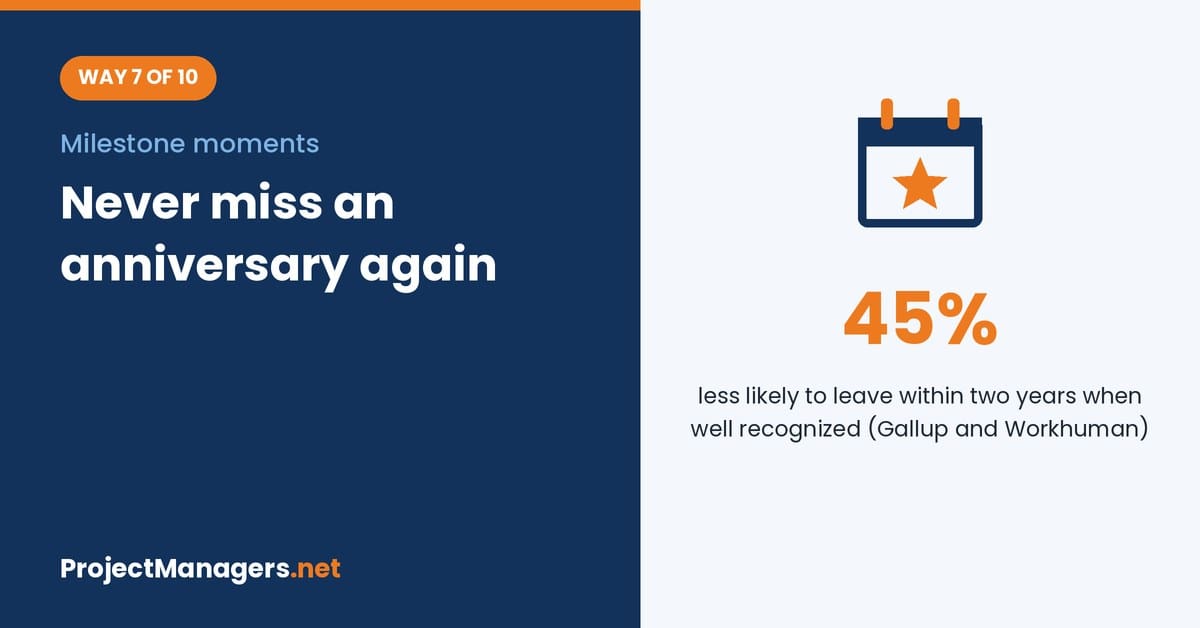
- 45%less likely to have left two years later: employees who received high-quality recognition.Gallup and Workhuman, 2024
- 75% vs 44%of remote workers feel appreciated when their company commemorates life events, versus those whose company does not.Workhuman
- 4.4xas likely to say their job gives them purpose when recognition meets four or more pillars.Gallup and Workhuman, via CXM
8. Professional Growth as a Form of Recognition

Investing in employee professional development tells a team member: we see your potential and we want you to grow here. This kind of recognition lasts longer than a thank you, because it shapes the person’s future.
For project managers, growth recognition is often free: a stretch assignment, leading a workstream, presenting results to the steering committee, mentoring a junior colleague or attending a conference as the team’s representative. When there is a budget, link it to performance, for example a learning allowance that grows with exceptional contributions.
How project managers can apply it:
- Ask each team member, in one-on-ones, which skill they want to build on this project.
- Rotate visible tasks (demos, client updates, risk reviews) so more people get exposure.
- Let top contributors present their own work to sponsors instead of presenting it for them.
- Mention growth recognition in performance input you send to functional managers.
Real-life example
Buffer's learning stipend
Buffer added a monthly learning and development stipend for every employee, on top of its free books perk, so team members could pay for online courses, tutorials or events. In the first month after launch, 21 of its 74 employees (28%) used it.
Source: Buffer, Why We Decided To Give All Employees $20 per Month for Learning and Development
- 88%of organizations are concerned about employee retention; providing learning is their No. 1 retention strategy.LinkedIn Workplace Learning Report 2025
- 91%of L&D professionals say continuous learning is more important than ever for career success.LinkedIn Workplace Learning Report 2025
- 1 of 12Gallup engagement elements asks whether employees had opportunities to learn and grow in the last year.Gallup, State of the Global Workplace
9. Wellness Initiatives That Show Genuine Care
Wellness support recognizes people as whole human beings, not just as resources on a schedule. For remote employees, whose home and office are the same room, this kind of care carries special weight. Access to mental health resources, flexible hours after a crunch and real protection of time off all say: we noticed how hard you worked.
Project managers have a direct influence here. You control meeting load, deadlines and on-call rotations. Leaders who talk openly about wellbeing and model healthy habits, like logging off on time and taking real vacations, create the psychological safety that turns wellness programs into genuine appreciation.
How project managers can apply it:
- Give a recovery day or a no-meeting day after each major milestone or crunch period.
- Protect focus time in the project calendar, especially for people in far time zones.
- Remind the team of available support (employee assistance program, mental health days).
- Watch for early burnout signs: late-night messages, missed stand-ups, short replies.
Real-life example
LinkedIn's RestUp! week
In April 2021, LinkedIn gave nearly all of its 15,900 full-time employees a paid week off, called RestUp!, to recharge and avoid burnout. A core team kept working and scheduled their time off later, and the company offered optional activities for people who felt isolated during the week.
Source: AFP via TechXplore, April 2021
“There is something magical about the entire company taking a break at the same time.”
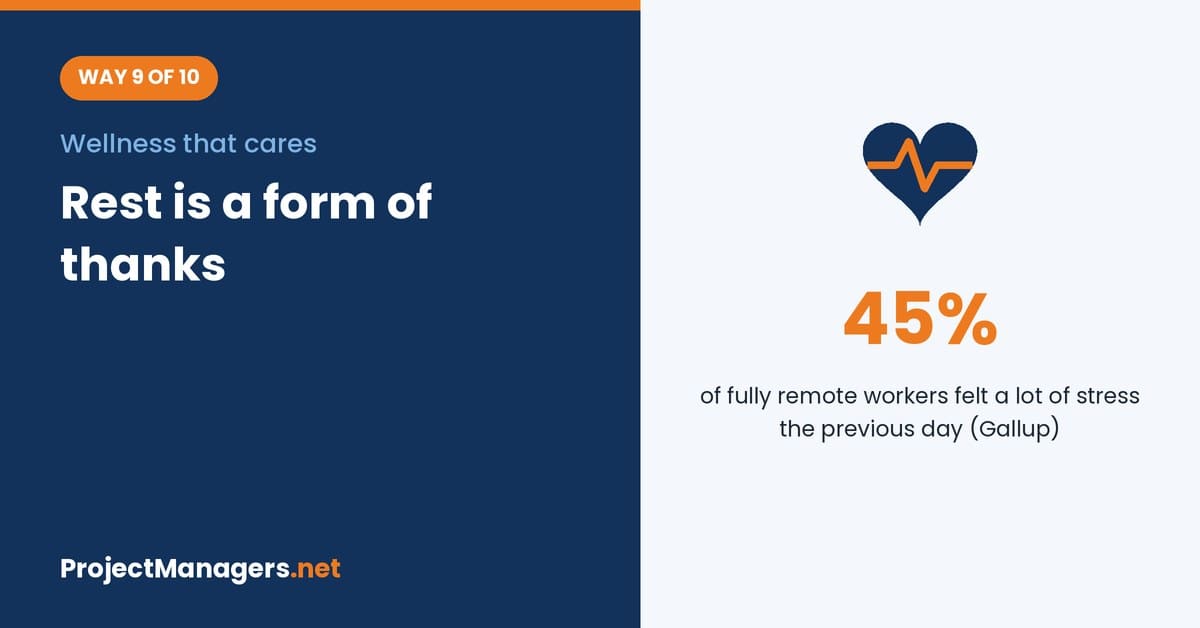
- 45%of fully remote workers experienced a lot of stress the previous day.Gallup, Remote Work Paradox
- 36%of fully remote workers are thriving in life, versus 42% of hybrid workers.Gallup, Remote Work Paradox
- 38%of fully remote workers who are both engaged and thriving are looking for a new job, versus 57% of all fully remote workers.Gallup, Remote Work Paradox
10. Leadership Connection Programs

Direct contact with senior leaders tells remote employees they are seen, not just counted. Executive participation in employee recognition programs adds weight to the appreciation: a personal video message, a thank you by name in a town hall or a sponsor joining a milestone celebration.
The key is authenticity. A scripted message read from a slide does little. A sponsor who knows what the data migration team actually did, and says so, builds trust across the whole project. Project managers can make this happen by briefing leaders with specific names and contributions before every sponsor meeting.
How project managers can apply it:
- Send your sponsor two or three names and specific contributions before each steering committee.
- Invite a leader to the first ten minutes of milestone celebrations to say thank you by name.
- Ask executives to record short personal video messages for exceptional contributions.
- Close the loop: share the leader’s thanks on your recognition wall.
Real-life example
Doug Conant's 30,000 notes
During his 10 years as CEO of Campbell Soup Company (2001 to 2011), Doug Conant wrote about 30,000 personal thank-you notes to employees, in a company of about 20,000 people. He wrote 10 to 20 notes a day, celebrating specific contributions, and they were often posted on desks around the world.
“When I started at Campbell's I wrote a short thank-you note to an employee, and the very next day it was in a frame on that employee's desk.”
- 24%of employees say their most memorable recognition came from a high-level leader or CEO.Gallup
- 22%of managers worldwide were engaged in 2025, down from 27% a year earlier.Gallup, State of the Global Workplace 2026
- 42%of senior leaders strongly agree recognition must be a key pillar of engagement and retention, up from 28% in 2022.Gallup and Workhuman, 2024
How to Build a Recognition Rhythm Into Your Project
The 10 ways work best as a rhythm, not a one-time event. The table below shows a simple cadence many project managers use on remote teams. The free Recognition Plan Builder above builds the same rhythm automatically from your team, milestones and budget.
| When | What | Who | Time needed | Ways |
|---|---|---|---|---|
| Every week | Wins and thanks round in stand-up or retro; posts on the recognition wall | Whole team | 5 to 10 minutes | 5, 6 |
| Every sprint or month | Personal recognition for each team member, in the way they prefer | Project manager and peers | 15 minutes per person | 1, 3, 4 |
| Each milestone | Virtual celebration with a leader or sponsor thank-you | Project manager, sponsor | 30 to 45 minutes | 2, 10 |
| After a crunch | Recovery day, no-meeting day or lighter workload | Project manager | Plan in schedule | 9 |
| Each quarter | Growth opportunity for top contributors; anniversary and birthday check | Project manager, functional managers | 30 minutes | 7, 8 |
Recognition also works best when roles are clear. If you are not sure who owns what on your project, the free roles and responsibilities templates help you see each person’s contribution, which makes specific recognition much easier.
Common Remote Recognition Mistakes Project Managers Should Avoid
- Recognizing only the visible people. Team members who speak up in meetings get noticed; quiet experts and people in far time zones do not. Track who you recognize.
- Generic praise. “Thanks, team” helps a little; naming the person, the work and the impact helps a lot more.
- Waiting for the end of the project. Recognition loses power with time. Gallup recommends recognizing good work every seven days.
- One reward for everyone. A gift card that cannot be used in a team member’s country tells them they were an afterthought.
- Ignoring the tax side. Gift cards and cash are taxable in many countries. Check before you promise anything.
- Forgetting vendors and contractors. On many projects, key work is done by people outside your company. A public thank you costs nothing.
Recognition will not fix every problem on a remote team. Unclear messages and unresolved tension undermine morale faster than any reward can rebuild it. See the 5 C’s of communication in project management, how to recognize the 5 conflict levels in the workplace and cross-cultural management strategies for distributed teams.
Remote Employee Recognition: Facts Worth Checking
Some recognition claims are repeated online without a source. Here is what the current evidence actually says.
| Claim | Verdict | What the evidence says | Source |
|---|---|---|---|
| Recognition only matters to younger employees. | Not supported | Gallup and Workhuman's findings on engagement and retention apply across the workforce they surveyed. The widely shared claim that Millennials and Gen Z are "73% more likely" to want recognition no longer has a working source. | Gallup and Workhuman |
| Remote workers are less engaged than office workers. | Mostly false | Globally, fully remote workers are the most engaged group (31%), but they are less likely to be thriving and report more loneliness and stress. | Gallup |
| Gift cards are a tax-free way to thank employees. | Depends on the country | In the U.S., cash and gift cards are always taxable. In Canada, gift cards can count as non-cash gifts only if strict CRA conditions are met. | IRS Pub. 15-B; CRA |
| In Canada, any recognition gift under $500 is tax-free. | Partly true | The $500 annual limit applies to non-cash gifts and awards. Rewards tied to job performance, such as finishing a project or meeting a target, are generally taxable. | Canada Revenue Agency |
| Recognition has to be expensive to work. | False | Gallup says recognition can be as small as a personal note or a thank-you card; what matters is that it is honest, specific and individualized. | Gallup |
| Most employees already feel well recognized. | False | Only 22% of employees say they get the right amount of recognition, unchanged since 2022. | Gallup and Workhuman |
| Peer recognition is just a nice extra. | False | Companies that promote peer-to-peer recognition were 35.7% more likely to report a positive impact on financial results. | SHRM and Globoforce |
| Recognition has a measurable link to turnover. | True | In a 2022 to 2024 longitudinal study, employees who received high-quality recognition were 45% less likely to have left. | Gallup and Workhuman |
Checked November 2026. Figures change; follow the source links for the latest numbers.
Video: 5 No-Cost Ways to Recognize Remote Employees
In this five-minute video, recognition researcher Christopher Littlefield of Beyond Thank You shares simple ways to make remote employees feel appreciated without spending money. Most of his ideas fit naturally into a project manager’s stand-ups, one-on-ones and team meetings.
5 No-Cost Ways to Recognize Remote Employees, Christopher Littlefield on YouTube (5 min). Watch on YouTube
Conclusion
Remote project teams do not need more perks; they need to know their work is seen. With these 10 ways, project managers can build a recognition rhythm that fits the project: a platform and a public wall for everyday thanks, peer recognition so praise does not depend on one person, celebrations and leader thanks at milestones, and personal gestures, growth and wellbeing support for each team member.
Start small. Pick three or four ways, put them in your project schedule with an owner and a date, and review them at every retrospective. Use the free Recognition Plan Builder to create your first plan in a few minutes, and explore the other free tools in the Free Project Management Toolkit. A team that feels recognized is easier to lead, more willing to go the extra mile when the project needs it, and much more likely to still be with you on the next project.
Suggested articles:
- How to Boost Team Morale with Virtual Recognition
- Managing Remote Teams Effectively in a Hybrid Work Environment
- Top 10 Cons & Disadvantages of Working from Home (WFH)
Remote Employee Recognition FAQ
How can I make virtual recognition feel genuine and not forced?
Be specific and timely. Recognize a concrete contribution soon after it happens, explain why it mattered to the project or the client, and match the format to the person: some people love a public shout-out, others prefer a private message. Avoid templates and generic phrases.
How often should project managers recognize remote employees?
Gallup recommends recognizing good work about every seven days across the team. In practice, aim for a weekly team wins round, a personal recognition for each team member every sprint or month, and bigger celebrations at milestones.
What are low-cost ways to recognize remote employees?
A specific thank-you message, a public post on the recognition wall, a handwritten card, a mention to the sponsor, a stretch assignment, a no-meeting day after a crunch and a two-minute peer thanks round in stand-ups all cost little or nothing.
Are gift cards for employees taxable?
In the U.S., cash and gift cards are always taxable wages, whatever the amount. In Canada, non-cash gifts and awards up to $500 a year can be tax-free, and gift cards can qualify only if strict CRA conditions are met; rewards tied to job performance are generally taxable. Check with your payroll team or tax advisor.
How do I recognize team members in different time zones?
Use asynchronous recognition: posts on a recognition channel, recorded videos and written notes people can see in their own working hours. Rotate meeting times for celebrations, or run two short sessions, so the same people are not always left out.
Should contractors and vendor staff be recognized too?
Yes. Public thanks, mentions to their own manager and invitations to milestone celebrations cost nothing and build loyalty. For gifts or rewards, check your contract and procurement rules first.
How do I measure the impact of remote recognition?
Track recognition frequency and coverage (who is recognized and how often), then compare with engagement survey scores, retention, sick days and project health indicators such as velocity or rework. Ask the team in retrospectives what recognition they value most.

Daniel Raymond, a project manager with over 20 years of experience, is the former CEO of a successful software company called Websystems. With a strong background in managing complex projects, he applied his expertise to develop AceProject.com and Bridge24.com, innovative project management tools designed to streamline processes and improve productivity. Throughout his career, Daniel has consistently demonstrated a commitment to excellence and a passion for empowering teams to achieve their goals.