
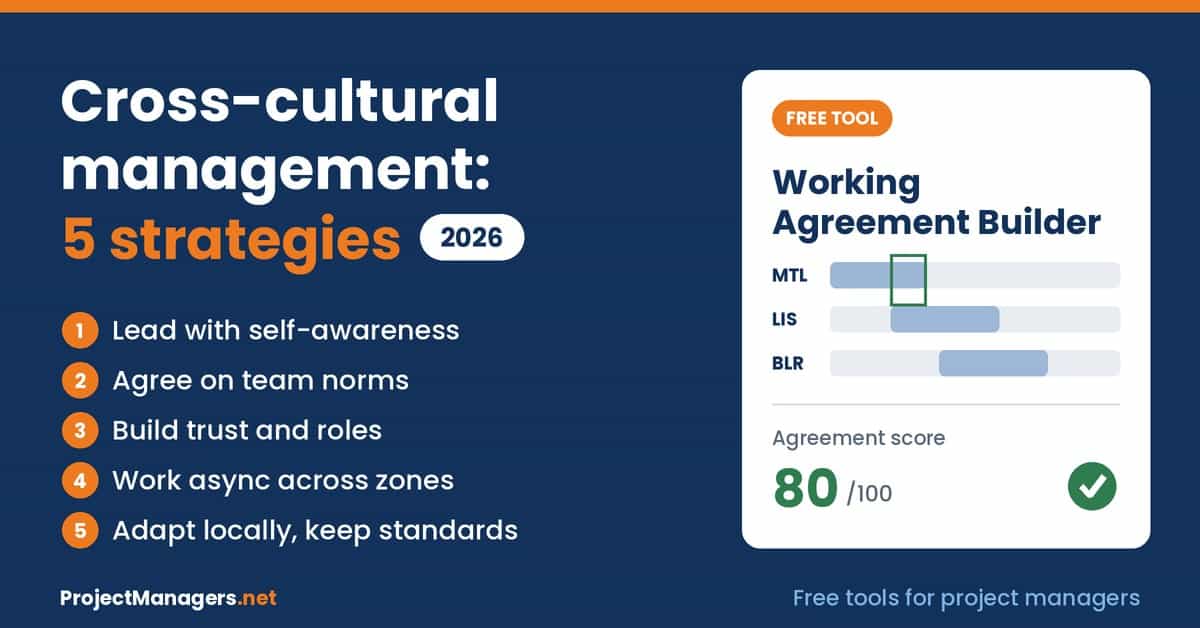
Cross-cultural management can determine whether an international project runs smoothly or becomes a costly exercise in misunderstanding. A missed deadline, an unclear instruction, or a decision made without consulting the right people can create friction between colleagues who are equally capable but work with different expectations. Effective management begins when leaders recognize these differences and establish working practices that allow everyone to contribute.
- Culture is a question, not an answer: nationality does not predict how one person works. Project managers ask, observe and agree on norms instead of relying on stereotypes.
- Motivation beats trivia: a 2025 study of global virtual teams found that the drive to work across cultures mattered more than knowing facts about them.
- Write the rules down: channels, response times, decision owners and a “silence is not agreement” rule prevent most cross-cultural misunderstandings on projects.
- The cost is real: 49% of executives say a communication misunderstanding has blocked a major cross-border deal.
According to Preply, cultural knowledge, training, and language learning can help professionals enhance their cross-cultural management skills. However, cultural awareness alone is not enough. Project managers must translate that awareness into clear communication, fair decision-making, realistic deadlines, and consistent accountability. The following five strategies explain how to manage multicultural teams without relying on stereotypes or compromising project standards.
The Growing Importance of Cross-Cultural Management
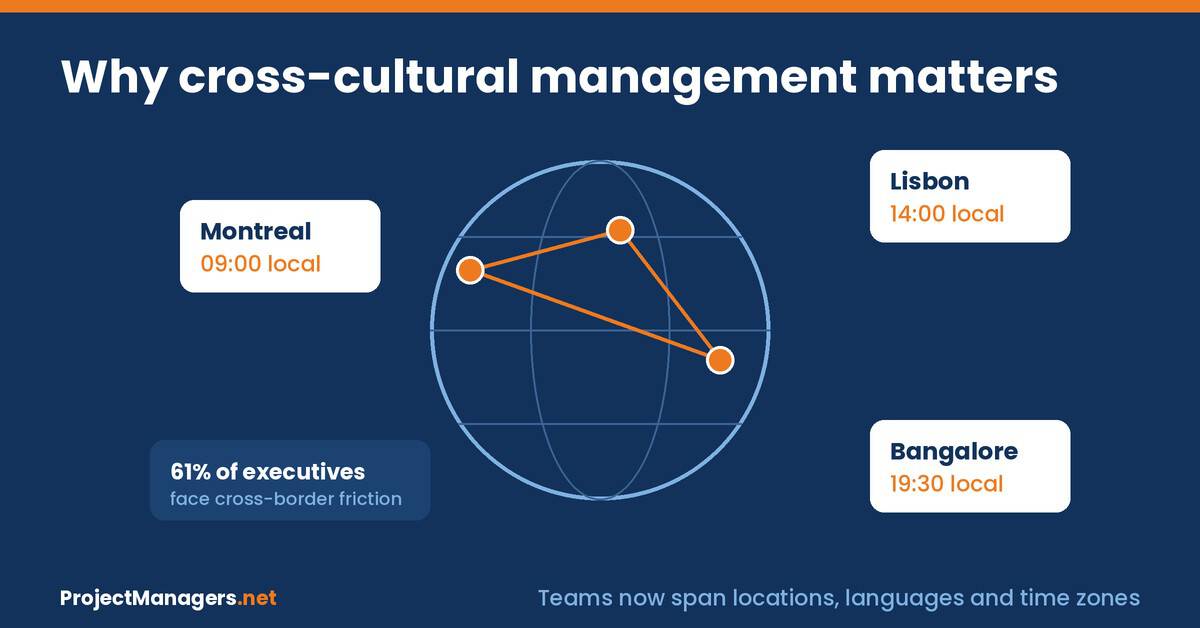
Cross-cultural management helps organizations coordinate people who bring different communication habits, professional expectations, languages, and approaches to authority. Its value extends beyond international expansion. Domestic teams can also contain significant cultural differences, while remote work connects colleagues who may rarely meet in person. Managers need practical methods for turning these differences into better collaboration rather than unnecessary conflict.
The challenge is to distinguish genuine cultural differences from individual preferences, organizational habits, and simple misunderstandings. Research published in the European Journal of International Management in 2025 examined cultural intelligence, psychological safety, and teamwork climate in global virtual teams. Its findings highlight the importance of team members’ motivation and reflective cultural awareness in supporting safer, more constructive collaboration.
Managers can strengthen cross-cultural coordination by establishing these foundations:
- Understand the Business Context: Learn how local regulations, customer expectations, professional conventions, and organizational structures affect the work.
- Recognize Individual Differences: Ask employees about their preferences instead of assuming nationality determines personality or behavior.
- Set Shared Expectations: Establish consistent standards for quality, deadlines, accountability, and respectful conduct across every location.
- Measure Practical Outcomes: Monitor missed handoffs, recurring misunderstandings, rework, and employee feedback to identify where coordination needs improvement.
Real-life example
Executives say culture, not language, causes most cross-border friction
In a 2012 survey of 572 executives, the Economist Intelligence Unit asked what causes misunderstandings in cross-border work. Differences in cultural traditions and workplace norms ranked far ahead of language problems or poor translations. Nearly half said a misunderstanding had already blocked a major international deal, and many linked unclear cross-border communication to lost productivity. For project managers, the lesson is that a shared language does not mean a shared way of working.
Source: Economist Intelligence Unit, Competing Across Borders, 2012 (572 executives)
By the numbers
- 51%name differences in cultural traditions as the top source of cross-border misunderstanding; only 27% name language diversity
- 76%of global employees surveyed in 2022 work on hybrid teams, often across locations
Source: Economist Intelligence Unit, Competing Across Borders, 2012 (572 executives); CultureWizard, Trends in Global Virtual Work, 2022
1. Developing Effective Cross-Cultural Leadership Skills
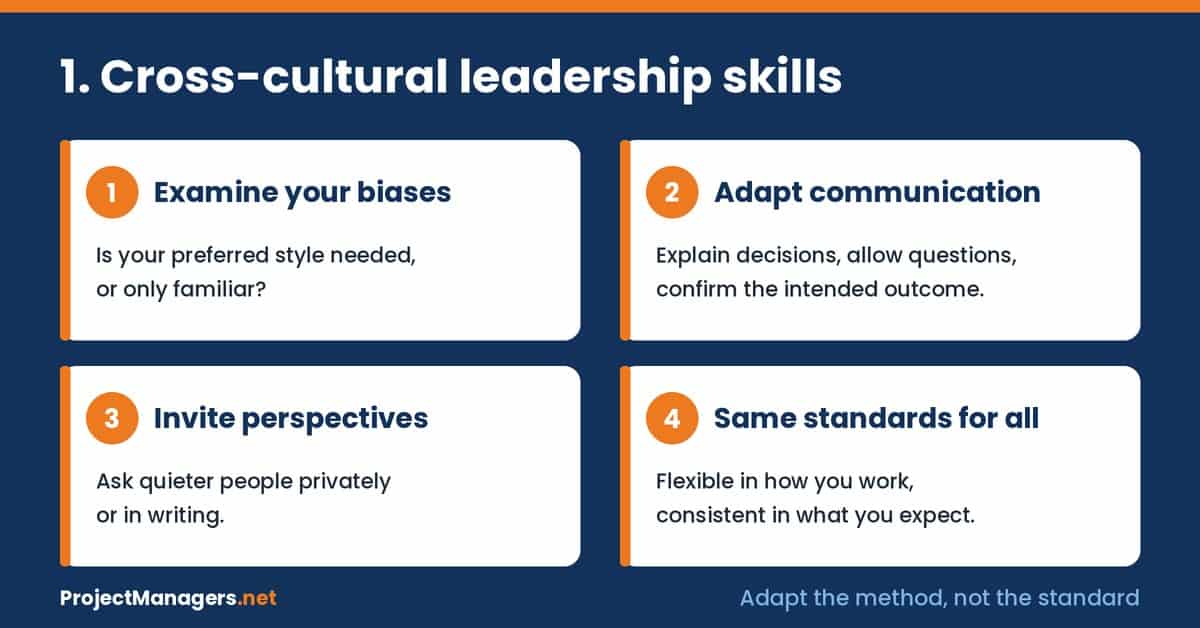
Effective cross-cultural leadership combines self-awareness, curiosity, and the ability to adjust management methods without abandoning clear standards. Leaders who understand their own assumptions are better positioned to recognize when a disagreement reflects different expectations rather than poor performance. Cultural intelligence, often abbreviated as CQ, describes capabilities associated with functioning effectively across cultural settings, but it should support learning rather than encourage managers to label people.
Develop these leadership capabilities through deliberate, everyday management practices:
- Examine Personal Biases: Identify assumptions about punctuality, initiative, professionalism, and respect. Consider whether your preferred working style is genuinely necessary or simply familiar.
- Adapt Communication: Explain decisions explicitly when colleagues need additional context. Allow time for questions, and confirm that everyone understands the intended outcome.
- Invite Different Perspectives: Ask quieter team members for their views through private conversations or written feedback when public discussion makes participation difficult.
- Separate Flexibility From Favoritism: Adapt how you communicate and collaborate, but apply performance standards consistently across the team.
Real-Life Example: A project manager leading colleagues in the United Kingdom and Japan notices that decisions made during meetings receive little immediate disagreement. Rather than interpreting silence as approval, the manager circulates proposals beforehand, invites written comments, and confirms decisions afterward. Team members gain more opportunities to contribute, and unresolved concerns become easier to identify before work begins.
Real-life example
Erin Meyer’s Culture Map compares positions, not people
INSEAD professor Erin Meyer built the Culture Map after seeing managers fall back on national stereotypes. It places cultures on eight scales, such as how people give negative feedback, make decisions and disagree. The point is relative: a manager learns where their own habits sit compared with a colleague’s, then adjusts. Meyer also advises leaders to expect the work to be hard and to keep adapting, which matches the self-awareness this strategy asks of project managers.
Source: Erin Meyer, Navigating the Cultural Minefield, Harvard Business Review, 2014
From the field
“What’s critical is understanding the relative difference between two countries.”
Erin Meyer, INSEAD, author of The Culture Map (source)
By the numbers
- 47%of executives say their companies do not offer enough language and communication training
- 40%say too little emphasis is placed on recruiting people suited to cross-cultural work
Source: Economist Intelligence Unit, Competing Across Borders, 2012 (572 executives)
2. Best Practices for Managing Multicultural Teams

Managing multicultural teams requires explicit working agreements because colleagues may interpret the same message, meeting, or deadline differently. Some employees prefer direct feedback, while others may communicate disagreement more cautiously. These tendencies vary within cultures, so managers should establish team-specific practices instead of assuming that a national background predicts an individual’s behavior.
Research on global virtual team conflict highlights the relationship between cultural awareness, psychological safety, and a constructive teamwork climate. Managers can apply these principles by making expectations visible and ensuring that employees can raise concerns without unnecessary embarrassment or retaliation.
Build dependable team practices around the following priorities:
- Agree on Communication Norms: Decide which channels to use for urgent requests, routine updates, formal decisions, and sensitive feedback. Document response-time expectations.
- Clarify Decision-Making Authority: Specify who recommends, approves, implements, and reviews decisions. This prevents consultation from being mistaken for final approval.
- Make Participation Inclusive: Circulate agendas before meetings, invite contributions from every location, and provide written alternatives for employees who communicate better asynchronously.
- Address Disagreement Constructively: Discuss the evidence, project risks, and proposed solutions rather than judging someone’s character or cultural background.
Real-Life Example: A distributed product team repeatedly misses requirements because developers interpret a stakeholder’s tentative comments as final approval. The project manager introduces a written decision log that records the approved requirement, decision owner, deadline, and outstanding questions. The team reduces ambiguity without requiring everyone to adopt the same communication style.
Real-life example
Rakuten made English its working language, then found culture still mattered
In 2010, Rakuten CEO Hiroshi Mikitani told about 7,000 Japanese employees, with some 3,000 overseas colleagues listening in, that English would become the company’s working language. Staff had two years to reach the required proficiency. Harvard professor Tsedal Neeley, who studied the change, found that a common language spread Japanese corporate practices to overseas offices, and some American employees felt a culture shock of their own. A shared language solved one problem, but the team still needed explicit norms.
Source: Harvard Business School Working Knowledge, interview with Tsedal Neeley
From the field
“Language barriers, I realized, were creating inefficiencies in our operations.”
Hiroshi Mikitani, CEO of Rakuten (source)
By the numbers
- 68%of executives say English is essential for their business, far ahead of Mandarin at 8%
- 49%cite different workplace norms as a major source of cross-border misunderstanding
Source: Economist Intelligence Unit, Competing Across Borders, 2012 (572 executives)
3. Building and Nurturing a Successful Cross-Cultural Team

A successful cross-cultural team develops trust through shared responsibility, fair treatment, and repeated opportunities to work together. Cultural training can provide useful context, but it cannot replace clear roles or resolve every interpersonal disagreement. Teams need practical routines that make collaboration dependable, especially when employees have different levels of authority, language confidence, or access to senior decision-makers.
Managers should also examine power imbalances. Employees who speak a dominant business language fluently may receive more attention than colleagues with equally valuable expertise. A fair team deliberately creates opportunities for contributions to be heard, evaluated on their merits, and reflected in project decisions.
Strengthen the team’s foundation through these actions:
- Invest in Relevant Training: Use realistic scenarios involving feedback, negotiation, meeting etiquette, and conflict resolution. Include local employees’ perspectives rather than presenting one culture as the default.
- Define Roles and Responsibilities: Document deliverables, decision rights, dependencies, and escalation routes so every employee understands how their work contributes to the project. A roles and responsibilities template makes this easier to share across locations.
- Build Relationships Through Shared Work: Pair colleagues across locations on meaningful assignments, encourage peer learning, and create opportunities for informal interaction without forcing participation.
- Recognize Contributions Fairly: Evaluate performance against agreed outcomes and acknowledge behind-the-scenes work, including coordination, mentoring, and knowledge sharing.
Real-Life Example: An international implementation team discovers that employees at headquarters routinely make decisions without consulting regional specialists. The project lead introduces cross-location review sessions and assigns regional representatives responsibility for validating local requirements. The team identifies practical constraints earlier, while regional employees gain a defined role in project governance.
Real-life example
Google found that how a team works beats who is on it
Google’s Project Aristotle studied 180 teams, 115 engineering project teams and 65 sales groups, to learn what made some more effective. Psychological safety came first: people on the best teams felt safe to take interpersonal risks, such as admitting a mistake or asking a basic question. Dependability and structure and clarity followed. For cross-cultural project teams, where some members may hesitate to challenge a decision, clear roles and safety to speak are the foundation.
From the field
“Safe for interpersonal risk taking.”
Amy Edmondson’s definition of psychological safety, as cited by Google re:Work (source)
By the numbers
- 180Google teams studied in Project Aristotle; psychological safety ranked first of five dynamics
- 2025study: motivational and metacognitive cultural intelligence predicted psychological safety; cultural knowledge alone did not
Source: Google re:Work; European Journal of International Management, 2025
4. Leveraging Technology for Cross-Cultural Collaboration

Technology supports cross-cultural collaboration when it makes information accessible, decisions traceable, and participation possible across different time zones. However, adding more software does not automatically improve teamwork. Managers should choose tools around actual coordination problems, establish consistent usage rules, and ensure that employees can access the information they need without depending on informal conversations in another location.
Asynchronous communication is particularly useful when teams cannot attend the same meeting. Written updates, recorded demonstrations, shared task boards, and documented decisions let colleagues contribute at different times. Synchronous meetings remain valuable for sensitive discussions, complex problem-solving, and situations where immediate clarification matters.
Choose and manage collaboration tools with these principles in mind:
- Use a Shared Project Workspace: Maintain one reliable location for task owners, deadlines, dependencies, project documents, and approved changes. Our ranking of the best project management software compares tools that can serve as this workspace.
- Establish Asynchronous Updates: Require concise progress reports that explain completed work, current blockers, next steps, and decisions needed from others.
- Make Meetings Time-Zone Fair: Rotate inconvenient meeting times when possible, distribute notes promptly, and avoid excluding remote colleagues from important decisions.
- Keep Language Accessible: Use plain language, explain unfamiliar acronyms, and provide written summaries after complex discussions. Translation tools can assist, but important decisions still require human verification.
Real-Life Example: A software team operating across three time zones loses a day whenever a developer needs clarification from a product owner. The manager introduces a shared requirements document, annotated screenshots, and a daily asynchronous update. The team reserves live meetings for issues that genuinely require discussion, reducing dependence on overlapping working hours.
Real-life example
GitLab runs an all-remote company on written, asynchronous work
GitLab has no company offices and collaborates asynchronously across many time zones. Its public handbook, which would run past 2,000 printed pages, documents processes so people can find answers without waiting for someone to wake up. Decisions and discussion outcomes are recorded where others can find them. GitLab still meets live for urgent issues, troubleshooting, brainstorming and relationship building, which mirrors the balance this strategy recommends for project managers.
Source: GitLab Handbook, Embracing asynchronous communication
By the numbers
- 2,000+printed pages in GitLab’s public handbook, its single source of truth for remote work
- 38%of global employees surveyed in 2022 work virtually every day
Source: GitLab Handbook; CultureWizard, 2022
5. Learning from Cross-Cultural Management Examples

Cross-cultural management becomes easier to apply when leaders examine how organizations adapt to local customers, employees, and business conditions. McDonald’s operations in China illustrate the broader principle that international organizations may need to adjust products and customer experiences to local preferences. Such adaptation is useful only when it reflects actual customer needs rather than assumptions about an entire population.
Project managers can apply the same principle internally. A global process should define essential requirements while allowing reasonable local adaptation in communication, stakeholder engagement, and implementation. The goal is neither to impose headquarters’ habits everywhere nor to allow every team to operate without shared standards.
Translate these lessons into practical cross-cultural management decisions:
- Adapt to Local Requirements: Validate customer expectations, legal obligations, and working conditions with people who understand the local environment.
- Preserve Essential Standards: Maintain consistent requirements for safety, quality, ethical conduct, security, and project reporting.
- Consult Local Expertise Early: Involve regional employees and stakeholders during planning, not after major decisions become expensive to change.
- Review Results Before Scaling: Test local adaptations, gather feedback, and measure whether they improve adoption, coordination, or customer outcomes.
Real-Life Example: A company introducing a customer service process across several countries discovers that a single script does not suit every market. Local teams adapt examples and phrasing while retaining the same service standards, escalation rules, and reporting requirements. The organization protects consistency without ignoring legitimate differences in customer expectations.
Real-life example
Walmart exported its store rules to Germany and lost about $1 billion
Walmart entered Germany in the late 1990s with practices that worked at home. Staff were asked to smile at shoppers, join the company’s morning chant and bag groceries, in a market where customers usually bag their own and some read the smiles as flirting. In July 2006 Walmart sold its 85 German stores to Metro and expected a pre-tax loss of about $1 billion. The case shows what happens when a process is rolled out without local input.
By the numbers
- 85Walmart supercenters sold to Metro AG in July 2006
- $1Bapproximate pre-tax loss Walmart expected from leaving Germany
Source: Walmart Form 8-K, July 28, 2006
Preventing Common Cross-Cultural Management Mistakes
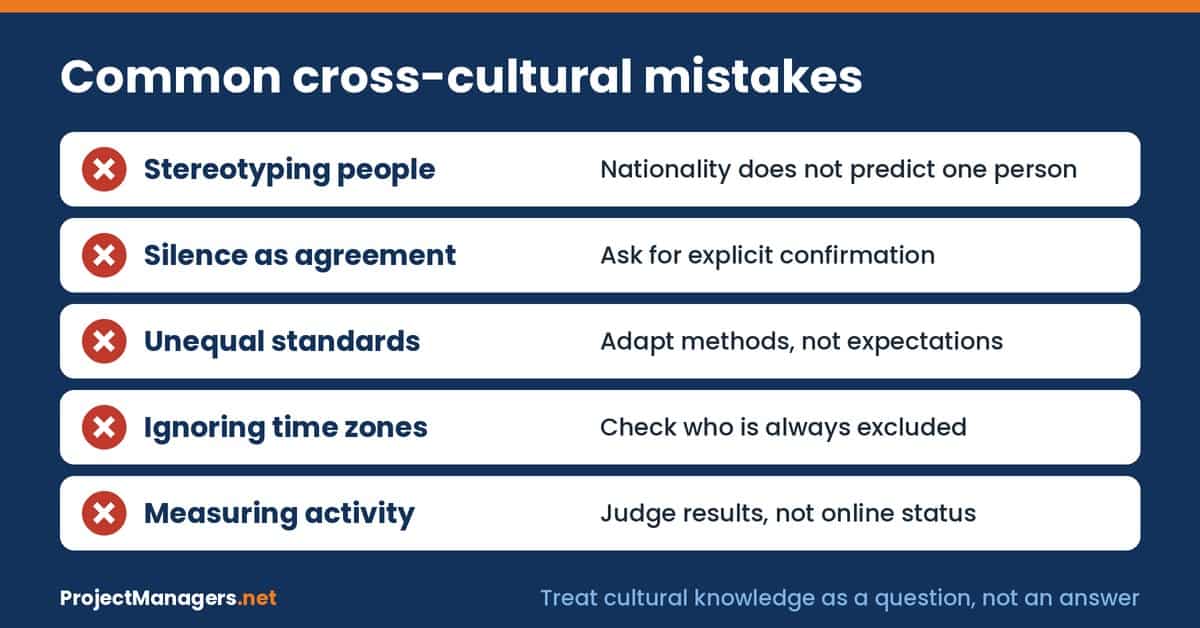
Cross-cultural management fails when leaders confuse cultural awareness with certainty about other people. Frameworks that describe national cultural tendencies can help generate questions, but they cannot reliably predict an individual’s behavior. A critical examination of cross-cultural management research by Terence Jackson, published in the International Journal of Cross Cultural Management, warns that cultural categories can reinforce stereotypes and obscure differences within societies.
Managers should therefore treat cultural knowledge as a starting point for inquiry, not a substitute for evidence. The practical objective is to discover what a particular team needs to work effectively while maintaining fair standards, mutual respect, and accountability.
Avoid these common mistakes before they undermine collaboration:
- Stereotyping Employees: Do not assume that nationality determines communication style, technical ability, leadership preferences, or willingness to challenge a decision.
- Treating Silence as Agreement: Ask for explicit confirmation, invite written objections, and record unresolved questions before approving important decisions.
- Applying Standards Unequally: Adjust communication methods when appropriate, but do not excuse misconduct or penalize employees for unfamiliar personal styles.
- Ignoring Language and Time-Zone Barriers: Check whether meeting schedules, unexplained terminology, or delayed responses prevent certain colleagues from contributing.
- Measuring Activity Instead of Results: Evaluate completed deliverables, quality, reliability, and collaboration rather than rewarding visibility or constant online availability.
Real-Life Example: A manager initially describes one employee as disengaged because the employee rarely speaks during meetings. After a private conversation, the manager learns that the employee prefers to review technical details before responding. Written pre-meeting questions create space for considered contributions, and the manager evaluates participation through the quality of the employee’s work and input. When disagreements do escalate, our guide to the 5 conflict levels in the workplace helps project managers decide when to step in.
Real-life example
DaimlerChrysler promised a merger of equals and delivered a culture clash
When Daimler-Benz and Chrysler combined in 1998, Daimler CEO Jürgen Schrempp called it a merger of equals. Within a few years, Stuttgart was issuing directives on everything from headquarters to business cards, the American leaders were gone, and the company had lost nearly half its value. Schrempp later admitted the Americans would not have agreed had he been open about German control. In 2007 Daimler sold 80.1% of Chrysler to Cerberus for $7.4 billion.
From the field
“These two cultures were therefore bound to collide.”
Gerald Meyers, former chairman of American Motors (source)
By the numbers
- $36Bapproximate value of Daimler’s 1998 deal for Chrysler
- $7.4Bprice Cerberus paid for 80.1% of Chrysler in 2007
Source: IndustryWeek, May 14, 2007
Free Cross-Cultural Working Agreement Builder
The five strategies above share one idea: write down how your team works instead of assuming everyone shares the same habits. Use this free builder to turn them into a working agreement your project team can review and sign. It loads with an example team in Montreal, Lisbon and Bangalore, so you can see a finished agreement before you enter your own.
- Add your locations: enter each city or team, its time zone and its working hours. The chart shows when everyone is at work and flags teams with no shared hours.
- Set communication norms: choose the channel and response time for urgent requests, routine updates, decisions and sensitive feedback.
- Agree on decisions and meetings: pick where decisions are recorded, who approves them and how meetings run.
- Cover language, feedback and review: add plain-language rules, the escalation path and how often you review the agreement.
- Fix the gaps and share: the score shows which practices are missing, with links to the right section of this article. Copy or download the agreement for your next team meeting.
Cross-Cultural Working Agreement Builder
Free toolSet your team’s locations, channels, decision rules and meeting habits. The builder checks your time zone overlap, scores the agreement against the 5 strategies in this article and writes a working agreement you can copy or download.
Cross-Cultural Management At A Glance: Key Practices And Outcomes
Effective cross-cultural management depends on observable team practices, not broad assumptions about national characteristics. The most useful interventions make communication clearer, responsibilities more visible, and disagreements easier to resolve. The following summary translates the article’s recommendations into decisions managers can implement and review during an international project.
Use these principles as a practical reference when reviewing your team’s working arrangements:
Key Practices and Outcomes
| Aspect | Key fact or answer | Why it matters |
|---|---|---|
| Cultural awareness | Individual behavior cannot be predicted reliably from nationality alone. | Reduces stereotyping and encourages direct inquiry. |
| Communication | Shared norms clarify channels, response times, and decision records. | Prevents misunderstandings and avoidable rework. |
| Psychological safety | Employees need practical opportunities to raise concerns. | Helps teams identify risks before they become larger problems. |
| Team governance | Clear roles and decision rights establish accountability. | Reduces confusion over approvals and ownership. |
| Remote collaboration | Asynchronous updates support teams across time zones. | Reduces unnecessary delays and meeting pressure. |
| Performance measurement | Track delivery, quality, coordination, and recurring blockers. | Connects management interventions to project outcomes. |
Test Your Cross-Cultural Management Skills
Six situations project managers meet on multicultural teams. Pick an answer, then open the explanation.
Can You Spot the Right Move?
Answer all six, then check your score: 5 or 6 means your team habits are strong; 3 or 4 means reread strategies 2 and 4.
A colleague in another office never objects during video calls. What should the project manager assume?
- AThey agree with every decision
- BThey are not engaged
- CNothing yet; ask for explicit confirmation
- DIt is a language problem
Show answer
Answer C: Nothing yet; ask for explicit confirmation. Silence is not agreement. Circulate proposals beforehand, invite written comments and confirm decisions afterward, as in the UK and Japan example in strategy 1.
Developers keep treating a stakeholder’s tentative comments as final approval. What fixes this best?
- AMore frequent meetings
- BA written decision log with a named owner
- CAsking the stakeholder to be more direct
- DRemoving the stakeholder from meetings
Show answer
Answer B: A written decision log with a named owner. A decision log that records the approved requirement, owner, deadline and open questions removes ambiguity without forcing one communication style.
According to the 2012 Economist Intelligence Unit survey, what is the top source of cross-border misunderstanding?
- APoor translations
- BLanguage diversity
- CDifferences in cultural traditions
- DTime zones
Show answer
Answer C: Differences in cultural traditions. 51% named differences in cultural traditions and 49% named workplace norms. Only 27% named language diversity.
A team in three cities has no working hour in common. What should the project manager do first?
- AMake the newest office work late
- BWork asynchronously and rotate live meetings
- CCancel all meetings
- DMove everyone to one time zone
Show answer
Answer B: Work asynchronously and rotate live meetings. Written updates and a shared workspace carry most of the work. When a live meeting is needed, rotate the inconvenient slot so no location always pays.
Which part of cultural intelligence most predicted psychological safety in the 2025 global virtual teams study?
- AKnowing facts about other cultures
- BMotivation to work across cultures
- CSpeaking several languages
- DYears of international travel
Show answer
Answer B: Motivation to work across cultures. Motivational CQ had the strongest effect and metacognitive CQ a moderate one. Cognitive CQ, or cultural knowledge, showed no significant effect.
Local support teams want to change the customer script. What should stay the same everywhere?
- AExamples and phrasing
- BGreeting style
- CEscalation rules and reporting
- DTone of voice
Show answer
Answer C: Escalation rules and reporting. Adapt communication locally, but keep safety, quality, ethics, escalation rules and reporting consistent across every location.
Cross-Cultural Management: Facts Worth Checking
Claims about culture spread fast. Here is what the sources behind this article actually say.
10 Cross-Cultural Claims, Checked
| Claim | Verdict | What the data says |
|---|---|---|
| You can predict how someone works from their nationality. | False | Meyer’s Culture Map compares relative positions between cultures and warns against stereotypes. Individuals vary within every culture. INSEAD / HBR, 2014 |
| Knowing facts about other cultures is the key to cultural intelligence. | False | In global virtual teams, motivational and metacognitive CQ predicted psychological safety. Cognitive CQ (cultural knowledge) had no significant effect. EJIM, 2025 |
| Language is the biggest cause of cross-border misunderstanding. | False | 51% cite cultural traditions and 49% workplace norms, against 27% for language diversity and 23% for poor translations. Economist Intelligence Unit, Competing Across Borders, 2012 (572 executives) |
| Cultural misunderstandings rarely cost real money. | False | 49% of executives say a misunderstanding has blocked a major cross-border transaction. Economist Intelligence Unit, Competing Across Borders, 2012 (572 executives) |
| A common company language removes cultural differences. | Partly | At Rakuten, English improved global communication but also spread Japanese practices abroad, and some American staff felt culture shock. HBS Working Knowledge |
| How a team works matters more than who is on it. | True | Google’s study of 180 teams found psychological safety was the most important of five team dynamics. Google re:Work |
| Most global employees now work on hybrid teams. | True | 76% of 1,500+ respondents work on hybrid teams, and 38% work virtually every day. CultureWizard, 2022 |
| Async-first companies never hold live meetings. | False | GitLab leans async but meets live for urgent issues, troubleshooting, brainstorming and relationship building. GitLab Handbook |
| Calling a deal a merger of equals prevents a culture clash. | False | DaimlerChrysler was announced as a merger of equals in 1998; Daimler sold 80.1% of Chrysler for $7.4 billion in 2007. ABC News, IndustryWeek |
| Most companies already give staff enough cross-cultural training. | False | 47% of executives say their companies do not offer enough language and communication training. Economist Intelligence Unit, Competing Across Borders, 2012 (572 executives) |
Checked November 2026.
Video: How Culture Shapes the Way Teams Work
Erin Meyer explains the Culture Map and why the same behavior can read as polite in one office and rude in another. It is a useful 11-minute primer to share with a new multicultural project team.
The Culture Map: The Future of Management
Erin Meyer, INSEAD professor and author of The Culture Map, walks through the scales she uses to compare how cultures communicate, give feedback, decide and build trust.
Video: Erin Meyer on YouTube, 11 min.
Conclusion
Mastering cross-cultural management requires more than learning etiquette or memorizing cultural differences. Managers must create working environments where people understand expectations, contribute their expertise, challenge assumptions, and remain accountable for results. Strong leadership, inclusive team practices, clear responsibilities, appropriate technology, and locally informed decisions provide a practical foundation for achieving these goals. The most effective approach combines consistency with flexibility.
Keep project objectives, quality standards, ethical requirements, and accountability clear, while adapting communication and collaboration methods to the people doing the work. Review recurring misunderstandings, invite feedback from every location, and improve the team’s working agreements as new challenges emerge. Start with one practical change, measure its effect, and build from there. When cultural awareness becomes part of everyday project management, diverse teams are better equipped to coordinate their work, resolve disagreements, and deliver results together.
Frequently Asked Questions About Cross-Cultural Management
Cross-Cultural Management: Common Questions
What is cross-cultural management?
Cross-cultural management is the practice of coordinating people whose cultural backgrounds, communication preferences, professional expectations, or working environments differ. It involves setting shared standards, adapting communication, resolving misunderstandings, and ensuring fair participation. Effective managers avoid assuming that nationality determines individual behavior. Instead, they learn what their team members need to collaborate effectively while maintaining consistent project objectives, quality requirements, and accountability.
Why is cross-cultural management important for project managers?
Cross-cultural management helps project managers coordinate international stakeholders, prevent communication breakdowns, clarify responsibilities, and address disagreements before they threaten delivery. It is especially useful when teams work across different time zones or communicate in a shared second language. Clear working agreements and inclusive decision-making can reduce avoidable confusion while helping managers identify local constraints, improve coordination, and keep project expectations consistent.
How can managers improve communication in multicultural teams?
Managers can improve communication by agreeing on response times, meeting practices, documentation standards, and decision-making procedures. Use plain language, explain technical terminology, and summarize important discussions in writing. Invite feedback through both live conversations and asynchronous channels. When misunderstandings occur, clarify the intended meaning directly rather than attributing the problem to someone’s nationality or assuming that silence indicates agreement.
What are the biggest challenges in managing multicultural teams?
Common challenges include language barriers, different expectations about feedback and authority, time-zone differences, unclear decision rights, and unequal participation. These issues become harder to resolve when managers rely on stereotypes or leave working expectations unstated. Establishing shared communication norms, documenting responsibilities, encouraging constructive disagreement, and reviewing recurring project problems can help teams address these challenges systematically.
How can technology support cross-cultural collaboration?
Technology supports cross-cultural collaboration through shared project workspaces, written decision records, asynchronous progress updates, video meetings, and accessible documentation. These tools help employees contribute across time zones and reduce dependence on informal conversations. Managers should select tools that solve specific coordination problems, establish clear usage expectations, and ensure important information remains accessible to everyone who needs it.
What is a team working agreement?
A team working agreement is a short document in which a project team records how it will communicate, make decisions, run meetings and handle disagreement. On cross-cultural teams it replaces assumptions with written norms, such as which channel to use for urgent requests or the rule that silence is not agreement. Review it regularly, for example every sprint or every month, and update it when recurring misunderstandings appear.
Suggested articles:
- 5 Ways to Build Cultural Accountability in Your Team
- Is Global Hiring Right for Your Next Project? (A 2026 Checklist)
- Managing Global Project Teams: How to Hire International Talent Without Compliance Headaches

Daniel Raymond, a project manager with over 20 years of experience, is the former CEO of a successful software company called Websystems. With a strong background in managing complex projects, he applied his expertise to develop AceProject.com and Bridge24.com, innovative project management tools designed to streamline processes and improve productivity. Throughout his career, Daniel has consistently demonstrated a commitment to excellence and a passion for empowering teams to achieve their goals.