
Project managers spend most of their day communicating: status updates, change requests, meeting recaps, escalations and task assignments. When a message is vague, too long, wrong, missing a piece or out of step with the rest of the project, people act on the wrong information. Work stalls, the same questions come back, and small problems reach the sponsor late.
The 5 C’s of communication give project managers a simple test for every message before it goes out. This guide explains each C with project examples, real cases and research, and it includes a free 5 C’s Message Checker that scores your own email or update in seconds.
- The 5 C’s are clarity, conciseness, correctness, completeness and cohesiveness. Together they make a project message easy to understand and act on.
- Poor communication is expensive: PMI found that 56% of the budget at risk on projects is at risk because of ineffective communications.
- Start every message with the point (status, decision or request), give exact dates and numbers, and point to one source of truth for details.
- Paste any status email, escalation or task assignment into the free checker below to see your score for each C and what to fix.
Your audience changes from message to message: team members, clients, senior executives, vendors and other stakeholders each need different information and detail. The 5 C’s work for all of them, in emails, chat, reports and meetings.
What Are the 5 C’s of Communication?
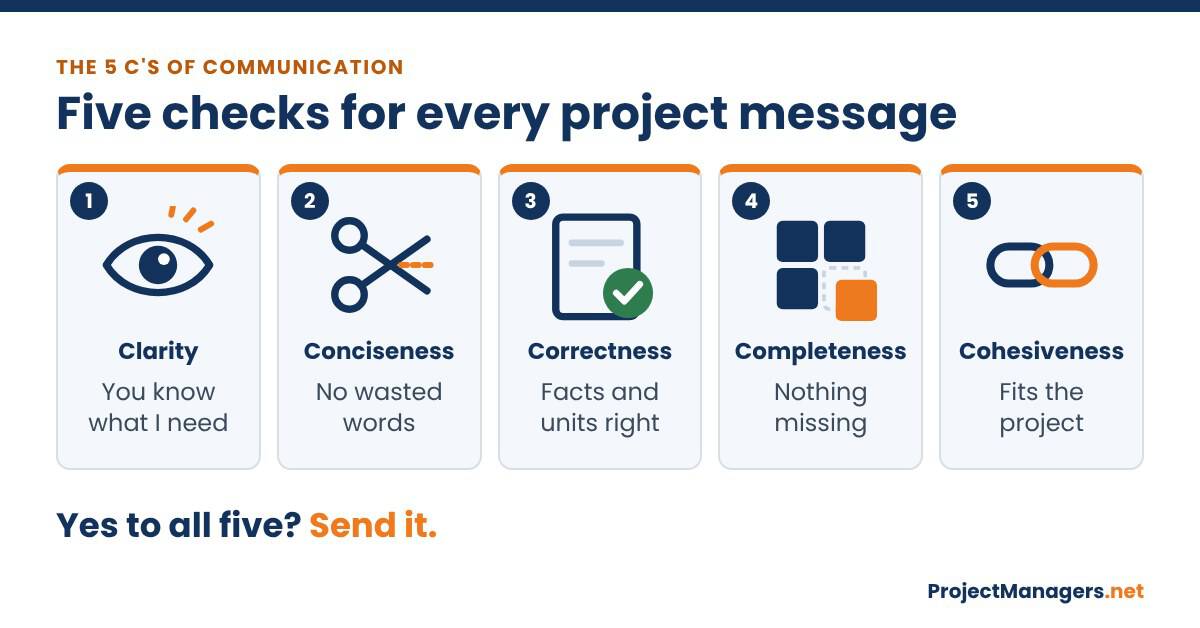
The 5 C’s of communication are five qualities that make a message work: clarity, conciseness, correctness, completeness and cohesiveness. A project manager can use them as a checklist before sending a status report, a change request or any message that asks people to act.
The 5 C’s at a glance
Each C answers one question about your message. If you can answer yes to all five, the message is ready to send.
| The C | Question to ask | Quick fix |
|---|---|---|
| 1. Clarity | Will the reader know exactly what I mean and what I need? | Put the request or decision in the first two lines. |
| 2. Conciseness | Can I remove any word, sentence or paragraph without losing meaning? | Cut filler and move details to a link. |
| 3. Correctness | Are every figure, name, date and unit right? | Check numbers against the plan or tracker before sending. |
| 4. Completeness | Can the reader act without coming back with a question? | Add the owner, the date and the impact. |
| 5. Cohesiveness | Does the message flow logically and match the rest of the project? | Use the same names and one source of truth. |
You will find other versions of the list. Some trainers use 7 C’s, adding qualities such as concrete and courteous, a checklist that MindTools credits to Scott Cutlip and Allen Center. A Forbes Coaches Council article on effective communication uses a different five for difficult conversations: clear, concise, compelling, curious and compassionate. For written project communication, the five in this guide are the most practical, because each one maps to a mistake project managers make every week.
Why the 5 C’s Matter for Project Managers
A project is a chain of decisions made by many people with partial information. Every message the project manager sends either keeps that chain moving or adds a delay. The numbers show how costly the second case is:
- In its 2013 Pulse of the Profession study, PMI found that ineffective communication puts 56% of the money at risk on projects at risk, and that one in five projects is unsuccessful because of it. Only about one in four organizations rated their communication as highly effective. (PMI)
- A Grammarly and Harris Poll survey of 1,252 US workers estimated that poor communication costs US businesses up to $1.2 trillion a year, or about $12,506 per employee. (Business Wire)
- Microsoft’s 2023 Work Trend Index found that 68% of workers lack enough uninterrupted focus time, and that the average employee spends 57% of their time communicating in meetings, email and chat. (Microsoft)
For a project manager, the cost shows up as rework, slipped dates and stakeholders who learn about problems too late. Good messages also save the team’s time: when every update follows the 5 C’s, people read less, ask fewer follow-up questions and make decisions faster. A communication plan decides who gets what and when; the 5 C’s decide whether each message actually works.
Free 5 C’s Message Checker
Paste a project email, status update, escalation or task assignment below. The checker scores it on each C and shows exactly what to fix:
- Pick the message type and main audience. Executives get a shorter word target than the project team.
- Paste your subject line and message. The tool opens with a vague status email so you can see how it works.
- Tick the three own checks once you have verified your facts. No tool can tell whether your numbers are true.
- Read the score for each C, the list of fixes and your marked-up message, then copy the outline for that message type if you want to start over.
Try the “Rewritten status email” example to see the same update after a 5 C’s rewrite. Your draft stays in your browser only, so you can come back to it later.
1. Clarity
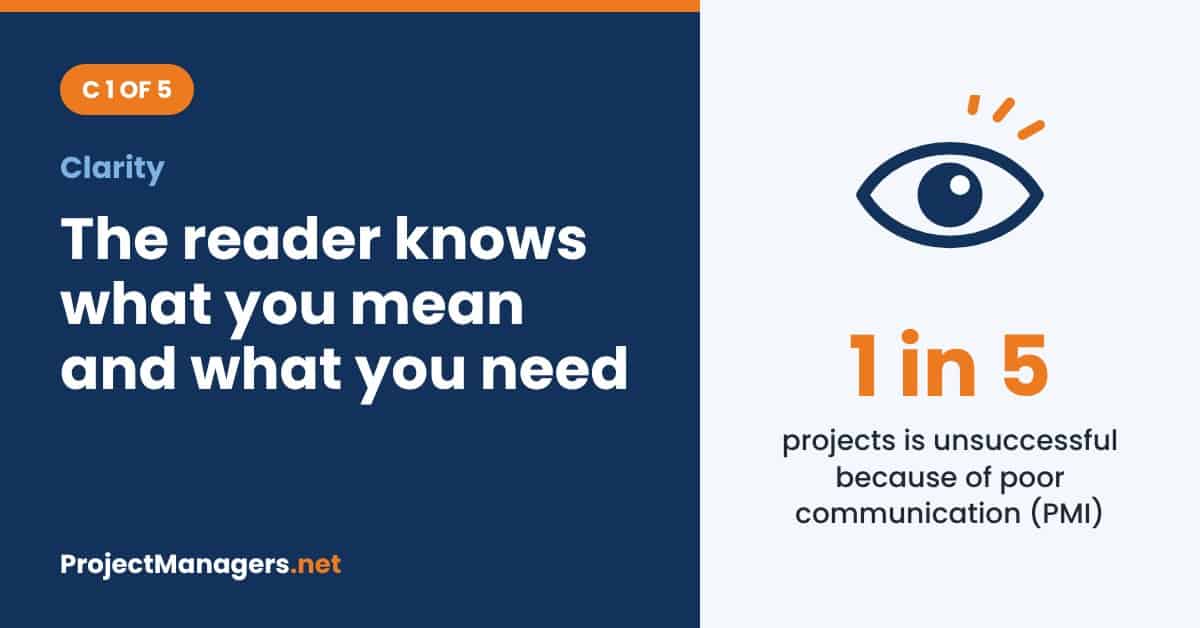
A clear message has one purpose, and the reader can say what it is after reading the first two lines. Clarity is not about simple words alone. It is about making sure the reader takes away the same meaning you intended, including what you need them to do.
Unclear messages are the most common problem in project communication, because the writer already knows the context. “The API issue might push us a bit” makes sense to the project manager who has been in every vendor call. To a sponsor, it says nothing about how late, how much, or what decision is needed.
How project managers write clearly:
- State the purpose first: a status, a decision, a request or “for information, no action needed.”
- Replace vague words such as “soon,” “a few,” “some issues” and “a bit over” with dates, counts and amounts.
- Explain acronyms and technical terms the audience may not know, especially for executives and clients.
- Use visual aids when they help: a simple timeline, a RAG status or a short table often says more than a paragraph.
- Ask questions and invite questions. In meetings, ask people to repeat the next steps in their own words.
Real-life example
The slide that buried the warning
Before the Space Shuttle Columbia broke up in 2003, engineers briefed NASA managers on the foam strike with PowerPoint slides. The investigation board found that the way the key chart was laid out, with its headings and bullet levels, highlighted the reassuring points and left the warnings about uncertainty hard to see. The data was there, but the message was not clear to the people who had to decide.
Source: Edward Tufte, on the Columbia Accident Investigation Board report
From the field
The great enemy of communication, we find, is the illusion of it.
William H. Whyte, Fortune, 1950 (the line often credited to George Bernard Shaw)
By the numbers
2. Conciseness

A concise message says what it needs to say in as few words as possible, without dropping anything the reader needs. Long messages get skimmed, and the important line in paragraph four is the one that gets missed.
Conciseness is about respect for the reader’s time. Instead of “I was wondering if you could maybe do me a small favor,” write “Can you review the test plan by Friday?” The second version is shorter, clearer and easier to act on.
For example, when communicating the project schedule, give each task its start and end dates, its duration and its dependencies in a short table or a link to the plan. Do not narrate the schedule in paragraphs.
How project managers keep messages short:
- Write for the busiest reader. Executives often decide from the subject line and the first sentence.
- Cut filler phrases such as “just wanted to,” “at this point in time,” “in order to” and “basically.”
- Keep sentences to about 20 words, and split anything over 30.
- Use short labeled parts (Summary, Issue, Decision needed, Next steps) instead of long paragraphs.
- Move background and detail to the plan, the risk log or a dashboard, and link to it.
Real-life example
Churchill’s call for brevity
In 1940, with Britain at war, Winston Churchill sent a note to government departments asking for shorter minutes, memos and reports. He asked writers to drop jargon and woolly phrases and to get to the point, because long papers were wasting the time of people who had to make fast decisions. The note was reissued in the 1950s and is still quoted in writing guides today.
Source: The National Archives (UK) blog
From the field
I have made this longer than usual because I have not had time to make it shorter.
Blaise Pascal, Provincial Letters, 1656
By the numbers
- 68%of workers say they do not have enough uninterrupted focus time in the workday.Microsoft, 2023
- 28%of the workweek of interaction workers goes to reading and answering email.McKinsey, 2012
3. Correctness
A correct message has accurate facts, figures, names, dates and units, and it uses correct grammar and spelling. People make decisions from your messages, so one wrong number can travel through the whole project.
If a project status report is full of errors, the sponsor cannot trust it, and the project manager may not see the real risks and issues either. Wrong figures in an update lead to wrong decisions in the project plan, the budget and the schedule. Even small slips, such as the wrong date for a milestone, cost credibility that takes months to rebuild.
How project managers keep messages correct:
- Check every figure against its source: the plan, the budget tracker or the risk register.
- State units, currency and time zones: “5 working days,” “$6,000 USD,” “noon ET.”
- Replace “probably” and “around 10%” with the real number, or say when you will have it.
- Never make claims you cannot back up, and correct errors openly as soon as you find them.
- Read the message once more before sending, or ask a team member to check high-stakes updates.
Real-life example
Mars Climate Orbiter: lost to a unit
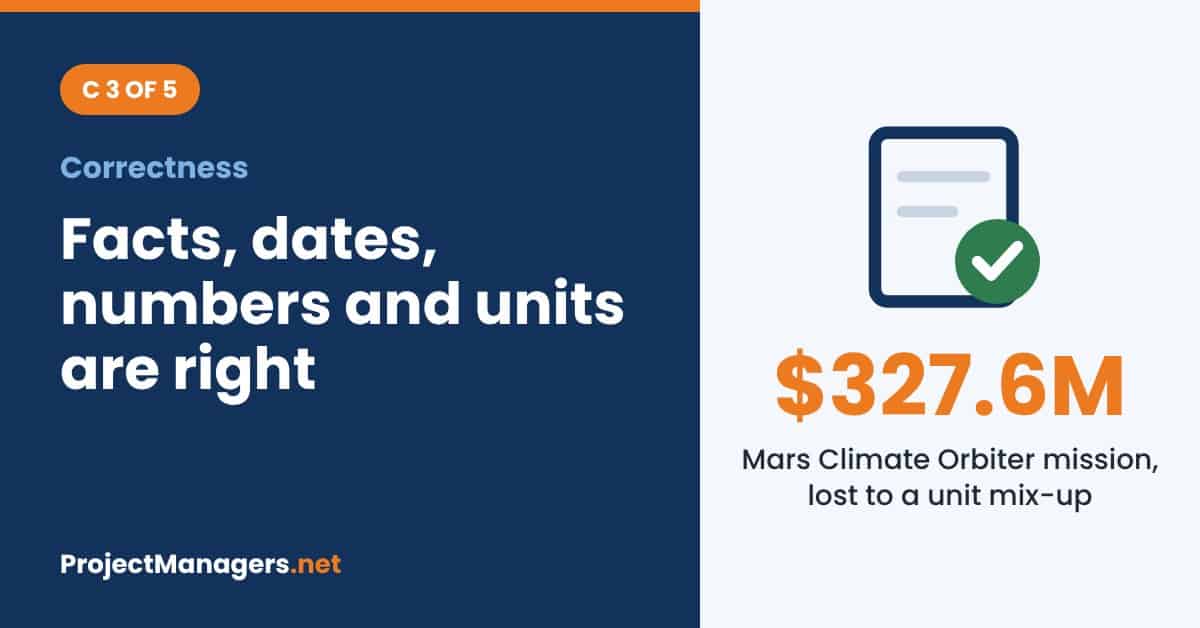
In September 1999, NASA lost the Mars Climate Orbiter as it arrived at Mars. Ground software sent thruster data in pound-force units while the navigation software expected newtons, so every correction was off by a factor of about 4.45. NASA’s later review also found that the teams worked in isolation and that concerns about the trajectory were discussed but never formally raised and resolved.
From the field
The difference between the almost-right word and the right word is really a large matter.
Mark Twain, letter to George Bainton, 1888
By the numbers
- $327.6Mwas the cost of the Mars Climate Orbiter mission.Guinness World Records
- 4.45xwas the size of the error between pound-force and newton values.NASA
4. Completeness
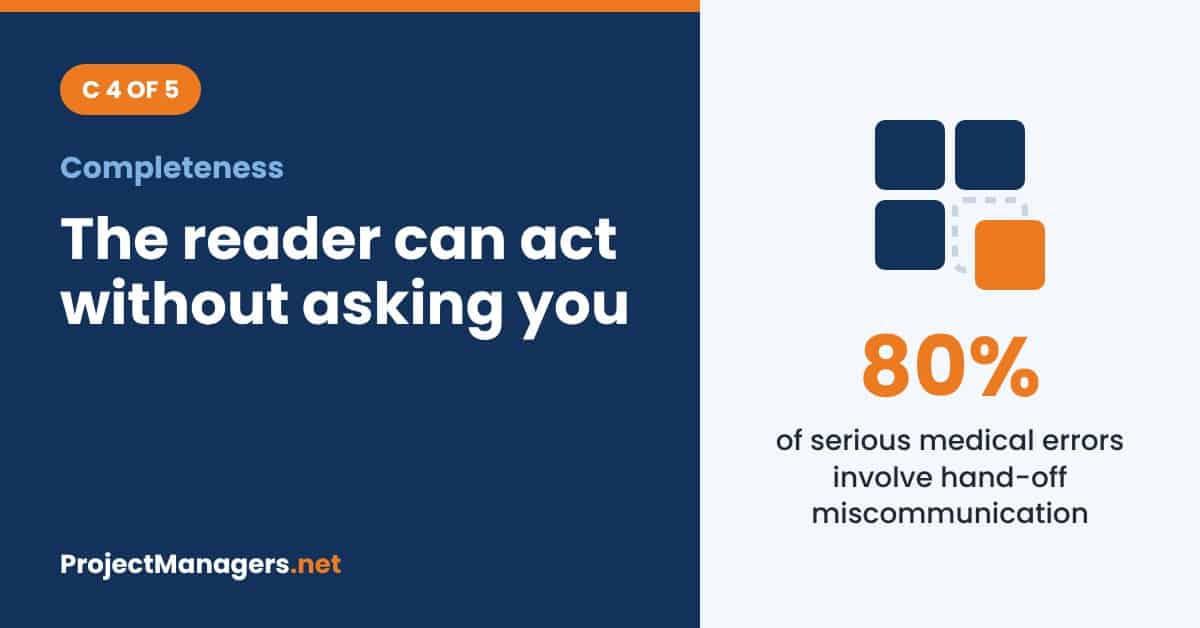
A complete message gives the reader everything they need to understand it and act on it, without coming back with questions. Leaving out a key detail, such as the owner, the due date or the impact, only creates confusion and delay.
Completeness does not mean long. A complete task assignment can be five lines if it covers what to do, who owns it, when it is due and what “done” looks like. The test is simple: could the reader act on this message if you were unreachable for the next two days?
Use actionable words, and match the content to the message type:
What a complete project message includes
Use this as a checklist for the messages project managers send most often. The 5 C’s Message Checker above looks for the same elements.
| Message type | It must include |
|---|---|
| Status update | Overall status, progress, issues and risks with impact, next steps with owners, decision or help needed, specific dates |
| Change request | What changes, why, impact on cost, schedule and scope, options, recommendation, decision date |
| Meeting recap | Decisions, action items, an owner and due date for each action, open questions, next meeting |
| Escalation | The problem, the impact, options considered, your recommendation, the decision needed and by when |
| Task assignment | The task, the owner, the due date with time zone, what “done” means, where to find inputs or help |
For roles and ownership in your messages, a RACI matrix tells you who must be consulted and who only needs to be informed.
Real-life example
The Gimli Glider: a handover with a missing piece
In July 1983, Air Canada Flight 143 ran out of fuel at 41,000 feet over Manitoba. The fuel gauges were out of service, and the crew loaded fuel using a pounds conversion when the new Boeing 767 used kilograms. A handover between pilots also left a wrong impression of how long the gauge problem had existed. The pilots glided the plane to a landing at a former air base in Gimli, and all 69 people on board survived.
Source: Wikipedia, Gimli Glider
By the numbers
- 80%of serious medical errors involve miscommunication between caregivers during hand-offs, according to the Joint Commission.Healthcare IT News
- 52%fewer defective hand-offs at hospitals that fully used the Joint Commission’s hand-off solutions.Healthcare IT News
5. Cohesiveness
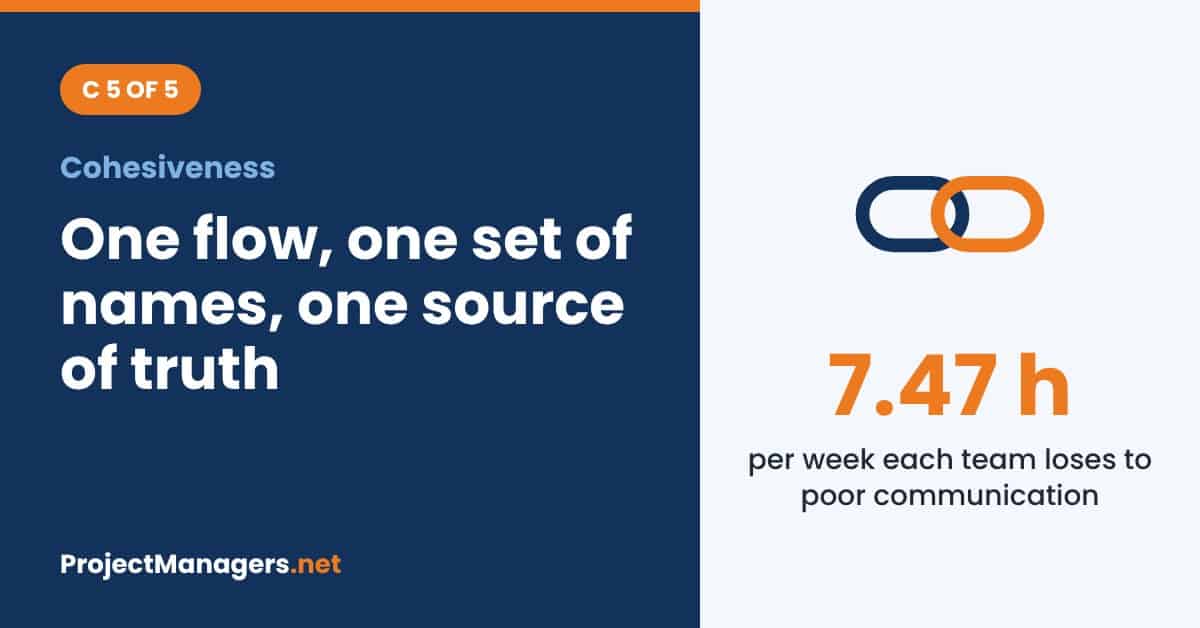
Cohesion is the thread that ties a project together. A cohesive message has a logical flow, with each point leading to the next, and it fits with everything else the project communicates: the same names for tasks and deliverables, the same status scale and the same channels.
Without cohesion, a project can easily unravel. The plan calls it “Phase 2,” the status report says “the integration work” and the vendor says “release B.” Team members waste time working out whether three messages describe the same thing.
There are many ways to foster cohesion in project communication:
- Use common communication platforms, such as Slack or Microsoft Teams, so every team member knows where to look for project news.
- Keep one source of truth (the plan, a dashboard or a project wiki) and link to it instead of copying details into every email.
- Hold regular team meetings, in person or by video, so everyone catches up on the latest project developments and shares ideas.
- Use the same terms, status colors and report format from week to week. A status report template makes this easy.
- Organize longer messages from the most to the least important point, with short labeled parts.
Real-life example
GitLab’s handbook-first approach
GitLab, one of the largest all-remote companies, treats its public handbook as the single source of truth. Team members are expected to look there first, and when something changes, the handbook is updated instead of starting a new document. Because information lives in one place, messages can link to it rather than repeat it, and everyone works from the same version.
By the numbers
- 7.47 hper week is the time leaders estimate each team loses to poor communication.Grammarly and Harris Poll, 2022
- 19%of the workweek of interaction workers goes to searching for and gathering information.McKinsey, 2012
By following the 5 C’s of communication, project managers can make sure every team member is on the same page and that the project keeps moving forward smoothly.
Example: A Status Email Before and After the 5 C’s
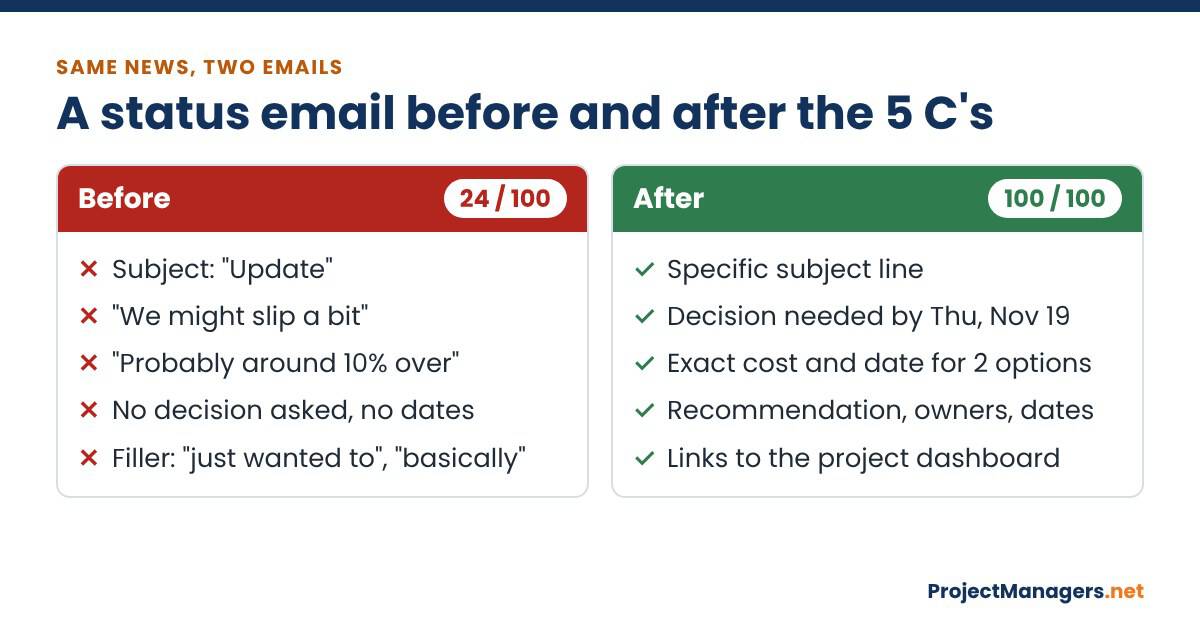
Here is a typical status email to a project sponsor, and the same update rewritten with the 5 C’s. Both are the examples loaded in the checker above.
Same news, two very different emails
Subject: Update Hi all, Just wanted to give you a quick update on where things are at with the portal project. Basically we have been working really hard and most of the stuff is done, but there were a few issues with the API that were found by the team and the vendor is looking into it. We might slip a bit, hopefully not too much, and the budget is probably around 10% over but its hard to say at this point in time. Let me know if you have any questions or concerns. Thanks
Subject: Client portal: status amber, decision needed by Thu, Nov 19 Hi Maria, Summary: The client portal project is amber. We need your approval of $6,000 in extra vendor hours by Thursday, Nov 19 to keep the Dec 1 launch. Done this week: – Login and invoice screens passed user testing (14 of 15 test cases). Issue: – The payment API (the link between the portal and the payment provider) fails on 3% of test payments. The vendor confirmed the bug on Nov 12. Options: – A: Approve $6,000 so the vendor fixes the bug this week. Launch stays Dec 1. Budget ends 4% over. – B: No extra spend. Launch moves to Dec 8. Budget ends 1% over. Recommendation: Option A, because 40 clients expect the Dec 1 date. Next steps: Raj retests the fix on Nov 23. I will send the next update on Nov 24. The plan and risk log are on the project dashboard. Thanks, Sam
The rewrite is longer, and that is fine: conciseness means no wasted words, not the fewest words. Every added line gives the sponsor something needed to decide.
What changed, C by C:
- Clarity: the decision and the deadline are in the first sentence, and the acronym is explained for a non-technical sponsor.
- Conciseness: filler such as “just wanted to,” “basically” and “at this point in time” is gone, and each part has a label.
- Correctness: “probably around 10%” became exact figures for each option, and “a bit” became a specific date.
- Completeness: the update now has a status, progress, the issue and its impact, options, a recommendation, owners and dates.
- Cohesiveness: the subject line matches the message, the parts follow a logical order and the email points to the project dashboard.
Do’s and Don’ts of Effective Communication in Project Management
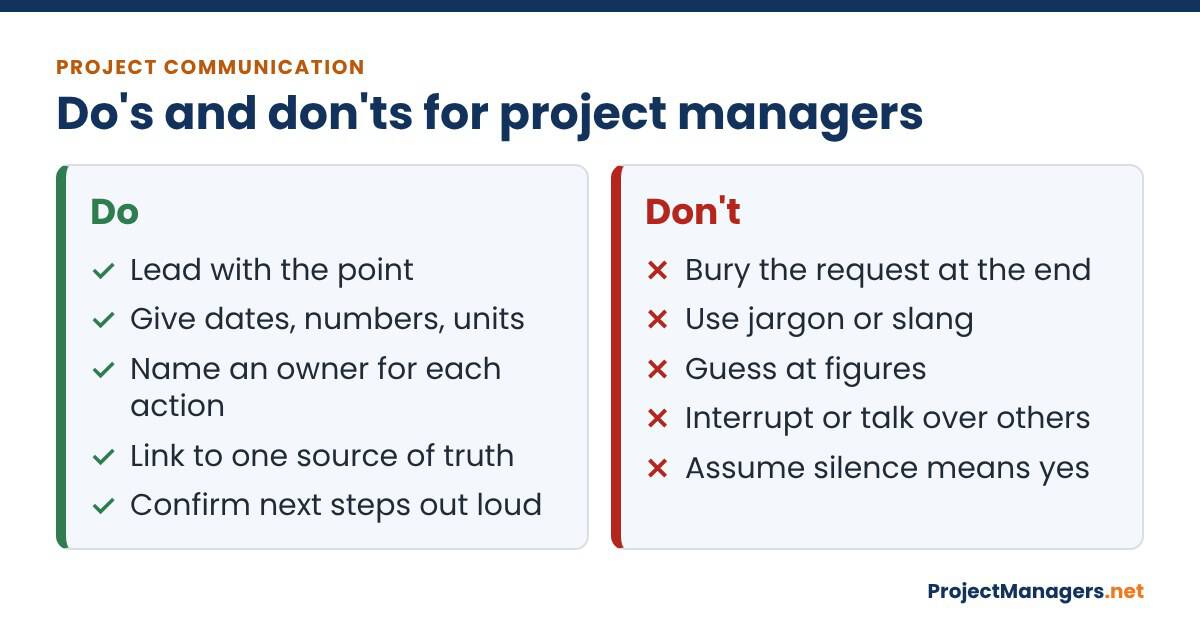
The 5 C’s apply to spoken communication too: in meetings, on calls and in one-to-ones. Keep these do’s and don’ts in mind for both written and spoken messages.
Do’s and don’ts for project managers
Each row pairs a habit to keep with the habit it replaces.
| Situation | Do | Don’t |
|---|---|---|
| Emails and chat | Lead with the point and a specific subject line | Bury the request at the end, or send “Update” as the subject |
| Status reports | Give the status, numbers and dates, then link to details | Guess at figures or write “on track” without evidence |
| Meetings | Speak clearly, at a moderate pace, and confirm next steps out loud | Talk too fast or too slow, interrupt or talk over others |
| Language | Use simple words and explain acronyms and jargon | Use slang, profanity or insider shorthand with clients |
| Bad news | Share it early, with the impact, options and your recommendation | Raise your voice, blame people or wait until the deadline |
| Feedback | Ask questions to check your message was understood | Assume silence means agreement |
When tension rises in a meeting, how you communicate decides whether a disagreement stays healthy. Our guide to the 5 conflict levels in the workplace shows how to spot when a discussion is turning into a conflict.
The 5 C’s of Great Communication
In this short video from Forbes Councils, communication coach G. Riley Mills shares his take on the 5 C’s of great communication.
Video by Forbes Councils on YouTube: The 5 C’s of Great Communication.
5 C’s of Communication Facts Worth Checking
Communication advice is full of numbers and quotes that are repeated without a source. Here is what holds up.
Facts worth checking
Each claim is checked against the original source where one exists.
| Claim | Verdict | What the source says |
|---|---|---|
| There is one official list of the 5 C’s of communication. | False | Lists vary by author. Some use 7 C’s, credited to Cutlip and Center (MindTools), and Forbes coaches use another five (Forbes). |
| George Bernard Shaw said the biggest problem in communication is the illusion that it has taken place. | False | The idea comes from William H. Whyte in Fortune magazine in 1950; the Shaw credit appears only decades later. Quote Investigator |
| Ineffective communication puts more than half of project budgets at risk. | Partly true | PMI found 56% of the money at risk is at risk because of communication, which is $75 million of the $135 million at risk per $1 billion spent, not half of the whole budget. PMI |
| One in five projects is unsuccessful because of ineffective communication. | True | This is a finding of PMI’s 2013 Pulse of the Profession study on communications. PMI |
| Project managers spend 90% of their time communicating. | Partly true | The figure is widely repeated, including in PMI material, but no original study is usually given. Microsoft data shows the average worker spends 57% of their time communicating. Microsoft |
| Poor communication costs US businesses up to $1.2 trillion a year. | True | This is an estimate from a 2021 survey of 1,252 workers by Grammarly and The Harris Poll, not a measured total. Business Wire |
| NASA lost the Mars Climate Orbiter because of a metric and imperial unit mix-up. | True | Pound-force values were read as newtons. NASA also pointed to isolated teams and concerns that were never formally raised. NASA |
| The shorter a message is, the better. | False | Conciseness means no wasted words. A message that leaves out the owner, date or impact fails on completeness and creates more messages later. |
| 80% of serious medical errors involve miscommunication during hand-offs. | True | This is the Joint Commission’s estimate for hand-offs between caregivers. It comes from health care, not project work. Healthcare IT News |
| Most workers have enough time to focus between meetings and messages. | False | In Microsoft’s 2023 survey of 31,000 people, 68% said they lack enough uninterrupted focus time. Microsoft |
FAQs
What are the 5 C’s of communication?
The 5 C’s of communication are clarity, conciseness, correctness, completeness and cohesiveness. They are five qualities a project manager can check before sending any message: is it clear, short, accurate, complete and consistent with the rest of the project?
Why are the 5 C’s important in project management?
Projects depend on many people acting on the same information. PMI found that ineffective communication puts 56% of the budget at risk on projects at risk and makes one in five projects unsuccessful. The 5 C’s reduce rework, follow-up questions and late surprises.
How can I avoid confusion and keep everyone focused?
Communicate clearly, concisely and consistently. Put the point in the first line, give exact dates and owners, share all relevant information in one place and tell people when something changes. Ask questions to confirm everyone understood the instructions.
Are there 7 C’s of communication?
Yes, some trainers use a 7 C’s list, such as clear, concise, concrete, correct, coherent, complete and courteous. The 5 C’s in this guide cover the same core ideas in a shorter checklist that suits project messages.
Which C matters most in an update for executives?
Clarity and conciseness. Executives often decide from the subject line and the first sentence, so lead with the status and the decision you need, keep the message short and link to the details.
Do the 5 C’s apply to meetings and spoken communication?
Yes. In meetings, state the purpose at the start, keep to the agenda, check facts before you quote them, confirm decisions and owners out loud and send a recap that uses the same names as the project plan.
Suggested articles:
- Communication Plan Template for Project Managers
- Communication Strategies Using Email for Project Success
- Communication Channels in Project Management: Formula and Examples

Shane Drumm, holding certifications in PMP®, PMI-ACP®, CSM, and LPM, is the author behind numerous articles featured here. Hailing from County Cork, Ireland, his expertise lies in implementing Agile methodologies with geographically dispersed teams for software development projects. In his leisure, he dedicates time to web development and Ironman triathlon training. Find out more about Shane on shanedrumm.com and please reach out and connect with Shane on LinkedIn.