
Picture a project manager who sends a detailed scope change by email, only to find out a week later that half the team read it differently. The message was sent, but it was never really understood. That gap is exactly what communication in project management is meant to close. In project management, communication is the process of passing information from one person to another. The goal is simple: the receiver should understand the message the sender intends to convey. Reaching that goal is harder than it sounds, because every communication channel has its own strengths and weaknesses, and each works better or worse depending on the situation.
That is why project managers rely on a mix of channels to communicate with stakeholders, from face-to-face meetings and telephone calls to emails and presentations. Face-to-face conversation usually works best for complex or sensitive information, since tone and body language help the message land. Email, by contrast, is fast and efficient, but it makes it easy to misread the sender’s intent.
The Importance of Communication Channels
Effective communication is a critical component of project management, ensuring that all stakeholders remain informed about the project’s progress and any changes that may arise. This is particularly important for facilitating necessary adjustments and equipping key team members with the information they need to adapt successfully.
Choosing the right channel is just as important as the message itself, because the channel shapes how quickly, clearly, and reliably information reaches the people who need it. Here is why communication channels matter so much in practice:
- Keeps Stakeholders Aligned: When updates reach everyone through the right channel, stakeholders share the same understanding of goals, timelines, and priorities. This reduces confusion and keeps the project moving in one direction.
- Reduces Misunderstandings: A message that suits its channel is far less likely to be misread. A complex change in scope is better explained on a call or video meeting than in a short chat message, where tone and nuance can get lost.
- Speeds Up Decision-Making: The right channel gets information to decision-makers quickly. A fast instant message can unblock a team member in minutes, while waiting on a slow email thread can stall progress for days.
- Creates a Clear Record: Written channels such as email provide documentation of what was said, when, and to whom. This is valuable for tracking decisions and resolving disagreements later.
- Supports Remote and Distributed Teams: Video and messaging tools connect people across locations and time zones. This keeps collaboration strong even when team members never meet in person.
- Helps Teams Adapt to Change: When scope, budget, or deadlines shift, timely communication gives the team room to adjust. Without it, small issues can grow into costly problems.
As the number of stakeholders grows, the number of possible communication paths grows even faster. That is why understanding the main channels and how to calculate them is a core skill for any project manager.
5 Most Common Communication Channels
There are five primary communication channels in project management: video, instant messaging, telephone, email, and written. Each has its own strengths and weaknesses, and no single channel is ideal for all situations.
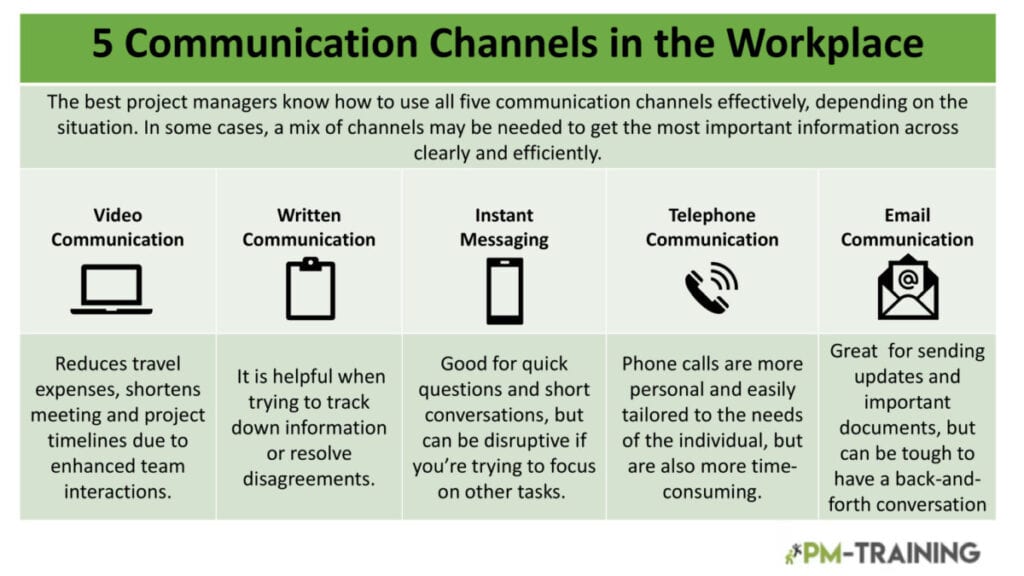
The best project managers know how to use all five communication channels effectively, depending on the situation. In some cases, a mix of channels may be needed to get the most important information across clearly and efficiently.
These are the five main communication channels that are typically used in project management:
1. Video Communication
Video conferencing is essential as it connects individuals who may not have the opportunity to interact face-to-face. It offers numerous benefits, including reduced travel expenses—particularly for employee training—and shorter meeting and project timelines. These advantages stem from improved team interactions and collaboration facilitated by video conferencing.
2. Written Communication
Written communication is one of the most important channels for project managers. This is because it provides a record of what was communicated, when it was communicated, and to whom it was communicated. This can be helpful when trying to track down information or resolve disagreements.
3. Instant Messaging
Instant messaging and online chat are good for quick questions and short conversations, as they allow for immediate responses and efficient communication. However, they can be disruptive if you’re trying to focus on other tasks, as notifications and interruptions may break your concentration. To use these tools effectively, it’s important to set boundaries and designate specific times for engaging in instant messaging.
4. Telephone Communication
Phone calls are more personal and can be more easily tailored to the needs of the individual, but they are also more time-consuming. They allow for real-time interaction and immediate clarification, making them particularly effective for resolving complex or sensitive issues. However, their time-intensive nature can make them less practical for routine updates or when communicating with larger groups. Tools for AI call summary and transcription help offset this by turning each call into a written record that can be shared with stakeholders who weren’t on the line.
5. Email Communication
An email is a great option for sending out updates and important documents, as it provides a clear and organized way to share information. However, it can be challenging to have a back-and-forth conversation using this method due to delays in responses and the lack of real-time interaction. For more dynamic discussions or immediate clarifications, other communication channels may be more effective.
The best project managers know how to use all five communication channels effectively, depending on the situation. In some cases, a mix of channels may be needed to get the most important information across clearly and efficiently.
How to Calculate Communication Channels
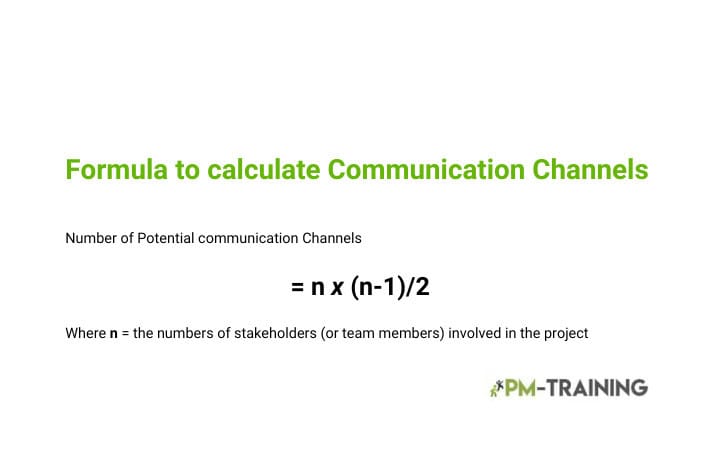
It is important to calculate the communication channels in project management in order to determine the most efficient way to communicate project updates to all stakeholders. The Communication channels formula for calculating the number of communication channels required is Ch = N(N-1)/2.
Where:
- Ch = the number of communication channels
- N = the number of stakeholders
With this information, project managers can determine the best way to communicate project updates to all stakeholders in a timely and efficient manner.
Easy Example of Communication Channels Using the Formula
In order to calculate the communication channels in a project, you first need to determine the number of team members. This can be done by multiplying the number of project roles by the number of people who fill those roles. Once you have the number of team members, you need to calculate the number of communication channels. This can be done by multiplying the number of team members by the number of project stakeholders.
For example, let’s take a look at how it would look with 6 team members.

Communication Channel PMP Questions
1. You are managing a telecommunications project, and 10 Quality engineers are reporting to the project manager. Due to a change in scope requested by your customer, you need to add a team member. You decide to hire 2 more quality engineers. How many communication channels will be increased by this hiring?
A. 21
B. 23
C. 66
D. 78
Answer: B
2. Your project has 13 stakeholders, including the project team. Calculate the total number of communication channels for the project.
A. 78
B. 80
C. 13
D. 91
Answer: A
3. There are two software developers, two quality engineers, 3 database engineers, and 1 product owner in your team. Calculate the number of communication channels
A. 40
B. 36
C. 28
D. 22
Answer: B
Video About Communication Channels Formula
This video dives into a critical concept for every project manager: the Communication Channels Formula. Understanding how communication complexity scales as your team grows is essential for maintaining project clarity. Let’s break down the formula, walk through the math, and see how you can apply it to your next project.
Conclusion
Mastering communication channels is a strategic necessity for every successful project manager. By understanding the unique strengths of video, written, instant messaging, telephone, and email, you can ensure clarity and alignment across your entire team. Choosing the right medium prevents the misunderstandings that often derail complex projects, allowing your vision to be conveyed accurately and effectively to everyone.
As your project scales, remember that the complexity of communication grows exponentially with every new stakeholder. Using the formula Ch = N(N-1)/2 helps you anticipate these challenges before they arise. By planning your communication flow deliberately and matching the channel to the message, you create a streamlined environment where information travels efficiently, and every team member stays informed.
FAQs
What are communication channels?
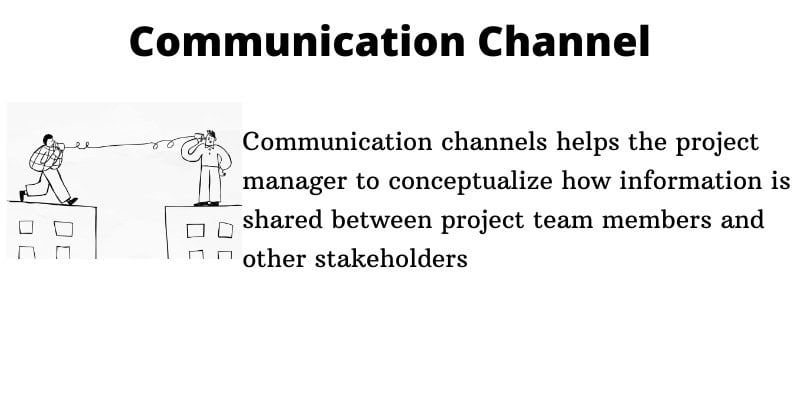
In essence, communication channels facilitate the exchange of information between project managers and stakeholders. They ensure that critical details are conveyed effectively to key team members, enabling the successful completion of the project.
What are the 5 channels of communication?
There are 5 main communication channels that project managers can use, including email, instant messaging, phone calls, and video conferencing. Each of these has its own advantages and disadvantages, so it’s important to choose the right one for your needs.
What is the formula for communication channels?
The formula for calculating the number of communication channels can be expressed as Ch = N(N-1)/2. Where “N” is the number of stakeholders.
Suggested articles:
- What Are The 5 C’s Of Communication In Project Management?
- Project Communication: Your Guide to Effective Project Management
- Communication Strategies Using Email for Project Success

Shane Drumm, holding certifications in PMP®, PMI-ACP®, CSM, and LPM, is the author behind numerous articles featured here. Hailing from County Cork, Ireland, his expertise lies in implementing Agile methodologies with geographically dispersed teams for software development projects. In his leisure, he dedicates time to web development and Ironman triathlon training. Find out more about Shane on shanedrumm.com and please reach out and connect with Shane on LinkedIn.