
Customers now expect instant payments, onboarding in minutes and an app that never goes down. Startups win on speed and personalization, while banks must modernize decades-old systems without breaking trust or regulations. For the project manager in the middle, the hardest decision often comes before the first sprint: which development partner should build it?
- Match the partner to the job, not the ranking. A neobank MVP, a lending engine and a core banking migration need very different teams, budgets and contracts.
- Compliance is shared, never outsourced. A vendor can build to PCI DSS, GDPR or DORA, but your product and your organization still own the audit.
- Budgets vary by 10x. Focused fintech tools often start around $40K to $80K, while client-facing payment or lending platforms commonly run $150K to $500K or more.
- Run the selection like a project. A written brief, the same questions for every vendor, reference checks and an exit plan reduce delivery risk more than any brand name.
Choosing well matters because fintech projects carry more risk than most software work. Secure architecture, regulatory alignment and the ability to scale are as important as features, which is why fintech software development companies play such a decisive role. The right partner helps you navigate compliance rules, integrate legacy systems and deliver an experience customers trust. The wrong one can turn a six-month project into a two-year recovery.
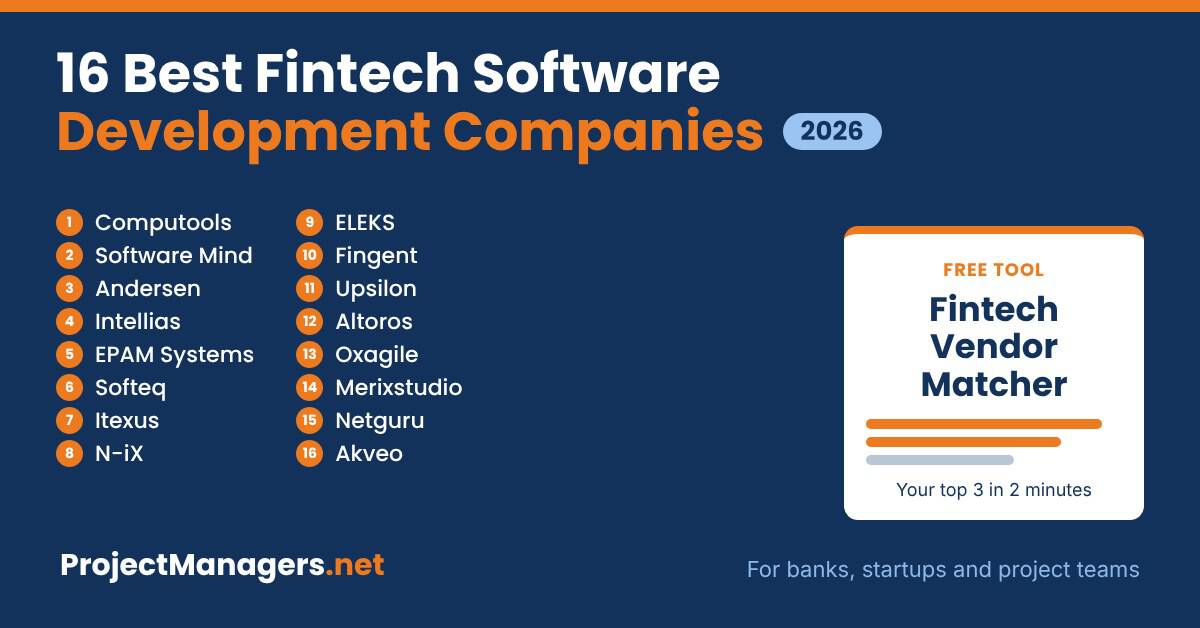
This guide reviews the 16 best fintech software development companies for banks and startups in 2026: Computools, Software Mind, Andersen, Intellias, EPAM Systems, Softeq, Itexus, N-iX, ELEKS, Fingent, Upsilon, Altoros, Oxagile, Merixstudio, Netguru and Akveo. It is written for the project managers, product owners and sponsors who must pick a partner and then deliver with them. Start with the free Fintech Vendor Matcher below to get a ranked shortlist in two minutes.
Free Fintech Vendor Matcher
Sixteen companies that all promise secure, compliant and scalable software are hard to compare. The matcher turns your project into a ranked shortlist, explains why each company fits, flags a watch-out and gives you questions to ask in the first call.
- Pick an example or start from yours. The Neobank MVP example is loaded so you can see how it works.
- Answer questions 1 to 6. Who the project is for, what you are building first, budget, timeline, how you want to work and any time zone or data residency needs.
- Choose up to 3 priorities. These carry the most weight, so pick the ones that would sink the project if they went wrong.
- Read your top 3 and the watch-outs. Each card links to the full review in this article.
- Copy the shortlist. Paste it into your project charter, a decision log or an email to your sponsor.
Tip: your answers are saved in your browser, so you can come back after talking to your team.
Fintech Vendor Matcher
Answer 7 quick questions to rank the 16 companies in this guide, with reasons, a watch-out for each, and questions for your first call.
Your top 3 matches
All 16 companies
Ask in the first call
Scores come from the public information reviewed for this guide in November 2026. Use them to build a shortlist, then confirm fit, price and team in vendor calls. Your answers are saved in this browser only.
What Does a Fintech Development Partner Actually Do?
A fintech software development company designs, builds and maintains financial products: mobile banking apps, payment and wallet systems, lending and credit platforms, wealth and trading tools, and the compliance workflows behind them (KYC, AML, fraud monitoring and regulatory reporting). The visible app is often the smallest part of the project. Most of the effort goes into integrations with core banking systems, payment processors, card networks, identity verification providers and data platforms.
For a project manager, that changes what you are really buying. You are not only buying developers. You are buying architecture decisions that auditors will review, security practices that protect customer money, and a team that will work inside your governance for months or years. That is why delivery maturity, security evidence and team stability count as much as hourly rates.
Fintech projects also have more stakeholders than a typical software project: compliance, risk, legal, information security, operations and often an external regulator. A good partner knows how to produce the evidence each of them needs (architecture records, test results, data flow maps) without slowing the project to a crawl.
How We Chose These 16 Companies
We reviewed each company website, published case studies and public review profiles in November 2026, and kept the companies that met all of the criteria below. The ranking reflects overall fit for banks and fintech startups; the matcher re-ranks them for your specific project.
What Every Company Had to Show
- Published fintech work: banking, payments, lending, wealth, digital assets or compliance projects you can read about.
- Security and compliance practice: certifications such as ISO 27001, or a documented approach to PCI DSS, GDPR, KYC and AML.
- Clear engagement models (project delivery, dedicated teams or staff augmentation) that a project manager can plan around.
- Independent client feedback on platforms such as Clutch.
How the Companies Are Grouped
To make the list easier to scan, the companies are grouped by the kind of project they suit best: full-cycle and enterprise partners, specialists for trading, wealth and lending, modernization and data partners, startup and blockchain builders, and design-led product teams. Some companies on this list may have a commercial relationship with ProjectManagers.net; this does not change the facts we report, and every company is described with the same structure, including a watch-out.
The 16 Fintech Development Companies at a Glance
The 16 Fintech Development Companies Compared
Founding year, base and services checked on each company website and public profiles in November 2026. Ask every vendor for a quote based on your own scope.
| Company | Founded, base | Best for | Engagement |
|---|---|---|---|
| #1 Computools | 2013, New York | End-to-end fintech delivery, KYC, fraud, payments | Project, dedicated team |
| #2 Software Mind | 1999, Poland | Scaling cross-functional teams | Dedicated team, augmentation |
| #3 Andersen | 2007, Warsaw | Large multi-stream programs | Project, team, augmentation |
| #4 Intellias | 2002, Lviv origin | Cloud and data modernization | Dedicated team |
| #5 EPAM Systems | 1993, Newtown PA | Global banks, capital markets | Large programs |
| #6 Softeq | 1997, Houston | Trading, wallets, secure devices | Project |
| #7 Itexus | 2013, USA | Wealth, lending, banking apps | Project, dedicated team |
| #8 N-iX | 2002, Lviv origin | Nearshore modernization | Dedicated team, augmentation |
| #9 ELEKS | 1991, Ukraine and Estonia | Risk analytics and forecasting | Discovery, project, team |
| #10 Fingent | 2003, USA and India | Lending and back-office automation | Project |
| #11 Upsilon | 2012, USA | Startup MVPs in about 3 months | Fixed-scope MVP |
| #12 Altoros | 2001, USA | Blockchain, tokenization, DeFi | Project, consulting |
| #13 Oxagile | 2005, USA and Europe | Payments, credit, KYC and AML | Project, dedicated team |
| #14 Merixstudio | 1999, Poznan | UX-driven consumer apps | Project |
| #15 Netguru | 2008, Poznan | Design-first banking and wallets | Product team |
| #16 Akveo | 2015, Warsaw, Vilnius, Austin | Compliance-ready builds, MVP to enterprise | Team, project, augmentation |
Full-Cycle and Enterprise Fintech Partners
These five companies can take on large, regulated programs and cover most roles in-house. They suit banks, insurers and fast-growing fintechs that need one accountable partner.
1. Computools: Strategic Partner for End-to-End Fintech Delivery
Computools takes the top spot because it covers the whole delivery path a project manager has to coordinate: discovery, architecture, build, compliance evidence and long-term support. Its fintech software development services span digital banking, payment orchestration and reconciliation, digital wallets, open banking API integration, KYC and KYB onboarding, and regulatory reporting automation. The New York headquartered company says it has more than 250 experts, 400+ delivered projects and 20+ fintech projects, with ISO 9001 and ISO 27001 certified processes.
What stands out for a project team is how Computools frames work as time-boxed outcomes. Its fintech page describes 90 to 120 day builds for fraud, reconciliation and open banking layers, and an MVP or single module in one to three months. In one published case, a European finance provider cut false positives by 52 percent and confirmed fraud cases by 41 percent after Computools built a real-time fraud detection and automated KYC platform. Clients rate the company 4.9 on Clutch across more than 100 reviews, and several reviewers single out its project management.
Key strengths
- Compliance-first architecture for PCI DSS, GDPR and DORA
- Legacy core and API integration without stopping operations
- Fixed delivery windows with target outcomes
- Microsoft and AWS partner, IAOP Global Outsourcing 100
Watch out: With about 250 experts, Computools is mid-sized. For a multi-country core banking replacement, ask how they would ramp the team and who backs up key roles.
Project manager tip: Ask for the 90-day plan in writing: scope, target outcome and the evidence your auditors will receive. It becomes the baseline for your project schedule and change log.
2. Software Mind: Scalable Engineering Teams for Financial Services
Software Mind is a Poland-headquartered engineering company with 1,600+ experts, 25+ years in business and 350+ clients, according to its website. Financial services is one of its core industries, with dedicated offers for fintech consulting, fintech app development and open banking software development. Its client list includes Backbase, Baillie Gifford, Finago Procountor and Mortgage Advice Bureau.
For a project manager, the appeal is capacity and continuity. Software Mind builds cross-functional teams (developers, QA, DevOps, UX and data specialists) that plug into your delivery process, and it now runs an AI-accelerated software development lifecycle in which engineers approve every plan and every merge. Delivery centers in Latin America give North American teams workday overlap, while its European centers serve EU clients.
Key strengths
- Large bench for long programs
- Open banking and digital banking platform work
- Cloud partnerships with AWS, Microsoft and Google Cloud
- Delivery centers in Europe and Latin America
Watch out: Software Mind also serves telecom, iGaming and life sciences. Ask to meet the financial services leads who would actually join your project.
Project manager tip: Write the team composition and replacement rules into the contract, including notice periods and overlap days for handovers. It protects your schedule when people rotate.
3. Andersen: Enterprise-Scale Financial Engineering
Andersen is a Warsaw-headquartered software development company founded in 2007, with development centers across Europe and offices in the UK and the US. Its financial services practice covers banking, insurance, investing, lending and crypto software, and its published cases include work for BNP Paribas and the lender MogoFinance. Industry listings put the team at more than 3,500 professionals, and Andersen has 100+ reviews on Clutch.
Andersen fits projects where you need many roles at once: business analysts, architects, QA engineers, DevOps, project managers and security specialists. Legacy modernization, penetration testing and managed support are all offered in-house, which reduces the number of vendors a project manager must coordinate. It also publishes research on data governance for financial institutions.

Key strengths
- Full bench: analysts, architects, QA, security, PM
- Banking, lending and insurance experience
- Legacy modernization and cloud migration
- Flexible staffing that scales up or down
Watch out: Large vendors can rotate people often. Ask who stays on your account after kickoff and what retention looks like on projects longer than a year.
Project manager tip: Ask the vendor to fill in your RACI matrix before signing, so ownership of security testing, release approvals and data migration is clear from day one.
4. Intellias: Cloud-Native and Data-Driven Banking
Intellias was founded in 2002 in Lviv and now employs close to 3,000 people, with offices in Poland, Ukraine, Spain, Portugal, the UK and the US. Financial services is one of its main domains, and fintech clients such as Zolva and Smava have reviewed its work on Clutch.
Intellias is strongest where the problem is technical depth: rebuilding data pipelines, event-driven architectures, real-time transaction monitoring, open banking integrations and migration from legacy cores to the cloud. It suits project managers running a long transformation where performance under load and regulatory alignment with PSD2 and GDPR both matter.
Key strengths
- Cloud engineering on AWS, Azure and Google Cloud
- Real-time transaction and AML analytics
- Complex third-party integrations
- Mature European delivery hubs
Watch out: Intellias gives its best value on long programs. A small, fast MVP may not get its strongest team, so confirm who would be assigned.
Project manager tip: Agree on non-functional requirements (latency, uptime, recovery time) early and put them in your acceptance criteria, not only in the functional backlog.
5. EPAM Systems: Mission-Critical Platforms at Global Scale
EPAM is a NYSE-listed engineering company founded in 1993 and headquartered in Newtown, Pennsylvania, with roughly 60,000 employees in more than 55 countries. Financial services is one of its largest verticals, and its acquisition of First Derivative expanded its capital markets and banking expertise.
EPAM is the pick when uptime and scale are non-negotiable: payment rails, trading ecosystems, risk management and regulatory reporting for global institutions. Its DevSecOps maturity and governance hold up to audits by large banks. For a project manager, EPAM brings structure: program management offices, delivery metrics and multi-year roadmaps.
Key strengths
- Decades of work with top-tier banks
- Mature DevSecOps and security governance
- Capital markets and trading expertise
- Multi-year transformation programs
Watch out: EPAM is priced and staffed for large institutions. Startups and small budgets are rarely a good fit.
Project manager tip: On programs this size, set up a joint steering committee with clear escalation paths, and pair the weekly status report with a monthly benefits review.
Specialists for Trading, Digital Assets and Wealth
These teams go deep on a narrower set of products. They suit projects where domain knowledge or security engineering matters more than headcount.
6. Softeq: High-Security Engineering for Trading and Digital Assets
Softeq is a Houston-based engineering company founded in 1997 that builds software, firmware and hardware. In financial technology, it works on trading platforms, crypto wallets, secure transaction systems and real-time monitoring, where encryption and fraud analytics matter as much as features.
Its mix of embedded and cloud engineering is useful for fintech projects that touch devices, such as payment terminals, hardware wallets or kiosks. It is a good fit for a project manager who wants one team to own the device, the backend and the security review.
Key strengths
- Cryptography and secure transaction design
- Trading, blockchain and wallet experience
- Embedded plus cloud engineering
- Secure-by-design architectures
Watch out: Fintech is one of several industries Softeq serves. Ask for trading or wallet case studies, not only IoT projects.
Project manager tip: Put a third-party penetration test in your project schedule before go-live and reserve time to fix findings. Our security risk assessment checklist helps you plan it.
7. Itexus: Fintech Specialist for Wealth, Lending and Banking Apps
Itexus is a US-registered company founded in 2013 that concentrates on custom software for financial services: banking apps, digital lending platforms, wealth management systems, robo-advisors and credit scoring engines. Its engineers combine machine learning with financial product design.
Because nearly all of its work is fintech, Itexus teams tend to arrive knowing the domain (amortization schedules, KYC tiers, suitability rules), which shortens discovery. That matters for a project manager on a tight MVP timeline.
Key strengths
- AI-driven investment and scoring platforms
- Lending, PFM and wealth-tech apps
- Machine learning for financial analytics
- Comfortable with startup budgets
Watch out: Itexus is a smaller company. Check bench depth if you plan to scale beyond 10 to 15 people.
Project manager tip: Use discovery to produce a short decision log on build versus buy for scoring, KYC and payment providers. It prevents the same debate from returning every sprint.
Modernization, Data and Automation Partners
These companies are strongest behind the scenes: cloud migration, data platforms, risk analytics and back-office automation for banks and lenders.
8. N-iX: Nearshore Modernization Partner for Banks and Fintechs
N-iX was founded in 2002 in Lviv and says it now has 2,400+ engineers in 10 countries. It has worked with fintech clients since 2010, including a cross-border payment engine for Currencycloud and a peer-to-peer lending platform for a UK fintech, and lists Raisin, Credit Agricole and Globacap among its financial clients. It holds ISO 27001 and ISO 9001 certifications.
N-iX shines in modernization: moving cores and data to the cloud, building lending and payment engines, and maintaining platforms for years. For project managers, its strength is stable, long-running teams in time zones that overlap with European business hours.
Key strengths
- Payments, lending and open banking experience
- Cloud migration and data platforms
- ISO 27001 and ISO 9001 certified
- Stable, long-running dedicated teams
Watch out: N-iX is strongest as a long-term dedicated team. Fixed-price, fixed-scope work is less its default model.
Project manager tip: For a long engagement, hold quarterly vendor reviews with a scorecard (velocity, defects, retention). Our guide to effective vendor management shows how.
9. ELEKS: Advanced Engineering for Data-Intensive Financial Systems
ELEKS has been building software since 1991 and is known for its R&D and data science culture. In 2009 it co-founded the Lviv IT Cluster with N-iX and SoftServe. In finance, it builds forecasting systems, risk dashboards, portfolio analytics and digital banking solutions.
ELEKS is a good partner when your project is mostly about decisions: pricing, risk, liquidity or portfolio models that leadership will rely on. It often starts with discovery or a proof of concept to validate the data before a full build, which helps a project manager control scope risk.
Key strengths
- 30+ years of enterprise engineering
- Forecasting, risk modeling and analytics
- Strong R&D and proof-of-concept practice
- Solutions for complex decision-making
Watch out: Their edge is analytics. For a consumer payments app, compare ELEKS with a product-led studio before deciding.
Project manager tip: Data cleaning and validation are usually the critical path. Log them as risks in your risk register with owners and dates.
10. Fingent: Automation-Focused Engineering for Banks and Lenders
Fingent was founded in 2003 and has offices in the US, India, the Middle East and Australia. Industry listings credit it with 600+ professionals and 700+ completed projects, with Mastercard and PwC among its clients. Its fintech work focuses on internal operations: loan origination, underwriting workflows, document automation and compliance operations.
For project managers in lending or bank operations, Fingent’s value is removing the manual steps that slow approvals. It combines automation (RPA and AI document processing) with cloud and API engineering. If you are also replacing a servicing platform, see our list of loan servicing software options.

Key strengths
- Deep process automation expertise
- Credit engines and underwriting workflows
- Cloud and API engineering
- Focus on accuracy and auditability
Watch out: Fingent’s focus is the back office. Customer-facing banking apps are not its main showcase.
Project manager tip: Measure the current cycle time (application to decision) before the build so you can prove the benefit after go-live.
Startup, Blockchain and Payments Builders
These partners move fast on defined products: an MVP, a blockchain platform or a compliant payments and credit engine.
11. Upsilon: Rapid MVP Builder for Fintech Startups
Upsilon is a product studio founded in 2012 that works with early-stage startups and scaleups. It offers discovery, rapid prototyping and MVP development in about three months, plus CTO-as-a-service and team extension. The team is small, around 60 people, with published rates in the $25 to $49 per hour range.
For a fintech founder or product manager, Upsilon is a way to get a budgeting app, lending MVP or payments prototype in front of users and investors quickly. It works in two-week sprints and builds modular architectures so the product can grow after launch.

Key strengths
- Fast MVP delivery
- UX-first product development
- Startup-friendly budgets and rates
- Experience across consumer fintech categories
Watch out: Upsilon is built for startups. Regulated bank projects need a partner with deeper compliance delivery.
Project manager tip: Even for an MVP, define the regulatory must-haves (KYC provider, where data is stored, audit logging) before sprint 1. Retrofitting them later costs more.
12. Altoros: Blockchain, Digital Assets and DeFi Engineering
Altoros has been an engineering company since 2001, with deep roots in cloud platforms and distributed systems. In finance, it builds blockchain payment systems, smart contracts, tokenization platforms and digital identity modules, and advises enterprises entering digital assets.
Altoros is useful when the hard part of your project is architecture: which chain, which custody model, how to connect on-chain logic to existing systems, and how to keep it secure. That guidance helps a project manager avoid expensive rework after launch.
Key strengths
- Smart contract and distributed systems engineering
- Tokenization and digital asset platforms
- Cloud-native infrastructure expertise
- Architecture guidance for compliance and security
Watch out: Altoros is a niche pick. If blockchain is only a small part of your product, a generalist may cost less.
Project manager tip: Budget for an independent smart contract audit and plan the release around it. Audit findings often move the go-live date.
13. Oxagile: Compliance-Focused Payments and Credit Platforms
Oxagile has built custom software since 2005 and specializes, on the fintech side, in systems where compliance, fraud prevention and data privacy are critical. Its teams build secure onboarding, KYC and AML automation, fraud detection tools, credit decision engines and payment gateways.
Oxagile designs for audit-ready workflows and secure data architecture, which suits institutions that cannot compromise on compliance. It also publishes practical guidance on choosing a fintech development partner, which is a useful sign of how it thinks about engagements.

Key strengths
- Strong AML and KYC engineering
- Secure payment and credit systems
- Data privacy by design
- Audit-ready, reliable workflows
Watch out: Oxagile is also known for video streaming work. Ask how many people on your team have shipped payments or KYC projects.
Project manager tip: Ask for a requirements traceability matrix that links each regulatory control to a test case. It turns compliance into something you can track in the project plan.
Design-Led and Product-Focused Teams
These companies compete on the customer experience and flexible delivery. They suit consumer fintechs and institutions that need one team from MVP to scale.
14. Merixstudio: UX-Driven Builder of Consumer Finance Apps
Merixstudio is a Poznan-based studio founded in 1999 that has served more than 350 clients. It is known for a human-centered approach to product design backed by solid backend engineering, and it builds budgeting apps, lending platforms, investment tools and consumer banking interfaces.
Merixstudio makes complex financial steps feel simple, which helps startups improve onboarding completion, engagement and retention. For a product or project manager, its design sprints are a fast way to test flows with real users before committing the build budget.
Key strengths
- UX-first philosophy
- Solid backend for complex APIs
- Lending and budgeting app experience
- Focus on clarity, usability and trust
Watch out: Merixstudio is a boutique team of under 100 people. Plan who will own compliance work and scaling after launch.
Project manager tip: Track design decisions and the user evidence behind them. It shortens debates with stakeholders and keeps scope stable.
15. Netguru: Design-First Partner for Digital Banking Apps
Netguru is a Poznan-founded software and design company (2008) that works with banks, neobanks and fintech startups. It builds mobile banking apps, digital wallets, savings platforms and fintech SaaS products, with strong product strategy and UI and UX design.
Netguru’s attention to user behavior helps financial brands stand out in crowded markets. It suits project managers whose success metric is adoption: app store ratings, onboarding completion and active users.
Key strengths
- Premium mobile and web design
- Product strategy capabilities
- Popular with fast-growing fintech brands
- Intuitive financial UX
Watch out: Netguru is design-led and priced accordingly. Core banking and back-office rebuilds are not its focus.
Project manager tip: Agree on the product metrics (activation, retention, store rating) at kickoff and review them at every sprint demo, not only feature completion.
16. Akveo: Compliance-Ready Custom Fintech Engineering for Banks and Startups
Akveo is a custom software development company, active since 2015 with offices in Warsaw, Vilnius and Austin, that specializes in financial technology. It builds digital banking apps, payment and e-wallet systems, wealth and portfolio management platforms, trading tools and AI-powered lending engines, from discovery and architecture to deployment and support.
Its recent work shows the range: an AI financial assistant for WealthFluent launched in six months, and a cross-platform mobile banking app that won two awards. Akveo designs around PCI DSS, GDPR and KYC and AML requirements, and offers three ways to work (dedicated team, project-based delivery and staff augmentation), which makes it a flexible choice for both startups and established institutions. A partner at PwC is among the clients who recommend it.
Key strengths
- Full-cycle fintech software development services, from MVP to enterprise platforms
- Banking apps, lending, payments and wealth management
- AI and generative AI for fraud detection, credit scoring and automation
- Dedicated team, project and staff augmentation models
Watch out: Akveo states that its compliance badges describe the frameworks it builds for, not certifications it holds. Map controls to your own audit plan.
Project manager tip: Akveo publishes cost ranges by product type. Use them to sanity-check your budget before the first call, then ask what drives the estimate up or down.
How to Choose a Fintech Partner in 30 Days
Vendor selection is a small project in its own right. Give it a sponsor, a deadline and a written decision. This four-week plan works for most bank and startup projects.
- Week 1, write the brief. Describe the outcome, users, regulators, must-integrate systems, budget band and deadline on two pages. Add your top risks from your project risk register.
- Week 2, shortlist and send the same questions. Use the matcher to pick three to five companies and send each the same request for information, so answers are comparable.
- Week 3, test the team, not the sales deck. Interview the proposed tech lead and project manager, ask for a short paid discovery or technical workshop, and call at least one financial services reference.
- Week 4, negotiate the contract. Lock in the named team and replacement rules, IP ownership, security obligations, audit rights, DORA-style resilience clauses if you operate in the EU, and an exit plan with handover of code and documentation.
Before signing, check the vendor the way your security team checks any supplier. Our guide to the best third-party risk management tools shows how to assess and monitor vendors without a large risk team. Then build the delivery plan together with your partner, using the same structure you would for an internal team, as in our 10 steps to write a project plan.
Fintech Delivery by the Numbers
Sources: Akveo fintech FAQ and the Computools fintech page, checked November 8, 2026. Vendor-reported figures: treat them as benchmarks, not quotes.
Fintech Vendor Facts Worth Checking
Vendor marketing and industry lists repeat a few claims that deserve a second look. Here is what we found when we checked them.
Common Claims About Fintech Vendors, Checked
| Claim | Verdict | What we found |
|---|---|---|
| A vendor with PCI DSS experience makes your product compliant. | False | Compliance depends on your architecture, hosting, third parties and processes. Vendors such as Computools and Akveo say plainly that they build to support standards, not that the product is automatically compliant. |
| A fintech MVP takes at least a year. | False | A focused MVP or module can ship in 1 to 3 months. Platforms with many integrations, data migration and regulatory reviews often take several months or more. |
| A bigger vendor is always safer for a bank. | Partly true | Large vendors bring bench depth and governance, but a smaller specialist can staff senior people on a mid-size project. Judge the named team, not the headcount. |
| DORA only matters to EU banks. | False | DORA has applied since January 17, 2025 to a wide range of EU financial entities, and it shapes their contracts with ICT providers anywhere in the world. |
| Eastern European teams cost less for similar quality. | Partly true | Rates are often lower than US or Western European teams, and several vendors here deliver from Poland or Ukraine. Total cost still depends on seniority, time zone overlap and rework. |
| A 4.9 Clutch rating proves fintech skill. | Unproven | Ratings cover all industries. Filter reviews by financial services, project size and recency, and call at least one fintech reference. |
Sources: vendor websites linked in this article and the EU Digital Operational Resilience Act (Regulation (EU) 2022/2554), checked November 8, 2026.
Video: What Is Fintech?
What Is Fintech? A Quick Primer
CNBC International explains what fintech covers, from payments and lending to digital banks, and why it is pushing traditional banks to change. It is a useful two-minute brief for sponsors and team members who are new to financial technology projects.
Fintech Software Development Companies FAQ
Fintech Development Partners: Your Questions Answered
What does a fintech software development company do?
It designs, builds, integrates and maintains financial software such as banking apps, payment systems, lending platforms, wealth tools and compliance workflows. The best partners also help with architecture, security testing, regulatory evidence and the integrations with banks, payment processors and KYC providers that make up most of the work on a fintech project.
How much does fintech software development cost?
It depends on scope and team. Akveo cites $40,000 to $80,000 for a focused internal tool or dashboard and $150,000 to $500,000 or more for a client-facing lending, payments or wealth platform. Computools puts a straightforward project of up to three months at around $50,000. Integrations, data migration and compliance requirements are what push budgets up.
How long does it take to build a fintech MVP?
A focused MVP, single module or integration can often ship in one to three months. Upsilon, for example, offers MVP development in about three months. Payment platforms, digital wallets, compliance systems and core modernization usually take several months to more than a year.
Which compliance standards should a fintech development partner know?
At a minimum: PCI DSS for card data, GDPR or other privacy laws, KYC and AML rules, and open banking rules such as PSD2 in Europe. SOC 2 matters for many US buyers, and EU financial entities must also meet DORA, which applies to their ICT providers through contracts. Ask for examples of each on past projects.
Should a bank choose a large vendor or a fintech specialist?
Choose by the job. Large vendors such as EPAM, Andersen or N-iX suit multi-year programs that need many roles and strict governance. Specialists such as Itexus, Oxagile or Upsilon can move faster on a defined product. Many banks use both: a large partner for the core program and a specialist for a customer-facing app.
How do I manage an outsourced fintech development project?
Treat the vendor as part of your project team: a shared backlog, a RACI for approvals and security testing, a risk register with regulatory risks, weekly status reports and a quarterly vendor review. Put team stability, IP ownership, security obligations and an exit plan into the contract before work starts.
Conclusion: Which Company Fits Your Project?
There is no single best fintech software development company, only the best fit for your project. Computools, Software Mind, Andersen, Intellias and EPAM suit regulated programs that need one accountable partner. Itexus, Softeq and Altoros go deep on wealth, trading and digital assets. N-iX, ELEKS and Fingent excel at modernization, data and automation. Upsilon, Oxagile, Merixstudio, Netguru and Akveo are strong choices when speed, compliance-ready payments or the customer experience decide success.
Whatever you choose, manage the partner like part of your project team: a clear brief, the same questions for every vendor, a named team in the contract and regular reviews after kickoff. Use the Fintech Vendor Matcher to build your shortlist, then let the first calls and reference checks make the final decision.
Suggested articles:
- Banking Systems Development: Driving Innovation in Finance
- The Pros and Cons of Using Digital Banking Platforms
- How Effective Vendor Management Improves Project Delivery and Operational Efficiency

Daniel Raymond, a project manager with over 20 years of experience, is the former CEO of a successful software company called Websystems. With a strong background in managing complex projects, he applied his expertise to develop AceProject.com and Bridge24.com, innovative project management tools designed to streamline processes and improve productivity. Throughout his career, Daniel has consistently demonstrated a commitment to excellence and a passion for empowering teams to achieve their goals.