
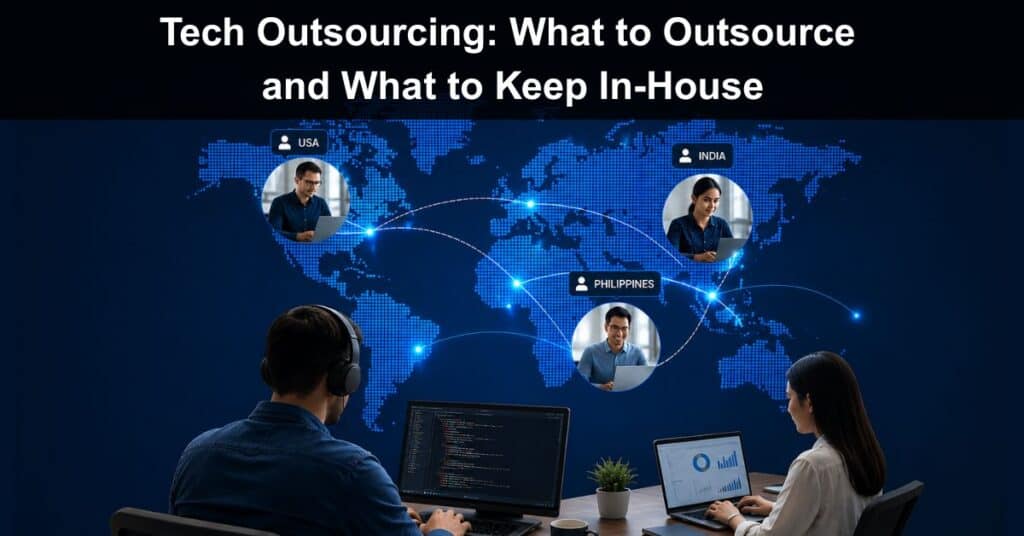
Every tech company eventually faces the same question: which functions belong inside the organization, and which are better handled by outside specialists? Tech outsourcing has become a proven way to control costs, access specialized skills, and move faster without expanding full-time headcount. Companies that get this decision right free up internal resources for the work that truly differentiates them.
At the same time, not every function is safe to hand off. Outsourcing carries real trade-offs, including communication friction, vendor dependency, and exposure of sensitive information. Some tasks are commodity work best delegated to experts, while others sit too close to the company’s competitive edge. Here is how to tell the difference.
Functions Ideal for Outsourcing
Certain business functions are resource-intensive but not tied directly to a company’s unique value, which makes them strong outsourcing candidates. These functions typically require specialized tools, round-the-clock coverage, or compliance expertise that is expensive to replicate internally. The five categories below consistently deliver the strongest return when handed to external specialists.
1. IT Support and Infrastructure
IT support and infrastructure keep every other system running, yet building a fully staffed internal team is costly, especially for round-the-clock coverage. Outsourcing IT support typically costs less than hiring equivalent full-time staff while still delivering continuous monitoring and faster incident response. It also removes the burden of keeping pace with constantly shifting security and compliance requirements.
Rising skills gaps in cloud security and zero-trust architecture have made outsourcing even more attractive for smaller teams. Consider these advantages before deciding how to structure support internally:
- Continuous Coverage: External providers typically offer 24/7 monitoring and response, something few internal teams can staff without significant overtime costs.
- Broader Expertise Access: A specialized provider brings a diverse bench of certified engineers rather than relying on one or two generalist hires.
- Predictable Costs: Managed service contracts often shift IT spending from unpredictable capital expenses to a fixed, forecastable monthly fee.
- Faster Issue Resolution: Dedicated support teams typically resolve routine outages faster because monitoring and ticketing are their core focus.
2. Software Development
Software development sits at the heart of most tech businesses, which is exactly why many leaders hesitate to send it outside. Keeping a full development team in-house is expensive, particularly when specialized skills like machine learning or DevOps engineering are only needed for specific projects. Outsourcing lets companies scale engineering capacity up or down without months of recruiting.
Outsourced development also shortens time-to-market, a critical advantage in a fast-moving industry. Several factors explain why this function outsources so effectively:
- Faster Scaling: Adding contract developers takes weeks rather than the months typically required for full-time hiring and onboarding.
- Specialized Skill Access: Outsourced teams often include niche expertise, such as AI integration or cloud-native architecture, that would be costly to hire permanently.
- Reduced Overhead: Companies avoid the cost of benefits, equipment, and office space tied to a larger permanent engineering staff.
- Flexible Engagement Models: Many providers now offer staff augmentation or co-managed arrangements, letting internal teams retain oversight while contractors handle execution.
3. Customer Service
Customer service directly shapes satisfaction and retention, yet most tech companies do not need a large in-house support team to deliver it well. Building multilingual, round-the-clock coverage internally requires significant staffing and infrastructure investment that smaller companies rarely have available.
Partnering with a customer support outsourcing company, such as SupportYourApp (https://supportyourapp.com/), delivers affordable multilingual coverage without sacrificing quality. The result is a rare combination: lower costs paired with a better customer experience. Key reasons this function transfers well include:
- Multilingual Reach: Established providers typically staff agents across multiple languages and time zones, extending coverage that a single in-house team cannot match.
- Scalable Staffing: Support volume can spike during product launches, and outsourced teams can flex capacity without a lengthy hiring cycle.
- Specialized Tools: Support providers often bring dedicated ticketing, chat, and quality-assurance systems already built for high-volume service.
4. Digital Marketing
Digital marketing is sometimes treated as an afterthought by newer tech companies, which is a costly mistake since marketing directly drives brand awareness and growth. Effective marketing today requires advanced tools, data analysis skills, and platform expertise that few small teams have fully in place. A comprehensive digital marketing strategy demands more resources and specialized knowledge than most internal teams can sustain alone.
Outsourcing digital marketing makes practical sense for several reasons:
- Access to Specialized Tools: Agencies typically maintain paid analytics, SEO, and advertising platforms that would be expensive for a small company to license independently.
- Cross-Channel Expertise: External marketers often bring experience across SEO, paid media, content, and social strategy simultaneously.
- Faster Campaign Execution: Established agencies can launch campaigns quickly since creative and technical resources are already in place.
5. HR and Payroll
HR and payroll carry significant compliance risk, particularly for companies operating across multiple locations or countries. External providers help ensure adherence to local labor regulations, reducing the risk of penalties or legal exposure that comes with managing this internally without dedicated expertise.
Beyond compliance, outsourcing HR and payroll delivers the same efficiency and expertise benefits seen in other outsourced functions. These are heavy administrative burdens that rarely need to sit with internal staff:
- Regulatory Compliance: Providers specializing in HR and payroll track changing labor laws across jurisdictions, reducing legal risk for companies with distributed teams.
- Administrative Efficiency: Outsourcing removes time-consuming payroll processing, benefits administration, and recordkeeping from internal staff’s daily workload.
- Scalable Support: As headcount grows, outsourced HR providers can absorb additional volume without requiring the company to expand its own HR department.
Functions That Should Be Kept In-House
Some functions sit too close to a company’s core value proposition, competitive strategy, or sensitive data to safely hand off. Losing direct control over these areas risks diluting the company’s vision or exposing information that competitors could exploit. The three categories below are consistently better managed internally, regardless of company size.
1. Core Business Operations
Core business operations generate a company’s revenue and form the foundation of its value proposition to customers. As the owner or leadership team, maintaining direct control over these operations is essential to protecting the company’s standards, culture, and long-term vision.
- Direct Accountability: Internal teams remain accountable to leadership in ways external vendors, focused on contract terms, typically cannot replicate.
- Consistency of Standards: Keeping core operations internal helps preserve the quality and brand experience customers associate with the company.
2. Product Development and Innovation
Product development requires constant, close collaboration between everyone involved in shaping the company’s direction. Outsourcing this function risks introducing external contributors who lack a deep understanding of the company’s long-term vision, potentially steering the roadmap away from strategic priorities.
- Strategic Alignment: Internal product teams stay closely connected to company goals, reducing the risk of misaligned features or priorities.
- Institutional Knowledge: In-house teams accumulate deep product context over time that outside contributors would need months to rebuild.
3. Strategic Planning and Decision-Making
Strategic planning and decision-making rarely get outsourced, and for good reason. These functions depend on internal knowledge and a thorough understanding of long-term company goals that external partners simply do not have. In-house teams can also react to market changes far faster, which matters when strategy needs to shift quickly.
- Faster Response Time: Internal decision-makers can pivot strategy immediately without the delays that come from coordinating external stakeholders.
- Confidentiality Protection: Keeping strategic planning internal limits the exposure of sensitive competitive information to third parties.
How to Decide What Fits Your Business
Choosing between outsourcing and keeping a function in-house depends less on cost alone and more on how close that function sits to the company’s core value. Recent industry data shows the motivation behind outsourcing has shifted: cost reduction dropped from being the primary reason for 70% of organizations to just 34% today, with companies now prioritizing specialized talent access and faster speed to market instead. That shift matters when weighing a decision.
Use this short framework to evaluate any function before deciding its fate:
- Proximity to Core Value: Functions that directly define the product or brand experience typically belong in-house, while support functions are safer to outsource.
- Data Sensitivity: Highly sensitive data, proprietary technology, or regulated information often calls for tighter internal control rather than third-party access.
- Talent Availability: If specialized skills are scarce or expensive to hire directly, an outsourced partner can close that gap quickly.
- Speed Requirements: Functions requiring rapid, same-day decision-making often perform better internally, where communication overhead is minimal.
Key Takeaways
Tech outsourcing remains one of the most reliable ways for growing companies to reduce costs, gain flexibility, and shorten time-to-market. IT support, software development, customer service, marketing, and HR and payroll all benefit from external expertise without compromising core operations. The right partner extends internal capability rather than replacing strategic control.
Core business operations, product development, and strategic planning should stay firmly in-house, since these functions define a company’s competitive identity and long-term direction. Balancing outsourced flexibility with protected core functions gives tech companies the best combination of speed, cost control, and strategic ownership as they scale.
Frequently Asked Questions About Tech Outsourcing
What is the difference between offshore and nearshore outsourcing?
Offshore outsourcing involves partnering with providers in distant time zones, often for lower costs, while nearshore outsourcing uses providers in nearby regions with overlapping working hours. Nearshore providers, particularly in Latin America and Eastern Europe, typically offer costs 20 to 30% below onshore rates while sharing time zones and similar business practices, making real-time collaboration easier.
Is outsourcing cheaper than hiring in-house staff?
Outsourcing often reduces direct costs like salaries, benefits, and equipment, but the full financial picture depends on the function and contract structure. Some specialized services, such as advanced cybersecurity monitoring, can cost significantly less through a managed provider than building an equivalent team internally, since providers spread infrastructure costs across many clients.
How do I protect sensitive data when outsourcing tech functions?
Protecting sensitive data starts with choosing providers that carry recognized security certifications and clearly defined service level agreements covering data handling. Limiting outsourced access to only the systems required for the contracted work, combined with regular security audits, further reduces exposure risk throughout the partnership.
Can small tech companies benefit from outsourcing?
Small companies often benefit the most from outsourcing since they typically lack the budget to build specialized teams internally. According to Clutch, 37% of small businesses now outsource at least one core function, with accounting, IT, marketing, and HR among the most common areas.
What is a hybrid or co-managed outsourcing model?
A hybrid or co-managed model splits responsibility between an internal team and an external provider, rather than fully outsourcing or fully retaining a function. For example, an internal team might manage business applications while an outsourced partner handles security monitoring and patching, giving companies flexibility without surrendering full control.
Suggested articles:
- How to Choose a Reliable IT Outsourcing Partner: 7 Expert Criteria
- How IT Outsourcing Shapes a Company’s Flexibility and Scalability
- Benefits of Outsourcing for E-commerce

Daniel Raymond, a project manager with over 20 years of experience, is the former CEO of a successful software company called Websystems. With a strong background in managing complex projects, he applied his expertise to develop AceProject.com and Bridge24.com, innovative project management tools designed to streamline processes and improve productivity. Throughout his career, Daniel has consistently demonstrated a commitment to excellence and a passion for empowering teams to achieve their goals.