
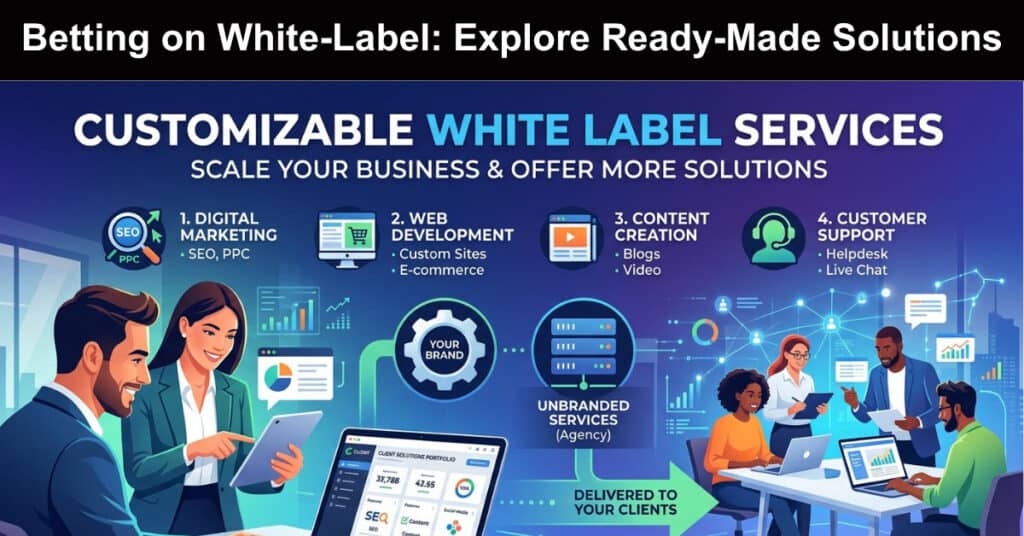
Betting on white label turns another company’s proven, ready-built product into your own revenue stream. Law firms, accounting firms, marketing agencies, and mailbox services increasingly adopt this model because it lets them expand their offerings without funding years of internal development. Rather than waiting to build capability yourself, you sign a partnership and begin selling a finished, tested product to your loyal customers almost immediately.
The firms that win with white-label business services resell proven capabilities that other customers already trust and use daily. This guide tells you how the model saves resources, traces its long and varied history, and shows when a business naturally settles on it. Adding a white-label ad exchange beside complementary products lets you serve more client needs under one coherent, recognizable brand.
White Label as a Smart Solution to Save Resources
Resources, costs, time, potential, and income are the words entrepreneurs juggle daily, and they must combine them into one formula for success. A white label produces that result without unnecessary risk. In this partnership, one party creates a product and licenses it, while the other customizes it, places its own brand on it, and sells it onward, so every participant clearly benefits.
The developer gains a new audience, extra visibility, and a fresh revenue line without spending heavily on promotion or losing focus on its core craft. The buyer saves production resources on the white label product model, launches quickly, and enters the market without building anything from scratch, after which both sides collect additional profit every month.
Consider what the white label model delivers to the reseller:
- Faster Product Launch: A finished solution goes live in weeks rather than the months or years that custom development would demand, which dramatically shortens the time between your decision and your first customer revenue.
- Lower Upfront Cost: You pay a predictable license or subscription fee instead of funding a full build team, which frees working capital for marketing, sales, and the customer acquisition that grows the business.
- Reduced Execution Risk: Because the product already runs in production for other paying clients, you inherit a proven working system instead of untested code, unproven features, and the bugs that plague brand-new builds.
- Flexible Scope: Ready-made modules let you assemble custom bundles and adjust package sizes as demand shifts, so you can tailor an offer to your market without commissioning expensive bespoke software.
When the Benefits Were Appreciated: From Music to IT and Beyond
The concept of white label began in the music business during the 1950s, when record companies pressed blank vinyl records that sellers rebranded and sold under their own labels. That simple idea expanded steadily into IT, banking, and countless other industries, and the cooperation can now take almost any form and any scale across sectors.
Agencies and resellers adopt the approach to widen their catalogs quickly, while software firms use it to distribute products through trusted channel partners. Retailers and banks license white-label products to serve customers under familiar names. No single profile dominates, because almost any business can find a supplier whose capability complements its own brand.
Several types of companies typically gain the most from this model:
- Resource-Limited Startups: Young companies without the capital or a dedicated staff to build software can launch a branded offering quickly and begin generating revenue while conserving their limited runway for other priorities.
- Scaling Service Firms: Agencies and consultancies add products to their service menus without diverting developers from client work and revenue-generating engagements, so billable hours stay protected while the catalog expands.
- Established Enterprises: Large firms use the model to test a market and validate genuine demand at low cost before committing to a major in-house build, a risky acquisition, or a long technical roadmap.
- Niche Resellers: Specialists pair a proven ready product with deep domain knowledge, which lets them serve vertical industries and buyer segments that broad generic vendors routinely overlook.
How Does a Business Come Up With This Idea?
Every industry has its own nuances, and business positions and goals differ, but several common signals point toward the white label decision. A company may lack the budget for marketing yet own a product that partners would find valuable. Alternatively, a firm may have exhausted its current product’s potential and need a second wind through new market entry strategies.
Market pressure also pushes organizations forward when customers and competitors force faster improvement. In that situation, you need working solutions you can adapt quickly instead of starting entirely from zero. Recognizing these triggers early lets you choose partners deliberately rather than react under time pressure and settle for the very first supplier you happen to meet.
Several telltale market conditions usually spark the white label decision:
- Limited Marketing Budget: The product exists and performs well, but no budget remains to promote it, so a partner who can market and distribute it becomes far more attractive than letting the asset sit idle.
- Exhausted Growth Potential: Demand has leveled off, and licensing the product to trusted partners reopens growth by reaching audiences and regions you cannot access with your current sales force alone.
- New Market Ambition: A partner provides instant distribution, local credibility, and a warm audience, which shortens the difficult path into unfamiliar territory and reduces the cost of entering it yourself.
- Missing Sales Discipline: Developers can ship a strong solution but have no one to own selling, so collaborating with a sales-savvy partner who can carry the revenue function makes sound business sense.
Explore Attekmi as White-Label Services Provider
White-label with Attekmi is built on a clear promise of value. The supplier handles technical delivery, branding flexibility, and ongoing support, which lets partners focus on customers and growth. Using a platform aligned with digital payment trends, a reseller can bring a complete, compliant product to market with modest effort and a reliable partner standing behind the service.
Partners can tailor the appearance of payment forms and related components, so the finished product carries their own identity rather than a generic look. Because Attekmi already maintains the infrastructure, compliance, and uptime, the reseller avoids the burden of building those systems. The arrangement is designed so that integration, support, and ongoing operation remain simple.
Here are the principal advantages a partner receives from the program:
- Quick Launch: Implementing and testing a ready-built product takes a fraction of the time required to develop and verify a custom solution from scratch, so partners reach the market much sooner.
- Branding Controls: You configure colors, logos, payment pages, and other visible elements so the finished service reads clearly as your brand to customers rather than looking like a plain white box.
- Flexible Integration: The platform slots into existing interfaces, websites, and internal workflows, which minimizes disruption, reduces training, and speeds adoption across the whole operation from day one.
- Ongoing Support: A dedicated technology team keeps the service running reliably around the clock, so you can scale without adding engineering headcount or worrying about infrastructure upkeep.
Conclusion
Betting on white label is a low-risk way to scale, raise revenue, and diversify your offers without heavy in-house development costs. Through carefully selected providers such as Attekmi, businesses can strengthen customer experience, protect brand consistency, and improve profitability at the same time. The model rewards preparation, clear contracts, and a provider that carries real operational weight behind its promises.
Begin by mapping the gaps in your current catalog, then evaluate partners on product quality, support, and cultural fit before you sign anything. Choose a supplier that makes integration effortless and stands behind its service every single day. When those pieces align, a ready-made solution becomes a dependable growth engine and a steady source of recurring profit.
Frequently Asked Questions About White Label Solutions
What is a white label solution?
A white label solution is a product built by one company and resold by another under its own brand. The maker handles production, development, and maintenance, while the reseller applies its name, sells the offering to customers, and keeps control of the relationship and margins. This split lets the reseller earn revenue from a finished capability with minimal technical burden.
How does white labeling save money?
White labeling removes the cost of research, design, development, and testing because the supplier has already built and verified the product in real use. You pay a license or subscription instead of funding a team, which frees working capital for marketing, sales, and other growth priorities. Retained budget can then be reinvested where it produces the largest returns.
Which businesses benefit from white label products?
Startups, agencies, consultancies, software resellers, and established enterprises all benefit when they want to expand their catalog quickly without building in-house. The model suits any firm with a strong brand, a loyal customer base, and a desire to broaden its offerings faster than internal development capacity would allow on its own, making it a natural fit for growing teams.
Is white labeling risky for my brand?
Risk stays low when you choose a reliable provider, agree on clear service-level standards, and monitor quality regularly. Because the underlying product is already proven in production, operational risk is often lower than launching unproven custom software. Diligent vendor vetting and contract clarity protect your reputation and keep the customer experience consistent and your brand promise intact.
Can I customize a white label product?
Most providers offer branding and configuration options so the product reflects your identity. You can often adjust colors, logos, text, and selected features, though big structural changes remain the supplier’s responsibility by design. Confirm the customization limits before signing so you know exactly how far the product can be shaped to match your brand and your customers’ expectations.
Suggested articles:
- White Label SEO Services: The Secret Behind Fast-Growing Agencies in 2026
- How to Build a Banking App: Why White-Label Solutions Save Time and Budget
- What Is a White Label App and How to Build One?

Daniel Raymond, a project manager with over 20 years of experience, is the former CEO of a successful software company called Websystems. With a strong background in managing complex projects, he applied his expertise to develop AceProject.com and Bridge24.com, innovative project management tools designed to streamline processes and improve productivity. Throughout his career, Daniel has consistently demonstrated a commitment to excellence and a passion for empowering teams to achieve their goals.