

Projects are rarely executed in a perfectly predictable environment. From budgets and timelines to resources and external dependencies, project planning relies heavily on assumptions. These assumptions may be made before the project begins or may emerge as the project progresses. According to the PMBOK® Guide and other established project management references, the assumption log is a critical project artifact used to record, track, and validate these assumptions throughout the project lifecycle. An assumption log helps project managers reduce uncertainty, identify potential risks early, and maintain alignment across stakeholders.
When used properly, it becomes a practical decision-support tool rather than just another document created for compliance. Projects typically use multiple logs and registers to maintain control and visibility. Assumption logs fall into this category and are particularly useful for activities that involve uncertainty. Since uncertainty is unavoidable in most projects, assumption logs are a natural and necessary artifact. Assumptions are an integral part of the planning process.
They are used as both artifacts and inputs for project decisions, schedules, cost estimates, and risk assessments. Without a structured way to document and review assumptions, teams risk building plans on weak or outdated foundations.
What Is an Assumption Log?
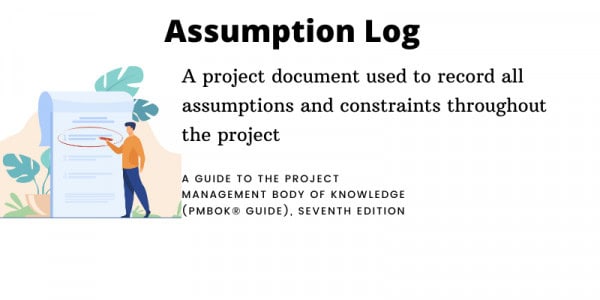
An Assumption Log is a project artifact in which all assumptions and constraints are formally recorded, tracked, and validated throughout the project lifecycle. Projects are planned by considering several assumptions. These assumptions exist before the project is implemented or emerge as the project progresses. An assumption is essentially a belief about a key factor—such as resource availability, technical performance, or stakeholder behavior—that is considered true, real, or certain without definitive proof at the time of planning. Constraints, often logged alongside assumptions, are limiting factors, such as fixed budgets, immovable deadlines, or regulatory requirements.
They are categorized as registers and logs. Assumptions logs are specifically used for activities that have inherent uncertainty in them. It is therefore a natural artifact used in activities that carry uncertainty, serving as a tool to bring implicit beliefs into the open for examination. Assumptions are an integral part of the planning process and are used as foundational artifacts and input for schedules, budgets, and scope definitions. By documenting them, a project team acknowledges the risks inherent in these beliefs and commits to actively managing them.
What Is Included In The Assumption Log?
A robust Assumption Log is more than a simple list; it is a tracking tool with defined fields that provide context, ownership, and a path to resolution. The following elements are typically assigned to each assumption entry:
- ID: A unique identifier for easy tracking and reference.
- Description and Name: A clear, concise statement of the assumption.
- Person or Owner: The individual responsible for validating or monitoring the assumption.
- Category: A classification (e.g., Resource, Technical, Schedule, Commercial, Environmental) to group similar assumptions.
- Date Logged: When the assumption was first formally documented.
- Uncertainty Rating: A qualitative (High/Medium/Low) or quantitative (scale of 1-5) assessment of how likely the assumption is to be incorrect.
- Impact Level: The potential effect on the project (e.g., High/Medium/Low) if the assumption proves false.
- Date Due / Validation Date: The target date by which the assumption must be proven true or false.
- Next Review Date: For ongoing assumptions, the date of the next periodic check.
- Action Plan: The steps required to validate the assumption or mitigate the impact if it is invalidated.
- Status: Open, Closed, or In Validation.
- Date of Closure: When the assumption was successfully validated or resolved.
The assumption log needs to be updated as more information is received and as items are closed. It is reviewed regularly during an ideal project, and the validation activities are verified. Critically, assumptions are prioritized in the log depending on their uncertainty level and their potential impact on the project. Assumptions with the highest potential impact and the highest level of uncertainty are deemed the highest priority and demand the most immediate attention and mitigation planning.
Assumption Log Examples
Practical Application of the Log
An assumption log template typically provides a structured framework with fields for the Project title, project date, and the core data points for each assumption. Below is a description of an assumption log populated with sample data for a product development project:
- Project Title: “Project Aurora – Next-Gen Prototype Development”
- Project Date: Q3 2024
In this example, categories such as Manufacturing, Design, Supply Chain, and Planning have been used. Specific assumptions are placed against each category:
- Manufacturing Category: “Assumption: The factory will have adequate capacity and machine time to produce five functional prototypes in October.”
- Design Category: “Assumption: Final cable dimensions will not exceed the 5mm diameter constraint defined in the initial architecture spec.”
- Supply Chain Category: “Assumption: Key component (SKU #X-45) will be available from the sole supplier with a lead time of no more than 4 weeks.”
- Planning Category: “Assumption: The project team will have access to the three dedicated software engineers as specified in the charter, starting on August 1st.”
Each of these entries would then be populated with an owner, uncertainty rating, impact level, and a validation plan. For instance, the supply chain assumption owner might be the Procurement Lead, with a validation action plan to “Secure a signed letter of intent from the supplier by July 15th.”
Download a free, pre-formatted assumption log template from here to see this structure in practice.

Assumption Log Template Google Sheets
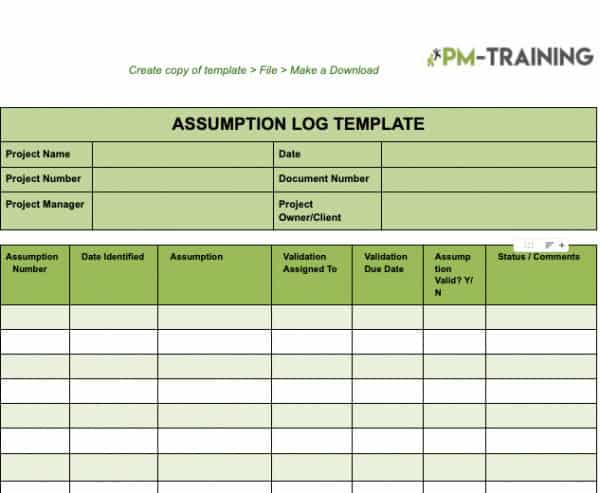
Using Google Sheets for your Assumption Log Template offers significant advantages for modern project teams. It provides a cloud-based, collaborative, and accessible platform that is ideal for a living document requiring regular updates from multiple stakeholders.
A well-designed Assumption Log Template in Google Sheets would include:
- A dedicated “Project Info” section for title, manager, and start date.
- A main log sheet with columns for all critical fields (ID, Description, Category, Owner, etc.).
- Data validation drop-down lists for fields like Category, Uncertainty, Impact, and Status to ensure consistency.
- Conditional formatting to visually highlight high-priority items (e.g., High Impact/High Uncertainty combinations in red).
- Filtering and sorting capabilities to view assumptions by owner, category, or due date.
- A separate “Closure Notes” column or tab to document the outcome once an assumption is validated.
The template’s strength lies in its real-time nature. Team members can update status, add comments, or adjust review dates from any location, ensuring the log always reflects the current project understanding. This turns the assumption log from an administrative task into an active risk management cockpit for the project team.
Assumption Log Best Practices
To maximize its effectiveness, the assumption log must be woven into the fabric of project management processes. Simply creating the log is not enough; it requires disciplined application and integration. Adhering to the following best practices will transform your assumption log from a static document into a powerful project governance tool.
- Initiate Early in the Project: An assumption log is not an afterthought. It should be created during the project initiation phase, immediately after the business case and project charter are developed. The charter itself contains high-level strategic assumptions, which must be transferred into the log as the first entries. This sets the tone that managing uncertainty is a project priority from day one.
- Establish a Regular Review Rhythm: The assumptions log must be regularly reviewed, and validation activities must be verified. Integrate this review into the project’s standard meeting cadence—such as weekly team stand-ups or bi-weekly steering committee meetings. This ensures all project team members are informed and accountable, and it prevents important assumptions from being forgotten as the project evolves.
- Prioritize Rigorously: Not all assumptions are created equal. Use the Uncertainty Rating and Impact Level fields to calculate a priority score (e.g., High/High = Critical). Focus validation efforts and management attention on these high-priority items first. This data-driven approach ensures resources are allocated to managing the assumptions that pose the greatest threat to project success.
- Link Proactively to Risk Management: Understand that assumptions created during the project lifecycle may become project risks. Risk management is therefore performed, in part, because of this very reason. A risk register and risk management plan are essential companion documents, and the assumptions log must not replace the risk register. Establish a clear workflow: when an assumption’s validation fails, or its uncertainty remains critically high, it must be formally assessed and migrated to the risk register with a defined mitigation or contingency strategy.
- Maintain Discipline in Updates: The assumptions log must be updated as more information is obtained and more items are closed. Assign clear ownership for this maintenance, typically to the Project Manager or a designated project coordinator. Every change in project scope, schedule, or resources should trigger a check: “Does this change any of our existing assumptions, or require us to log new ones?”
- Promote Transparency and Collaboration: Treat the log as a collaborative tool, not a hidden report. Store it in a shared location (like Google Sheets) and encourage all team members and key stakeholders to review it and suggest new assumptions. A culture that openly discusses and challenges assumptions is a culture that proactively manages risk.
Video about Assumption Log
This video section provides a dynamic, visual guide to the Assumption Log. See how to practically build, manage, and leverage this critical tool, transforming abstract concepts into clear, actionable steps for your project’s success.
Assumption Log Vs Risk Register
Clarifying Key Project Artifacts
A common point of confusion lies in distinguishing the Assumption Log from the Risk Register. While related, they serve distinct purposes. The assumptions log is used by the project manager and the project team members to document, capture, and track project assumptions throughout the life cycle of the project. They are an important part of the project’s foundation. Assumptions require validation and follow-up to determine if they will or will not impact the project.
Its primary focus is on uncertainty that is currently accepted as true. On the other hand, a risk register is a risk management tool used for the identification, analysis, and response planning for potential future events that could have a negative (or sometimes positive) impact on the project. Its primary focus is on uncertain events that may occur.
| Assumptions Log | Risk Register |
|---|---|
| A place to log and track assumptions believed to be true. | A document to record and manage potential future risks. |
| May or may not include a detailed mitigation strategy; focus is on validation. | Must contain a mitigation, avoidance, or contingency response strategy. |
| Focuses on probability, impact, and response; the identification date is less critical than risk score. | Focuses on probability, impact, and response; the identification date is less critical than the risk score. |
| Entries are closed once validated as true or false. | Focuses on probability, impact, and response; the identification date is less critical than the risk score. |
In essence, an invalidated assumption often becomes a risk, creating a clear workflow from the log to the register.
Transforming Assumptions into Assurance
In the final analysis, the Assumption Log is far more than a project management formality; it is a testament to a team’s professionalism and foresight. It moves the project from a plan built on unspoken hopes to a resilient framework built on managed, validated knowledge. By diligently capturing, prioritizing, and validating assumptions, project managers systematically reduce the fog of uncertainty that shrouds every complex initiative.
The use of an accessible, collaborative tool like a Google Sheets template democratizes this process, ensuring the entire team can participate in safeguarding the project’s foundations. Remember, the goal is not to eliminate all assumptions—that is an impossibility—but to control them. A well-maintained log ensures that when an assumption proves false, it is not a catastrophic surprise but a managed event with a prepared response, seamlessly transitioning into the risk register.
Ultimately, mastering the assumption log is a cornerstone of proactive project management. It builds stakeholder confidence, provides early warning signals for potential issues, and creates a disciplined approach to navigating the inherent unknowns of any project. By embracing the practices and tools outlined in this guide, teams can transform assumptions from potential liabilities into structured elements of a successful project delivery strategy.
FAQ: Project Assumptions and Logs
What are project assumptions examples?
Project assumptions are statements about conditions or resources believed to be true for planning purposes. Common examples include: “The project team will have access to the resources they need, both material and human,” “Vendor delivery will occur within the stated 2-week window,” “Stakeholders will provide feedback within 48 hours of request,” and “Specialized software licenses will be procured and installed prior to the start of Phase 2.”
What is the assumption log in a project?
An assumption log is a living project document where all project assumptions are formally logged, tracked, and validated. It serves as an audit trail for the project’s foundational beliefs, ensuring they are actively managed rather than forgotten. Project assumptions are made out of necessity to allow planning to proceed, and the log is the tool that ensures these necessities do not become blind spots.
What is a RAID log?
A RAID log is a consolidated project management tool used to track four key elements: Risks, Assumptions, Issues, and Dependencies. It provides a high-level, at-a-glance view of a project’s health and key concerns. While convenient for smaller projects, complex projects often benefit from maintaining separate, more detailed logs for each element (like a dedicated Assumption Log and Risk Register) due to the depth of information required for effective management. The Assumption Log discussed here would represent the “A” component within a RAID log structure.
Suggested articles:
- 11 Best Agile Templates For Project Management
- Understanding and Utilizing RAG Status in Project Management
- SWAG Estimates in Project Management

Shane Drumm, holding certifications in PMP®, PMI-ACP®, CSM, and LPM, is the author behind numerous articles featured here. Hailing from County Cork, Ireland, his expertise lies in implementing Agile methodologies with geographically dispersed teams for software development projects. In his leisure, he dedicates time to web development and Ironman triathlon training. Find out more about Shane on shanedrumm.com and please reach out and connect with Shane on LinkedIn.