

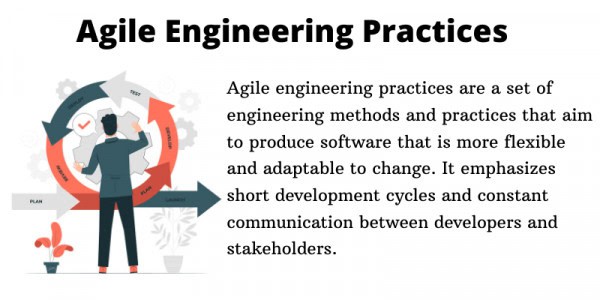
Agile engineering best practices are a set of methods and approaches designed to help software teams produce flexible, high-quality software that responds effectively to change. The methodology emphasizes short development cycles, continuous collaboration between developers and stakeholders, and a commitment to delivering working software quickly through iterative progress. Teams that adopt these practices consistently report faster delivery, stronger code quality, and better alignment with customer expectations.
Agile engineering emerged as a direct response to the limitations of traditional development models such as the V-model, which often struggled to accommodate shifting requirements or reduce the cost of late-stage changes. By breaking work into manageable increments and building feedback loops into every stage of development, agile teams gain the ability to course-correct before small problems become expensive failures. This makes the methodology especially valuable in fast-moving, competitive environments.
What Is Agile Engineering?
Agile engineering is a software development methodology that prioritizes the ability to make changes quickly, collaborate openly, and deliver working software in short, structured cycles known as sprints. It is grounded in the principles of the Agile Manifesto, which places individuals and interactions above rigid processes, and customer satisfaction above exhaustive documentation. Rather than following a fixed plan from start to finish, agile teams continuously reassess priorities and adapt their approach based on feedback and evolving requirements.
The 4 Key Principles of Agile
The Agile Manifesto defines four foundational values that guide every agile engineering team. These principles are not prescriptive rules but rather guiding priorities that help teams make better decisions under uncertainty. Understanding them is essential before adopting any specific agile practice, as they shape the mindset behind every technique and workflow choice a team will encounter during development.
- Individuals and Interactions: People and direct communication take precedence over processes and tools, recognizing that collaboration drives better outcomes than rigid workflows.
- Working Software: Delivering functional software is valued over producing extensive documentation, keeping the focus on tangible, usable results at every stage of development.
- Customer Collaboration: Ongoing engagement with customers is prioritized over rigid contract negotiation, allowing requirements to evolve based on real needs and feedback.
- Responding to Change: Adapting to new information or shifting priorities is valued above following a predetermined plan, enabling teams to stay aligned with actual project goals.
Benefits of Agile Engineering Practices
Agile engineering delivers measurable advantages across the entire software development lifecycle, from planning through delivery. Teams that consistently apply agile principles experience improvements in speed, quality, and stakeholder alignment. These benefits are not incidental. They are the direct result of structured collaboration, iterative delivery, and a culture that treats feedback as a core input rather than an afterthought. Organizations that embrace these practices position themselves to compete more effectively in dynamic markets.
- Reduced Risk: Working in short iterations allows teams to detect and address problems early, minimizing the chance that a project will drift far from its objectives before correction is possible.
- Improved Quality and Speed: A consistent focus on testing and code review leads to higher software quality while also accelerating delivery timelines through better process discipline.
- Enhanced Teamwork: The agile framework encourages open communication and shared responsibility, which strengthens team morale and reduces the friction that can slow cross-functional collaboration.
- Increased Customer Satisfaction: Delivering working software at regular intervals keeps customers informed and involved, resulting in greater confidence in the product and stronger long-term relationships.
6 Agile Engineering Best Practices with Examples
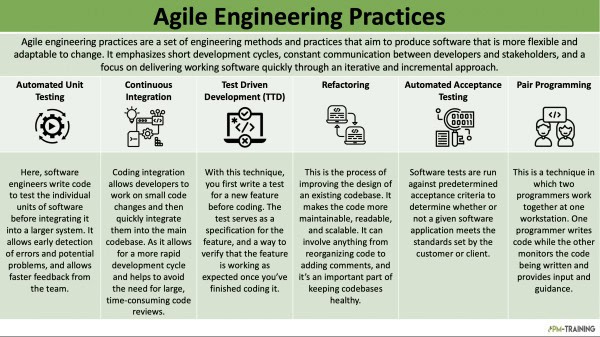
Developing software can be a complex and time-consuming process. But by using Agile methodologies, software development teams can streamline their workflow and get their product to market faster by using the right tools and practicing them efficiently. Some common agile engineering practices are:
1. Automated Unit Testing
Automated unit testing is a practice in which engineers write code specifically designed to test individual units of software before those units are integrated into a larger system. This approach ensures high code quality from the earliest stages of development and significantly reduces the number of defects that reach the final product. Because tests run automatically, the feedback cycle is faster and does not depend on manual intervention from a dedicated testing team, making it scalable across large projects.
Beyond defect reduction, automated unit testing provides a safety net that supports confident refactoring and feature development over time. When developers know that a comprehensive test suite will catch regressions immediately, they can introduce changes with less hesitation. This accelerates development velocity and contributes to a codebase that remains maintainable and adaptable as the product evolves across multiple release cycles.
2. Continuous Integration
Continuous integration is the practice of merging new code changes into a shared codebase frequently, typically using automated tools such as a CI server to validate each change. This process allows developers to work on discrete, focused updates and integrate them into the main branch quickly and reliably. By catching conflicts and compatibility issues early, continuous integration prevents the buildup of technical debt and eliminates the bottleneck of large, infrequent code merges that slow development teams down.
The discipline of continuous integration also reinforces broader agile values by keeping the entire codebase in a consistently deployable state. Teams can demonstrate progress to stakeholders at any point in the sprint, which supports transparency and trust. Combined with automated testing, continuous integration creates a development pipeline that catches problems quickly, reduces manual overhead, and enables teams to ship software with greater predictability and confidence.
3. Test-Driven Development (TTD)
Test-driven development is a technique in which engineers write a test for a new feature before writing the implementation code itself. The test defines the expected behavior and serves as both a specification and a verification tool. Once the feature is built, the test confirms that it performs as intended. This approach forces developers to think carefully about design decisions upfront, which reduces ambiguity and leads to cleaner, more purposeful code throughout the development process.
TDD also contributes meaningfully to long-term code maintainability. Because every feature is accompanied by a test from the moment it is created, the codebase accumulates a reliable safety net that grows alongside the product. Developers can refactor or extend existing functionality with confidence, knowing that any unintended side effects will be caught immediately. This makes TDD one of the most impactful practices an agile team can adopt for sustained code quality.
4. Refactoring
Refactoring is the process of restructuring existing code to improve its design, readability, and scalability without altering its external behavior. It is typically performed during sprints as part of ongoing code maintenance, ensuring that the codebase remains clean and manageable as the product grows. Refactoring tasks can range from renaming variables for clarity to reorganizing entire modules, and each improvement compounds over time to reduce the complexity that slows development teams down.
In an agile context, refactoring is not an optional cleanup task but a core engineering discipline. Technical debt accumulates quickly in fast-moving projects, and teams that neglect refactoring often find their velocity declining as the codebase becomes harder to understand and extend. By treating refactoring as a routine part of the sprint cycle, agile teams protect their ability to deliver quality software consistently and avoid the costly rewrites that result from prolonged neglect.
5. Automated Acceptance Testing
Automated acceptance testing evaluates software against predefined criteria established by the customer or stakeholder to determine whether the application meets agreed-upon standards. Unlike unit testing, which examines individual code components in isolation, acceptance testing assesses the full functionality of the application from an end-user perspective. This distinction makes it an essential complement to other testing practices, providing validation that the delivered software actually solves the problem it was designed to address.
6. Pair Programming
Pair programming is a collaborative technique in which two developers work together at a single workstation. One writes code while the other reviews it in real time, offering guidance, catching errors, and contributing ideas as the work progresses. This continuous peer review reduces defects, improves design decisions, and strengthens communication between team members. While it may appear less efficient on the surface, pair programming consistently produces higher-quality output and reduces the time spent on debugging and rework later in the development cycle.
Best Practices for Agile Engineering Teams
Agile engineering requires more than adopting the right tools or techniques. It demands a team culture that is genuinely committed to flexibility, transparency, and continuous improvement. Teams that apply agile practices successfully tend to share a common set of behavioral principles that reinforce their technical work and keep the team aligned through change, uncertainty, and competing priorities across every stage of the project.
- Be Flexible and Adaptable: Teams must be willing to revise plans based on new information, treating change as an expected part of the process rather than a disruption.
- Work in Short Cycles: Delivering in sprints keeps feedback loops tight, ensures regular stakeholder alignment, and reduces the risk of investing heavily in the wrong direction.
- Focus on Customer Needs: Every decision should trace back to real customer value, keeping the team grounded in outcomes rather than outputs or internal preferences.
- Use Collaboration and Communication: Open, frequent communication between developers, testers, and stakeholders eliminates misalignment and keeps the entire team moving in the same direction.
- Remain Open to Change: A proactive mindset toward improvement, whether in process, code, or team dynamics, is what separates high-performing agile teams from those that stagnate over time.
Video About Agile Engineering Practices
Watch this video for a concise overview of agile engineering practices in action. It covers key techniques used by modern software teams, including continuous integration, test-driven development, and pair programming, helping you understand how these practices work together to improve code quality and delivery speed.
Conclusion
Agile engineering best practices represent a proven approach to building software that is responsive, maintainable, and aligned with real customer needs. Practices such as test-driven development, continuous integration, pair programming, and refactoring each address a specific challenge in the development process, and together they create a workflow that consistently produces better outcomes. The benefits extend beyond code quality, reaching into team collaboration, delivery speed, and long-term product sustainability.
Organizations that commit to these practices do not simply adopt a new methodology. They build an engineering culture that treats improvement as continuous and change as an advantage. Whether a team is just beginning its agile journey or looking to sharpen existing processes, applying these principles with discipline and consistency will lead to more reliable software, stronger teams, and greater confidence in every product shipped.
FAQs About Agile Engineering
What is the difference between agile engineering and traditional software development?
Traditional software development, such as the waterfall or V-model approach, follows a linear, sequential process where each phase must be completed before the next begins. Agile engineering, by contrast, works in short iterative cycles that allow teams to adapt continuously. This makes agile significantly better suited to projects where requirements are likely to evolve or where early delivery of working software is a priority.
How long is a typical agile sprint?
A sprint is a fixed time period during which a team completes a defined set of work. Most agile teams run sprints that last between one and four weeks, with two weeks being the most common duration. The appropriate length depends on the team’s size, the complexity of the work, and how frequently stakeholders need to review progress and provide feedback.
Can agile engineering practices be applied outside of software development?
While agile originated in software development, its core principles have been applied successfully in marketing, product design, operations, and project management. The underlying values of iterative delivery, collaboration, and responsiveness to change translate well across many disciplines. Teams in non-technical fields often adapt specific practices such as sprints and retrospectives without adopting the full software-focused toolkit.
What is the role of a product owner in agile engineering?
The product owner is responsible for defining and prioritizing the work that the development team undertakes. They represent the interests of the customer and stakeholders, maintain the product backlog, and ensure that the team is always working on the most valuable tasks. A strong product owner provides clear direction, makes timely decisions, and serves as the primary point of contact between the business and the engineering team.
How do agile teams measure success?
Agile teams typically measure success through a combination of delivery metrics and quality indicators. Common measures include sprint velocity, which tracks how much work is completed per sprint, defect rates, customer satisfaction scores, and the frequency of deployable releases. Rather than measuring success purely by adherence to a plan, agile teams prioritize outcomes, focusing on whether the software delivered actually meets user needs and business objectives.
Suggested articles:
- Agile Project Management Guide (Skills & Methodologies)
- Breaking Down the Agile Working Model
- 9 Reasons to Choose Lean vs Agile for Better Products

Shane Drumm, holding certifications in PMP®, PMI-ACP®, CSM, and LPM, is the author behind numerous articles featured here. Hailing from County Cork, Ireland, his expertise lies in implementing Agile methodologies with geographically dispersed teams for software development projects. In his leisure, he dedicates time to web development and Ironman triathlon training. Find out more about Shane on shanedrumm.com and please reach out and connect with Shane on LinkedIn.