
Delivering projects on time is one of the most consistent pressures project managers face across every industry. When schedules fall behind or deadlines tighten, two proven compression techniques come into play: fast tracking and crashing. Both methods are designed to accelerate project completion, but they operate differently and carry distinct advantages and risks.
Understanding how each technique works, where it delivers the most value, and when to apply it is essential for any manager navigating a compressed timeline.
What Is Fast Tracking?
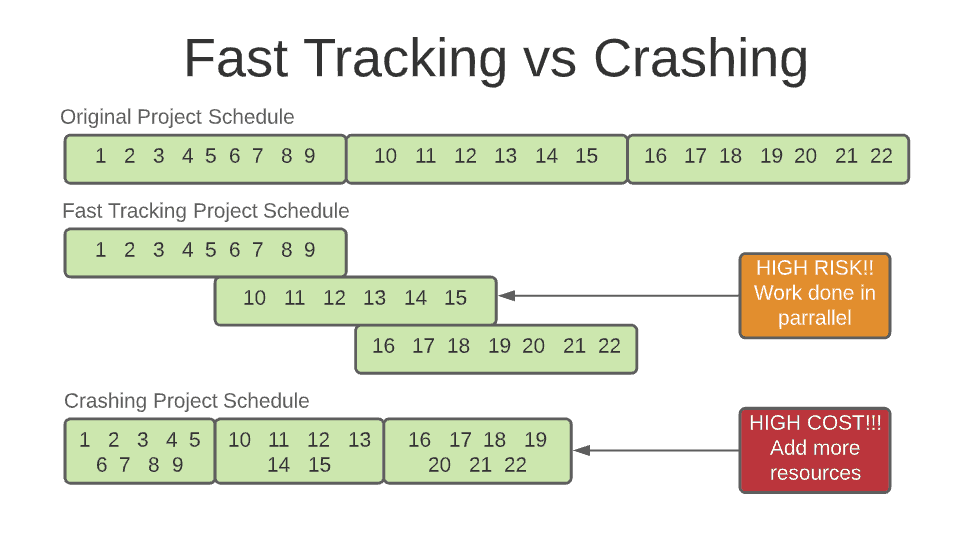
Fast tracking is a project management technique in which tasks originally planned to occur in sequence are instead performed simultaneously or with deliberate overlap. Rather than waiting for one activity to finish before starting the next, the project manager identifies tasks that can run in parallel without creating unacceptable dependencies or quality risks. This overlapping of work allows the project to move faster without necessarily adding resources or increasing the overall budget, making it one of the more cost-effective compression options available.
The technique is most effective when there is sufficient slack in the project schedule and when the tasks being overlapped are not tightly dependent on each other’s outputs. Fast tracking requires careful planning and clear communication among team members, as working on interdependent tasks simultaneously increases the risk of rework if earlier tasks change. When applied with discipline and a thorough understanding of task relationships, fast tracking can meaningfully reduce project duration while keeping costs under control.
Key Advantages of Fast Tracking
Fast tracking offers measurable benefits for projects where time is the primary pressure and budget flexibility is limited. By reorganizing the sequence of tasks rather than adding resources, it allows managers to recover schedule time without significantly increasing costs. The following advantages illustrate why fast tracking is a widely used and valuable compression technique across project environments of varying complexity.
1. Reduces Project Duration Without Added Cost
One of the most compelling advantages of fast tracking is that it compresses the project schedule without requiring additional budget or resources. Because the technique relies on overlapping existing tasks rather than bringing in new personnel or tools, the cost base remains largely unchanged. This makes it an attractive first option for managers who need to recover time on a project but cannot justify the expense of adding resources. Delivering faster at the same cost is a clear and immediate win for both the project team and its stakeholders.
2 Improves On-Time Delivery Performance
Fast tracking directly addresses schedule slippage by pulling forward the start dates of downstream tasks, which increases the likelihood of meeting the original project deadline. When a project falls behind due to early delays, overlapping later tasks can recover lost time without pushing the final delivery date. This improvement in on-time delivery performance strengthens the project team’s credibility with stakeholders and reduces the pressure that builds when milestones are consistently missed throughout the project lifecycle.
3 Increases Team Productivity
When tasks are overlapped thoughtfully, team members remain consistently engaged rather than waiting for upstream activities to conclude before they can begin their own work. This reduction in idle time increases overall productivity and keeps the project moving at a steady pace. Fast tracking encourages a more dynamic and collaborative working environment where team members must coordinate closely, share information proactively, and solve problems in real time, all of which contribute to a more efficient and high-performing project team.
4 Demonstrates Leadership Commitment to Deadlines
Choosing to fast-track a project sends a clear signal to sponsors, stakeholders, and senior leadership that the project manager is proactive and committed to meeting delivery expectations. Rather than accepting a delay or immediately requesting additional budget, fast tracking shows a willingness to find creative solutions within existing constraints. This kind of decisive, resourceful response builds trust with key decision-makers and positions the project manager as someone who can be relied upon to deliver results even when circumstances become challenging.
5. Preserves Budget Allocation
Because fast tracking does not require the addition of new resources, the project’s original budget allocation remains intact. This is a significant advantage in organizations where budget overruns carry serious consequences or where funds for additional resources are simply unavailable. By compressing the schedule through sequencing changes rather than resource additions, managers protect their financial position while still responding effectively to schedule pressure. This preserves flexibility for other project needs and avoids the approval processes that often slow down resource requests.
Risks of Fast Tracking a Project
Fast tracking offers real schedule benefits, but it introduces risks that can undermine those gains if not actively managed. Because tasks are overlapped rather than sequenced, the project environment becomes more complex and more sensitive to change. Project managers must understand these risks clearly before applying the technique and put appropriate controls in place to prevent them from eroding the time savings fast tracking is designed to deliver.
- Increased Rework Potential: When overlapping tasks share tight dependencies, changes to earlier task outputs can invalidate work already completed on downstream activities. Without rigorous dependency mapping, rework can consume more time than the compression technique originally saved.
- Reduced Quality Control Time: Overlapping tasks leave less time for quality checks between activities. Errors in earlier tasks can propagate into downstream work before they are identified, making them significantly more expensive and disruptive to correct at a later stage.
- Insufficient Risk Assessment: Moving tasks forward reduces the time available to identify and respond to emerging risks. Project managers may find themselves reacting to problems rather than anticipating them, increasing the likelihood of unexpected delays and compounding schedule pressure.
- Communication Breakdown: Parallel working demands a higher level of coordination among team members. Without clear communication protocols and frequent check-ins, teams working on interdependent tasks simultaneously can develop conflicting assumptions that lead to misalignment, errors, and wasted effort.
- Stakeholder Expectation Mismanagement: Fast tracking can give stakeholders the impression that the original schedule was unnecessarily conservative. This can create pressure to fast-track future projects as a default, even when the conditions do not support it, setting unrealistic expectations that become difficult to manage over time.
What Is Crash Planning?
Crash planning, also referred to as schedule crashing, is a project management technique that reduces the duration of individual tasks by adding resources to them. This could involve assigning additional team members, authorizing overtime, bringing in contractors, or investing in tools and technology that accelerate task completion. Unlike fast tracking, crashing directly targets the critical path by identifying which tasks, when shortened, will produce the greatest reduction in overall project duration relative to the cost of the additional resources required.
The technique works by reducing slack time on the critical path, which shortens the total project timeline. To apply it effectively, managers must first identify all tasks on the critical path and then rank them by the cost and feasibility of compression. Tasks that can be shortened at the lowest additional cost should be crashed first. While crashing is effective at recovering significant schedule time, it comes with a higher cost than fast tracking and requires careful management of the additional resources introduced to avoid quality issues and communication breakdowns.
Key Advantages of Crash Planning
Crash planning delivers clear benefits in situations where schedule recovery requires more than a reorganization of task sequences. By injecting additional resources into critical path activities, it provides a more powerful and direct mechanism for compressing project timelines. The following advantages outline why crashing remains a valuable tool for project managers facing significant schedule pressure or hard delivery deadlines.
1. Achieves Significant Schedule Compression
The most direct advantage of crash planning is its ability to produce substantial reductions in project duration in a relatively short period. By adding resources to critical path tasks, managers can recover days or weeks of schedule time that would otherwise be lost. This level of compression is often not achievable through fast tracking alone, particularly when task dependencies are tight, and there is limited scope for parallel working. Crashing gives managers a powerful lever to pull when the project timeline requires a decisive and immediate response.
2. Meets Hard and Non-Negotiable Deadlines
When a project is tied to a fixed external deadline such as a product launch, regulatory submission, or contractual obligation, crashing provides the means to meet that commitment even when the schedule has slipped. Unlike fast tracking, which depends on the availability of tasks that can be safely overlapped, crashing can be applied to almost any critical path activity as long as resources are available. This flexibility makes it the preferred technique when the finish date is non-negotiable, and the cost of missing it outweighs the expense of additional resources.
3. Reduces the Risk of Project Failure
A project that is significantly behind schedule carries an elevated risk of complete project failure, particularly if stakeholder confidence erodes or funding is withdrawn. Crash planning addresses this risk directly by providing a structured and resource-backed mechanism to recover the schedule and restore confidence. By demonstrating a concrete plan to get the project back on track, managers reduce uncertainty, reassure sponsors, and protect the investment that has already been made. In high-priority projects, this risk reduction benefit alone can justify the added cost of crashing.
4. Creates Benefits for Future Projects
The data generated during a crashing exercise, including which tasks were compressed, by how much, and at what cost, provides valuable reference material for future project planning. Managers who document their crashing decisions build an organizational knowledge base that improves the accuracy of future estimates and reduces the time needed to respond to similar schedule pressures in subsequent projects. This forward-looking benefit means that the investment made in crashing one project can generate efficiency gains across many projects that follow.
5. Provides a Structured Response to Scope Changes
When unexpected scope additions increase the volume of work mid-project, crashing provides a structured way to absorb that additional workload without pushing back the delivery date. By adding resources to affected critical path tasks, the project can accommodate new requirements while still meeting its original timeline commitments. This is particularly valuable in client-facing projects where scope changes are common, and the ability to respond without delaying delivery is a key differentiator. Crashing transforms what could be a disruptive event into a manageable and well-executed adjustment.
Risks of Crash Planning a Project
Crash planning is a powerful schedule recovery tool, but it comes with risks that can quickly offset its benefits if not carefully controlled. Introducing additional resources under time pressure changes the dynamics of the project team and increases the complexity of day-to-day management. Understanding these risks before committing to crashing allows project managers to put the right safeguards in place and avoid turning a schedule problem into a broader project crisis.
- Cost Escalation: Adding resources to critical path tasks increases labor expenses and may require overtime pay, contractor fees, or rapid equipment procurement. Without a thorough cost-benefit analysis, the financial impact of crashing can exceed the value of the schedule time recovered.
- Quality Degradation: Compressing task durations reduces the time available for testing, review, and error correction. When work is rushed to meet an accelerated timeline, defects are more likely to reach later project stages, where they become significantly more costly to resolve.
- Onboarding and Integration Delays: New team members or contractors added during crashing require time to understand project standards, processes, and dependencies. This onboarding period can temporarily slow progress before the additional resources begin delivering meaningful value to the schedule.
- Resource Allocation Conflicts: Crashing often draws resources from other projects or departments, creating competing priorities and potential bottlenecks elsewhere in the organization. If those resources are already committed, securing them quickly enough to make a meaningful difference can be difficult and disruptive.
- Diminishing Returns on Compression: Each successive round of crashing typically yields less schedule recovery at a higher cost. Once the most cost-effective critical path tasks have been crashed, further compression becomes progressively more expensive and less impactful, limiting the overall usefulness of the technique as a sustained recovery strategy.
Comparing the Advantages: Fast Tracking vs Crash Planning
Both fast tracking and crash planning deliver schedule compression, but the advantages each technique offers are rooted in fundamentally different approaches to the problem. Fast tracking reorganizes how work is sequenced, while crash planning changes how much resource is applied to accelerate individual tasks. Understanding where each technique excels helps managers select the right tool for the right situation and extract the maximum benefit from whichever approach the project conditions demand.
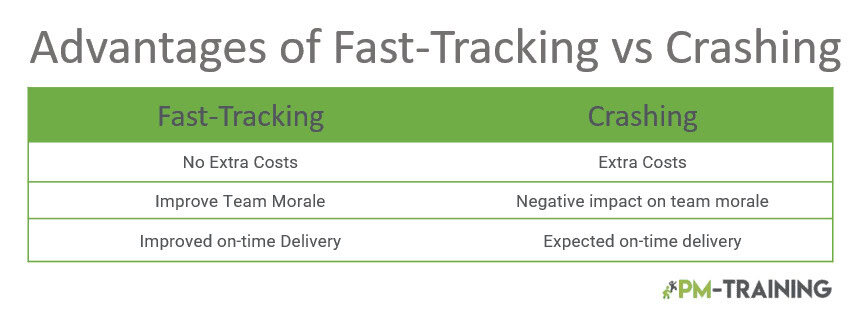
- Cost Efficiency: Fast tracking compresses the schedule without adding resources, keeping the project budget intact and making it the more financially accessible option. Crash planning delivers compression through resource investment, which increases cost but produces more powerful and reliable schedule recovery in situations where sequencing changes alone are insufficient.
- Schedule Flexibility: Fast tracking improves schedule flexibility by pulling forward downstream tasks without altering the project’s resource base, giving managers room to recover time while preserving other options. Crash planning provides direct control over task duration on the critical path, offering a more targeted and measurable approach to closing specific schedule gaps.
- Team Engagement: Fast tracking keeps the existing team consistently engaged by eliminating idle periods between sequential tasks, improving productivity without disruption. Crash planning brings in additional capacity that allows the core team to maintain sustainable workloads while the extra resources absorb the compression burden on critical activities.
- Stakeholder Confidence: Fast tracking demonstrates proactive and resourceful leadership by finding schedule solutions within existing constraints, which builds credibility with sponsors and stakeholders. Crash planning signals a decisive and well-resourced response to schedule pressure, reassuring stakeholders that the project has both the plan and the capability to meet its commitments.
- Application Range: Fast tracking is highly effective when task dependencies allow for safe overlap and the team has the coordination capability to manage parallel working. Crash planning can be applied to virtually any critical path activity where resources are available, making it a more broadly applicable technique across diverse project types and environments.
Comparing the Disadvantages: Fast Tracking vs Crash Planning
Both fast tracking and crash planning introduce challenges that can complicate project delivery if not managed with care. While their advantages make them valuable compression tools, their disadvantages reveal important limitations that project managers must account for before committing to either approach. Understanding where each technique falls short helps managers make more informed decisions, apply the right safeguards, and avoid the common pitfalls that turn a schedule recovery effort into a broader project problem.
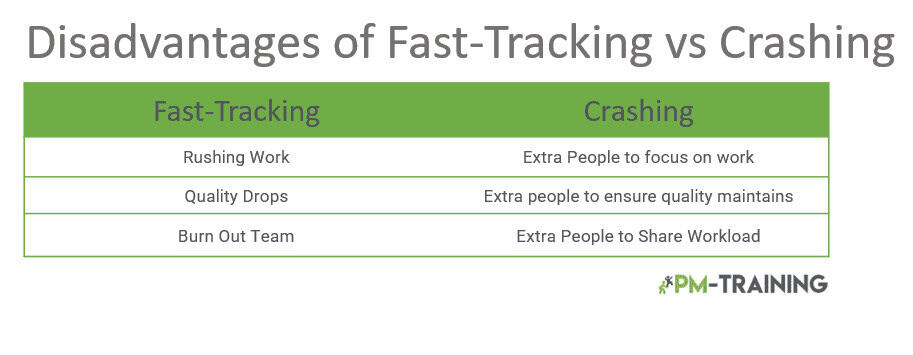
- Cost Impact: Fast tracking does not add direct costs but can generate significant indirect costs through rework and error correction when overlapping tasks produce conflicting outputs. Crash planning increases costs directly and immediately through additional labor, overtime, and resource procurement, with expenses rising further if multiple rounds of crashing are required.
- Quality Risk: Fast tracking reduces the time available for quality checks between dependent tasks, increasing the likelihood that errors carry forward undetected. Crash planning compresses individual task durations, leaving less time for testing and review, which raises the risk of defects reaching later project stages where they are more disruptive and costly to address.
- Schedule Reliability: Fast tracking can create a false sense of schedule recovery if rework later consumes the time that was saved through overlapping. Crash planning can produce diminishing returns as successive rounds of compression become progressively more expensive and yield less meaningful schedule reduction.
- Team Impact: Fast tracking increases coordination demands and creates communication pressure as team members manage interdependent tasks simultaneously without the clarity that sequential working provides. Crash planning introduces new personnel quickly, which can disrupt team cohesion, create onboarding delays, and add management complexity at a time when the project is already under pressure.
- Risk Exposure: Fast tracking reduces the time available for risk assessment between tasks, allowing emerging issues to develop further before they are identified and addressed. Crash planning draws resources from other projects or departments, creating secondary risk exposure across the broader organizational portfolio that extends well beyond the project being recovered.
When to Use Each Technique
Knowing when to apply fast tracking versus crashing can make the difference between a project that recovers smoothly and one that loses time, budget, or quality. Both techniques serve the same goal of schedule compression, but they suit very different project conditions. The table below summarizes the key decision factors to help project managers choose the right approach for their situation.
Comparison Table:
| Decision Factor | Fast Tracking | Crashing |
|---|---|---|
| Budget Availability | Limited or constrained | Flexible or sufficient |
| Schedule Pressure | Moderate | Severe or critical |
| Task Dependencies | Tasks can be safely overlapped | Tasks require additional resources to compress |
| Team Experience | High — can manage parallel workstreams | Moderate — can absorb new resources quickly |
| Deadline Type | Flexible or negotiable | Fixed and contractually binding |
| Risk Tolerance | Higher — rework is possible | Lower — structured resource addition |
| Cost of Missing Deadline | Lower than crashing cost | Higher than the cost of added resources |
| Best Applied | First, before crashing | After fast tracking, if gap remains |
Video Comparing Fast Tracking vs Crashing
Watch this video for a clear, visual breakdown of how fast tracking and crashing compare as schedule compression techniques. See real examples of when to apply each method and how they impact your project’s timeline, cost, and risk.
Conclusion
Fast tracking and crash planning are two of the most effective tools available to project managers who need to recover schedule time without abandoning project objectives. Fast tracking delivers speed at low cost by reorganizing task sequences, while crash planning delivers more powerful compression by adding resources where they are needed most on the critical path. Each technique carries distinct advantages that make it the right choice under the right conditions, and both are most effective when applied with a clear understanding of the project’s constraints and priorities.
The most skilled project managers do not treat these techniques as last resorts but as planned responses to predictable schedule pressures. By understanding the advantages of each approach and knowing when to apply them individually or in combination, managers can navigate tight deadlines with confidence and precision. As project complexity and stakeholder expectations continue to rise, the ability to compress schedules strategically and without sacrificing quality is a fundamental competency that separates effective project managers from reactive ones.
Fast Tracking and Crash Planning FAQs
What is the main difference between fast tracking and crash planning?
Fast tracking compresses the project schedule by overlapping tasks that were originally planned in sequence, without adding resources or significantly increasing cost. Crash planning reduces task duration by adding resources such as additional staff, overtime, or tools to critical path activities. Fast tracking reorganizes how work is sequenced, while crashing changes how much resource is applied to accelerate individual tasks on the critical path.
When should a project manager use fast tracking instead of crashing?
Fast tracking is the better choice when the budget is constrained, and there are tasks in the schedule that can be safely overlapped without creating unacceptable risks of rework or quality issues. It is most effective when schedule pressure is moderate, and the project team has the coordination capability to manage parallel working. If the schedule gap is too large to close through sequencing alone, or if the deadline is fixed and non-negotiable, crashing becomes the more appropriate technique.
Does crash planning always increase project costs?
In most cases, yes. Crash planning requires adding resources to critical path tasks, which typically means additional labor costs, overtime pay, or contractor fees. The degree of cost increase depends on which tasks are crashed and how much compression is needed. Project managers should always calculate the cost of crashing against the cost of missing the deadline before committing, as in some cases, the financial penalty for a late delivery may be higher than the expense of the additional resources required.
Can fast tracking and crash planning be used together on the same project?
Yes, and this is often the most effective approach. Fast tracking is typically applied first to compress the schedule at no additional cost by identifying tasks that can be safely overlapped. If further compression is still needed after fast tracking, crashing is then applied selectively to the highest-priority critical path tasks. Using both techniques in sequence allows project managers to minimize cost while still achieving the level of schedule recovery the project requires.
What are the biggest risks of using crash planning on a project?
The primary risks include increased costs, potential quality issues from rushed or overloaded work, and communication breakdowns when additional resources are introduced quickly. Crashing can also create resource conflicts if the new personnel or tools needed are already committed to other projects. Additionally, compressing task durations too aggressively can reduce the time available for testing and quality assurance, which increases the likelihood of defects or errors reaching later stages of the project.
Suggested articles:
- Advantages of Resource Leveling vs Resource Smoothing
- Why the Discovery Phase Is Critical for Successful Project Delivery
- The New Project Update Stack: Real-Time Tracking Meets Visual Reporting

Shane Drumm, holding certifications in PMP®, PMI-ACP®, CSM, and LPM, is the author behind numerous articles featured here. Hailing from County Cork, Ireland, his expertise lies in implementing Agile methodologies with geographically dispersed teams for software development projects. In his leisure, he dedicates time to web development and Ironman triathlon training. Find out more about Shane on shanedrumm.com and please reach out and connect with Shane on LinkedIn.