

Brainstorming is one of the most widely used thinking processes in professional and creative settings alike. Whether you are working individually or within a team, the practice provides a structured space to generate ideas freely, explore unconventional solutions, and work through complex problems. Organisations across industries rely on it to spark innovation and break through the mental blocks that often slow progress at the start of a project or initiative.
At its core, brainstorming involves two key phases: idea generation and analysis. In the first phase, participants produce as many ideas as possible without judgment or filtering. In the second step, those ideas are evaluated, grouped, and refined into actionable solutions. This article covers five free brainstorming techniques and templates to help individuals and teams run more productive, structured sessions.
Benefits of Brainstorming
Brainstorming offers meaningful advantages whether you are tackling a strategic challenge or simply trying to unlock a creative block. Its structured flexibility makes it effective in virtually any professional context, from product development to operational problem-solving. Understanding what it delivers helps teams approach sessions with the right mindset and expectations.
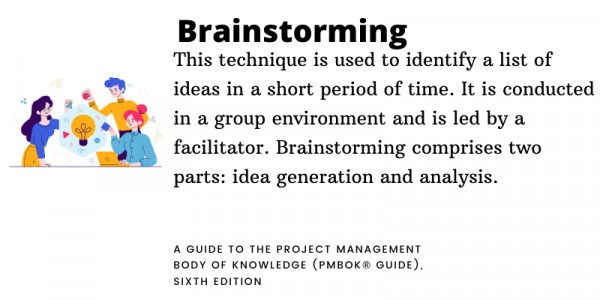
Here are some of the core benefits brainstorming consistently delivers:
- Creative Exploration: Brainstorming encourages participants to move beyond conventional thinking and consider ideas they might not have entertained in a more structured setting. By suspending judgment during the idea generation phase, individuals are more likely to surface novel, unconventional solutions to difficult problems.
- Reduced Decision Fatigue: When a team is overwhelmed by options or stuck on how to proceed, brainstorming provides a process for narrowing down possibilities in a systematic way. Rather than struggling with ambiguity, participants can evaluate a defined list of ideas and make more confident, informed decisions.
- Stronger Team Collaboration: Group brainstorming encourages participants to build on each other’s ideas rather than working in isolation. This dynamic fosters a sense of shared ownership over solutions, strengthens working relationships, and produces outcomes that reflect a broader range of perspectives.
- Enhanced Self-Awareness: The process of exploring different ideas and solutions helps individuals better understand how they think and what they value. Recognising patterns in your own idea generation can sharpen your problem-solving instincts and improve how you contribute to future collaborative efforts.
Methods of Brainstorming
There is no single correct way to run a brainstorming session. Different methods suit different team sizes, problem types, and work styles. Selecting the right technique increases both participation and the quality of ideas generated. Familiarity with several approaches gives facilitators the flexibility to adapt to changing needs.
Here are five commonly used brainstorming methods to consider:
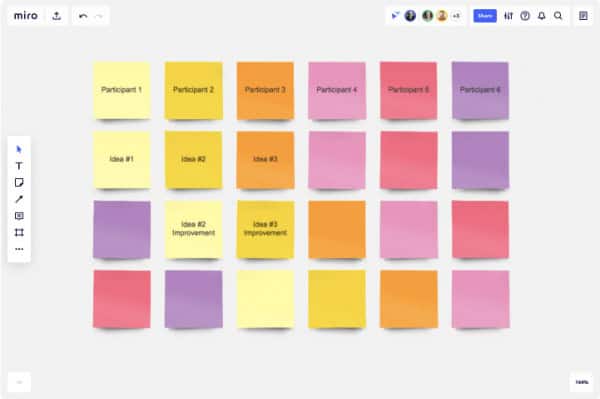
1. Brainwriting
Each participant writes their ideas independently before sharing them with the group, either on paper or using a digital tool. This method is particularly effective for introverted team members and helps prevent dominant voices from overshadowing quieter contributors.
2. Round Robin
Team members take turns sharing one idea at a time in a rotating sequence, ensuring that every participant has an equal opportunity to contribute. This structured format discourages interruptions and keeps the session focused and balanced.
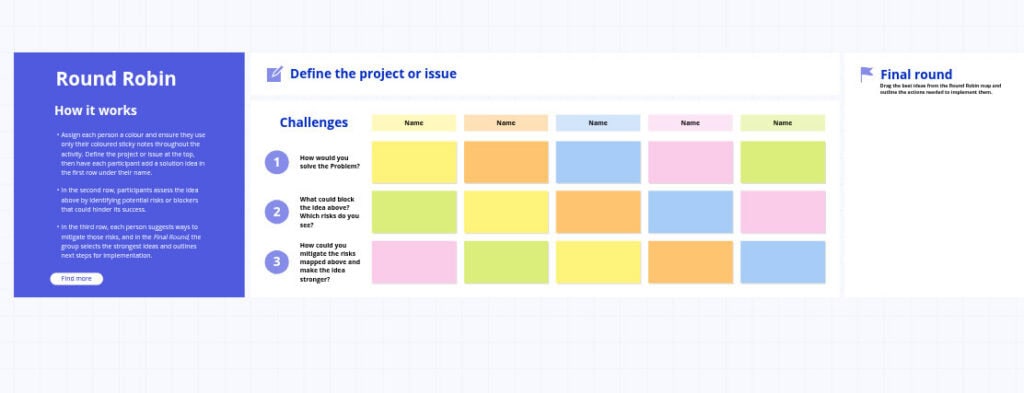
Round Robin Template | Conceptboard
3. Sticky Notes
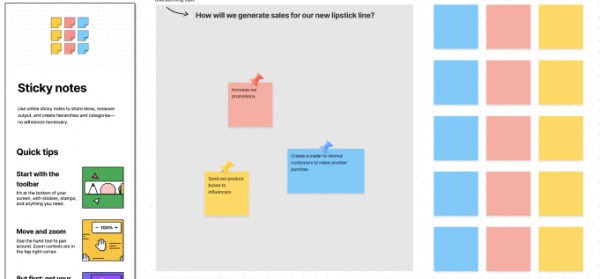
Participants write individual ideas on sticky notes and post them on a shared wall or whiteboard, making it easy to group similar ideas and identify themes. The visual layout helps teams see connections between concepts at a glance.
4. Mind Mapping
A central topic or problem is placed at the centre of a diagram, with related ideas branching outward in a radial structure. Mind maps are especially useful for visualising relationships between ideas and for exploring a topic in multiple directions simultaneously.

Mind Mapping Template | Moqups
5. Brainstorming Templates and Tools
Digital templates and dedicated brainstorming software help teams capture ideas quickly, keep sessions organised, and store outputs for reference. Tools like Asana, Conceptboard, and Figma offer purpose-built templates that accommodate both individual and group sessions.
How to Conduct Brainstorming
Running an effective brainstorming session requires preparation, clear structure, and a facilitation approach that keeps participants engaged. Without a process in place, sessions can drift off-topic or fail to produce actionable output. Following a consistent set of steps ensures that every session delivers meaningful results.
Prepare an Outline
Before the session begins, take time to define its purpose clearly. Ask yourself the following questions to establish a clear direction:
- What are the goals of the session?
- What kind of information do you need to gather?
- Who will be participating in the session?
Having clear answers to these questions ensures that the session stays focused and that participants arrive with the right context. A well-prepared outline also helps the facilitator manage time and steer the group when discussions start to drift.
Select a Template
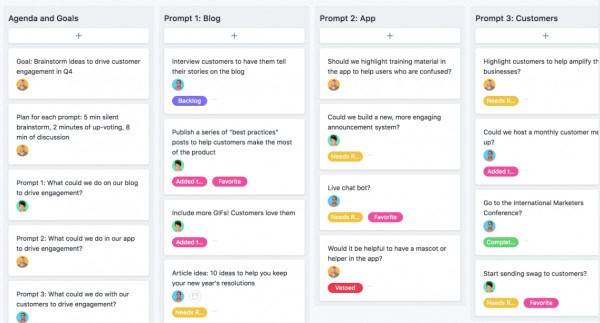
Choosing the right template gives your session structure and ensures that important elements are not overlooked. Select a template that aligns with the complexity and format of your project, then open or print it before the session begins. Start by entering the project name at the top, so participants share a common reference point from the outset.
List Ideas
With the template in place, participants should begin generating ideas freely without filtering or judging them. The goal at this stage is pure volume: the more ideas recorded, the broader the pool to draw from during the evaluation phase. Quantity matters more than quality in this initial step, so encourage everyone to contribute without hesitation.
Add Details
Once an initial list has been established, participants can begin adding depth to the most promising ideas. For creative projects, this might involve sketches or reference images; for business contexts, it may include early-stage market research or competitive analysis. Fleshing out ideas at this stage helps the team assess their viability more accurately before moving into evaluation.
Ask for Help
Brainstorming does not have to be a solitary or insular process, and reaching out for input strengthens the quality of outcomes. Colleagues, mentors, and online communities can provide perspectives that the immediate team may have missed. Inviting external input at the right moment can unlock ideas that internal familiarity with a problem might otherwise obscure.
Facilitation Principles
Beyond the mechanics of running a session, a few guiding principles determine whether a brainstorming session succeeds. These principles apply regardless of the method or template used:
- Focus on Quantity: The goal of the generation phase is to produce as many ideas as possible, with judgment and evaluation reserved for later. Encourage participants to keep ideas flowing without stopping to assess their merit or practical feasibility.
- Encourage Wild Ideas: Unusual or seemingly impractical ideas often contain the seeds of genuinely innovative solutions. Creating a safe space for creative risk-taking leads to more interesting, diverse output and prevents sessions from producing only predictable answers.
- Withhold Judgement: All contributions should be welcomed during the generation phase, even those that seem unlikely or difficult to implement. Premature criticism discourages participation and narrows the scope of ideas before the group has fully explored the problem space.
- Embrace Constructive Criticism: Once the generation phase concludes, the evaluation phase should be approached with openness and rigour. Teams should weigh each idea on its merits, identify what is promising, and set aside what does not serve the session’s defined goals.
5 Free Brainstorming Techniques and Templates
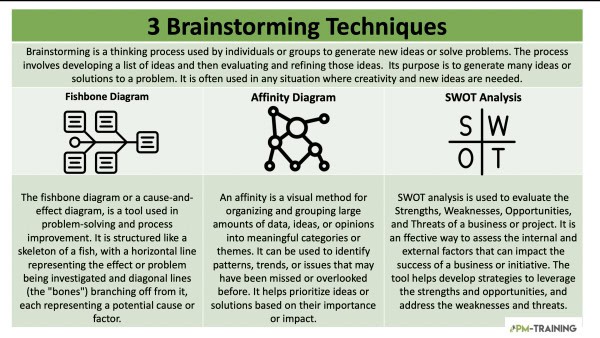
Structured brainstorming tools give teams a reliable framework for moving beyond open-ended discussion and into focused, visual problem-solving. Each of the five techniques below comes with a free template that can be printed or used digitally, making them accessible for teams of any size or budget. Selecting the right tool for your situation significantly improves both the depth and usefulness of the ideas your session produces.
1. The Fishbone Diagram Template
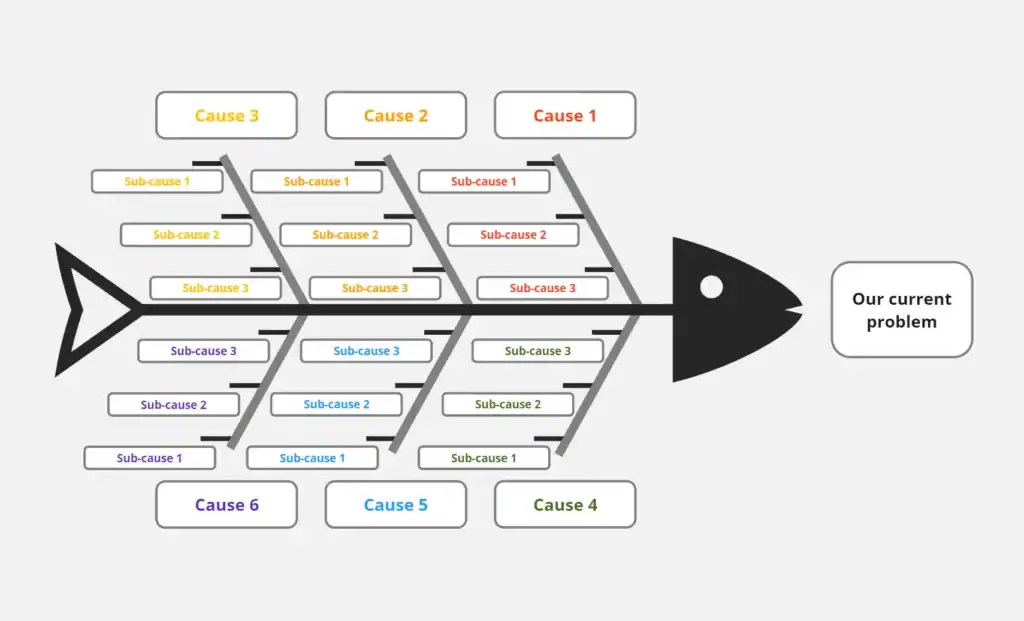
Fishbone Diagram Template | Miro
The fishbone diagram, also known as the Ishikawa diagram, is designed to identify the root causes of a specific problem by mapping potential contributing factors visually. It works especially well in quality management, process improvement, and project retrospectives, where understanding why a problem occurred is as important as resolving it. Free fishbone diagram templates are available through tools such as Conceptboard, Miro, and Canva, and can be used digitally or printed for in-person sessions.
Follow these steps to use the fishbone diagram effectively:
- Identify the problem you want to brainstorm and write it as a clear, specific problem statement.
- Draw a horizontal line on paper or a whiteboard and label the right end with the problem statement.
- Draw diagonal lines branching off the main line and label each branch with a major category of potential causes, such as people, process, tools, or environment.
- Brainstorm specific causes within each category and record them on the corresponding branches, adding as much detail as the group can generate.
2. The Affinity Diagram Template
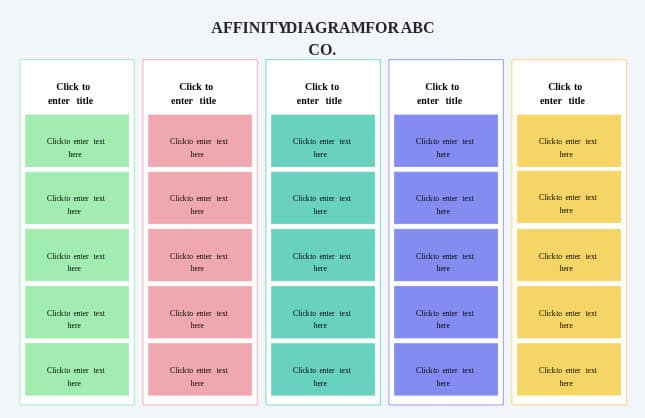
Affinity Diagram Example | Creately
The affinity diagram is a categorisation tool that helps teams make sense of large volumes of unstructured ideas by grouping them into meaningful themes. It is particularly effective after an open brainstorming session, where many ideas have been generated and need to be organised before any evaluation can begin. Free affinity diagram templates are available through Conceptboard, FigJam, and Mural, and work equally well in remote or in-person team settings.
Follow these steps to apply the affinity diagram:
- Gather your team and have participants brainstorm and organize ideas related to a specific topic or challenge, without filtering or discussing them at this stage.
- Have each participant write their individual ideas on separate sticky notes or cards, recording one idea per note to keep grouping clean and manageable.
- As a group, sort the notes into clusters based on natural similarities, relationships, or shared themes, allowing the categories to emerge organically rather than being imposed in advance.
- Discuss the themes that emerge from each cluster and explore what they collectively reveal about the problem or opportunity being examined.
3. The SWOT Analysis Template
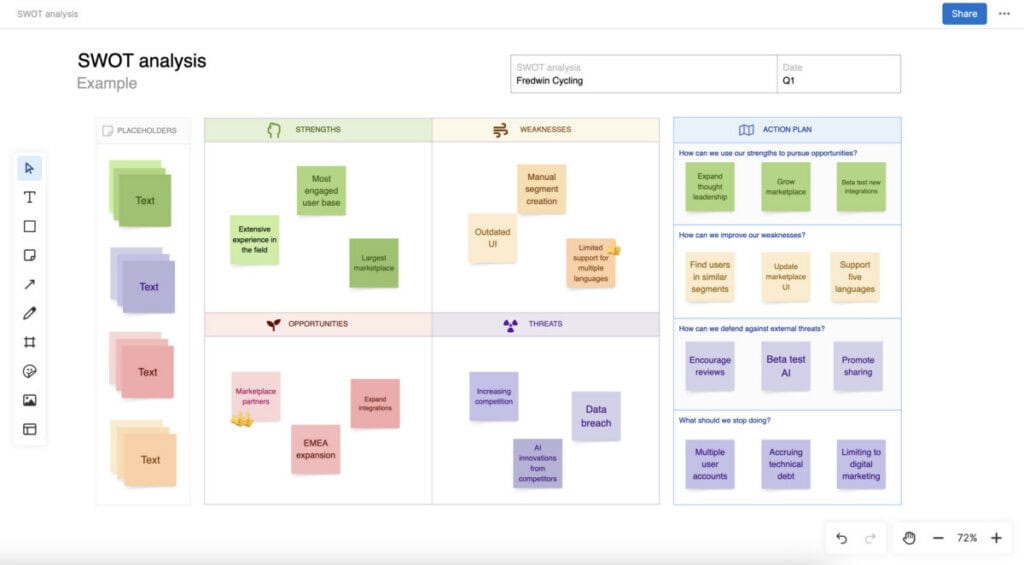
SWOT Analysis Template | Aha.io
The SWOT analysis is a strategic brainstorming tool that helps teams evaluate a project, product, or organisation across four key dimensions: strengths, weaknesses, opportunities, and threats. It is widely used in planning, decision-making, and competitive analysis to ensure teams consider both internal capabilities and external conditions before committing to a direction. Free SWOT analysis templates are available through Asana, Canva, and Smartsheet, and can be adapted for team workshops or individual strategic reviews.
Follow these steps to conduct a SWOT analysis:
- Identify the organisation’s or project’s key strengths, focusing on internal advantages that differentiate it from alternatives or competitors.
- Identify areas of weakness or internal limitations that could hinder performance or reduce the team’s ability to execute effectively.
- Identify external opportunities that could be leveraged for growth, improvement, or strategic advantage in the current environment.
- Identify external threats that could pose a risk to success, including market shifts, competitive pressures, or resource and capacity constraints.
4. The Reverse Brainstorming Template
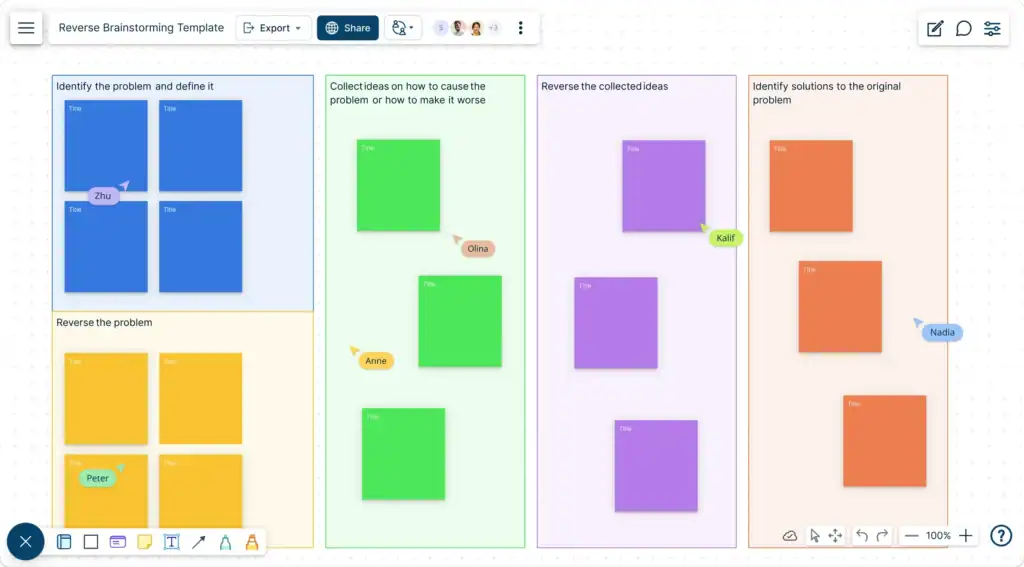
Reverse Brainstorming Template | Creately
Reverse brainstorming is a creative problem-solving technique that approaches challenges from the opposite direction. Rather than asking how to solve a problem, participants ask how they could cause it or make it worse, which often surfaces assumptions and blind spots that conventional brainstorming misses. Free reverse brainstorming templates are available through Miro and FigJam, and the technique works particularly well when a team feels stuck or when standard approaches have failed to generate fresh ideas.
Follow these steps to run a reverse brainstorming session:
- Clearly define the problem you want to solve and write it where all participants can see it throughout the session.
- Reverse the problem statement by asking the opposite question, such as “How could we make this problem worse?” or “What would guarantee this project fails?”
- Brainstorm freely in response to the reversed question, generating as many ideas as possible without filtering, judging, or discussing feasibility.
- Review the reversed ideas and flip each one back into a potential solution or preventive action that directly addresses the original problem statement.
5. The Six Thinking Hats Template
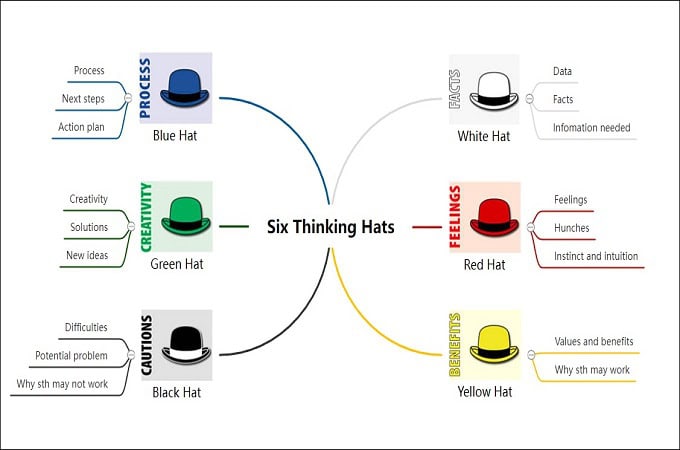
The Six Thinking Hats Template
The Six Thinking Hats technique, developed by Edward de Bono, is a structured method that guides teams to examine a problem from six distinct perspectives, each represented by a coloured hat. By assigning a specific thinking mode to each hat, the technique prevents the group from becoming stuck in a single analytical lens and ensures that emotional, creative, critical, and optimistic viewpoints all receive dedicated attention. Free Six Thinking Hats templates are available through Miro, Lucidchart, and Canva, and are well-suited to strategic planning sessions, product reviews, and team decision-making workshops.
Follow these steps to apply the Six Thinking Hats:
- Introduce each of the six hats to the group: white for facts and data, red for emotions and instinct, black for caution and risk, yellow for optimism and benefits, green for creativity and new ideas, and blue for process management and facilitation.
- Assign the blue hat to the facilitator, who will guide the session and manage transitions between thinking modes throughout the discussion.
- Work through each hat in sequence, giving the group a defined time window to think and contribute only from that hat’s designated perspective.
- After completing all six perspectives, use the insights gathered to synthesise a well-rounded view of the problem and identify the most balanced and informed path forward.
Conclusion
Brainstorming is a versatile and well-proven approach to idea generation that benefits individuals, teams, and organisations across virtually every domain. From the root-cause clarity of the fishbone diagram to the multi-perspective rigour of the Six Thinking Hats, each of the five techniques covered here addresses a different dimension of creative and strategic thinking. Pairing the right technique with a free, accessible template removes the barriers to getting started and keeps sessions structured and productive.
By building brainstorming into regular workflows, teams create a culture where creativity and critical thinking coexist. Templates and structured tools ensure that ideas are captured, organised, and evaluated systematically rather than lost after the session ends. Whether you are solving an operational problem or exploring a new product direction, a well-run brainstorming session provides the clarity and creative momentum needed to move forward with confidence.
FAQs
What is brainstorming, and how does it work?
Brainstorming is a structured thinking process used by individuals or groups to generate ideas and solve problems. It involves two phases: idea generation, where participants produce as many ideas as possible without judgment, and analysis, where those ideas are evaluated, grouped, and refined into actionable solutions that address the original challenge.
Why is brainstorming important in a professional context?
Brainstorming is important because it unlocks creative thinking, reduces decision fatigue, and strengthens team collaboration. By creating a structured space for open idea generation, teams get to move past mental blocks, surface diverse perspectives, and arrive at solutions that might not emerge through conventional discussion or top-down decision-making processes.
How many people do you need for an effective brainstorming session?
Brainstorming can be done alone or in groups of virtually any size, though groups of four to eight participants tend to produce the best balance of diverse input and manageable discussion. Larger groups benefit from structured methods such as brainwriting or round robin, which ensure that all voices are heard and no single participant dominates the session.
What is the difference between brainwriting and traditional brainstorming?
Traditional brainstorming typically involves open verbal discussion in a group setting, which can favour more vocal participants. Brainwriting, by contrast, asks each individual to write their ideas independently before sharing them with the group. This format reduces social pressure, limits groupthink, and often leads to a greater volume and diversity of contributed ideas.
How do you evaluate ideas after a brainstorming session?
After generating a list of ideas, teams should move into a structured evaluation phase. Common approaches include using an affinity diagram to group similar ideas, applying a SWOT analysis to assess feasibility and risk, or using a simple scoring matrix to rank ideas against predefined criteria. The goal is to narrow the pool down to the most viable and impactful options.
Suggested articles:
- Top 10 Free Fishbone Diagram Templates
- Discovery Workshops for Software Projects: From Idea to Validated Roadmap in 5–10 Days
- Project Managing Campaign Launches: Turning Creative Ideas into Executable Plans

Shane Drumm, holding certifications in PMP®, PMI-ACP®, CSM, and LPM, is the author behind numerous articles featured here. Hailing from County Cork, Ireland, his expertise lies in implementing Agile methodologies with geographically dispersed teams for software development projects. In his leisure, he dedicates time to web development and Ironman triathlon training. Find out more about Shane on shanedrumm.com and please reach out and connect with Shane on LinkedIn.