
Manufacturers running project-based or engineer-to-order operations deal with a problem that standard ERP configurations were not built to handle: production management and project management run as separate functions, often in separate systems, creating two versions of the truth about the same work. The ERP platforms worth evaluating for this issue share one trait: they project budgeting, milestone tracking, and resource planning inside the same system that handles production scheduling, BOM management, MRP, and shop floor execution.
When project scope changes, production plans adjust. When shop-floor costs accrue, project financials are updated. Six platforms handle this with varying depth, and the right choice depends on where your complexity sits.
What Project-Based Manufacturers Need From an ERP
Before comparing ERP platforms, it helps to be specific about what project-based manufacturing demands that standard discrete manufacturing does not. Three core requirements stand out:
- Job-Level Cost Tracking: Labor hours, material consumption, and overhead allocation must tie back to individual projects in real time. If your finance team cannot see the margin on a specific customer project until the job closes, you are flying blind on pricing and profitability across every active order. Project budgeting has to connect to the production cost ledger so that when materials are issued to the floor, or labor is booked against a work order, those costs flow into the project record without a manual journal entry.
- Resource Planning Across Concurrent Projects: If you run fifteen active ETO jobs with overlapping timelines, your schedulers need to allocate machine capacity, tooling, and labor across those projects and flag conflicts before they become missed delivery dates. Milestone tracking should tie to production events, not just calendar dates, so that when a subassembly clears quality inspection, the project record reflects it.
- Engineering Change Management: Changes arrive mid-project and affect scope, cost, and timeline at once. A single BOM revision needs to propagate through the project plan, the production schedule, and the financial forecast in one step, not three. If your team handles that through emails and spreadsheet updates, bridging two disconnected systems, you already know the cost in rework and margin erosion.
1. Priority Software ERP
Priority Software has spent more than three decades building ERP for manufacturers, and the project management capabilities sit inside the same platform as the production modules. That single-platform architecture is the reason Priority takes the top position for mid-size project-based manufacturers: your project data and your production data share one data model, which means you do not spend your first year building integrations between two systems or reconciling two sets of numbers at month-end.
Production Capabilities:
- Multi-level BOM management, MRP with sales-order-to-work-order pegging, finite and infinite capacity scheduling, shop floor data collection, quality management, and serial/lot traceability as native functions
- MTS, MTO, ETO, and CTO coexist within the same instance
- Product Data Management gives your engineering team version-controlled BOM access with CAD integration, so when an engineer issues a change order mid-project, it moves through both the project record and the production plan without manual re-entry
Project Management Module:
- Build budgets grounded in live operational and financial data
- Track expenses against actuals as production progresses
- Manage resource allocation across concurrent projects
- Monitor milestones tied to production deliverables
- Production delays and project timelines are updated from the same data source; shop floor costs feed into project financials without an export step
AI and Pricing:
- AI ERP companion updated May 2026 — query data in natural language, generate reports, run demand forecasting, and automate business rules
- IDC recognized Priority as a Major Player in the 2025 Worldwide AI-Enabled Midsize Business ERP Applications assessment
- Pricing starts at $600/month for five users and $120/month per additional user; full implementations run three to six months
Best Fit: Priority Software ERP is the best fit for mid-size manufacturers between 50 and 500 employees running project-based, ETO, or contract manufacturing who need production depth and project management on a single platform, deployed in months at a mid-market cost structure. TEC ranked Priority the top ERP vendor in its 2025 Insight Report on ERP Solutions for SMBs.
2. IFS Cloud
IFS built its reputation in industries where the job does not end when the product ships. Aerospace, defense, industrial equipment, and energy companies that manufacture complex products and then maintain them in the field for decades need an ERP that ties production, project delivery, asset management, and service together. IFS Cloud does that in one platform, bundling ERP with Enterprise Asset Management and Field Service Management under a single data model.
Manufacturing and Compliance Capabilities:
- Multi-mode manufacturing (discrete, ETO, MTO, project-based), finite capacity scheduling, supply chain execution, and integrated quality management
- Compliance frameworks covering ITAR, AS9100, DFARS, and FAA requirements
- Project management connects to production, procurement, and finance, so costs, timelines, and resource usage update as work moves through the shop and into the field
- IDC positioned IFS as a Leader in the Worldwide SaaS and Cloud-Enabled Manufacturing ERP Applications 2024–2025 assessment
Pricing and Investment Fit:
- Deployments for 100 to 500 users run between $200K and $800K per year; implementation adds one to two times that annual cost
- A 75-person manufacturer at $15M in revenue will find the price disproportionate to the business
- A $100M operation with asset-intensive contracts and field service obligations will find it proportional
Think IFS: If your manufacturing operations carry through to long-term asset management and field service, you operate in regulated industries with complex compliance requirements, and your revenue supports an enterprise-tier investment.
3. Microsoft Dynamics 365
Dynamics 365 connects project management and manufacturing through two applications: Supply Chain Management for production operations and Project Operations for planning, resource management, and financial tracking. Both sit on Microsoft Dataverse, so your team works through Outlook, Teams, Excel, and Power BI without middleware between the ERP and the tools they already use every day.
Core Capabilities:
- Supply Chain Management covers discrete manufacturing with MRP, production scheduling, BOM management, manufacturing execution, quality management, and warehouse operations
- Project Operations handles budgeting, resource scheduling, time and expense tracking, and project accounting
- Project team time logged against a manufacturing job feeds into both the project budget and production cost ledger from the same entry
- Microsoft Copilot adds AI across workflows, and the Power Platform provides an extension layer for custom applications
Limitations and Pricing:
- Complex, discrete, ETO, or project-based operations with advanced scheduling, MES-level shop floor execution, or finite capacity planning often require ISV add-ons from AppSource
- Pricing starts around $180 per user per month for Supply Chain Management, with Project Operations as an additional line item
- Implementation runs six to eighteen months
Think Dynamics 365: If your organization already runs on Microsoft infrastructure, your team needs project accounting alongside moderate manufacturing operations, and you value Power BI integration and familiar administration tools over deep native production capabilities.
4. Epicor Kinetic
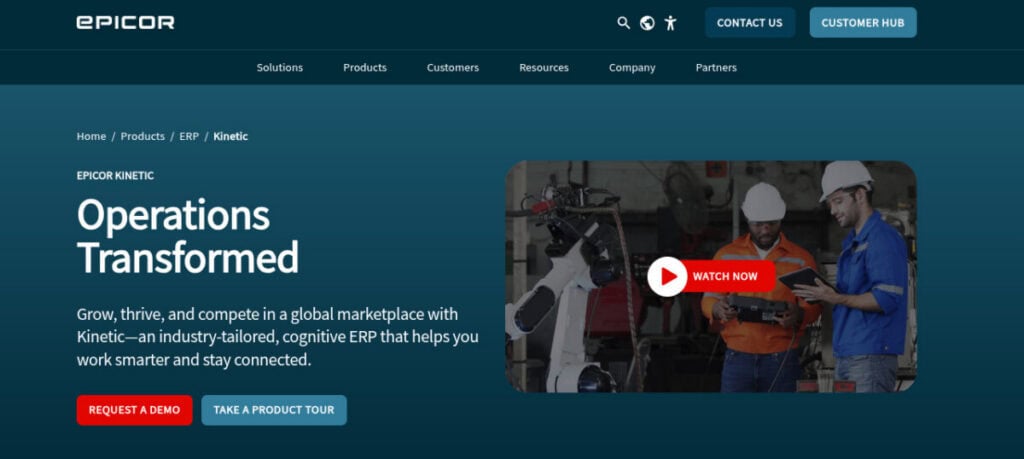
Epicor Kinetic gives you serious manufacturing depth for discrete operations, and the platform handles project-based work through job-level cost tracking rather than through a formal project management module in the way Priority or IFS do.
Core Manufacturing Capabilities:
- Shop floor control, production scheduling, MES-level execution, BOM and routing management, quality workbenches with statistical process control, and supply chain operations all ship as core capabilities
- The Advanced Planning and Scheduling module offers finite capacity planning through a visual scheduling board
- Job-level tracking covers labor, materials, and overhead against individual customer jobs with real-time margin visibility and cost overrun alerts
Recognition and Pricing:
- Gartner placed Epicor as a Leader in the 2024 Magic Quadrant for Cloud ERP for Product-Centric Enterprises
- G2 reviewers average 3.9 out of 5, with manufacturing modules earning praise and the interface earning complaints
- Implementation timelines run five to ten months; total cost of ownership falls between $100K and $500K
Key Distinction — Job-Centric, Not Project-Centric:
- Portfolio views across concurrent projects with milestone tracking, resource leveling, and Gantt planning are thinner than what Priority or IFS offer
- Best suited for operations where production depth and job-level profitability visibility are the primary needs
Think Kinetic: If you run a mid-market job shop, MTO, or ETO operation where MES-level shop floor execution and job-level cost visibility are the primary decision drivers, and formal project portfolio management is a secondary need.
5. Oracle NetSuite
Oracle NetSuite’s clearest advantage for project-based manufacturers is financial, not operational. The SuiteProjects module gives you project budgeting, resource planning, time tracking, billing, and project accounting. The Advanced Manufacturing module adds production scheduling, quality management, and inventory controls. Together, they create a cloud-native system where project financials and production operations share data.
Financial and Operational Capabilities:
- Financial consolidation handles multi-entity, multi-currency, and global tax compliance without heavy customization
- Connects commercial and financial operations in a way that manufacturing-first platforms often do not match out of the box
- Best suited for contract manufacturers running project-based work across multiple subsidiaries or geographies
Limitations and Pricing:
- Shop floor execution, finite scheduling, and advanced capacity planning for complex manufacturing operations tend to need third-party extensions
- Pricing starts at $999 per month, base plus $99 per user per month.
- Implementation runs three to nine months.
Given the configuration complexity across SuiteProjects and Advanced Manufacturing, most organizations rely on a specialized NetSuite implementation service to ensure both modules are properly integrated and aligned with their specific production and financial workflows.
Think NetSuite: If project financial management, multi-entity consolidation, and global compliance drive your ERP decision as much as production management, and your manufacturing complexity stays light to moderate.
6. Acumatica Cloud ERP
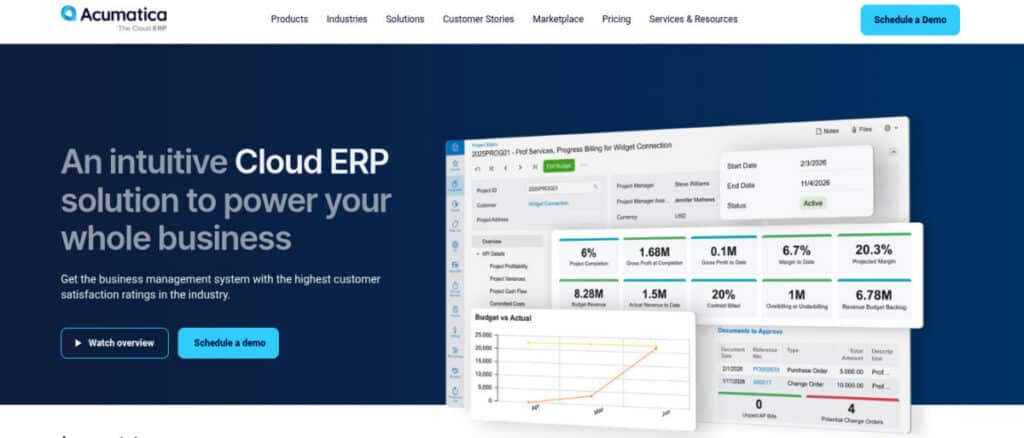
Acumatica Cloud ERP pairs a Project Accounting module with its manufacturing suite, and the consumption-based licensing model removes the per-user cost barrier that keeps many manufacturers from giving their full workforce system access.
Core Capabilities:
- Project budgeting, cost tracking, change order management, and project billing alongside BOM management, production scheduling, MRP, and inventory
- Modern cloud architecture with a clean interface and consumption-based licensing that scales with usage rather than headcount
- A credible upgrade path for manufacturers leaving older on-premise systems like Dynamics GP or Sage 100 MFG
Limitations and Pricing:
- Integration depth between project accounting and manufacturing is lighter than what Priority, IFS, or even Dynamics 365 offer
- Native capabilities cover cost tracking and billing well, but fall short on resource scheduling, milestone-driven execution, and cross-project portfolio management
- Pricing starts around $1,800 per month for the base manufacturing bundle; implementation takes three to six months
Think Acumatica: If you are a small to mid-size manufacturer leaving an older system, you need project cost visibility with flexible licensing, and your production and project management complexity stays moderate.
How to Choose a Manufacturing ERP with Project Management
Your decision comes down to where your complexity sits and how much integration you need between the project layer and the production layer.
Platform Recommendations at a Glance:
- Priority Software: Best when both production and project management requirements are substantive, and you need a single mid-market platform, with MTO, ETO, and CTO capabilities alongside project budgeting and milestone tracking
- IFS Cloud: Right when asset management and field service carry the same operational weight as production and project delivery, with an unmatched functional scope for asset-intensive operations
- Dynamics 365: Makes sense when your IT environment already runs on Microsoft, and project accounting needs to integrate with moderate manufacturing operations
- Epicor Kinetic: Competes on shop floor depth with strong job-level cost tracking for MTO and ETO job shops
- NetSuite: Fits when project financial complexity and multi-entity operations drive the decision
- Acumatica: Earns its place when licensing flexibility and straightforward project cost tracking sit at the top of your criteria
The one consistent mistake in this category is choosing an ERP based on the manufacturing modules alone and layering project management on top through a separate tool afterward. That approach recreates the data fragmentation problem you were trying to solve. If project-based work makes up a meaningful share of your revenue, the project management capability should carry the same evaluation weight as production scheduling and BOM management from the start of your search.
Suggested articles:
- How ERP Improves Job Costing and Inventory Management
- How to Plan a CMMS Software for a Manufacturing Project Successfully
- Bridging Production and Planning: Project Management in Custom Manufacturing

Daniel Raymond, a project manager with over 20 years of experience, is the former CEO of a successful software company called Websystems. With a strong background in managing complex projects, he applied his expertise to develop AceProject.com and Bridge24.com, innovative project management tools designed to streamline processes and improve productivity. Throughout his career, Daniel has consistently demonstrated a commitment to excellence and a passion for empowering teams to achieve their goals.