
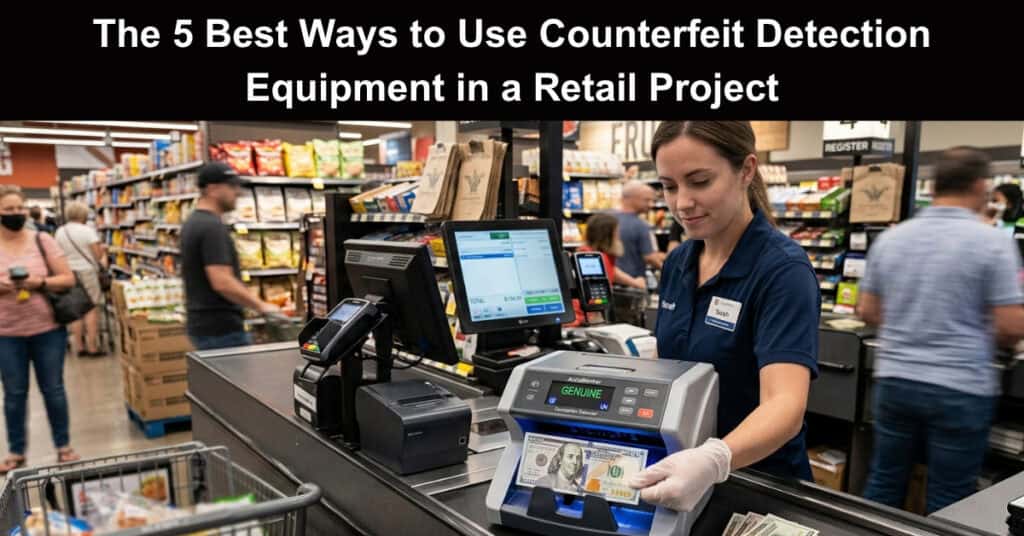
Cash still moves quickly through many retail environments. A busy store can process hundreds of notes during a single shift, often across several registers and multiple employees working under time pressure. One counterfeit bill can pass through unnoticed when verification depends entirely on visual judgment during a rush, especially when staff are focused on speed rather than careful inspection.
That is why counterfeit detection equipment for retail operations deserves a defined place in store planning. The equipment can support cashiers during live transactions, help cash-office teams review takings, and give managers a more consistent way to handle notes that raise suspicion.
For a new store, remodel, or equipment upgrade, the practical question is where detection adds the most value. Retailers gain more from placing the right device at the right point in the cash cycle than from buying equipment and leaving staff to decide when to use it.
1. Check Higher-Risk Notes at the Point of Sale
The checkout is the best place to stop a counterfeit note before it enters the cash drawer. Once the customer has left, identifying the note becomes much less useful because the store may already have accepted the loss. Automatic counterfeit note detectors work well in this setting because they give the cashier a quick result. The employee inserts the note, the device checks its security characteristics, and the transaction can continue without a long manual inspection.
Stores do not necessarily need to scan every bill. Many retailers focus on higher denominations or use the detector when a note looks unusual. Placement directly affects usage. A detector hidden under the counter or shared between distant registers will be used less often during busy periods. In a retail rollout, placing equipment within the cashier’s normal reach makes verification part of the transaction, not an extra task.
2. Recheck Cash During Till Reconciliation
A counterfeit note can still reach the drawer despite front-line controls. Shift changes and till reconciliation provide another chance to catch it before cash from several registers is combined. Cash-office staff usually work more slowly than cashiers, giving them more time to examine questionable notes. Automatic equipment can help confirm concerns raised during counting and reduce reliance on one employee’s visual judgment.
Catching a suspect note at this stage can also help the store identify where it entered the operation. If cash has already been pooled from every register, that trail is much harder to reconstruct. Keeping verification close to the individual till count gives managers better information when they review the incident.
For stores with several registers, reconciliation can also show recurring weaknesses in the cash-handling process. If suspect notes repeatedly appear in one drawer, management can review how that register is operated and provide more focused training to the staff involved. Recording the till number and shift alongside the detector result gives the store a clearer record than simply removing the note from the count.
3. Verify Cash Before Preparing the Bank Deposit
Deposit preparation is the last internal checkpoint before cash leaves the store. A final verification step can prevent a suspect note from reaching the bank and becoming a problem after the deposit has been submitted. This is especially useful in high-cash locations. A single store may accumulate notes from many registers over the course of a day. Running questionable bills through a detector during deposit preparation gives the cash-office team another chance to catch something missed earlier.
The equipment used here can differ from the unit at checkout. Speed and easy operation usually dominate front-counter requirements. Back-office teams may prefer equipment suited to repeated verification during counting. Store planners should treat those two environments separately, rather than assuming one device type fits every cash-handling point.
A final check before deposit preparation can also reduce disputes over where a questionable note entered the process. Once the deposit has left the store, tracing the source becomes far harder. Keeping the detector near the counting area lets staff isolate a suspect bill before bundling it with the rest of the cash and record it while the day’s transaction records are still easy to review.
4. Use Detectors to Support Staff Training
Employees still need some knowledge of genuine currency even when the store uses automatic detection. A device alert is easier to handle when the cashier already knows the important information. Training can combine real notes with the same detector employees will use on the floor. Staff can see how the device reacts during normal operation and learn the store procedure for a note that fails verification. This makes the equipment familiar before the employee faces a customer waiting for change.
The response procedure deserves equal attention. A cashier should know who to contact and how to handle the interaction without accusing the customer of deliberately passing counterfeit currency. That part belongs in store-opening training because the detector only identifies a problem for review. It does not handle the customer conversation.
5. Place Equipment Where Cash Exposure Is Highest
Not every register carries the same counterfeit risk. A service desk that regularly handles large cash payments may need stronger controls than a low-volume counter. Stores that stay open late may see different transaction patterns from locations with shorter trading hours. Retailers can use transaction history and cash volumes to decide where dedicated equipment belongs. A flagship store with heavy cash traffic may justify detectors across several checkout lanes.
A smaller location may only need one unit at the main register and another in the cash office. This approach is especially useful in multi-store projects. Instead of giving every location the same equipment package, the rollout can reflect actual transaction volume. The project team can standardize the operating procedure while adjusting device quantities to each store’s exposure. This keeps control consistent without buying more equipment than the site needs.
To Recap
Counterfeit detection works best when it follows the way cash actually moves through the store. The first check belongs close to the customer transaction. Later checks can support reconciliation and deposit preparation. Training gives staff enough confidence to use the equipment correctly, while thoughtful placement keeps the process practical during busy trading periods.
For retail project teams, the equipment is a small part of the overall store build, but its location and operating procedure should be decided before opening day. Once those choices are built into the cash-handling workflow, counterfeit detection becomes much easier for staff to use consistently.
Suggested articles:
- Why Should Retailers Adopt Omnichannel to Improve Experience?
- The Popularity of Interactive Digital Sign Kiosks in Modern Retail Environments
- Optimizing Inventory Management with Mobile Barcode Software Solutions

Daniel Raymond, a project manager with over 20 years of experience, is the former CEO of a successful software company called Websystems. With a strong background in managing complex projects, he applied his expertise to develop AceProject.com and Bridge24.com, innovative project management tools designed to streamline processes and improve productivity. Throughout his career, Daniel has consistently demonstrated a commitment to excellence and a passion for empowering teams to achieve their goals.