
Compliance projects fail differently from software projects. A software project fails visibly. It ships late, or it ships broken, and everyone knows. A compliance project fails quietly, months after go-live, when the recurring task nobody owns stops running and nobody notices until an auditor asks. Healthcare exclusion screening is the clearest example of the pattern.
The requirement is monthly, the scope crosses three or four departments, and the failure modes are known before you start. That makes it a project management problem before it is a procurement one.
Why This Project Is Harder Than It Looks
Four characteristics make it different from a standard tooling rollout.
- It Has No End Date: Most projects deliver something and close. This one delivers a recurring operational process, which means the handover is the deliverable rather than the software.
- Scope Is Defined by Payment Flow, Not Headcount: Employees, vendors, and contractors providing items or services payable by federal health care programs all fall in scope. That pulls in transportation providers, billers and coders, equipment suppliers, and administrative services, which sit in systems your project sponsor may not control.
- The Requirement Is Softer Than the Exposure: OIG’s special advisory bulletin states plainly that no federal statute or regulation requires providers to check the LEIE. What OIG does is recommend regular screening at a monthly cadence. State Medicaid agencies face a harder rule under 42 CFR 455.436, and Medicare Advantage plans, state Medicaid programs, and Medicaid managed care organizations generally require it contractually.
- Success Is Invisible: A screening programme working correctly produces nothing. That makes it the first thing to degrade once the project manager moves on.
Phase One: Define Scope Before You Look at Tools
Every failed implementation I have seen skipped this and started with a vendor demo.
- Map the Systems Holding Names: HR, credentialing, accounts payable, procurement. If a name exists in a system nobody mapped, it will not get screened.
- Agree the Population in Writing: Employees, contractors, vendors, and anyone providing services integral to patient care. OIG has indicated civil penalty liability is greatest in that last group.
- Establish How Many State Lists You Need: This is the requirement most projects get wrong, and it is covered below.
Phase Two: The Requirement That Decides Vendor Selection
There are dozens of state Medicaid exclusion lists, and coverage varies enormously between vendors. A tool that screens “OIG, SAM and state lists” might cover every available state, or it might cover one. If you operate in three states and your tool covers one, your project has delivered a documented gap. Get the count in writing during procurement, before price comparison. It is the single requirement most likely to surface as a defect after go-live.
The Options, Compared
1. Exclusion Screening
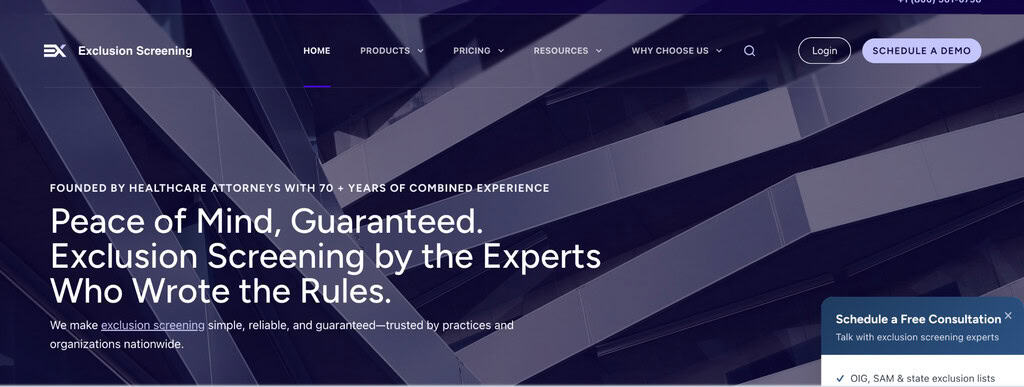
Best for: projects needing published pricing, full state coverage, and a defensible audit trail.
Exclusion Screening was founded by healthcare attorneys with more than 70 years of combined experience, including a former DOJ National Health Care Fraud Coordinator. That background shows in how the service is structured: the emphasis is on resolving matches defensibly rather than generating alerts.
Key Features
- OIG LEIE, GSA SAM, and state Medicaid list screening
- Social Security Administration Death Master File
- Documented multi-point identity verification
- Monthly monitoring with alerts
- SAFER™ platform access on every plan
- Published pricing from $30 per month
What It Screens
Its proprietary SAFER™ platform screens against:
- OIG LEIE, the List of Excluded Individuals and Entities
- GSA SAM, the System for Award Management
- State Medicaid exclusion databases
- Social Security Administration Death Master File
How It Handles Matches
This is the part that decides whether screening produces work or produces answers. The service confirms identity using multiple data points and documented logic, determining whether a match is genuinely the same individual or entity. The stated goal is reducing both false positives and false negatives. For a compliance team, the difference is measured in hours. A tool that flags forty names and leaves you to verify each one has moved the work rather than removed it.
Pricing, Published
Both tiers cover up to 100 screens per month.
| Basic | Premium | |
|---|---|---|
| Price | $30/month | $40/month |
| OIG LEIE | Yes | Yes |
| GSA SAM | Yes | Yes |
| State Medicaid lists | 1 | All available |
| Monthly monitoring and alerts | Yes | Yes |
| SAFER™ platform access | Yes | Yes |
Read that state list row carefully, because it is the entire decision. The ten-dollar difference between tiers buys you every available state list instead of one. If you operate in more than one state, or contract with anyone who does, Basic leaves a gap that will surface in an audit rather than in your monthly report.
Both plans include identity verification, monthly monitoring with alerts, dedicated support, and full SAFER™ access. Custom pricing applies above 100 screens, including vendor screening and compliance hotline bundles. Comparing OIG Exclusion checks on published rates rather than a sales call is unusual in this category, and it makes budgeting a project line item rather than an unknown.
Consider
The 100-screen ceiling on both published tiers means larger rosters move to custom pricing and a conversation. The service also recommends limiting access to three users, though additional logins are available by arrangement.
2. ProviderTrust
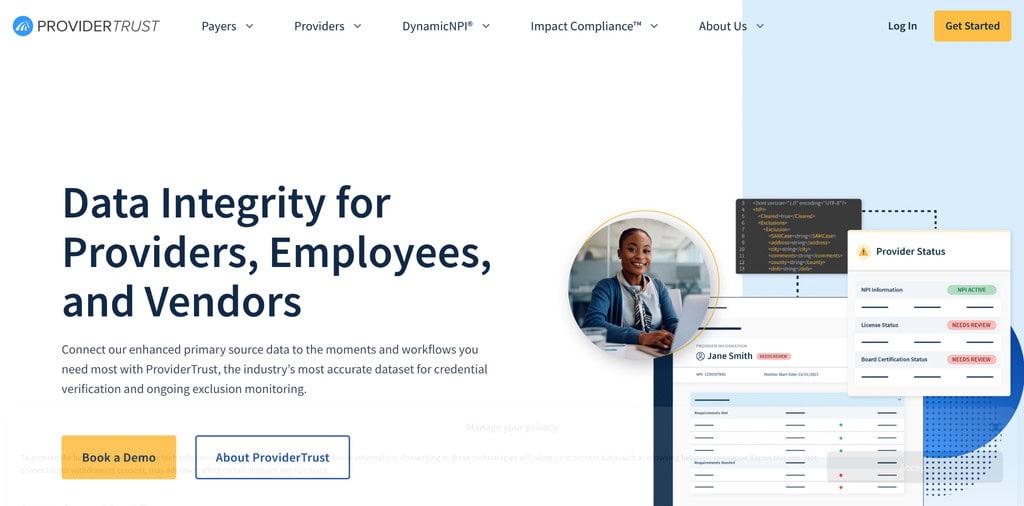
Best for: projects where credential monitoring is in scope alongside screening.
An established healthcare compliance platform covering OIG LEIE screening, SAM.gov debarment checking, state Medicaid list monitoring, license verification, and alerting.
Pricing: not published. Contact required, which means budgeting on an estimate until procurement completes.
Consider: credential monitoring is genuine added scope if your project needs it and unnecessary cost if it does not. Confirm the state list count during the sales process rather than assuming full coverage.
3. Verisys
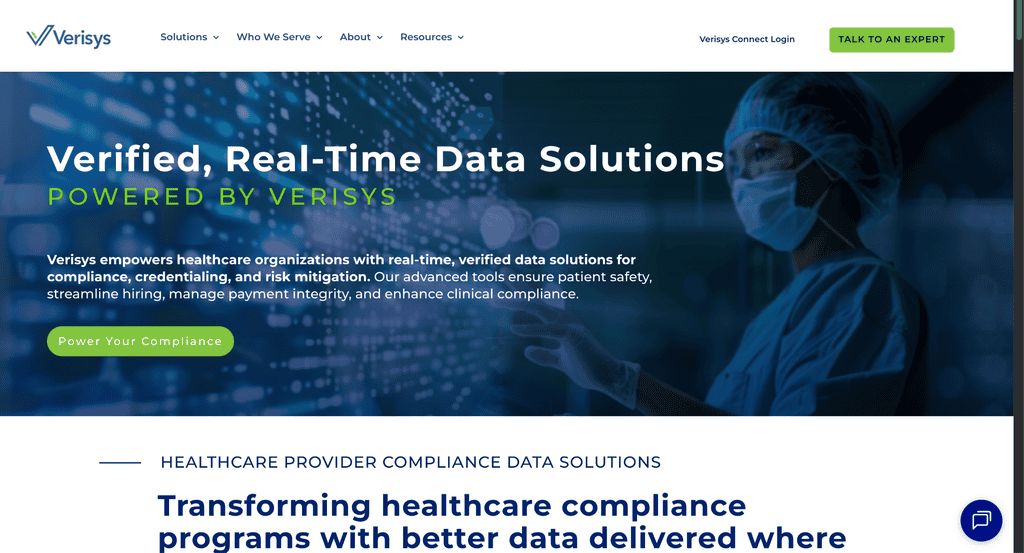
Best for: projects where credentialing is the primary deliverable and screening is a component.
A credentialing and compliance monitoring platform covering primary source verification, OIG and SAM exclusion monitoring, state license monitoring, DEA and board certification tracking, plus automated re-verification workflows.
Pricing: not published. Contact required.
Consider: the credentialing depth is the reason to choose it. If screening is your only requirement, the scope exceeds the need.
4. ClientCare

Best for: home health, hospice, and post-acute projects needing eligibility monitoring too.
Bundles rolling eligibility verification via 270/271 transactions, coverage lapse detection with alerts, OIG LEIE and SAM.gov screening with fuzzy name matching, CSV roster upload from common EMRs plus automated monthly re-screening after LEIE updates.
Pricing: from $249 per month, with a 30-day trial and no card required.
Consider: the eligibility side is the differentiator. If your project scope is screening alone, you are funding the half you will not use.
5. Manual Screening Against the Source Files

Best for: single-site projects with small static rosters and a named owner.
OIG publishes the LEIE as a downloadable file and a searchable online tool, both free. SAM.gov is free. State lists are individually accessible.
Pricing: no licence cost. Time cost instead.
Consider: OIG replaces the full downloadable file monthly and recommends using the complete updated database rather than supplement files alone. Doing this across multiple state lists with documented verification on every potential match is a recurring job, and it scales badly.
Comparison at a Glance
| Solution | Published pricing | State list coverage | Identity verification | Extras |
|---|---|---|---|---|
| Exclusion Screening | $30 or $40/month | 1 or all available | Documented, multi-point | SSA Death Master File, compliance hotline |
| ProviderTrust | No | Confirm directly | Not published | Licence and credential monitoring |
| Verisys | No | Confirm directly | Not published | Primary source credentialing |
| ClientCare | From $249/month | Confirm directly | Fuzzy name matching | Eligibility verification |
| Manual | Free | Whatever you build | Yours to perform | None |
Details other than Exclusion Screening reflect published positioning as of September 2026. Confirm before purchase.
Phase Three: Build the Risk Register Properly
Most compliance registers list failure modes flat, which is why they get read once and then ignored. Grouping by risk categories makes them reviewable, because each category has a different owner and a different cadence.
- Compliance Risk: Missed monthly windows, inadequate scope definition, undocumented exceptions. Owner: Compliance. Review: monthly.
- Data Quality Risk: Name-matching errors, stale rosters, systems holding names nobody mapped. Owner: HR and Supply Chain jointly. Review: quarterly.
- Vendor Risk: Undocumented list coverage, tier limitations discovered after purchase. Owner: Procurement. Review: at renewal.
- Evidence Risk: Incomplete audit packets, inconsistent filing, no review trail. Owner: Compliance. Review: monthly, with the run.
Four categories, four owners, four cadences. A flat list gives your steering group none of that, and it gives whoever inherits the process nothing to work from.
Phase Four: Design the Handover
Screening fails when it belongs to nobody in particular, so the handover is where the project either succeeds or quietly does not.
- Assign Owners That Do Not Move: Compliance owns the policy and reviews exceptions. HR owns employee data. Supply Chain owns vendor data. IT supports the feeds.
- Tie the Run to the File Refresh: Recurring calendar holds aligned to the monthly LEIE update, not to an arbitrary date.
- Add Trigger-Based Screening for new hires, new vendors, and role changes, so the monthly run is a safety net rather than the only control.
- Hand Over the Register, Not Just the Tool: Whoever inherits this needs the risk categories, the owners, and the review dates, or the process degrades to whatever the first person to leave remembered.
The Monthly Runbook
- Export the current roster of employees, contractors, and vendors.
- Screen against the LEIE, SAM.gov, and every applicable state list.
- Investigate each potential match and verify identity using an SSN or EIN.
- Record false positives and the reason each was cleared.
- Escalate confirmed matches to Compliance under your policy.
- File the completed evidence packet somewhere consistent and access-controlled.
The evidence packet is the deliverable, not the screening run. It needs the roster used, the run date, the source files or search output, verification records for each potential match, the disposition of each exception plus evidence of review or approval. An auditor is not asking whether you screened. They are asking you to prove what you screened, when you screened it, and how you resolved what came back.
Defining Done
Compliance projects need acceptance criteria like any other, and “the tool is live” is not one.
- Scope is documented and signed off by every system owner.
- The register exists, grouped by category, with named owners and review dates.
- Three consecutive monthly runs have completed with complete evidence packets.
- The operational owner can run it without the project team present.
Until all four are true, the project is not finished regardless of what the Gantt chart says.
FAQs
Is monthly OIG screening legally required?
Not by federal statute for providers. OIG’s special advisory bulletin states no law requires checking the LEIE, but OIG recommends monthly screening. State Medicaid agencies face a monthly requirement under 42 CFR 455.436, and Medicare Advantage plans, state Medicaid programs, and Medicaid managed care organizations generally require it contractually.
Who has to be screened?
Anyone providing items or services payable by federal health care programs, directly or indirectly. Employees, contractors and vendors, including transportation providers, billers and coders, equipment suppliers and administrative services.
How many state Medicaid lists should a tool cover?
Every state where you operate, at minimum. Coverage varies sharply between vendors and between tiers of the same vendor. Exclusion Screening’s Basic plan covers one state list, and Premium covers all available state lists, a ten-dollar difference and the main reason to compare tiers rather than headline prices.
What does exclusion screening cost?
Exclusion Screening publishes $30 per month for Basic and $40 for Premium, both covering up to 100 screens, with custom pricing above that. Most competitors do not publish rates at all.
How do I resolve a potential match?
Verify identity using an SSN or EIN before acting. Record the verification, the decision, and the reasoning. A name match alone is not a finding.
What goes in the audit packet?
The roster used, the run date, source files or search output, verification records for potential matches, the disposition of every exception plus evidence of the required review or approval.
Can we just use the free OIG search?
For a small static roster, yes. It is defensible. The difficulty is doing it monthly across multiple state lists with consistent documentation, which is where the time cost overtakes the licence cost.
Suggested articles:
- Project Management in Regulated Industries: Compliance, Risk & Software Needs
- 9 Vital Tools for Healthcare Project Managers
- The 5 Biggest Benefits and Drawbacks of Compliance & Coordination in Project Management

Daniel Raymond, a project manager with over 20 years of experience, is the former CEO of a successful software company called Websystems. With a strong background in managing complex projects, he applied his expertise to develop AceProject.com and Bridge24.com, innovative project management tools designed to streamline processes and improve productivity. Throughout his career, Daniel has consistently demonstrated a commitment to excellence and a passion for empowering teams to achieve their goals.