
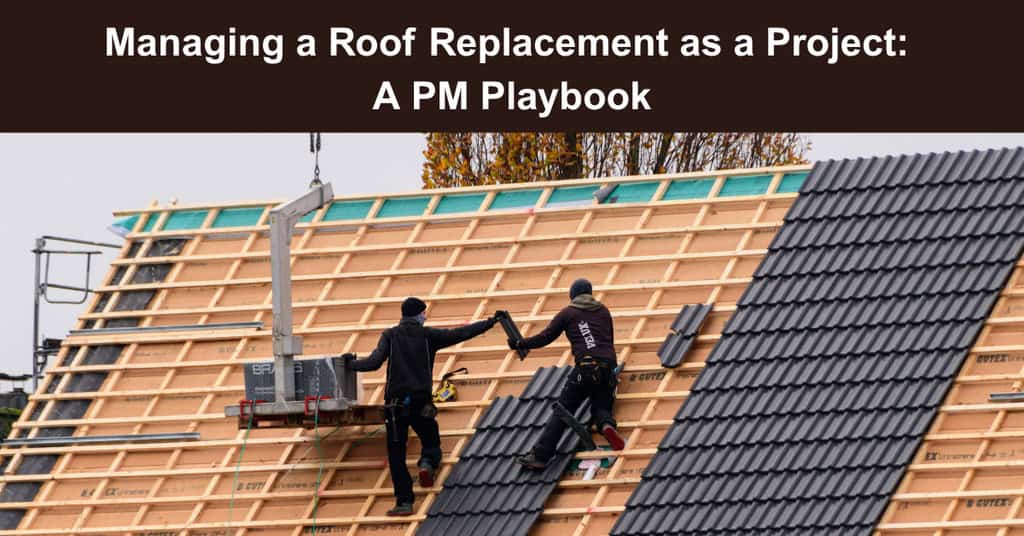
A roof replacement looks like a trade job, but it behaves like a project. It has a fixed scope, a hard weather window, a third-party vendor, an insurance stakeholder, and real safety exposure. Facility managers and property owners who treat it as a single phone call often end up with slipped dates, disputed invoices, and warranties nobody can find.
Key Takeaways
- A roof replacement is a short, high-risk project, and it deserves a charter, a schedule, a procurement plan, and a risk register like any other.
- U.S. insurers logged 2,769,362 hail loss claims from 2017 to 2019, and 69% of them landed between March and June.
- Licensing rules for roofers vary by state, so contractor vetting falls on you: insurance certificates, BBB standing, references, and written bids.
- A contractor who offers to waive or absorb your insurance deductible should fail your procurement criteria outright.
- Closeout is where warranty value is won or lost: collect documents, photos, and sign-offs before the final payment.
This playbook maps a roof replacement onto the project life cycle you already know. It is written for project managers handling commercial buildings, rental portfolios, or their own homes, especially in regions where hail season sets the calendar.
1. Treat the Roof as a Project, Not a Repair Call
A roof replacement follows the same four phases as any project, just compressed into weeks instead of months. Writing a one-page project charter up front forces the decisions that usually get skipped: who approves spend, what “done” means, and how much contingency you hold.
| Phase | Roofing tasks | PM output |
| Initiation | Inspection, damage photos, insurance notice | Charter, budget range |
| Planning | Scope of work, material choice, bids, schedule | Plan, procurement plan, risk register |
| Execution | Tear-off, decking repairs, install, daily cleanup | Status reports, change requests |
| Closure | Final walk-through, permits closed, warranty filed | Closure report, lessons learned |
A simple project plan with a work breakdown structure is enough. The value is in naming owners for each task, especially the insurance and permit items that fall between the property owner and the contractor.
2. Scope and Schedule Around Storm Season
Hail sets the roofing calendar across much of the country, so plan around it rather than react to it. The National Insurance Crime Bureau counted 2,769,362 U.S. hail loss claims from 2017 to 2019. May was the single heaviest month, and March through June together accounted for 69% of all claims.
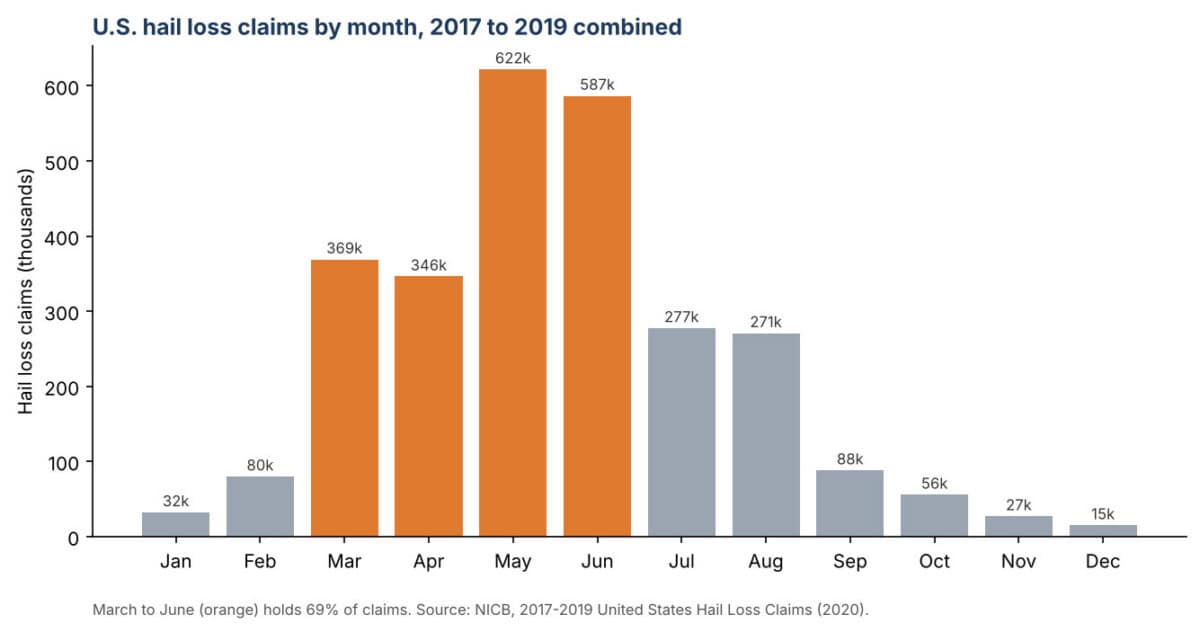
Source: NICB, 2017-2019 United States Hail Loss Claims.
The pattern has not eased. The Insurance Information Institute reports 5,432 hail events nationwide in 2025, up from 5,373 in 2024, based on National Weather Service Storm Prediction Center data.
Three scheduling rules follow from this data:
- Book Planned Replacements for Late Summer Through Winter: Contractor demand spikes after spring storms, and lead times stretch with it.
- Build a Weather Buffer into Every Milestone: A tear-off cannot sit open in a storm, so weather days belong in the baseline, not in a change request.
- Track Progress with an Index, Not a Feeling: The Schedule Performance Index flags a slipping job early enough to act.
3. Procure the Contractor with a Scorecard
Contractor selection is the decision that carries the most risk. Licensing requirements for roofers differ from state to state, and some areas have none at all, so a business card proves very little. That puts vetting on you. The Federal Trade Commission advises getting several written estimates to avoid home improvement scams, confirming the contractor’s licence with your state or county, and asking for proof of insurance.
It also warns against paying the full cost up front and says to hold the final payment until the work is done to your satisfaction. Turn that guidance into a weighted scorecard so bids are compared on the same terms. Your procurement plan and a short request for proposal give every bidder the same scope to price.
| Criterion | Weight | What to verify |
| Insurance and bonding | 25% | Certificate of insurance; call the insurer to confirm |
| Reputation | 20% | BBB rating and accreditation; review counts and recency |
| Warranty terms | 20% | Workmanship warranty length in writing; manufacturer warranty |
| Scope clarity | 15% | Line-item bid covering tear-off, decking, flashing, cleanup |
| Schedule and access | 10% | Start date, crew size, emergency response |
| Payment terms | 10% | No full prepayment; payments tied to milestones |
One rule is pass or fail, not a weighting: never accept an offer to waive, pay, or rebate your insurance deductible. Some states ban the practice outright; Colorado, for example, made it illegal for roofing contractors in 2012, according to the Colorado Roofing Association.
Whichever contractor you choose, lock the agreed terms into a written supplier contract with milestones, cleanup duties, and warranty documents listed as deliverables. The FTC also recommends filling in every blank space and writing any verbal promises into the contract.
Real-life Example: Here is what a strong bid looks like in practice. LOA Roofing & Construction, an Austin roofing company at 706 W. Ben White Blvd., holds an A+ rating and has been BBB Accredited since October 29, 2018, according to its Better Business Bureau profile. Its Austin page displays a 5.0-star Google rating across more than 1,000 reviews. LOA states that it offers a lifetime workmanship warranty, no-cost and no-obligation roof inspections, and drone inspections when the owner cannot be on site. The company also says its team brings 30+ years of combined experience across residential and commercial roofing, including TPO, EPDM, metal, and clay tile systems. Each of those claims maps directly to a row on the scorecard above.
4. Build a Roofing Risk Register
A roofing job concentrates several risks into a few days. A risk register built before work starts turns those risks into owned actions.
| Risk | Likelihood | Impact | Response |
| Storm during tear-off | Medium | High | Weather buffer; tarps staged; daily forecast check |
| Rotten decking found | Medium | Medium | Per-sheet decking price agreed in the bid |
| Worker fall | Low | Severe | Confirm fall protection plan and insurance |
| Insurance scope dispute | Medium | High | Photo log; adjuster on site; written scope |
| Material delay | Low | Medium | Confirm stock before start date |
Safety deserves its own line even though the contractor owns it. The Occupational Safety and Health Administration reports that 1,069 construction workers died on the job in 2022, and 395 of those deaths involved falls from elevation. That is why the insurance check carries the heaviest weight on the scorecard.
Hidden decking damage is the most common source of scope change. Agree on a per-sheet replacement price in the bid, then log any extra sheets through a change request form so the final invoice holds no surprises.
5. Track Progress and Close Out
Execution is usually the shortest phase on a residential roof, while commercial systems run longer. Either way, a short daily project status report with photos covers progress, issues found, weather, and the plan for tomorrow.
Closeout is where warranty value is secured. Before the final payment, collect these items:
- Final inspection sign-off and any closed permits
- Manufacturer warranty registration and the written workmanship warranty
- Before, during, and after photos, including decking repairs
- Lien waivers and the final itemized invoice
File them with a project closure report, then run a quick review using a lessons learned template. The next roof on your portfolio will go faster.
The Bottom Line
A roof replacement runs best when you manage it as a project, with a charter, a weather-aware schedule, a scored contractor selection, and a live risk register. Hail data shows when demand will spike, and consumer guidance tells you which contractor behaviours to rule out. Plan the work, vet the vendor, document the closeout, and the roof becomes one of the most predictable projects in your portfolio.
Common Questions Answered
How long does a roof replacement project take?
The installation is usually the shortest phase for a home, while commercial roofs take longer. Inspection, bidding, insurance approval, and materials usually add several weeks, so plan the whole project, not just the install.
Do roofers need a licence?
It depends on where the property is. Rules vary by state and sometimes by county, so confirm local requirements and still check insurance certificates, BBB standing, and references before signing.
Can a contractor cover my insurance deductible?
You should not accept that offer. Some states make it illegal for roofers to waive or rebate a deductible, and the deductible remains your responsibility under the policy.
When is the best time to schedule a roof replacement?
Late summer through winter is usually easiest, because spring hail drives demand. March to June held 69% of U.S. hail claims in NICB’s 2017 to 2019 data.
How much contingency should I hold?
Hold enough to cover unknown decking repairs, since rot is only visible after tear-off. Ask each bidder to price replacement decking per sheet so you can size the reserve.
Suggested articles:
- Managing a Multi-Family Rental Property Upgrade: A Project Manager’s Guide to Budget Control
- Top 5 Mistakes to Avoid When Planning a Commercial Renovation Restroom Project
- How to Reduce Costly Rework in Construction Projects

Daniel Raymond, a project manager with over 20 years of experience, is the former CEO of a successful software company called Websystems. With a strong background in managing complex projects, he applied his expertise to develop AceProject.com and Bridge24.com, innovative project management tools designed to streamline processes and improve productivity. Throughout his career, Daniel has consistently demonstrated a commitment to excellence and a passion for empowering teams to achieve their goals.