
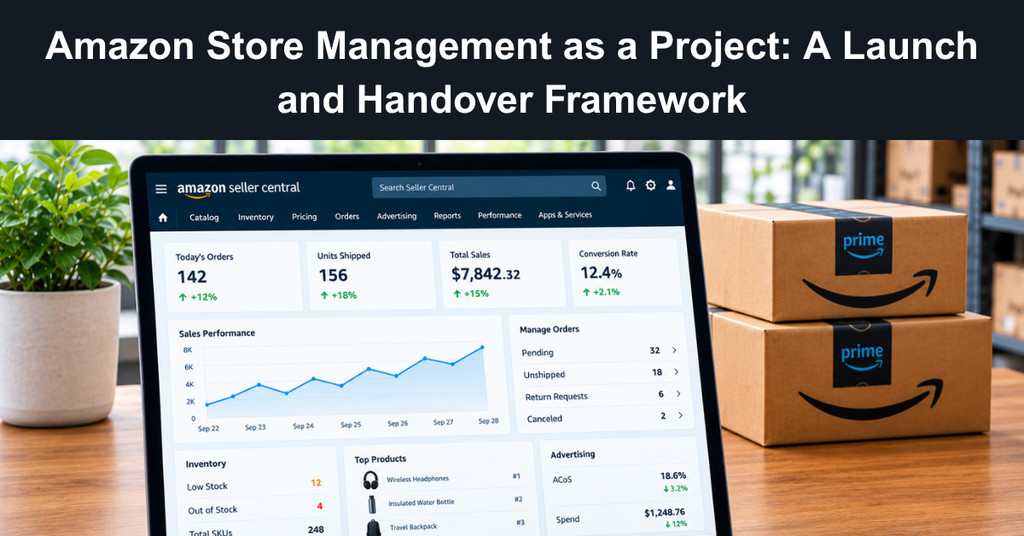
When a company decides to start selling on Amazon, the work usually arrives on someone’s desk without being called a project. There is no charter, no risk register, and no defined end date. There is a launch date somebody promised to the board, a spreadsheet of product costs, and an assumption that the ecommerce team will work it out.
It behaves like a project in every way that matters. It has a temporary lifespan, a unique deliverable, cross-functional dependencies, and a handover to ongoing operations. Managed as a project, it lands predictably. Managed as a series of tasks, it produces the familiar pattern: a launch that slips twice, a marketing push aimed at products that are not yet sellable, and an operations team inheriting something nobody documented.
This is a framework for running that work properly, written for project managers who are not marketplace specialists.
Where the Project Ends and Operations Begin
Define this first, because it determines your scope. A reasonable definition of done is the first full month in which the store is live, listings are stable, inventory is replenishing on a known cycle, and the Amazon store operating routine has an owner. Everything after that is business as usual, not project work.
Teams that skip this definition never close the project. The project manager is still chasing listing fixes and advertising decisions six months after launch, because no handover was ever planned and nobody agreed who owned the channel.
Build the Critical Path Around Lead Times, Not Effort
The usual scheduling instinct is to estimate effort for each task and sequence accordingly. On a marketplace launch, most of the timeline is not effort at all. It is waiting. Three chains run in parallel, and the longest one sets your launch date:
- Inventory: Production, freight, customs, receiving at the warehouse, and inbound transfer to the marketplace. On an ocean shipment, this can exceed 90 days end to end.
- Brand and Compliance: Trademark registration, brand registry enrolment, and approval to sell in restricted categories. Trademark timelines in particular are measured in months and are outside your control.
- Content and Listings: Photography, copy, and enhanced content, which is the only chain your team fully controls and therefore the only one that compresses under pressure.
Sequencing errors here are expensive. A launch scheduled from the shipment date rather than the receive date books advertising against products that cannot be bought yet. Committing to a launch date before the trademark is filed puts a milestone behind a government processing queue.
Key Takeaway: On marketplace launches, the critical path usually runs through waiting periods you do not control. Schedule the buffer where the waiting is.
Treat Platform Approvals as External Dependencies
Several gates in this project belong to the marketplace, not to your team. Account verification, brand registry enrolment, category ungating, and storefront review all have their own queues, and none of them respond to escalation from your side. The platform’s own seller documentation is the authoritative source for what each step requires, and it is worth reading before you commit dates rather than after a submission is rejected.
Handle these the way you would handle any external dependency. Log each one with its expected duration and its worst realistic case, identify what a rejection costs in rework, and make sure the tasks that follow are not scheduled to start the day the approval is expected. Rejections are common and usually involve resubmitting documentation, so build in at least one cycle.
Agree the RACI Before the First Listing Goes Up
Marketplace launches cross more functions than people expect: supply chain, finance, creative, customer service, legal for trademark work, and whoever owns advertising. A RACI matrix is worth the hour it takes, because two specific ownership gaps cause most of the friction later.
The first is listing content approval. Product copy on a marketplace is both a marketing asset and a compliance document, since it must persuade customers while also meeting the platform’s accuracy and category rules. When marketing and legal each assume the other has signed off, listings go live with unverified claims, and those claims often have to be pulled later, costing time and credibility.
The second is the boundary between advertising and inventory. Advertising scales demand, supply chain commits stock months earlier, and if neither is accountable for pacing spend against stock position, the launch produces a stockout at exactly the moment it is working. Amazon PPC management software that reads inventory position alongside campaign performance narrows this gap, because spend decisions then reflect stock on hand rather than a forecast agreed months earlier.
A Risk Register That Reflects Marketplace Reality
Generic risk registers list “supplier delay” and “budget overrun” and miss what actually goes wrong on a marketplace. Four risks are worth carrying with named owners and defined triggers.
| Risk | Early signal | Response to agree in advance |
| Stockout at launch | Days of cover falling below the replenishment cycle | Taper advertising to top converting keywords rather than switching it off |
| Listing suppressed or edited | Traffic drops with no change in advertising | Named owner checks listing status daily in the first weeks |
| Account health issue | Policy notification or a rising defect rate | Escalation path and a response deadline, since these have time limits |
| Advertising overspend | Cost per click rising while conversion is flat | Spend cap and a review trigger, not a monthly look back |
The value is not the register itself. It is having decided the response before the situation occurs, because each of these escalates within days rather than weeks.
Plan the Handover as a Deliverable
The handover is where marketplace projects most often fail, and it fails quietly. The launch succeeds, the project team disperses, and three months later nobody has checked account health or pruned the advertising campaigns.
Treat the operating runbook as a project deliverable with an acceptance criterion. At minimum, it should specify the weekly checks and who performs them, the reporting format and cadence, the escalation path for account issues, and access arrangements, including which individual logins exist and how they are revoked.
Who receives that handover is a genuine decision, not an administrative detail. Some companies keep the channel in-house with a dedicated manager. Others hand ongoing Amazon store management to an external team and keep their own people on product and brand work. Either is defensible. What causes problems is the third option, where the channel is absorbed into someone’s existing role as an extra responsibility with no defined time allocation, and the work quietly stops happening.
Report in Four Numbers
Sponsors who do not work in ecommerce will not follow a discussion about advertising cost of sale or inventory performance. Four figures carry the status without requiring the vocabulary:
- Units sold against forecast, which shows whether demand matched the plan.
- Days of inventory cover, which shows whether the next problem is already scheduled.
- Advertising spend against sales generated, which shows whether growth is being bought or earned.
- Account health status, which is the risk indicator that can end the channel entirely.
Pair those with standard milestone reporting and the project reads like any other project, which is the point. Marketplace work is not exotic. It is a project with unusually rigid external dependencies and an operations phase that starts the moment the project ends.
Failure Modes Worth Watching For
- A launch date committed before the trademark application is filed.
- Advertising scheduled from the shipment date instead of the receive date.
- No single owner for listing content approval.
- A risk register that does not include account suspension.
- A handover with no named owner and no defined weekly routine.
- Project closure declared at launch rather than after a stable operating month.
Closing Thought
Selling on a marketplace is not a project management problem in disguise. It is a project, with dependencies that behave differently from the ones most PMs are used to, because a significant part of the schedule belongs to a platform that does not take your calls. Map those dependencies honestly, assign ownership before launch rather than during the first incident, and treat the handover as a deliverable, not an email.
The launch becomes predictable, the handover has an owner, and the channel survives the moment the project team walks away. What started as an undocumented scramble becomes a repeatable operation that keeps performing quietly long after the original sponsors move on to the next initiative.
Suggested articles:
- Simplifying Life as an Amazon Seller
- 11 Top-Rated Amazon Repricers for Online Arbitrage Sellers Who Need Speed Above Everything (2026 Review)
- 10 Challenges You Will Face When Selling on Amazon

Daniel Raymond, a project manager with over 20 years of experience, is the former CEO of a successful software company called Websystems. With a strong background in managing complex projects, he applied his expertise to develop AceProject.com and Bridge24.com, innovative project management tools designed to streamline processes and improve productivity. Throughout his career, Daniel has consistently demonstrated a commitment to excellence and a passion for empowering teams to achieve their goals.