
Confluence is a powerful collaboration tool I’ve used to track action items and meeting minutes across various projects and programs. Whether you’re managing a single agile sprint or overseeing a complex multi-project program, keeping track of who owes what, and by when, is one of the most critical (and often most painful) parts of project management.
In our last article, I showed you how to build a project status reporting dashboard for large projects or programs. I’ve included my Overall Portfolio status and supporting Portfolio Action items in the snapshot below.
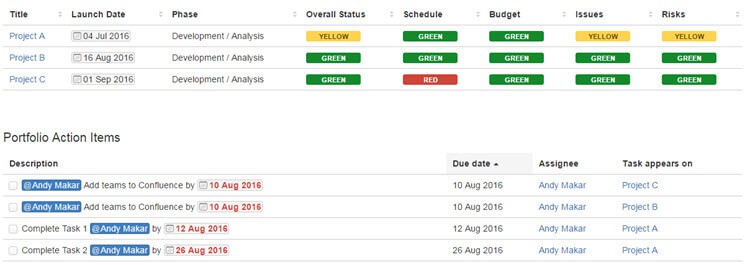
Example of Overall Portfolio status and supporting Portfolio Action items
During program status reviews, each project manager would present project status, and action items were identified and captured in Confluence. The action items were quickly gathered across multiple Confluence pages and Confluence spaces using the Confluence Task Report macro. As team members completed their action items, the list was automatically updated before the next status review. Let’s get started with some simple Confluence task tracking.
Why Use Confluence for Action Item Tracking?
Before diving into the steps, it’s worth understanding why Confluence stands out as an action item tracking tool compared to alternatives like spreadsheets or standalone task managers. Traditional approaches all suffer from the same core problem: they require manual upkeep. Common culprits include:
- Emailing a list of action items after a meeting
- Maintaining a shared Excel file that only one person updates
- Relying on a whiteboard that gets erased before everyone sees it
- Pasting action items into a chat thread that gets buried within hours
In large programs with multiple project managers and dozens of stakeholders, this becomes unsustainable quickly. Confluence solves this by embedding tasks directly into the pages where the work is documented — meeting minutes, project status updates, sprint retrospectives — any Confluence page can hold live tasks that aggregate automatically into a master list. The result is a self-maintaining action item registry that updates in real time as team members check off completed items.
This is particularly valuable in PMO (Project Management Office) environments, where a program director needs visibility across five, ten, or even twenty concurrent projects without chasing down individual project managers for updates.
Step 1. Create a Task List on a Page
The task list is created by formatting a line of text using the checkmark icon in the toolbar. Project managers create individual task lists for each status report. Use these two shortcuts to speed up task creation:

Below is a simple task list with people assigned and target dates identified.
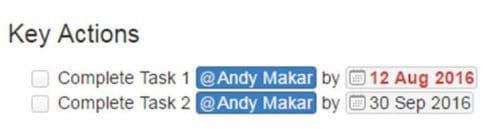
Go ahead and create your task list and save the page.
Practical Tip: Be as specific as possible when writing action item descriptions. Instead of writing “Follow up on vendor contract,” write “Follow up with procurement team on Oracle vendor contract renewal — confirm pricing by EOD Friday.” The more context baked into the task itself, the less back-and-forth is required when someone reads it cold a week later.
For teams using Confluence alongside Jira, you can also reference Jira issue keys directly in task descriptions. This creates a natural bridge between high-level program action items and the underlying development tickets, giving technical stakeholders the traceability they need.
Step 2. Create a Label for the Page
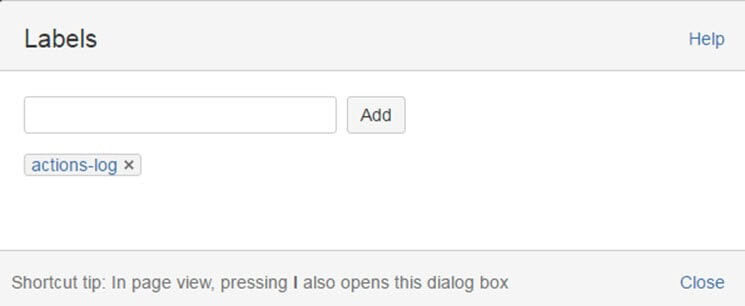
Labels are the glue that holds this entire system together. They allow the Task Report macro to pull tasks from across multiple pages and spaces into a single unified view. To add a label:
- Click the “L” key (or navigate to the label section at the bottom of the page)
- Create a label and call it actions-log or some other variant
- Click Close
Labeling conventions matter. If you’re managing a large program, consider a structured labeling taxonomy from the start. For example:
Actions-Log: General project action items.Steering-Committee: Items escalated to executive sponsors.Team-Meetings: Recurring team meeting follow-ups.Risk-Actions: Action items tied specifically to risk mitigation.
Consistent labels make it easy to generate targeted reports for different audiences — one view for the project team, another for the steering committee, and a third for the PMO dashboard. The small investment in naming conventions upfront pays dividends throughout the program lifecycle.
Step 3. Insert the Task Report Macro into the Portfolio Page
Refer back to the Portfolio status page. You can create separate pages, but I like associating the action items with all the projects within a program. To insert and configure the Task Report macro:
- Insert a Task Report Macro
- Enter the Space name or page names that contain the desired checklists
- Select the relevant space — in my example, I’ve selected the EPMO space
- Enter the actions-log label
- Enter “incomplete” for the Task Status
- Select the number of tasks to display
- Type the column names to display — I use the standard description, due date, assignee, and location fields
- Select the sort-by option
- Click the Preview icon to refresh the list
- Click Save
When you save the page, the list of open action items from all the projects in the Confluence space with the ‘actions-log‘ label will be displayed automatically.
In page edit mode, the Task report looks like the following snapshot.
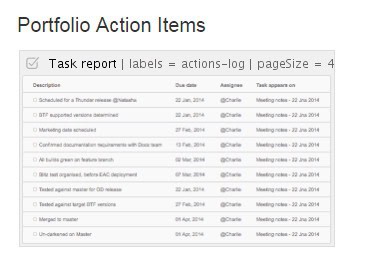
When you save the page, the list of open action items from all the projects in the Confluence space with the action-items label will be displayed.
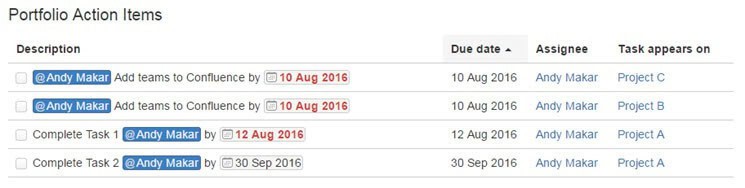
Sorting Strategy: I recommend sorting by due date ascending — this puts the most overdue and soonest-due items at the top of the list, which naturally focuses the team’s attention during status meetings. If you have a particularly large program, a secondary sort by assignee can help you quickly identify if any one person has a disproportionate number of open items.
Step 4. Manage Completed Actions
If you want to view a separate list of completed actions, copy the same macro and change the Task Status to Complete. This is more useful than it might initially seem. A completed action item list serves as a lightweight audit trail that’s particularly valuable during:
- Phase-Gate Reviews: Demonstrate what was committed to and delivered.
- Lessons-Learned Sessions: Trace patterns in how issues were resolved.
- Mid-Engagement Handoffs: Help a new project manager get up to speed quickly.
- Stakeholder Reporting: Show sponsors a concrete record of follow-through.
Consider placing the completed actions macro in a collapsible section on the portfolio page, so it’s available for reference without cluttering the primary view during active status reviews.
Additional User Questions
How do I add multiple labels to the action items list?
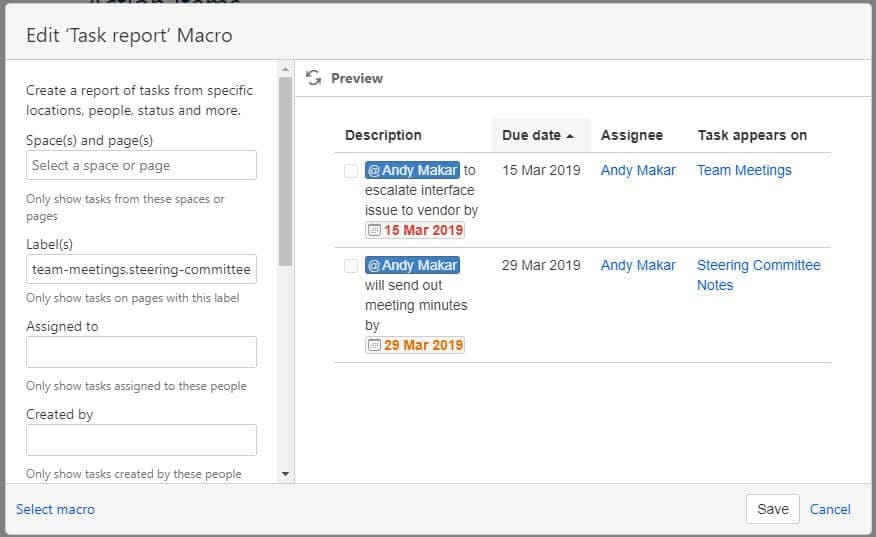
In this example, I created two pages in Confluence and tagged them with the label team meetings and steering committee. Each page has its own set of tasks as action items.
Add each label separated by a comma in the label(s) box.
Can I use the Task Report macro across multiple Confluence spaces?
Yes — and this is one of the most powerful features of the macro for program-level reporting. By default, the Task Report macro pulls tasks from a single space, but you can configure it to reach across multiple spaces by entering each space key in the Space(s) field, separated by commas.
This is particularly useful when:
- Different project teams maintain their own dedicated Confluence spaces
- A shared services team (e.g., IT, Legal, Finance) operates in a separate space but still owns action items relevant to your program
- You’re managing a cross-functional initiative where no single space captures all the work
Keep in mind that users viewing the portfolio page will only see tasks from spaces they have permission to access. If a stakeholder reports missing items from their task report view, check their space permissions first — that’s almost always the root cause.
Can I filter the Task Report by a specific assignee?
Yes, though it requires a small workaround since the Task Report macro doesn’t have a built-in assignee filter in all versions of Confluence. The most straightforward approach is to:
- Use the Assignee column in your Task Report so individual owners are clearly visible at a glance
- Create a dedicated page for each team member or workstream lead, label it with a unique tag (e.g.,
actions-sarah), and build a separate Task Report scoped to that label - In Confluence Cloud, use the Page Properties Report macro in combination with task lists for more granular filtering options
For large programs with ten or more active contributors, building assignee-specific views is worth the extra setup time. It allows each team member to see only their own open items, reducing noise and improving individual accountability without requiring them to scroll through the full portfolio list.
Managing Multiple Labels and Multiple Teams
Projects and program teams can manage tasks by applying proper labels and developing different task reports tailored to different audiences. For example, I once created two pages in Confluence — one for regular team meetings and one for steering committee sessions — and tagged them with the labels team-meetings and steering-committee, respectively. Each page had its own set of tasks as action items.
To pull tasks from both pages into a single report, simply add each label separated by a comma in the label(s) box of the Task Report macro. This gives leadership a unified view while still allowing each team to manage its own page and workflow independently. This multi-label approach scales gracefully. A program with eight project workstreams can have eight labeled pages, all feeding a single portfolio-level task report — giving the program director one consolidated place to review outstanding items across the entire initiative.
Tips for Keeping the System Healthy
Even the best Confluence setup can degrade over time without basic hygiene. A few practices that help keep the system working effectively:
- Run a Weekly Review: During your status meeting, open the task report and walk through open items. This keeps the list visible and reinforces accountability without requiring additional tooling or process overhead.
- Archive Completed Pages Periodically: Once a project phase closes, archive the Confluence space or move completed pages to an archive section. This keeps the task report focused on active work and prevents the list from becoming unwieldy.
- Establish Ownership Early: Assign every action item to a specific person, not a team or role. “The development team” will never complete a task; “Sarah Chen” will. The Confluence @ mention makes individual assignment easy and sends an automatic notification to the assignee.
- Use Due Dates Consistently: A task without a due date is a wish, not an action item. Make due dates mandatory on all action items, and sort the task report by due date to create natural urgency during reviews.
- Avoid Task Sprawl: If a single page accumulates more than 20–25 open tasks, it’s a sign that work needs to be broken into sub-pages or that stale items need to be reviewed and closed out.
Final Thoughts
Confluence’s power comes from its flexibility, although some initial overhead is involved in setting up the pages. Once the labeling conventions are established and the Task Report macro is configured, the system largely runs itself — updating automatically as team members check off their items before the next review cycle. This approach is a flexible, low-overhead solution for managing meeting minutes and action items across programs of virtually any size.
For PMO leaders and program managers looking to get consistent visibility without heavy tooling investment, the Confluence Task Report macro is one of the most underrated features on the platform. Start small — build one task list, label it, and set up your first Task Report. Once you see how cleanly it aggregates across pages and spaces, you’ll wonder how you managed programs without it.
Suggested articles:
- Atlassian Confluence for Project Management
- Confluence Tutorial: Build a Project Portfolio Dashboard
- Top 10 Cons & Disadvantages of Using Confluence

Andrew Makar, DMIT, PMP, CSM is an IT director with delivery experience across projects, programs and portfolios in Digital Marketing, Automotive, Software and Financial Management industries. He is an enthusiastic leader who effectively translates project management theory into practical application. His area of interest and practice is in implementing Agile processes and SCRUM techniques to deliver better software to his customers. Find out more about Andrew on andymakar.com and please reach out and connect with Andrew on LinkedIn.