
Growing businesses frequently struggle to execute advanced corporate strategies without draining capital reserves on full-time executive salaries. Today, corporate leaders require highly sophisticated financial guidance that transcends elementary asset protection and tax preparation. Fractional advisory solutions deliver enterprise-grade fiscal oversight on a flexible schedule, allowing mid-sized firms to navigate volatile economic environments without committing to long-term operational overhead.
Modern fractional executives fundamentally reshape corporate development because their strategic financial leadership has transcended traditional boundaries. These temporary specialists provide comprehensive management interventions that address immediate cash shortfalls while simultaneously configuring deep capital allocations for international expansion. Organizations utilizing external corporate officers gain access to specialized software deployments, risk mitigation structures, and sophisticated cap-table modeling traditionally reserved for Fortune 500-level multinational conglomerates.
Introduction to the Strategic Role of Virtual CFOs
Basic bookkeeping operations fail to sustain corporate momentum within modern, hyper-competitive commercial ecosystems. Expanding entities require dynamic financial steering to navigate intricate market contractions, shifting regulatory compliance burdens, and capital raising initiatives. Virtual CFOs resolve this operational bottleneck by delivering high-impact planning solutions that actively transform basic accounting entries into defensive market positions.
The selection of a temporary financial partner introduces diverse core capabilities required to establish sustainable business value across multiple enterprise layers. Executive teams utilize these distributed skill sets to achieve complete structural alignment by implementing the following five distinct corporate workflows:
- Financial Planning and Analysis: Establishing multi-year predictive modeling systems helps companies isolate profitable segments. This data framework maps historical operational expenses alongside real-time client acquisition dynamics to construct elastic capital pathways that safely accommodate sudden macroeconomic corrections.
- Risk Management Systems: Designing comprehensive risk mitigation profiles shields enterprise capital assets from volatile market shifts. Outlining clear contingency playbooks isolates vulnerable vendor nodes, addresses currency valuation variances, and establishes strong internal authorization limits that prevent systemic corporate fraud.
- Stakeholder Engagement Protocols: Structuring clean reporting transparently communicates corporate health to private equity syndicates. Crafting clear investor dashboards simplifies balance sheet reporting, contextualizes operational cash usage, and accelerates seed rounding efforts by building institutional credibility.
- Technological Integration Programs: Deploying modern enterprise resource systems converts manual data entry pipelines into automated platforms. Centralizing financial ledger access removes communication silos across business divisions, minimizes mathematical processing vulnerabilities, and accelerates closing cycles using cloud architectural stacks.
- Cross-functional Collaboration Frameworks: Aligning corporate division leaders with overarching macroeconomic targets unifies disconnected operational segments. Integrating fiscal guardrails directly into product development and marketing departments prevents budget overruns, optimizes resource velocity, and establishes absolute accountability across leadership.
Core Responsibilities of Virtual CFOs
Deploying an external leader establishes a reliable framework for managing short-term ledger stability. Modern fractional officers address these baseline challenges through precise data processing and rigorous liquidity supervision, transforming basic administrative accounting pipelines into robust corporate mechanisms that reliably secure transactional visibility across the entire corporate structure via:
Financial Analysis and Reporting
Accurate and continuous corporate accounting remains fundamental to surviving unexpected economic shifts. Fractional executives translate dense spreadsheet data into clear operational insights, allowing leadership teams to execute fast changes before systemic problems materialize. This predictive reporting architecture replaces reactive historical ledgers with real-time operational visibility that improves ongoing corporate performance.
Cash Flow Management
Maintaining a healthy liquidity profile dictates whether a growing business survives sudden economic contractions. External corporate officers establish rigorous cash visibility algorithms that track daily working capital changes, identify operational burn rates, and extend runway duration. These sophisticated mathematical frameworks allow corporate leaders to make capital allocation commitments without risking technical insolvency.
Strategic Financial Planning and Forecasting
Long-term corporate health requires clear economic models that anticipate future commercial developments. Fractional experts structure these forward-looking pathways by drafting extensive funding frameworks and testing financial reactions under stressful organizational developments, guaranteeing the enterprise maintains a balanced trajectory during complex growth cycles by implementing:
Long-term Financial Planning
Corporate expansion requires dedicated multi-year capital frameworks that align daily spending habits with long-term enterprise goals. Fractional financial officers build structural funding roadmaps that evaluate long-term market trends, calculate equipment depreciations, and allocate cash for research initiatives. This structural architecture ensures organizations remain highly competitive while building deep, long-term balance sheet durability.
Scenario Analysis and Decision Support
Evaluating multiple future market conditions allows modern companies to build resilient capital defense systems. Fractional specialists execute complex simulation testing to model how supply chain delays, price drops, or labor shortfalls impact net revenue margins. These quantitative reviews guide executive boards toward safe expansion avenues while minimizing exposure to volatile macroeconomic disruptions.
Enhancing Business Growth and Performance
Sustaining commercial momentum demands absolute alignment between strategic execution and long-term shareholder monetization objectives. Financial advisors accelerate this trajectory by installing precise accountability scorecards and structuring exhaustive transition pathways, maximizing the ultimate capitalization value of the entire corporate enterprise through:
Performance Monitoring and KPI Tracking
Translating corporate growth goals into measurable daily actions requires a disciplined focus on key performance metrics. Fractional officers isolate and track highly specialized key performance indicators, including customer lifetime value and net working capital efficiency ratios. Establishing these objective operational benchmarks helps organizations improve resource allocation and quickly eliminate underperforming operational segments.
Exit Strategy Planning
Maximizing corporate valuation ahead of a corporate buyout demands meticulous multi-year structural preparation. Financial advisory specialists organize structural due diligence reviews, optimize capital structures, and clean up historical balance sheets to attract private equity buyers. This rigorous operational positioning significantly strengthens leadership bargaining positions, ensuring shareholders secure the highest possible returns.
Risk Management and Compliance
Protecting accumulated corporate resources requires a comprehensive security architecture that addresses traditional and digital liabilities. Distributed financial officers safeguard corporate capital by executing exhaustive entity exposure reviews and establishing multi-layered online network protocols to insulate vulnerable infrastructure elements. This involves:
Conducting Risk Assessments
Corporate expansion naturally exposes an organization to diverse regulatory, operational, and commercial liabilities. Fractional compliance experts execute comprehensive corporate audits to identify hidden legal exposures, evaluate vendor concentration risks, and structure robust insurance defenses. This defensive planning minimizes unexpected litigation expenses and protects hard-earned corporate assets from catastrophic market events.
Implementing Cybersecurity Measures
Modern financial networks face constant digital threats from sophisticated corporate espionage and ransomware syndicates. External financial officers collaborate with technology teams to deploy multi-layered encryption systems and secure payment verification pathways. Establishing these rigorous digital control frameworks protects sensitive client bank details, satisfies privacy requirements, and prevents devastating financial wire losses.
Integration of Financial Technology
Modernizing corporate ledger architectures remains essential for maintaining transactional processing velocity across competitive markets. Strategic financial consultants guide this modernization by selecting cloud data applications and configuring automated bookkeeping pipelines to decrease human processing errors across operations through:
Leveraging Digital Tools
The modern financial sector demands automated data processing systems to handle complex transaction volumes. Fractional technology leaders introduce advanced algorithmic accounting tools, automated reconciliation networks, and predictive artificial intelligence models into corporate systems. This technology modernization gives leadership instantaneous access to performance data, driving fast, evidence-based business choices.
Automating Financial Processes
Manual data entry pipelines drain employee hours and introduce costly mathematical mistakes into core corporate ledgers. Remote financial managers optimize accounting workflows by automating invoice generation, employee expense management, and vendor payment distributions. Eliminating repetitive clerical friction lowers administrative overhead and allows corporate teams to focus on revenue-producing tasks.
Strategic Partnerships and Stakeholder Management
Optimizing external commercial alignments unifies disparate organizational divisions behind unified financial objectives. Fractional leadership personnel reinforces these critical networks by cultivating transparent investor communications and embedding uniform financial objectives directly into everyday cross-functional operational environments by:
Building Relationships with Stakeholders
Maintaining strong transparency with external capital partners dramatically lowers corporate borrowing fees and improves market reputation. Fractional executives establish formal reporting cadences that deliver clear compliance verifications to banking partners and investment boards. This institutional communication style builds long-term creditor confidence, unlocking access to flexible lines of credit when needed.
Aligning Financial and Organizational Goals
Corporate divisions frequently develop conflicting operational priorities that waste capital resources and delay product deliveries. Remote financial officers eliminate these organizational silos by tying individual departmental budgets directly to consolidated net margin targets. This financial unification ensures sales, engineering, and marketing teams coordinate activities to maximize overall corporate profitability.
Conclusion
The strategic implementation of fractional executive solutions provides growing firms with a distinct advantage in complex markets. By injecting enterprise-grade asset management, automated software integration, and predictive planning directly into corporate frameworks, these advisors turn accounting cost centers into engines for expansion. This flexible leadership model unlocks institutional expertise without burdening growing balance sheets with permanent executive overhead liabilities.
Embracing dynamic financial leadership positions mid-sized businesses to scale safely through upcoming industry disruptions. As digital technology alters accounting standards and globalized supply networks introduce complex currency variables, fractional corporate officers remain essential for long-term survival. Securing this high-level guidance preserves working capital, satisfies changing regulatory compliance standards, and drives sustainable value creation for company shareholders.
Frequently Asked Questions About Virtual CFOs
How does a Virtual CFO differ from a traditional CFO?
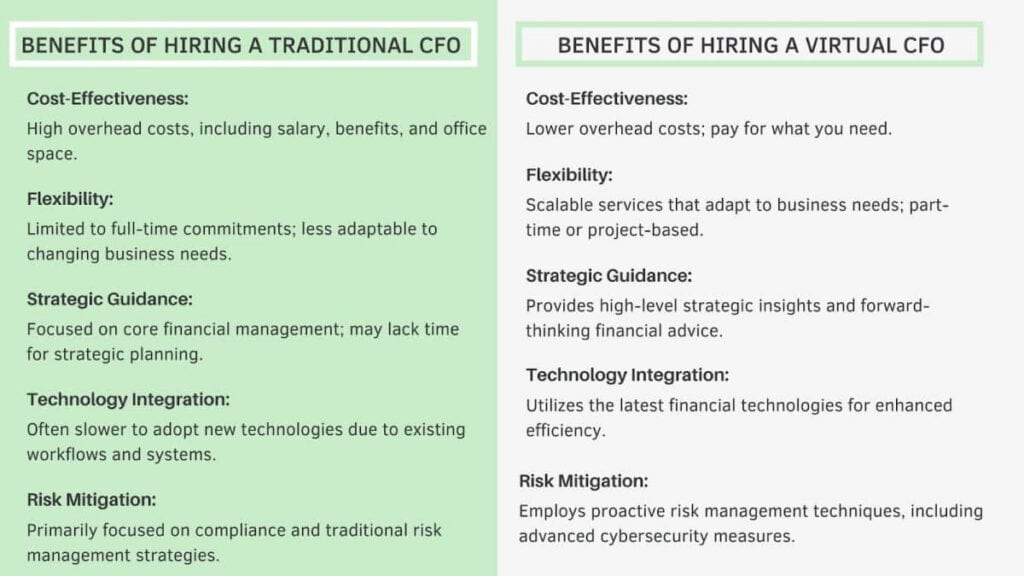
A virtual chief financial officer delivers elite corporate advisory services on a fractional, part-time schedule rather than maintaining a permanent internal office. This deployment model allows small and mid-sized enterprises to access sophisticated capital strategy, automated tool integration, and structural risk management without paying expensive enterprise-level executive compensation packages.
Why are Virtual CFOs beneficial for startups?
Emerging companies navigate severe capital limitations while simultaneously trying to manage complex early-stage scaling milestones. Fractional executives provide these venture-backed startups with institutional fundraising design, rigorous burn-rate monitoring, and scalable corporate structures, allowing management teams to secure investor financing while keeping internal operational overhead completely minimized.
What should businesses consider when choosing a Virtual CFO?
Organizations evaluating external corporate advisory firms must assess specific industry history, software architecture familiarity, and past capital restructuring achievements. The selected expert must demonstrate an ability to translate dense statistical ledgers into plain business directions that align cleanly with current corporate growth targets and internal communication loops.
Can a Virtual CFO assist with international tax compliance?
Fractional financial specialists configure corporate frameworks to handle multi-jurisdictional sales taxation, import tariffs, and global transfer pricing guidelines. Introducing these advanced regulatory workflows safeguards growing international brands from costly cross-border compliance penalties while optimizing international entity structures to preserve legal net revenue across multiple corporate subsidiaries.
How often do Virtual CFOs interact with internal company management?
Communication schedules adjust based on current corporate goals, ranging from daily check-ins during capital acquisitions to structured monthly financial health reviews. Utilizing secure video platforms, automated project tracking tools, and shared ledger systems ensures fractional executives maintain absolute visibility and remain continuously accessible to guide major corporate choices.
Suggested articles:
- How Global Project Managers Can Avoid Financial Compliance Pitfalls
- Why Use Financial Analysis When Creating Your Project Plan
- Top Tools to Help Project Managers Build Smarter Financial Portfolios

Daniel Raymond, a project manager with over 20 years of experience, is the former CEO of a successful software company called Websystems. With a strong background in managing complex projects, he applied his expertise to develop AceProject.com and Bridge24.com, innovative project management tools designed to streamline processes and improve productivity. Throughout his career, Daniel has consistently demonstrated a commitment to excellence and a passion for empowering teams to achieve their goals.