
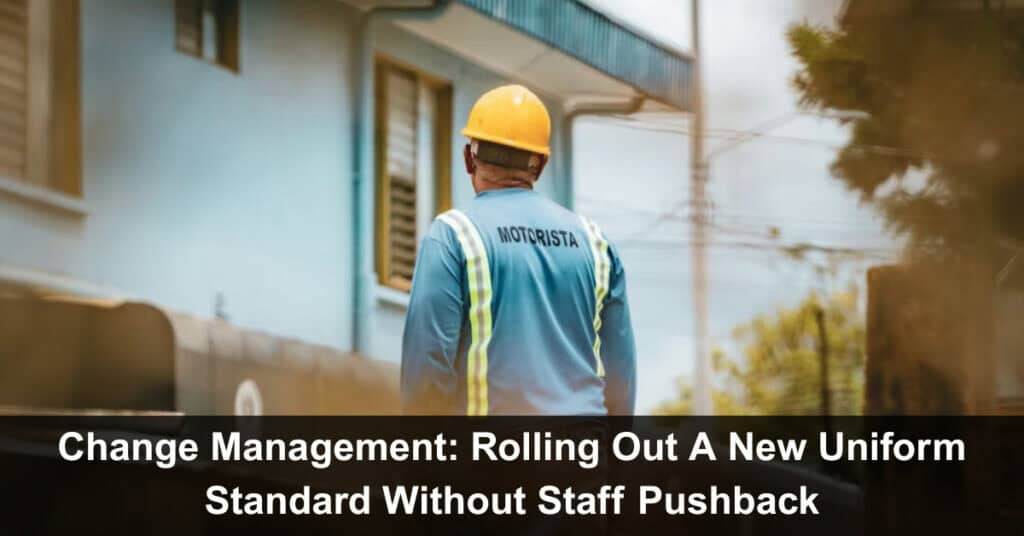
Uniform changes fail when they’re treated like a procurement task instead of a people-and-operations change. Staff don’t push back because they hate “a new shirt”—they push back because the rollout creates friction: uncomfortable fits, inconsistent sizing, unclear allowances, awkward branding rules, or a policy that ignores how work actually gets done. For a project manager, the goal is simple: introduce a standard that improves safety and professionalism while making it easier (not harder) for teams to show up ready.
Below is a change-management rollout plan you can lift into your project template—built around predictable resistance points, measurable adoption steps, and supplier realities.
Start With the Hardest Item First: Fit, Function, and Durability
If you want buy-in, don’t begin with logos and colours—begin with comfort and task-fit, especially for work, because that’s where crews feel restrictions first (kneeling, climbing, carrying tools, heat). Run a short “requirements capture” that focuses on movement, pocket layout, reinforcement areas, wash cycles, seasonal needs, and PPE compatibility. Then turn those requirements into a trial list that staff can actually evaluate on the job.
For teams that need a practical reference point when comparing options, use Westpeak’s pants and work trousers catalogue as a quick resource for the range of common trouser types (e.g., chinos vs cargos vs stretch styles) and belt options that organizations typically standardize around: https://www.westpeak.co.nz/catalog/work-trousers-and-belts
Your change control here is a fit trial, not a survey. Pick a small representative group (different body types, roles, and shifts) and trial two or three variants for a defined period. Capture feedback in plain operational terms: “Does this rip, bind, overheat, ride down, snag, or limit reach?”
Build the Case for Change Around Outcomes People Care About
Change frameworks keep you honest: Prosci’s ADKAR model frames successful individual change as Awareness, Desire, Knowledge, Ability, and Reinforcement. Kotter’s change steps emphasize urgency, coalition, vision, barrier removal, and short-term wins. You don’t need to “teach the model” to staff—you use it to structure your rollout.
Translate the “why” into three outcomes that matter on-site or in service roles:
- Safety and compliance (right visibility, right fabrics, correct PPE integration when relevant)
- Ease of getting ready for work (clear standard, predictable replacements, fewer wardrobe decisions)
- Professional identity (customers/clients can identify staff quickly and confidently)
If high-visibility garments are part of your standard, anchor requirements to recognized standards rather than opinions. ISO 20471:2013 specifies requirements for high-visibility clothing intended to signal the wearer’s presence in daylight and under headlights at night.
Avoid the “Single Supplier, Single Cut” Trap With a Tiered Uniform Architecture
One uniform spec rarely suits every role. The trick is to standardize what must be consistent and allow controlled variation where work differs. A practical architecture is:
- Core identity layer: colour palette, logo placement rules, and minimum garment types per role
- Functional layer: role-based variants (construction vs warehouse vs field service vs front-of-house)
- Seasonal layer: approved warm-weather and cold/wet-weather equivalents
This is where referencing multiple suppliers helps you justify your choice and create options without chaos. Brands like Snickers Workwear emphasize trousers in many sizes, fits, and designs for professional trades, supporting a “choose the right cut within the standard” approach.
Blåkläder positions its work pants range as covering different professions (carpenters, electricians, etc.), which is useful when you’re aligning variants to job realities rather than personal preference. MASCOT highlights stretch-focused ranges and broad trouser assortments, reinforcing the idea that mobility and fabric choice can be standardized by role.

Pilot Like a Product Release: Small Cohort, Real Work, Clear “Win” Criteria
Pilots fail when they’re too short, too polite, or too disconnected from real conditions. Treat the pilot like operational testing:
- Run it long enough to include repeated laundering and at least one “tough day.”
- Put garments into the highest-friction tasks (kneeling, lifting, crouching, long walks).
- Define pass/fail criteria: tears, seams, comfort, heat management, pocket usability, and shrinkage.
Use the pilot to generate short-term wins (Kotter), such as “reduced uniform complaints,” “faster morning readiness,” or “fewer replacement requests,” then publicize those wins.
Make Procurement Invisible to Staff: Sizing, Exchange, and Replenishment are the Real Adoption Levers
If staff have to fight the process, they’ll blame the uniform. Your rollout should include:
- A sizing method (in-person try-on day, sample kits, or measured size guides)
- A no-drama exchange policy during the first weeks
- A replacement cadence and budget (what’s free, what’s subsidized, what’s self-funded)
When you talk to suppliers, don’t just ask about the product. Ask about fulfilment realities: lead times, size availability, embroidery/printing turnaround, and returns handling and management. Global providers like Portwest present large catalogues of work trousers across ranges, which can support continuity of supply if you design the standard around items that are consistently stocked. Helly Hansen Workwear similarly groups different pants types (construction, cargo, shell, rain, hi-vis), which helps you define approved variants without reinventing categories.
Communicate the Policy Like a Tool, Not a Rulebook
Your policy should answer the questions staff actually ask:
- What do I wear for my role, in my season?
- How do I get it, exchange it, and replace it?
- What’s changing, and what isn’t?
- What happens if something is out of stock?
Use “show, don’t tell.” Post a one-page visual standard (photos of approved combinations) and a simple ordering guide. Reduce ambiguity: “Approved options A/B/C for role X,” rather than “wear black trousers.”
Reinforce Without Policing: Feedback Loops, Minor Fixes, and a Clean Cutover Date
Reinforcement (ADKAR) is where many rollouts collapse. If managers default to nitpicking, you’ll trigger resentment. Instead, keep a feedback channel open for 30–60 days.
- Fix the few issues that appear repeatedly (sizing gaps, missing women’s cuts, hot-weather alternatives).
- Set a clear cutover date, but include a practical transition window for replacements and deliveries.
For broader choice sets, it can help to reference mainstream workwear players as “approved-equivalent benchmarks” when staff ask why you’re not using their favourite brand. Dickies positions itself around durable workwear and sells a wide range of work pants, which is a useful example when explaining that durability and fit variety are non-negotiables in your standard.
Wrapping Up
A uniform standard rolls out smoothly when you treat it as change management plus supply chain, not branding plus policy. Start with the garments people feel most—trousers and footwear-adjacent choices—pilot in real conditions, and make sizing and exchanges effortless. Standardize identity, allow role-based variants, and tie requirements to recognized safety needs when applicable. Do that, and you’ll get adoption because the uniform works—then compliance becomes the easy part.
Suggested articles:
- How Organizational Change Management Guides Project Success
- Change Management Process Template for Project Managers
- The Project Manager’s Rollout Plan For Membership Management Software

Daniel Raymond, a project manager with over 20 years of experience, is the former CEO of a successful software company called Websystems. With a strong background in managing complex projects, he applied his expertise to develop AceProject.com and Bridge24.com, innovative project management tools designed to streamline processes and improve productivity. Throughout his career, Daniel has consistently demonstrated a commitment to excellence and a passion for empowering teams to achieve their goals.