
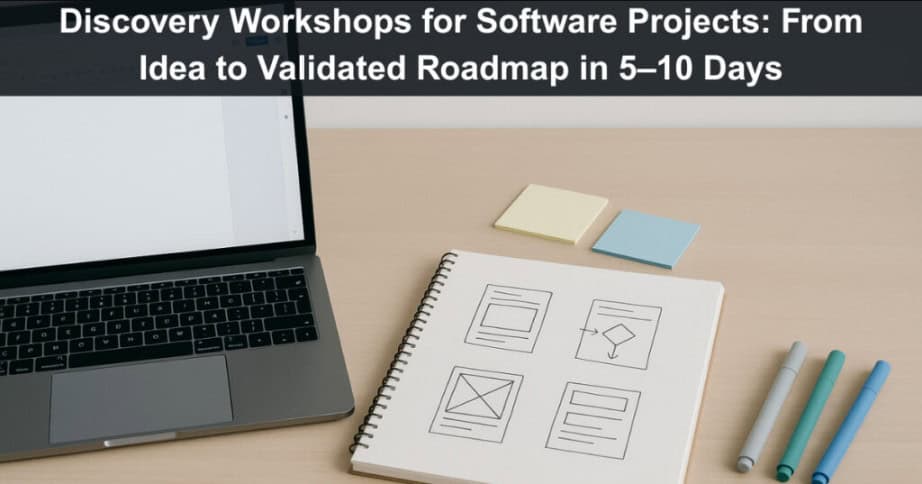
Transforming an initial software idea into a validated roadmap is a crucial step for project managers. Discovery workshops are instrumental in this process, offering a structured approach to planning and stakeholder alignment. This article explores how these workshops convert ideas into actionable plans within just a few days—reducing risk and building clarity across teams.
In software development, moving from concept to a validated roadmap can be intimidating. However, discovery workshops streamline that journey in just 5–10 days. Designed to facilitate early planning, define scope, and ensure cross-team alignment, they’re an essential part of any Agile or hybrid delivery model. Let’s break down why they matter, what they produce, and how they build the foundation for successful delivery.
The Role of Discovery Workshops in Early Planning
In the early stages of software development, uncertainty often dominates discussions around scope, requirements, and budget. Discovery workshops bridge this gap by guiding teams through structured conversations that define what needs to be built and why it matters. They focus on aligning all stakeholders, clarifying objectives, and setting expectations that are realistic and measurable. By addressing potential risks upfront, these sessions help teams move from speculation to clarity before coding even begins.
Key Functions of Discovery Workshops
Discovery workshops serve multiple functions that set the tone for successful delivery. Each session brings together stakeholders, technical experts, and business owners to shape the project’s early direction.
- Clarify project goals and translate them into measurable objectives that guide execution.
- Reduce rework by identifying ambiguous or high-risk areas early in planning.
- Strengthen collaboration between technical and business teams through open dialogue.
- Establish accountability and ensure everyone understands their role in delivery.
Building Realistic Expectations
Establishing realistic expectations is one of the core advantages of a discovery workshop. Teams discuss constraints, identify unknowns, and collectively define what success looks like. This early clarity ensures that estimates and timelines are grounded in facts rather than assumptions. Anticipating challenges early also builds trust among participants and helps create a proactive rather than reactive delivery culture. When integrated with Agile methods, this process supports continuous improvement and refinement across the entire roadmap.
Driving Innovation Through Collaboration
Innovation rarely happens in isolation. Discovery workshops create an environment where teams can think freely while maintaining strategic focus. By bringing together developers, UX designers, analysts, and end-users, these sessions allow different perspectives to influence the product’s design and functionality. Instead of ideas being dictated from the top down, creativity emerges from diverse experiences and viewpoints, resulting in more balanced and effective solutions. This collaborative energy often sparks insights that lead to real innovation.
Benefits of Cross-Functional Collaboration
Cross-functional collaboration transforms how teams identify opportunities and solve complex problems. It allows the workshop to become more than a planning tool—it becomes an engine of creativity.
- Encourages diverse perspectives that uncover new technical or business possibilities.
- Challenges assumptions and exposes weak points in early thinking before development.
- Promotes creative exploration of unconventional ideas that can reshape project direction.
This open exchange often results in more robust solutions and helps teams see beyond initial assumptions. The outcome is software that not only meets user expectations but often exceeds them.
Enhancing Communication and Documentation
One of the most underestimated benefits of discovery workshops is their ability to enhance communication and documentation across the entire project lifecycle. Many software projects fail not because of poor technical execution, but due to unclear communication among stakeholders. Workshops counter this by establishing a consistent process for capturing and sharing critical decisions, rationale, and assumptions. This structured documentation becomes a single source of truth that supports clarity even as the project evolves and new members join the team.
Why Documentation Matters
Documentation produced during a discovery phase is more than a formality—it serves as a living record that preserves alignment and intent.
- Provides a foundation for onboarding new team members without loss of context.
- Offers transparency by clearly documenting decisions and design justifications.
- Encourages participation from quieter members who may hold valuable insights.
This ensures that all perspectives are included and that no vital information is lost between phases. It also allows the PMO to maintain visibility across teams while preserving transparency and accountability throughout execution.
Establishing a Shared Vocabulary
Many software projects stumble because technical and business teams interpret requirements differently. Discovery workshops address this problem directly by creating a shared vocabulary that unites everyone involved. When teams agree on definitions and use consistent terminology, communication becomes faster and more precise. This shared understanding prevents misinterpretations that can cause delays or unnecessary rework later in the development cycle. It is one of the simplest yet most powerful outcomes of these sessions.
Long-Term Impact
Establishing a shared vocabulary has lasting effects that extend beyond the workshop itself.
- Reduces confusion and ambiguity when defining project requirements.
- Prevents design or development errors caused by miscommunication.
- Accelerates decision-making during Agile sprint cycles.
- Maintains consistency and momentum across all project phases.
This clarity helps organizations maintain cohesion across multiple teams and departments, especially in long-term or large-scale projects.
Key Deliverables from Discovery Workshops
A well-run discovery workshop always produces tangible outputs that guide further development. These deliverables form the blueprint for execution and ensure that every team member understands the vision and direction of the project. By documenting insights, defining goals, and identifying constraints, teams can transition smoothly from planning to implementation. The value of these deliverables lies in their ability to anchor decisions in verified understanding rather than guesswork.
Core Outputs Include
- Clear Vision and Goals: Defines what the software aims to achieve, aligning all stakeholders on measurable outcomes and enabling accurate resource planning, cost estimation, and long-term strategic direction.
- Constraints and Requirements Map: Identifies technical, financial, and regulatory limitations early, ensuring design and development decisions remain practical, achievable, and aligned with organizational capabilities and project scope.
- User Journey Maps and Personas: Visualize user behavior and pain points to design around real needs, fostering empathy, improving usability, and ensuring the product delivers genuine value to its intended audience.
- High-Fidelity Wireframes or Prototypes: Turn ideas into tangible visual models for validation, helping teams collect feedback, refine usability, and confirm functionality before committing resources to full-scale development.
“At Mobile Reality, our discovery workshops turn ideas into tested, validated roadmaps in under two weeks. It’s not just about planning—it’s about de-risking decisions early and aligning teams fast. That’s how we’ve consistently helped startups and enterprises avoid scope creep and build with confidence.” — Marcin Sadowski, CTO at Mobile Reality.
Feature Prioritization and Technical Exploration
Feature prioritization ensures that the most valuable work is addressed first. During discovery workshops, teams often use structured methods to identify essential features and defer less critical ones. This approach keeps the roadmap lean while still accommodating flexibility for future enhancements. The process also involves exploring technical feasibility to ensure that proposed ideas can be implemented within constraints. These combined exercises reduce risk and make delivery more predictable.
MoSCoW Framework for Prioritization
The MoSCoW method is a simple yet effective way to structure priorities.
- Must-haves: Non-negotiable features that define the minimum viable product.
- Should-haves: Important features that enhance functionality but are not urgent.
- Could-haves: Optional features that can be added later if time allows.
- Won’t-haves: Features intentionally deferred to maintain focus on the essentials.
Technical Exploration and Feasibility Testing
Technical exploration often takes the form of short experiments or spikes that validate potential solutions. Teams may test new frameworks, APIs, or system integrations before committing significant resources. Value versus effort mapping also helps allocate time efficiently by balancing technical difficulty with business importance. This process ensures that effort is focused on the initiatives with the highest impact and least risk.
Risk Management and Roadmap Validation
Every software project carries inherent risk. Discovery workshops tackle this issue early by identifying uncertainties and assigning mitigation actions before execution. The creation of a risk register provides visibility into potential obstacles, helping teams plan with foresight. These early evaluations form the basis of a validated roadmap—a document that not only guides development but also adapts to new insights as the project progresses.
How Discovery Workshops De-Risk Software Projects
Risk management within discovery sessions helps organizations make informed decisions.
- Identifies risks early through structured discussions and scenario modeling.
- Assigns clear ownership for mitigation and follow-up actions.
- Validates technical direction through prototypes and feasibility studies.
- Builds stakeholder confidence through transparent, data-driven decision-making.
A validated roadmap evolves with changing priorities and ensures long-term alignment between delivery teams and business leaders. For PMOs, this leads to more reliable forecasting, improved budgeting accuracy, and greater strategic control.
Why Discovery Workshops Are Worth the Investment
Adding a one or two-week discovery phase to a project may seem like a delay, but the value it delivers far outweighs the time invested. Workshops prevent the costly mistakes that often occur when projects start without a shared understanding. They reduce ambiguity, shorten feedback loops, and help organizations avoid rework. The result is a faster, smoother development cycle with fewer surprises and greater predictability.
Measurable Benefits
- Reduces risk exposure by validating assumptions early.
- Accelerates delivery by aligning teams around clear priorities.
- Improves quality through better requirement definition and validation.
- Builds stakeholder trust through transparent collaboration and documentation.
Conclusion
Discovery workshops compress months of fragmented discussions into one focused effort that delivers clarity and alignment. In less than two weeks, teams can define goals, validate assumptions, and produce a roadmap that is both actionable and adaptable. These sessions turn uncertainty into structure and transform scattered ideas into a strategic direction.
Whether for startups seeking product validation or enterprises scaling digital systems, discovery workshops ensure that every project begins on solid ground and stays on course through delivery. By investing just 5–10 days upfront, organizations gain months of clarity and confidence that ripple through every phase of execution.
Suggested articles:
- How AI and Automation Are Changing Software Development Costs in 2026?
- Cost Savings Without Compromising Quality in Offshore Software Development
- Top 16 Best Software Development Companies to Work With

Daniel Raymond, a project manager with over 20 years of experience, is the former CEO of a successful software company called Websystems. With a strong background in managing complex projects, he applied his expertise to develop AceProject.com and Bridge24.com, innovative project management tools designed to streamline processes and improve productivity. Throughout his career, Daniel has consistently demonstrated a commitment to excellence and a passion for empowering teams to achieve their goals.