
Growing an enterprise SaaS company is exciting until organic growth starts demanding more people, more time, and a bigger budget. The challenge isn’t just attracting traffic; it’s building a scalable system that drives qualified leads and revenue without constantly expanding your team. Many companies hit this wall early, cycling through hires and agencies without ever solving the root problem: they lack a repeatable, efficient growth system.
That’s where Enterprise SaaS SEO becomes a competitive advantage. Unlike traditional SEO, Enterprise SaaS SEO focuses on managing large websites, complex product offerings, and lengthy buying journeys at scale. When done right, it helps enterprise brands increase organic visibility, capture high-intent prospects, and generate sustainable revenue growth without adding headcount.
Let’s see how enterprise SaaS companies can use SEO to create efficient growth engines that work smarter, not larger.
Why Enterprise SaaS Companies Need a Different SEO Strategy
The Limitations of Traditional Content Marketing
Publishing three blog entries every week performed well in 2015. The markets for SaaS content are currently crowded. Dozens of gamers write identical “what is X” instructions for the same terms in each category. It is costly and generally ineffective to produce more content in the absence of a clear demand signal. Producing subpar content in large quantities is more expensive than the traffic it generates. Quality over volume is a fiscal argument, not just a cliche.
Enterprise SEO and Startup SEO
Early-stage SaaS can work quickly and concentrate on a certain set of keywords. Enterprise is not the same. You are in charge of thousands of pages, numerous products, buyer personas, regional variances, and frequently antagonistic internal stakeholders. It won’t make much of an impact for a junior SEO hire to optimize metadata one page at a time. Governance, architecture, and systems are all necessary for enterprise SEO, not simply execution.
The Revenue Impact of Organic Search
Organic traffic compounds. A sponsored campaign ends as soon as the funds run out. For years, a programmed page or well-optimized content asset can produce leads. The true benefit of organic for corporate SaaS can be seen in customer acquisition costs.

[Source: Brightedge]
Businesses with well-established SEO operations frequently report organic CAC at a fraction of paid channels, with greater close rates and better lead quality.
The Core Principle: Scale Systems, Not Teams
What “Scalable SEO” Actually Means
Building processes that yield repeatable results without requiring proportionate human work each time is the goal of scalable SEO. This includes
- Internal linking systems that don’t need quarterly human audits
- Keyword frameworks that update automatically
- Content templates that non-SEO authors can use effectively
A flywheel is the aim. It is an early infrastructure investment that yields compounding rewards with little ongoing work.
Common Scaling Mistakes
Hiring writers before simplifying procedures is the most common error. Adding more content to a flawed plan will only hasten its failure. Relying on manual optimization for tasks that need to be automated and posting content without first verifying demand are directly behind that.
1. Build an Enterprise Keyword Strategy Around Revenue, Not Traffic
Prioritize Bottom-of-Funnel Keywords
Reports show that traffic numbers are good, but closing rates are more important. Because the customer already knows what they’re looking for, bottom-of-funnel keywords like “top [category] software,” “product” vs. [competitor], and “product” for [industry] convert at far greater rates. Your keyword approach should be anchored by comparison phrases, solution-aware searches, and commercial intent keywords. Although high-volume awareness content has its purpose, it only increases bounces if your conversion architecture isn’t developed.
Create Topic Clusters That Support Revenue Goals
Although topic clusters are not a new concept, the majority of corporate teams do them badly. Topical authority is not produced by a pillar page in the absence of a supporting content hub. The supporting material for each pillar should be closely related, and the internal connections between them should be intentional and consistent rather than an afterthought.
Map Keywords to the Customer Journey
People are drawn in by awareness-raising information. Content that is thoughtful keeps them interested. They are converted by decision content. Expansion content facilitates upselling and lowers attrition. The majority of SaaS businesses overemphasize awareness while ignoring the middle and bottom of the funnel, which are where money truly resides.
2. Create Programmatic SEO Assets That Scale
[Source: eesel]
What Programmatic SEO Means for SaaS
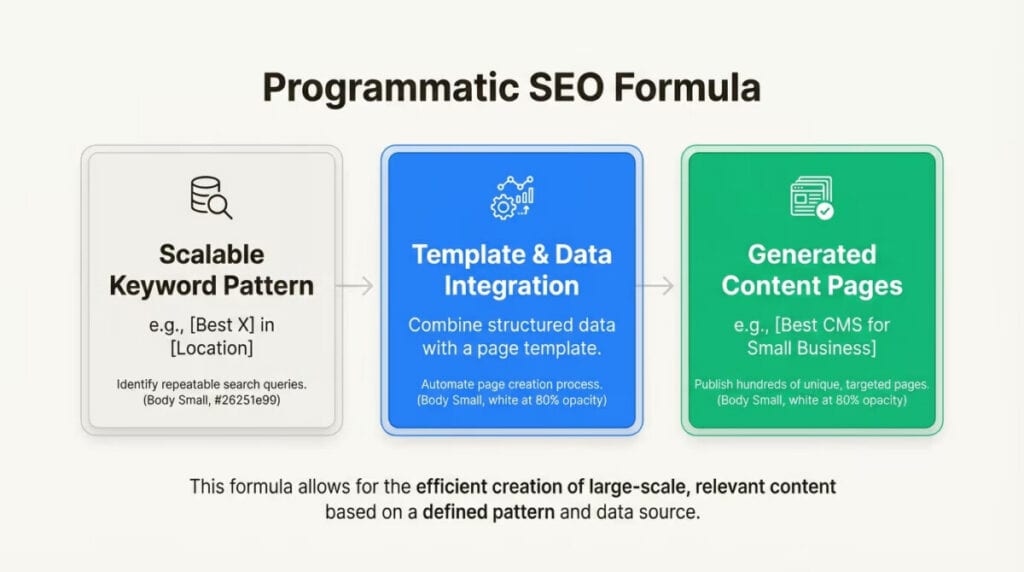
Instead of developing every site from scratch, programmatic SEO uses structured data to create vast sets of pages. This opens up massive scale for SaaS without requiring proportionate effort to produce content.
High-Impact Programmatic Page Types
Integration pages (your product plus all the tools it connects with), industry-specific landing pages, use-case pages, competitor comparison pages, and feature pages are the most useful programmatic page kinds for corporate SaaS. Each of them focuses on large-scale high-intent search queries.
How to Avoid Thin Content at Scale
Thin content, or pages that rank for nothing because they say nothing significant, is a concern associated with programmatic. Avoid this by making sure every site isn’t just a template with switched variables, has a true, unique value proposition, and, when feasible, draws in dynamic data. Programmatic pages can be raised considerably over the thin-content criterion by using user-generated content, actual benchmark data, and professional commentary.
3. Turn Product Data Into SEO Growth Engines
Product-Led SEO Explained
Data on user behavior, benchmarks, aggregated insights, and templates are already being produced by your product. The majority of SaaS providers aren’t disclosing that information in ways that encourage natural traffic. This is reversed by product-led SEO, which makes product-generated value visible to the public, draws in organic traffic, and establishes a natural conversion route into the product.
Types of Product Data That Create Organic Traffic
- User-generated content (public profiles, shared dashboards, community resources)
- Platform-generated industry benchmarks
- Downloadable templates
- Aggregated insights reports all create organic traffic that compounds without requiring traditional content production
Examples of Product-Led SEO Opportunities
Free calculators related to your main application. Interactive tools that demand registration to save results and provide value up front. industry databases that are accessible to the general public. resource collections that establish themselves as a category’s primary source of information. These assets generate consistent organic traffic with a direct conversion path and naturally draw links.
4. Automate SEO Operations Without Sacrificing Quality
Automating Keyword Research and Content Briefs
The initial keyword grouping, competitive gap research, and short development that used to take hours per topic may now be automated using modern SEO tools. This eliminates the low-value tasks, so your team can concentrate on making decisions rather than gathering data, but it does not replace strategic judgment.
Scaling On-Page Optimization
It is possible to manage schema markup implementation, internal linking recommendations, and metadata production programmatically at scale. Manual optimization is insufficient for enterprise websites with thousands of pages.
AI’s Role in Enterprise SaaS SEO
AI speeds up analysis and manufacturing. It does not take the place of expertise-driven content, strategic positioning, or editorial judgment. Utilize AI to identify content gaps, create metadata variations, and create first drafts. Maintain human control for anything that interacts with customers and where precision, tone, and brand voice are important. Governance is important because large-scale AI-assisted content deteriorates more quickly than manual material in the absence of quality management.
5. Build a Content Production System That Doesn’t Require More Writers
Create Reusable Content Frameworks
Modular content blocks, concise formats, and templates enable writers to generate consistent work more quickly. A new writer may create SEO-optimized, on-brand material in a matter of days instead of months with a well-designed framework.
Repurpose Existing Assets
Webinar recordings, customer success stories, product documentation, and sales decks contain vast amounts of unrealized content value for the majority of corporate SaaS organizations. These can be repurposed into SEO-optimized formats to create significant content without requiring an additional hour of research.
Establish Editorial SOPs
The common issue of scaling content output while scaling mistakes and inconsistencies equally is avoided by standardizing workflows with explicit quality checkpoints. As production increases, publishing guidelines keep manpower requirements constant and minimize revision cycles.
6. Strengthen Technical SEO for Enterprise Scale
At the corporate level, crawl budget is a significant limitation. Search engines prioritize because they are unable to crawl everything. Your most important pages will be crawled less frequently and indexed more slowly if your site architecture requires crawlers to navigate layers of low-value sites.
First, fix the site’s architecture. Make sure the most important pages on your website are at the bottom of the hierarchy. Use structured data, such as product, FAQ, review, and organization schemas, to provide search engines with more accurate signals about the content of your pages. Index bloat is more prevalent than most corporate teams think and has a direct influence on organic performance, so keep an eye on indexation health on a frequent basis.
7. Build Authority Without Scaling Outreach Teams
Original research, benchmark reports, and industry studies are examples of data-driven link building that generate links at scale without the need for manual outreach in proportion to the volume of links. Over the course of its existence, a well-written industry report can quietly produce hundreds of links.
Your current brand assets are not being utilized to their full potential. A dedicated outreach staff is not necessary to implement link and brand authority opportunities created by executive voices, customer case studies, active community participation, and partner ecosystems.
8. Use SEO and CRO Together to Increase Revenue Per Visitor
Only when your conversion routes are working will more traffic be beneficial. Pricing pages, competitor comparison pages, and solution-specific landing pages—the pages where purchases are actually made—are the most crucial pages to optimize for corporate SaaS.
Enhance demo request processes, lower sign-up barriers for free trials, and make sure high-intent sites have distinct, one-time conversion objectives. Measure not just session counts but also organic pipeline created and organic-attributed ARR.
The Future of Enterprise SaaS SEO
Today, enterprise SaaS visibility extends well beyond traditional blue-link search results. Answer engine optimization, large language model (LLM) visibility, and AI-powered search experiences are rapidly emerging as critical organic channels. Meanwhile, first-party data is poised to become an increasingly decisive competitive advantage in the fight for organic visibility.
Developing assets that are truly hard to duplicate, such as proprietary data, brand authority, product-led traffic loops, and technical infrastructure that accumulates over time, is necessary to build defensible organic growth.
Final Thoughts
Scaling organic revenue without scaling headcount is an execution challenge, not a theoretical one. The companies that consistently succeed share a common trait: they invest in infrastructure rather than chasing output. A growing team of writers simply cannot replicate the compounding returns delivered by well-designed systems, automation, programmatic assets, and product-led SEO loops. The opportunity is substantial — but capturing it requires discipline, not volume.
Frequently Asked Questions (FAQs)
What is Enterprise SaaS SEO?
Search engine optimization techniques created for large-scale software firms handling intricate site designs, several products, and a variety of customer audiences across high-volume keyword landscapes are referred to as enterprise SaaS SEO.
What distinguishes startup SEO from enterprise SEO?
Managing thousands of pages, several stakeholders, regional differences, and technical complexity at a scale that necessitates automation and governance rather than just manual execution is what enterprise SEO entails.
Which programmatic SEO page types work best for SaaS?
High-intent organic traffic is regularly generated for SaaS companies by integration pages, competitor comparison pages, industry-specific landing pages, use-case pages, and feature pages.
How do you calculate the ROI of SEO for business SaaS?
Instead of focusing on vanity metrics like rankings or raw traffic volume, pay attention to organic pipeline created, organic-sourced ARR, and client acquisition cost through organic channels.
Suggested articles:
- How SaaS Companies Can Leverage India’s SEO Outsourcing
- The Top 8 B2B SEO Agencies for SaaS Companies
- 5 Best SaaS Link Building Services

Daniel Raymond, a project manager with over 20 years of experience, is the former CEO of a successful software company called Websystems. With a strong background in managing complex projects, he applied his expertise to develop AceProject.com and Bridge24.com, innovative project management tools designed to streamline processes and improve productivity. Throughout his career, Daniel has consistently demonstrated a commitment to excellence and a passion for empowering teams to achieve their goals.