
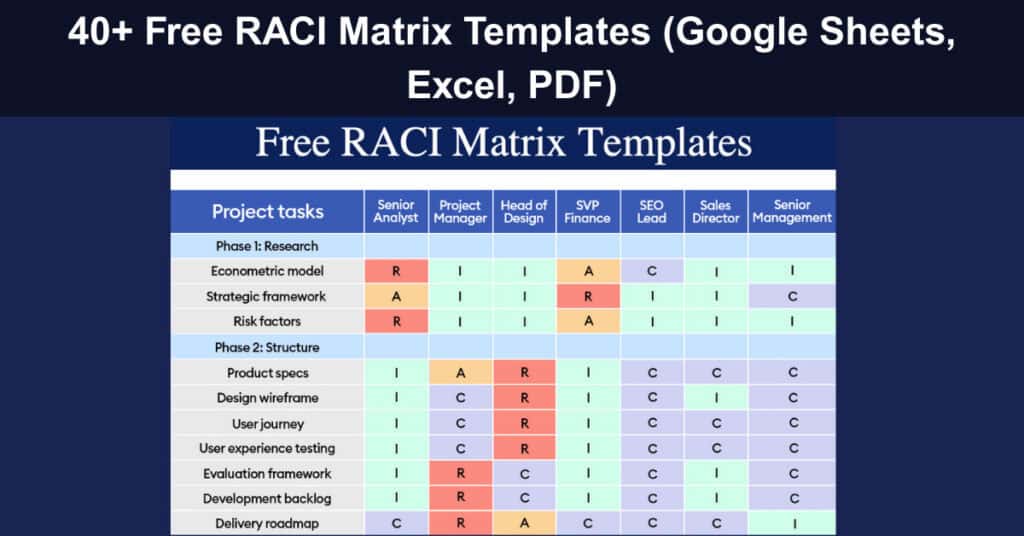
The Responsibility Assignment Matrix, better known as the RACI Matrix, is one of the most effective tools available for tracking roles and responsibilities within a project. For anyone working in project management or IT, it creates a clear framework for delegation, decision-making, and stakeholder participation that can make a measurable difference in project outcomes.
Used correctly, the RACI matrix ensures every task has an owner, every stakeholder knows their role, and no one falls through the cracks. To save time building one from scratch, project managers rely on RACI matrix templates — and this guide covers everything you need to know about using them, along with 40+ free options across every major platform.
A Real-World Example
To illustrate the value of a RACI matrix, here’s a practical scenario. At a startup, the team needed to produce user guides — a task that would ideally fall to a technical content creator or product marketer. No such person existed on the team, so the work had to be distributed across the Product Owner, Designer, Team Lead, and Digital Lead. The problem was that nobody was clearly responsible for the final outcome.
Running a roles and responsibilities session using the RACI matrix resolved this immediately. Every task was assigned at least one responsible stakeholder, and no task had more than one person accountable. The result was improved clarity, stronger ownership, and a more committed team.
What Does RACI Stand For?
Understanding what each letter represents is the foundation of using the matrix correctly. RACI is not just an acronym; it is a precise framework for defining how each person on a team relates to each task. Misassigning these roles is one of the most common reasons RACI matrices fail in practice, so it is worth taking the time to understand each designation clearly before building your first chart.
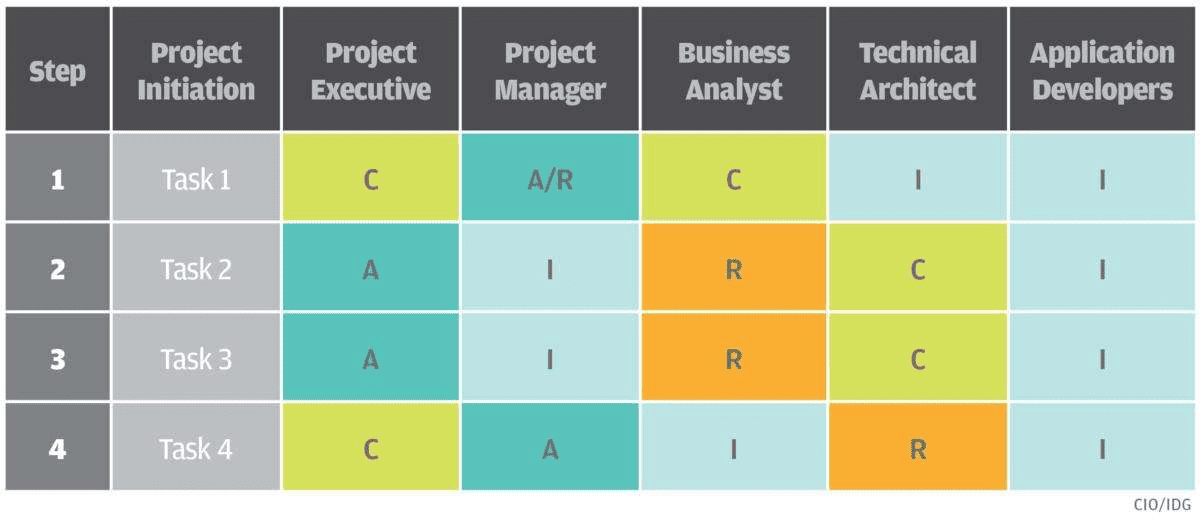
Each letter in RACI represents a type of stakeholder involvement:
- Responsible: The people who do the actual work. There should be at least one Responsible party for every task, though there can be more than one where collaboration is needed.
- Accountable: The person ultimately answerable for the outcome. Critically, there should only ever be one Accountable stakeholder per task. This single point of accountability is what keeps decision-making clean and prevents conflicts when issues arise.
- Consulted: People whose input and expertise can support the work. These stakeholders have a two-way communication relationship with the team — they are asked for input, and they respond.
- Informed: People who need to be kept up to date on progress and results. Unlike Consulted stakeholders, communication with Informed parties is one-way — they receive updates but are not expected to provide feedback or make decisions.
In practice, one person may hold multiple roles across different tasks or even within the same task. For example, a senior manager might be Accountable for a deliverable while also being Responsible for one specific component of it. What should never happen is having more than one person Accountable for the same task — that ambiguity is a reliable recipe for delays and finger-pointing.
Why Use a RACI Matrix?
A RACI matrix aligns responsibilities and communication so teams avoid confusion, speed decisions, and strengthen ownership across tasks—helping projects stay on track and stakeholders stay informed from start to finish.
- Clear Ownership: Ensures every task has a named Responsible party so work isn’t missed or left unclaimed.
- Single-Point Accountability: Assigns one Accountable person per task to prevent conflicting decisions and clarify final approval authority.
- Better Stakeholder Communication: Defines who to consult and who to inform so input is gathered when needed and updates reach the right people.
- Reduced Ambiguity: Removes uncertainty about roles and responsibilities, preventing duplicated effort and gaps in delivery.
- Stronger Team Buy-In: Sets clear expectations up front, increasing engagement and ownership across the team.
- Faster Decision-Making: Predefined roles speed approvals and reduce delays caused by unclear authority.
- Easier Handoffs And Scaling: Simplifies transitions between phases or personnel and helps onboard new team members quickly.
- Risk Reduction: Reveals unassigned tasks and bottlenecks early so you can address risks before they derail the project.
5 Rules for Building an Effective RACI Matrix
A RACI matrix is only as useful as the discipline behind it. Many teams create one at the start of a project and never look at it again, or build one that is too vague to be actionable. Following a clear set of rules from the beginning ensures your matrix remains a practical, living tool throughout the project rather than a box-checking exercise.
- Identify All Tasks That Need to Be Completed: Before assigning anyone to anything, make sure your task list is comprehensive. Missing a task at this stage means missing an owner, and unowned work is how projects develop blind spots. Break deliverables down to a granular enough level that each row in your matrix represents a clear, discrete action.
- Identify All Project Participants and Stakeholders: List every person or role that will be involved in or affected by the project. This includes not just the core delivery team but also approvers, subject matter experts, external vendors, and leadership stakeholders who need to stay informed. The more complete your stakeholder list, the more useful your matrix will be.
- Assign Responsible, Accountable, Consulted, and Informed Designations for Every Task: Work through each task systematically and assign the appropriate RACI designation for each stakeholder. Resist the temptation to leave cells blank out of uncertainty — if you are unsure who should own something, that uncertainty is itself a signal worth addressing before the project begins.
- Ensure Every Task Has at Least One Person Marked as Responsible: No task should exist in the matrix without a clear owner. If a task has no Responsible party, it is either incomplete or it does not belong on the list. This rule is non-negotiable — unassigned tasks are the leading cause of things falling through the cracks on complex projects.
- Discuss the Completed Matrix With the Full Team to Confirm Agreement: A RACI matrix built in isolation by the project manager and handed down to the team is far less effective than one that is reviewed and agreed upon collectively. Hold a brief alignment session where every stakeholder can see their assignments, raise concerns, and confirm their understanding. This single step dramatically increases the matrix’s effectiveness.
How to Create a RACI Matrix Template: 3 Steps
Creating a RACI matrix does not need to be a lengthy or complicated process. With the right approach, even large and complex projects can be mapped out clearly and efficiently. The key is to work through the process in the right order — roles first, then stakeholders, then assignments — rather than trying to do everything at once.
Step 1 — Identify Roles
Start by identifying every role involved in the project. Be thorough here: the goal is to capture every function that will touch the project in any meaningful way, whether that is hands-on delivery, decision-making authority, specialist input, or executive oversight. If the team is large, roles can be listed at the function level rather than naming individuals — for example, “UX Designer” rather than a specific person’s name. This makes the matrix easier to maintain if team membership changes mid-project.
Step 2 — List Stakeholders
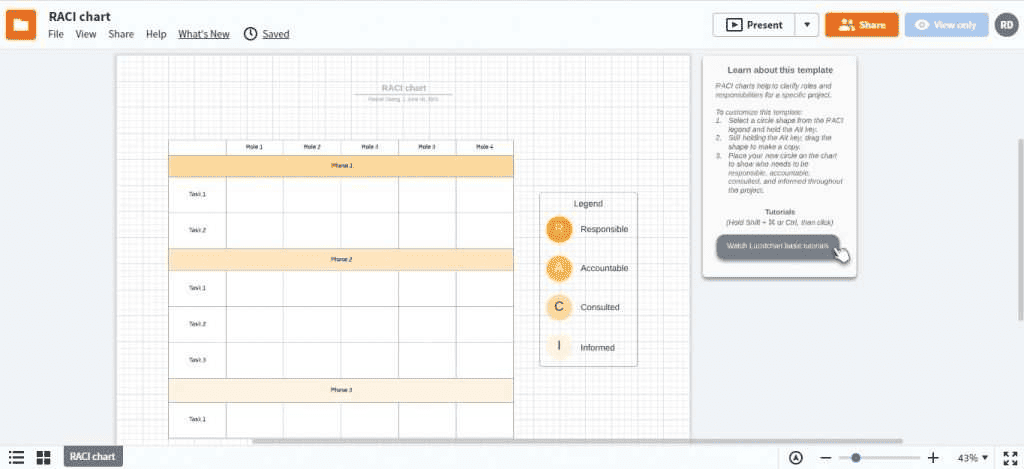
List every stakeholder across the top row of the RACI table, with each column representing one person or role. At this stage, resist the urge to pre-filter who “really” matters — it is better to include someone and assign them an Informed designation than to leave them out entirely and have them feel blindsided later. Stakeholders who are consistently well-informed tend to be more supportive and less likely to raise last-minute objections.
Step 3 — Assign Responsibilities
Fill in each cell of the matrix to designate who is Responsible, Accountable, Consulted, or Informed for every task. Work through each row carefully and apply the five rules outlined above as you go. Once the matrix is populated, review it as a whole before sharing it with the team — look for tasks with no Responsible party, tasks with multiple Accountable stakeholders, and any stakeholders who appear nowhere in the matrix, as these are common errors that are easy to fix at this stage but costly to discover later.
27 RACI Matrix Templates in Google Sheets
Using Google Sheets lets multiple people access and update the template simultaneously. It’s free and supports real‑time collaboration, making it ideal for group work. For these reasons, we migrated the following templates from freely available Excel versions on other sites to Google Sheets.
- RACI Chart (Roles and Responsibilities Matrix)
- RACI Chart Example
- RACI Matrix Example
- Project Management RACI Matrix Example
- Project RACI Matrix Example
- Factory RACI Chart Example
- Organizational Project Management RACI Matrix Example
- Basic RACI Blank Chart and Example 1
- Basic RACI Blank Chart and Example 2
- Project Manager RACI Blank Chart and Example
- RACI Matrix Example
- Stakeholders RACI Chart Example
- Sales Force RACI Chart Example
- 27 – Blank RACI Chart and Example
- IT Department RACI Chart Example
- Project Planning RACI Chart Example
- Task Distribution RACI Matrix Example
- Project Management RACI Blank Chart Example
- Simple Company Activities RACI Chart Example
- Blank Team RACI Chart
- Tasks RACI Blank Chart
- Project Manager RACI Chart Example
- Project Manager RACI Matrix Blank and Example
- Project Management Service RACI Matrix Example
- Project Planning RACI Chart Example
- Project Deliverable or Activities Blank RACI Matrix
- Basic Project RACI Example
RACI Templates in Excel
Excel is a powerful platform for creating charts and configuring rules for complex diagrams. It offers extensive formatting, formulas, and customization options that make it ideal for building detailed RACI matrices. However, Excel is less suited for real‑time collaboration: shared files can become out of sync, versions may be lost, and email or file‑share workflows often create bottlenecks. For collaborative, frequently updated RACI matrices, consider using cloud‑based tools (for example, Google Sheets or a dedicated RACI tool) to maintain a single source of truth and reduce versioning issues.
- TemplateLab – 21 Free RACI Templates
- Word Templates – 12+ Free RACI Templates
- Stakeholdermap.com RACI Template
- RACI Chart RACI Template
- UIT Stanford RACI Diagram
- Tactical Project Manager RACI Template
- Sample Templates RACI
- Sinnaps RACI Matrix Template
- Hubspot RACI Chart Template
- PMO RACI Chart
RACI Templates in PDF
This is the best platform for your charts if you need to send documents to members and want to preserve their format. PDFs have the option to be interactive and can be imported into platforms like Excel and Word. It is best served as a final document, as it is not ideal to use when you want to send it to others to have things changed.
RACI Templates in PowerPoint
RACI Templates in Word
There are some similarities between using Word and Google Docs. It has the option of creating charts, and it can transfer between platforms like Excel and PDF. Word is a standard platform for many people to have on their computers. The challenge with Word is that it comes with a difficult format. It also creates a bottleneck with files, as you cannot edit in real time
RACI Template Online Software / Tools
For teams that want more than a static spreadsheet, dedicated online tools offer real-time collaboration, visual clarity, and integrations with the rest of your project management stack. These platforms are particularly valuable for distributed teams or organizations running multiple projects simultaneously, where keeping a shared RACI matrix up to date in a spreadsheet quickly becomes unmanageable. If you are already using one of the tools below, building your RACI matrix directly within the platform is almost always more efficient than maintaining a separate file.
- Miro: Miro’s RACI template lets you map responsibilities visually on an interactive board, making it especially useful for running live stakeholder alignment sessions. Team members can contribute in real time, add comments, and link the matrix to other planning artifacts on the same board.
- Asana: Asana’s RACI matrix template lets teams define decision-making roles directly within their existing project workflows. It supports custom fields for tracking each RACI designation, Timeline View for visualizing task ownership across the project, and integrates natively with tools like Slack, Google Workspace, and OneDrive. Particularly well-suited for teams that want their responsibility assignments connected to live tasks and approvals rather than sitting in a separate document.
- Sinnaps: A project management platform with built-in RACI matrix support and automatic scheduling features. Particularly useful for teams that want their responsibility assignments to feed directly into a project timeline. Registration required.
- Creately: A diagramming and visual workspace tool that offers RACI matrix templates alongside a wide range of other project planning diagrams. Good for teams that need to produce polished, presentation-ready responsibility charts. Registration required.
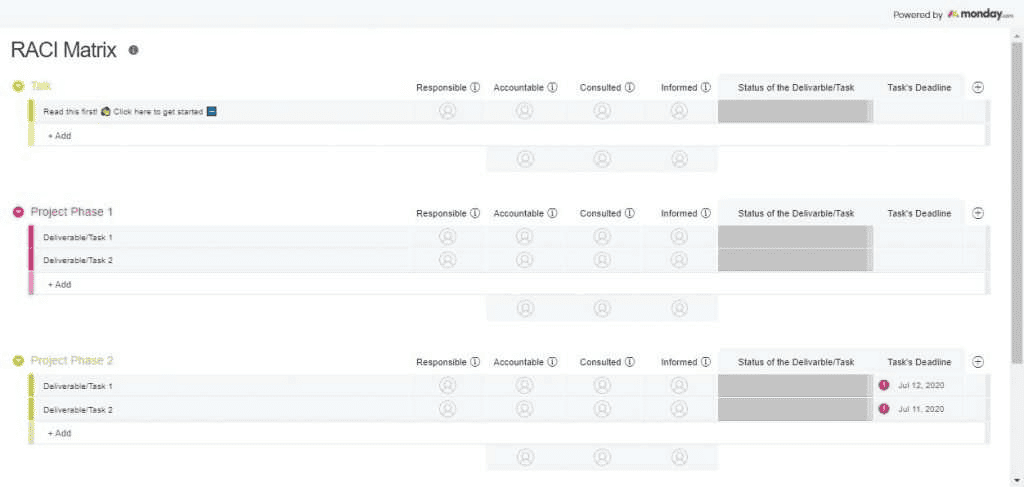
- Monday.com: A widely used work operating system with RACI matrix templates built into its project management workflows. Best suited for teams already using Monday as their primary project management platform. Registration required.
Video About RACI Matrix
If you’re a visual learner or want a quick, engaging overview of how to use the RACI matrix in real projects, this short video breaks it down step-by-step.
Conclusion on Using the RACI Matrix
A RACI matrix is one of the simplest and most effective tools a project manager can use to eliminate role ambiguity and keep stakeholders aligned. When everyone on the team knows exactly what they are responsible for — and what they are not — projects move faster, decisions get made more cleanly, and fewer things fall through the cracks.
Whether you choose to build yours in Google Sheets, Excel, or a dedicated platform like Asana or Miro, the format matters far less than the discipline of actually using it. Start with a template, run an alignment session with your team, and treat the matrix as a living document throughout the project. The upfront investment in clarity pays back many times over before the project is done.
FAQs on RACI Matrix
What does RACI stand for?
RACI stands for Responsible, Accountable, Consulted, and Informed. Each letter represents a type of role a stakeholder can hold in relation to a specific task or deliverable within a project.
How do I create a RACI matrix?
Start by choosing a platform — Google Sheets is a strong free option for collaborative teams. Then follow three steps: identify the roles involved in the project, list all stakeholders across the top of the matrix, and assign each person an R, A, C, or I designation for every task. Make sure every task has at least one Responsible party and no more than one Accountable stakeholder.
Is RACI used in Agile?
Yes. While Agile environments emphasize shared ownership and fluid roles, the RACI matrix is particularly useful during the working agreement stage when a new team is forming, and stakeholder roles are still being defined. It helps clarify expectations early and prevents confusion as the team ramps up.
Can one person hold multiple RACI roles?
Yes. It is common, especially on smaller teams, for one person to be both Accountable and Responsible for a task. The key constraint is that no task should have more than one Accountable person — that single point of accountability is what keeps decision-making clean and prevents confusion when issues arise.
When should you use a RACI matrix in a project?
The best time to build a RACI matrix is during the project planning phase, before execution begins. Establishing role clarity upfront means the team can hit the ground running without ambiguity about ownership. That said, a RACI matrix can also be introduced mid-project when confusion about responsibilities starts to slow things down.
Suggested articles:
- The Pros and Cons of Using RACI Matrix
- Top 10 Cons or Disadvantages of Using RACI Matrix
- Top 10 Pros or Advantages of Using RACI Matrix

Shane Drumm, holding certifications in PMP®, PMI-ACP®, CSM, and LPM, is the author behind numerous articles featured here. Hailing from County Cork, Ireland, his expertise lies in implementing Agile methodologies with geographically dispersed teams for software development projects. In his leisure, he dedicates time to web development and Ironman triathlon training. Find out more about Shane on shanedrumm.com and please reach out and connect with Shane on LinkedIn.
Wow Amazing Glad I have found this Platform I surely hope to connect learn and grow from Here