
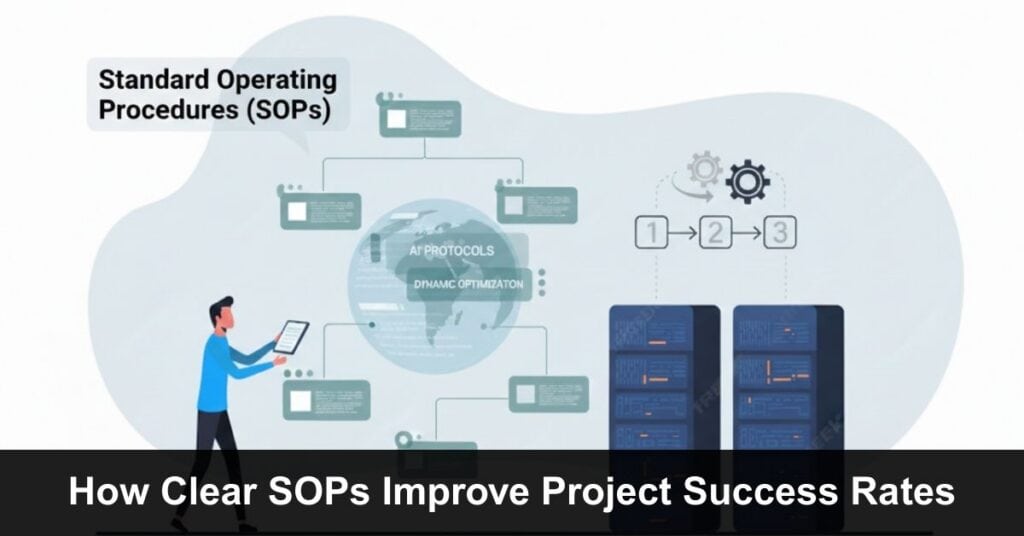
Project success rarely depends on effort alone. Even experienced teams miss deadlines, exceed budgets, or struggle with quality issues, not because they lack skill, but because they lack clarity. When roles, steps, approvals, and expectations are not clearly defined, confusion quietly spreads. Clear Standard Operating Procedures (SOPs) act as a stabilizing force inside project environments, creating structure, consistency, and accountability across every phase of execution.
Many project professionals enhance this capability through a SOP writing course, recognizing that strong documentation skills directly influence delivery performance.
What Makes Projects Derail?
Projects typically fail for predictable reasons, and understanding these failure patterns is the first step toward prevention. Despite advances in project management methodologies and sophisticated tracking tools, many projects still struggle with fundamental execution challenges. The most common derailment factors include:
- Miscommunication Between Stakeholders: When project sponsors, team members, and end users operate with different assumptions about scope, priorities, or success criteria, alignment becomes nearly impossible. Without documented communication protocols and decision-making frameworks, critical information gets lost in translation, leading to conflicting expectations and missed deliverables.
- Inconsistent Task Execution: Team members approach similar tasks differently when standardized methods don’t exist. This variability introduces quality issues, makes it difficult to estimate accurately, and creates dependencies that are hard to track. What works for one team member may not translate to another, creating bottlenecks and rework cycles.
- Rework Due to Unclear Instructions: Ambiguous requirements and vague task descriptions force teams to guess at intended outcomes. When deliverables don’t meet unstated expectations, entire work streams must be repeated. This rework consumes budget, erodes morale, and pushes timelines beyond acceptable limits.
- Delayed Approvals: Without clearly defined approval hierarchies and documented decision rights, simple sign-offs become multi-week ordeals. Approvers are unclear about what they’re approving, who should approve first, or what criteria should guide their decisions. These delays cascade through project schedules, affecting every downstream activity.
- Knowledge Gaps During Team Transitions: When experienced team members leave, or new members join mid-project, undocumented tribal knowledge disappears. New team members struggle to understand context, rationale for past decisions, and the “why” behind current processes. This learning curve extends timelines and increases the risk of repeating past mistakes.
While tools and software help track progress, they cannot compensate for poorly defined processes. Without structured procedures, each team member interprets tasks differently. Over time, this inconsistency compounds into delays and budget overruns. Clear SOPs eliminate guesswork by documenting how recurring project activities should be performed, reviewed, and approved.
1. SOPs Create Execution Consistency
In multi-project environments, consistency is critical. When every project team follows standardized steps for risk assessment, change management, reporting, or quality control, outcomes become more predictable. Instead of reinventing the wheel with each new project:
- Processes are predefined
- Responsibilities are assigned
- Deliverables are standardized
- Approval pathways are documented
This consistency reduces variation—a major factor in project failure. Teams spend less time clarifying instructions and more time delivering results.
2. They Reduce Risk Exposure
Unstructured workflows increase operational risk. When procedures are unclear, important checks are skipped. Compliance requirements may be overlooked. Documentation may be incomplete.
Clear SOPs:
- Define control points
- Outline escalation procedures
- Document risk mitigation steps
- Specify quality assurance requirements
By embedding risk controls directly into the workflow, SOPs prevent minor oversights from escalating into major project issues.
3. SOPs Improve Communication
Communication breakdown is one of the most cited reasons for project failure. Often, the issue is not poor communication skills but unclear expectations.
A well-written SOP answers key questions upfront:
- Who is responsible?
- What exactly needs to be done?
- When must it be completed?
- How should it be executed?
- What documentation is required?
When these elements are clearly documented, communication becomes structured rather than reactive. Teams no longer rely solely on verbal instructions or scattered emails.
4. Faster Onboarding and Knowledge Transfer
Project environments frequently experience team transitions. Without documented procedures, valuable knowledge leaves with departing employees.
Clear SOPs preserve institutional knowledge by:
- Capturing step-by-step instructions
- Documenting decision-making frameworks
- Defining templates and standards
- Recording lessons learned
New team members can integrate more quickly because they have access to clear operational guidance. This continuity directly improves project stability.
5. Enhanced Accountability
Ambiguity weakens accountability. When responsibilities are not formally documented, it becomes difficult to measure performance objectively.
Standard Operating Procedures (SOPs) assign:
- Specific task ownership
- Clear approval authorities
- Defined deliverable standards
- Measurable checkpoints
With this structure, performance discussions become fact-based rather than subjective. Accountability strengthens team discipline and improves overall project outcomes.
6. Improved Time and Cost Control
Rework is expensive. Delays caused by misunderstandings consume both time and budget. Clear SOPs minimize rework by ensuring tasks are completed the first time correctly.
When procedures are standardized:
- Estimation becomes more accurate
- Timelines become realistic
- Resource allocation improves
- Budget forecasting gains precision
Predictability increases, and predictability is one of the strongest indicators of project success.
7. Stronger Governance and Compliance
For organizations operating in regulated environments, documentation is not optional. Audits, compliance checks, and governance reviews demand traceability.
Clear SOPs:
- Provide documented evidence of controls
- Ensure consistent reporting formats
- Align project activities with regulatory requirements
- Support audit readiness
Project managers who understand structured documentation practices are better positioned to navigate governance challenges effectively. Many professionals pursue structured learning through sop writing training courses to build this competency and align project documentation with organizational standards.
8. Better Stakeholder Confidence
Stakeholders want confidence—not surprises.
When projects operate under documented procedures:
- Reporting formats are consistent
- Decision-making processes are transparent
- Risk responses are structured
- Change management follows clear pathways
This transparency builds trust. Stakeholders gain assurance that the project is not dependent on individual improvisation but on structured systems.
9. Continuous Improvement Becomes Possible
You cannot improve what you cannot measure. Clear SOPs establish a baseline. Once a process is documented, it can be evaluated, refined, and optimized. Performance metrics can be aligned with procedural steps, enabling data-driven improvements. Organizations that invest in structured sop training often develop stronger cultures of continuous improvement because teams understand how to refine documentation as processes evolve.
The Link Between SOP Quality and Project Success Rates
Research in operations management consistently highlights process maturity as a key predictor of performance outcomes. Projects that operate with standardized, well-documented procedures experience:
- Lower variance in delivery timelines
- Reduced error rates
- Improved compliance
- Higher stakeholder satisfaction
Clear SOPs do not eliminate all risks, but they significantly reduce uncertainty. In complex project environments, reducing uncertainty is often the difference between success and failure.
Final Thoughts
Project success is not accidental. It is engineered through clarity, structure, and disciplined execution. Clear SOPs transform project management from reactive problem-solving into proactive system management. They create alignment, reduce risk, enhance accountability, and build organizational resilience.
For project managers seeking to improve success rates consistently, strengthening documentation practices is not a minor administrative task; it is a strategic capability. When processes are clearly defined and properly executed, projects become predictable, scalable, and far more likely to achieve their intended outcomes.
Suggested articles:
- Goals and Objectives: Strategic Framework for Project Success
- Boosting Project Success with Team Collaboration Tools in 2025
- Tips for Choosing Team Members to Ensure Project Success

Daniel Raymond, a project manager with over 20 years of experience, is the former CEO of a successful software company called Websystems. With a strong background in managing complex projects, he applied his expertise to develop AceProject.com and Bridge24.com, innovative project management tools designed to streamline processes and improve productivity. Throughout his career, Daniel has consistently demonstrated a commitment to excellence and a passion for empowering teams to achieve their goals.