
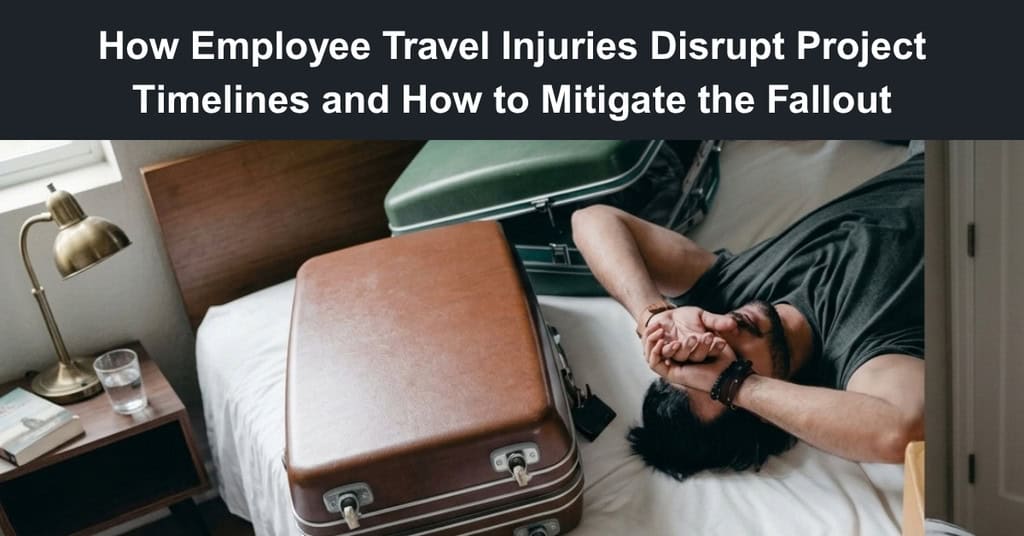
For project managers, PMO directors, and enterprise operations leaders, resource scheduling is a delicate science. Every Gantt chart, agile sprint backlog, and milestone deliverable relies on a fundamental assumption: that key personnel will be available to execute their assigned tasks according to schedule.
However, corporate mobility remains an essential requirement for driving enterprise growth. Project leaders, lead architects, technical subject matter experts (SMEs), and implementation engineers frequently commute between client sites, regional offices, and vendor negotiations.
When an unexpected travel incident—such as a severe motor vehicle collision—suddenly sidelines a critical team member, the resulting impact extends far beyond standard human resources administration. An employee travel injury acts as a direct operational shock to active project roadmaps, threatening deliverable quality, inflating budget burn rates, and risking contractual Service Level Agreement (SLA) breaches.
Understanding the structural mechanics of how business travel injuries derail project execution allows operations executives to build resilient contingency frameworks while protecting both enterprise capital and injured team members.
1. Immediate Loss of Subject Matter Leadership and Critical Bottlenecks
The most immediate consequence of a sudden employee travel injury is the sudden absence of specialized domain leadership. In modern enterprise project environments, cross-functional teams depend heavily on senior personnel who possess deep institutional knowledge and technical expertise.
Loss of Proprietary Domain Knowledge
Specialized SMEs and senior project managers hold critical context regarding client relationships, architectural decisions, and custom codebases or workflows. When a vehicular accident forces an immediate medical leave, this operational context becomes abruptly inaccessible, stalling decision-making loops across interdependent work streams.
Resource Burnout and Workload Friction
In the wake of a key team member’s absence, project managers often attempt to reallocate active tasks across remaining team members. Forcing existing staff to absorb executive-level or highly technical workloads leads to acute resource over-utilization, heightened stress, fatigue, and a sharp increase in deliverable error rates.
Onboarding Lag Times and High Contractor Costs
Attempting to replace a specialized resource on short notice presents significant financial and logistical hurdles. Sourcing, vetting, and onboarding external contractors or interim consultants requires substantial ramp-up time. This onboarding lag time stalls active development sprints while consuming unallocated project reserves.
2. Delayed Deliverable Milestones and Severe Contractual SLA Risks
Physical trauma sustained during business transit frequently creates a cascading schedule slippage across complex project roadmaps. When critical-path tasks stall, downstream dependencies fail sequentially.
SLA Breaches and Financial Penalties
Enterprise contracts routinely incorporate strict Service Level Agreements (SLAs) governed by firm delivery deadlines. When an injury disrupts project milestone delivery, the resulting delay can trigger contractual penalties, cure-notice issues, client forfeitures, or even the loss of multi-year account renewals.
Project Schedule Slippage Across Dependencies
Modern project management methodologies rely on tightly coupled task dependencies. If an injured senior developer or systems engineer is unable to complete a foundational architectural layer, testing teams, quality assurance specialists, and deployment engineers are left completely idle, expanding overall project duration.
Profit Margin Erosion
Extending a project’s lifecycle directly increases operational burn rates. Extended timeline durations force enterprises to expend additional billable hours on management overhead and status reporting, directly eroding profit margins across key business accounts.
3. Administrative Resource Drain and Complex Third-Party Claims
Managing the aftermath of a corporate travel accident introduces a heavy administrative burden that distracts project management officers, corporate legal teams, and HR leaders from core growth initiatives.
Executive Management Distraction
Coordinating workers’ compensation compliance, duty-of-care audits, disability paperwork, and emergency project re-staffing diverts executive attention away from strategic objectives.
Differentiating Workplace Coverage from Third-Party Negligence
Determining liability after a business travel collision requires navigating complex legal boundaries. While standard workers’ compensation insurance provides baseline medical benefits, it rarely compensates for the full spectrum of loss—such as extended lost earning capacity, future career disruption, or severe pain and suffering caused by a negligent third-party driver.
Real-Life Application: Navigating Regional Commute Risks and Civil Recovery
To understand how enterprise risk management and third-party civil claims function in practice, consider a real-world scenario involving regional corporate transit in Northern California.
Case Scenario: The Interstate 80 Tech Implementation
A senior enterprise solutions architect based in Northern California was tasked with leading a multi-phase system deployment for a major corporate client. During a routine business trip along the heavily traveled Interstate 80 corridor—a primary transit artery connecting regional business centers—the architect’s vehicle was broadsided by a negligent commercial transport driver who ran a red light at an off-ramp intersection.
The Operational Shock
The severe collision resulted in immediate hospitalization, requiring emergency spinal surgery and several months of intensive rehabilitation. The sudden loss of the lead architect created an instant operational shock:
- The project’s critical deployment milestone was missed by six weeks.
- The enterprise incurred tens of thousands of dollars in emergency contractor fees to audit and complete the unassigned technical architecture.
- The client invoked a milestone delay clause, threatening contract termination.
The Legal and Financial Resolution
Because workers’ compensation benefits provided only partial wage replacement and covered basic medical bills, the injured executive faced substantial uncompensated losses, including lost future earning capacity and long-term rehabilitation costs.
To address the full scope of financial damages caused by the third-party driver’s negligence, the injured specialist partnered with dedicated legal advocates. By retaining a specialized personal injury attorney Sacramento, the executive launched a thorough civil investigation:
- Subpoenaing black-box telemetry and commercial driver logging records to establish clear driver fault.
- Working with forensic economic experts to calculate the full loss of lifetime earning potential and specialized bonus structures.
- Securing a comprehensive third-party civil recovery that covered all out-of-pocket medical expenses, long-term care needs, and unrecovered wages beyond basic workers’ compensation limits.
This real-life case highlights why corporate duty-of-care strategies must account for third-party civil remedies when key personnel are injured in transit.
Safeguarding Operational Continuity and Key Personnel
For enterprise organizations, managing employee travel risk requires a comprehensive policy that extends beyond basic corporate travel insurance. Bridging project management risk mitigation with dedicated civil legal recovery ensures that both enterprise project stability and individual financial security remain protected following a severe transit incident.
By establishing clear emergency re-staffing protocols, maintaining cross-trained subject matter backups, and encouraging injured personnel to seek complete third-party recovery, business leaders can effectively buffer their operations against unexpected travel disruptions while upholding their commitment to workforce well-being.
Suggested articles:
- Who Should Project Managers Consult After Employee Work Injuries?
- How to Manage Workplace Injury Claims Within Your Project Team
- 7 Signs You May Need a Personal Injury Lawyer for Your Claim

Daniel Raymond, a project manager with over 20 years of experience, is the former CEO of a successful software company called Websystems. With a strong background in managing complex projects, he applied his expertise to develop AceProject.com and Bridge24.com, innovative project management tools designed to streamline processes and improve productivity. Throughout his career, Daniel has consistently demonstrated a commitment to excellence and a passion for empowering teams to achieve their goals.