
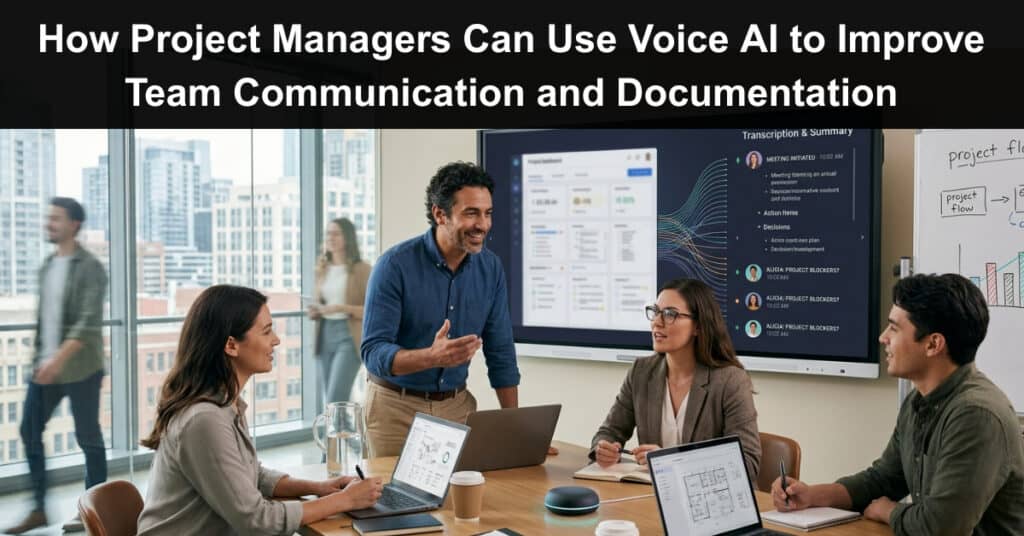
Project management is fundamentally a communication discipline. Plans only deliver results if the right information reaches the right people clearly and on time, and the tools a project manager uses to communicate shape whether that happens or not. Status reports that nobody reads, training documentation that doesn’t get reviewed, update calls that could have been a clear voice message: these are project execution problems, but they’re also communication format problems.
Voice AI is showing up in project workflows in ways that address some of these problems directly. Not as a replacement for the communication disciplines that make projects work, but as a format addition, one that makes certain kinds of project communication faster to produce, more accessible to distributed teams, and easier to update when project details change.
AI text to speech is the starting point for most project management applications. A written status update, meeting summary, or training document can be turned into a narrated audio version in seconds, a format that some team members will engage with on a commute, between meetings, or in a screen-free context where they’d never open a written document.
Status Updates and Project Communications
The written status report has a long history of being produced and not read. Length, formatting, and the time required to parse dense project information all work against consistent readership, particularly for stakeholders who are involved in multiple projects and receive multiple status reports per week.
A narrated version of the same content changes the consumption context. A three-minute audio summary of a project’s weekly status can be listened to during a commute, a coffee break, or the transition between meetings, contexts where a two-page PDF would not be opened. Fish Audio generates narrated audio from a written script through a web interface or API with time-to-first-audio in the 70–100ms range. A weekly status summary is generated in seconds.
Training and Onboarding Documentation
Project managers with onboarding responsibilities know the frustration of documentation that’s accurate on the day it’s written and outdated within weeks as the project evolves. AI voice cloning addresses this at the source. Fish Audio can generate a consistent narrator voice from a reference sample as short as 15 seconds. Once that voice exists as a reusable asset, updating the audio narration of a training document is as simple as editing the script and regenerating. The production cost of an update is essentially zero.
AI voice cloning for commercial use requires a paid plan, since the free tier is limited to personal, non-commercial projects. With Fish Audio, you can start with a consistent narrator voice from the community voice library, featuring over 2,000,000 voices. This helps onboarding content sound uniform without building a custom clone.
Meeting Transcription and Documentation
Speech-to-text is the complementary capability that matters as much as generation for project management workflows. Fish Audio’s ASR runs at $0.36 per audio hour and returns multi-speaker labeled transcripts with timestamps automatically. For a project manager running weekly team calls, every meeting can be transcribed programmatically — decisions are captured with attribution, action items are searchable by text, and stakeholders who missed the call have a complete record rather than a summary filtered through someone’s notes.
Here is how automated meeting transcription directly improves team documentation and alignment:
- Attributed Decision Logs: Captures exactly who made key commitments and decisions during calls without relying on manual note-taking.
- Searchable Action Items: Converts hours of spoken discussions into easily searchable text records to quickly track follow-ups and deliverables.
- Complete Records for Absent Stakeholders: Provides remote or absent team members with unfiltered, timestamped records rather than selective summaries.
Multilingual Teams and Global Projects
Fish Audio’s S2.1 Pro covers 83 languages from a single endpoint. For a project manager working with a distributed global team, a status update or training document can be narrated in every language the team uses, not through a separate vendor or a separate workflow per language, but through the same platform. A team member receiving project communications in their first language is better positioned to act on them accurately than one parsing content in their second.
Localized voice updates streamline global team collaboration in several key ways:
- Single-Platform Localization: Eliminates the need for multiple localization vendors by generating voiceovers in 83 languages from one workflow.
- Higher Comprehension & Accuracy: Ensures non-native speakers receive critical project updates in their primary language, reducing misunderstandings.
- Unified Onboarding & Messaging: Delivers consistent training modules and project briefings across international hubs simultaneously.
Risk and Issue Communication
Fish Audio uses open-domain natural-language emotion tags that allow narration tone to be scripted directly. An issue escalation can be narrated with [clear urgency, direct delivery — this needs a decision today while a standard risk log update uses a more measured pace. The tone is embedded in the script rather than requiring a separate direction session.
Tailoring audio delivery to project priority offers three distinct operational benefits:
- Context-Driven Urgency: Signals critical blockers and urgent escalations immediately using authoritative, direct audio tones.
- Calibrated Risk Reporting: Maintains a steady, measured cadence for routine risk log updates to avoid unnecessary team panic.
- Scripted Emotional Control: Embeds tone instructions directly into documentation without requiring manual voice direction or re-recordings.
Pricing and Getting Started
Fish Audio’s API pricing is usage-based at $15 per million characters, with no monthly minimum. For non-developer use through the web interface, the Plus plan is $11/month with commercial use rights and a monthly generation allowance. The free tier covers limited personal use only and is not appropriate for team communications or project documentation.
The practical starting point for project management use: identify one communication category where audio would improve reach or engagement, such as a weekly stakeholder update, an onboarding module, a recorded project brief, and run a real draft through the platform. The production step adds minutes, not hours, to an existing documentation workflow.
Where It Fits and Where It Doesn’t
Voice AI adds the most value to project communication in cases where format is part of the problem: stakeholders who don’t read written reports, team members for whom documentation is a comprehension burden, training content that needs updating more often than a manual process allows, and meetings where transcription has been left to note-takers.
It doesn’t solve communication problems that are fundamentally about process, alignment, or stakeholder engagement; those require the judgment and interpersonal work that’s specific to the project manager’s role. What it offers is a format upgrade that makes the communication that already needs to happen easier to produce, easier to distribute, and more likely to be consumed.
Suggested articles:
- Beyond Chat: Driving Project Outcomes Through Integrated Video & Voice
- How AI-Powered Voice Agents Are Redefining Sales in 2025
- How AI Voice Generators Can Enhance B2B Sales and Marketing Calls

Daniel Raymond, a project manager with over 20 years of experience, is the former CEO of a successful software company called Websystems. With a strong background in managing complex projects, he applied his expertise to develop AceProject.com and Bridge24.com, innovative project management tools designed to streamline processes and improve productivity. Throughout his career, Daniel has consistently demonstrated a commitment to excellence and a passion for empowering teams to achieve their goals.