
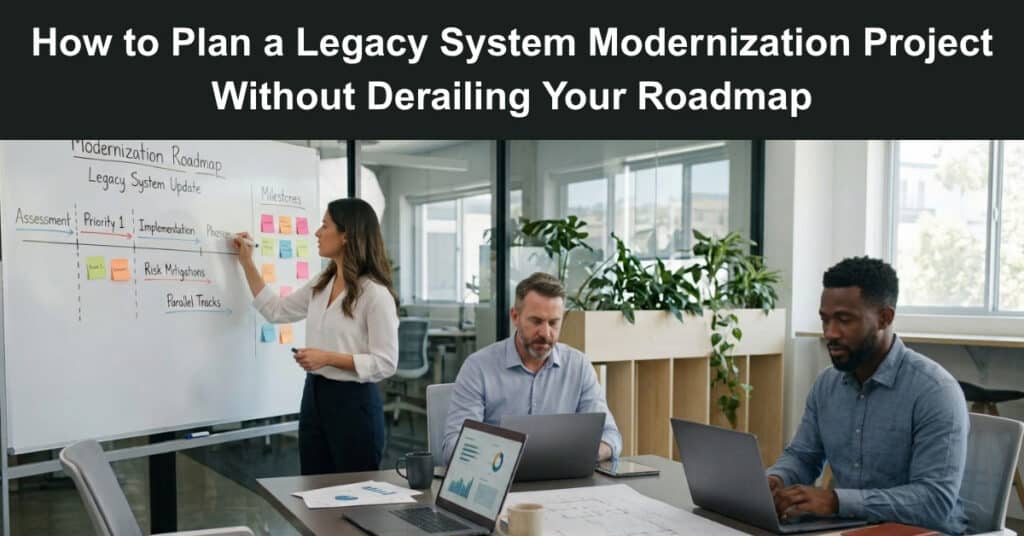
Plan a legacy system modernization project the same way you’d plan any other major initiative, and there’s a good chance it quietly consumes the roadmap you were trying to protect. Modernization work has a habit of expanding past its original scope, pulling engineers off feature work for longer than anyone budgeted for, and leaving product stakeholders blindsided when a quarter’s worth of planned releases quietly slip. None of that is inevitable. It’s usually the result of treating modernization planning like a smaller version of regular product planning, when it actually needs its own approach.
This is a practical playbook for project managers and PMO leads who need to plan a modernization project that gets the legacy system fixed without becoming the reason the rest of the roadmap falls apart.
Key Takeaways
- Legacy modernization projects derail roadmaps most often because they’re planned with the same certainty as regular feature work, when they’re fundamentally less predictable.
- Scoping modernization as a separate track with its own budget of time and people prevents it from silently competing with the product backlog.
- A phased rollout with parallel runs is almost always safer than a single, high-stakes cutover.
- A modernization-specific risk register catches problems that a standard project risk register usually misses.
- Bringing in outside expertise makes the most sense when internal capacity is limited, and the project timeline is already under business pressure.
Why Legacy Modernization Projects Commonly Derail Roadmaps
Three patterns show up again and again in modernization projects that end up eating far more roadmap time than planned.
- First, the scope of hidden dependencies inside the legacy system gets underestimated, because nobody fully mapped them before committing to a timeline.
- Second, there’s no dedicated time budget for the unknowns that inevitably surface once the migration actually starts.
- Third, the same engineers responsible for the modernization work are also expected to keep shipping regular product features, which means every unexpected modernization delay directly delays the product roadmap too, since it’s the same people and the same calendar.
Understanding these three patterns is most of the battle. Almost every planning mistake described in this article traces back to one of them, so keeping this list in mind while building the project plan catches a surprising number of problems before they happen.
Step 1: Scope the Modernization Separately from the Product Roadmap
The single highest-leverage decision a PM can make is giving the modernization project its own track, with its own time budget and, ideally, its own dedicated people, rather than trying to fit it into the same sprints as ongoing feature work. Treating modernization as “something the team does between features” all but guarantees it gets deprioritized every time a feature deadline gets tight, which is exactly how these projects end up dragging on for a year instead of a planned quarter.
This doesn’t necessarily mean a fully separate team in the org chart. It can be as simple as reserving a fixed percentage of sprint capacity exclusively for modernization work, and treating that reservation as non-negotiable the same way an SLA commitment would be, rather than the first thing that gets cut when a product deadline is at risk.
Step 2: Build a Realistic Timeline with Buffer for Unknowns
Legacy systems reliably contain dependencies nobody fully remembers: a report that pulls from an undocumented table, an integration that quietly depends on a specific quirk of the old system’s behavior. Planning a modernization timeline with the same precision used for well-understood feature work sets the project up to blow through its deadline the first time one of these dependencies surfaces.
A more realistic approach builds in an explicit buffer, often twenty to thirty percent of the estimated timeline, specifically earmarked for unknowns rather than folded quietly into task estimates where nobody can see it. This buffer should be visible in the project plan and communicated to stakeholders as a deliberate part of the estimate, not hidden contingency that only appears when something goes wrong.
Step 3: Map Stakeholders and Set Expectations Early
A modernization project touches more people than the engineering team alone. Support teams need to know if their tools will change. Sales may need to know if a feature freeze affects a competitive deal in progress. Leadership needs to understand, well before the project starts, that some fraction of engineering capacity is shifting away from new features for a defined period.
Building a RACI matrix specifically for the modernization project, separate from the one used for regular product work, clarifies who needs to be consulted, who needs to be informed, and who actually owns decisions when trade-offs come up mid-project. Skipping this step is one of the most common reasons stakeholders feel blindsided months into a project they technically should have known about from day one.
Step 4: Choose a Phased Rollout Over a Big-Bang Cutover
A single, all-at-once cutover from the old system to the new one concentrates all of the project’s risk into one moment. If something goes wrong, there’s often no clean way back, and the pressure to fix problems live, in production, tends to produce worse decisions than the same problems would if caught during a controlled rollout.
A phased rollout, running the old and new systems in parallel and migrating functionality piece by piece, spreads that risk out over time. It takes longer in total, and it requires more careful planning to keep both systems in sync during the transition, but it gives the team room to catch and fix problems at a much smaller scale before they can affect the whole system at once.
Step 5: Build a Risk Register Specific to Modernization Work
A standard project risk register, built around scope creep and resource availability, misses several risks that are specific to modernization work and worth tracking separately.
- Hidden dependencies between legacy modules that only surface once the migration is already underway.
- Bus-factor risk from relying on the one person who actually understands how the old system works.
- Ongoing priority conflicts between the modernization team and the product feature team competing for the same engineers.
- Underestimated time needed to test backward compatibility with systems that integrate with the one being modernized.
Reviewing this register on a regular cadence, not just once at the start of the project, catches emerging risks early enough to actually respond to them, rather than discovering them only once they’ve already caused a delay.
Step 6: Decide When to Bring In Outside Expertise
At some point in planning, most PMs face a real question: does the internal team have the bandwidth and specific experience to execute this modernization well, or does it make more sense to bring in outside help? The honest answer often depends less on the internal team’s skill and more on capacity. A team fully staffed for product work rarely has meaningful slack for a multi-month modernization effort layered on top.
At this stage, many PMOs turn to legacy system modernization services specifically to run the migration in parallel with the internal team’s existing roadmap, rather than pulling core product engineers off feature work for months at a time. This keeps the product roadmap moving while a dedicated team handles the modernization track with its own timeline and its own accountability.
This decision works best when it’s made early in planning rather than as a mid-project rescue after the internal team has already fallen behind. Bringing in outside expertise from the start allows the engagement to be scoped properly, with clear ownership boundaries between the internal and external teams, rather than as a hurried patch applied to a project that’s already off track.
A Sample Phased Timeline Template
A concrete example helps more than abstract advice when it comes time to actually build the plan. A reasonable phased timeline for a mid-sized modernization project might look like this: an initial audit and prioritization phase to map dependencies and rank components by risk, followed by a pilot migration of a single, non-critical module to validate the approach and surface unknowns cheaply. From there, a parallel run phase keeps both systems operating simultaneously while confidence builds, followed by staged expansion to additional modules, and finally a full decommissioning of the old system once every dependency has been confirmed migrated.
This structure isn’t a fixed formula, since every legacy system carries its own specific complications, but it gives a PM a starting template to adapt rather than building a modernization timeline entirely from scratch. Adjusting the pilot module and the pacing of the staged expansion phase to match the specific system in question is usually where the real planning work happens.
Communicating Progress Without Overwhelming Stakeholders
Modernization work is inherently harder to demo than feature work. There’s rarely a shiny new screen to show in a sprint review, and “we migrated another backend module” doesn’t generate the same enthusiasm as a new customer-facing feature. This creates a communication gap where stakeholders start to wonder what the modernization team is actually doing, even when the project is on track.
A simple fix is reporting progress against the phased timeline rather than against individual technical tasks. Instead of describing which tables were migrated this sprint, report which phase of the plan the project is in and what percentage of the total scope that phase represents. This gives non-technical stakeholders a way to track progress that doesn’t require understanding the underlying system, and it makes it much easier to flag a delay early, before it becomes a surprise at the end of the quarter.
Handling Scope Creep in a Modernization Project
Scope creep shows up differently in modernization work than in feature development. It rarely arrives as a stakeholder asking for something new. Instead, it shows up as the team discovering, mid-migration, that a component depends on something nobody had scoped, and quietly expanding the project to address it because leaving it unaddressed feels riskier than the schedule slip.
- Treat every newly discovered dependency as a formal scope change, logged and reviewed, rather than an invisible extension of the current phase.
- Decide explicitly whether a newly discovered issue must be fixed now or can be deferred to a later phase, rather than defaulting to fixing everything as it’s found.
- Revisit the timeline buffer whenever a significant new dependency is confirmed, rather than assuming the original buffer will absorb it.
Handling scope changes this way keeps the project plan honest. It also gives the PM a clear, documented reason for any timeline adjustment, which is far easier to communicate to stakeholders than an unexplained delay that appears to come out of nowhere.
Conclusion
A legacy system modernization project doesn’t have to come at the expense of the rest of the roadmap. It usually does when it’s planned with the same assumptions as ordinary feature work: fixed timelines, no dedicated capacity, and no separate risk framework for the specific ways modernization projects tend to go wrong. Treating it instead as its own track, with its own buffer, its own stakeholder map, and a clear decision about internal versus external capacity, is what separates a modernization effort that quietly succeeds from one that becomes the story everyone tells about the year the roadmap fell apart.
FAQs
How do you keep a legacy modernization project from delaying the product roadmap?
Scope the modernization work as its own track with dedicated time and, where possible, dedicated people, rather than folding it into the same sprints as feature work. This prevents modernization delays from directly cascading into the product roadmap, since the two tracks no longer compete for the exact same capacity.
What’s the ideal team size for a legacy system modernization project?
It depends heavily on the size and complexity of the system, but a common mistake is understaffing modernization relative to the hidden dependency work involved. Sizing the team based on the initial audit findings, rather than a rough guess made before the audit, tends to produce more realistic staffing.
Should legacy modernization be run as a separate project or folded into regular sprints?
Running it as a separate project, or at minimum a clearly ring-fenced portion of sprint capacity, is generally safer. Folding it into regular sprints without protection almost always results in modernization work losing priority whenever a feature deadline gets tight.
How much time buffer should a PM add for unknown dependencies in a modernization project?
A buffer in the range of twenty to thirty percent of the estimated timeline is a reasonable starting point for most legacy systems, though older or less documented systems may warrant more. The buffer should be explicit in the plan rather than quietly absorbed into individual task estimates.
When does it make sense to bring in an external team for legacy modernization instead of using in-house staff?
It tends to make the most sense when internal capacity is already fully committed to product work, or when the timeline is under business pressure that doesn’t leave room for the internal team to ramp up gradually. Deciding this early in planning, rather than mid-project, gives the engagement a much better chance of being scoped and executed cleanly.
Suggested articles:
- Why Application Modernization Services Are the Critical Enabler for Cloud-Native Development
- Strategic Planning for Digital Transformation Projects
- How to Create a SaaS Migration Plan

Daniel Raymond, a project manager with over 20 years of experience, is the former CEO of a successful software company called Websystems. With a strong background in managing complex projects, he applied his expertise to develop AceProject.com and Bridge24.com, innovative project management tools designed to streamline processes and improve productivity. Throughout his career, Daniel has consistently demonstrated a commitment to excellence and a passion for empowering teams to achieve their goals.