
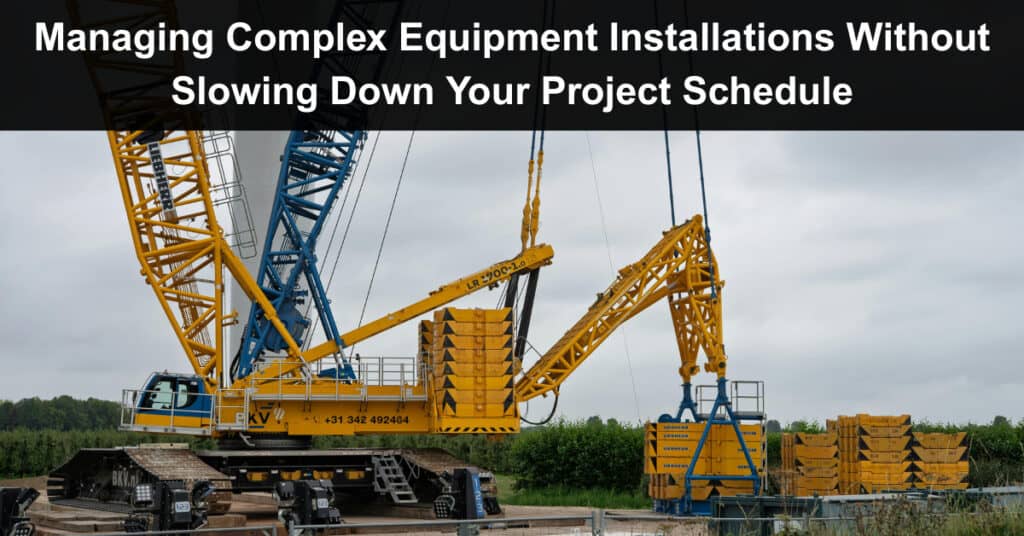
Managing complex equipment installations without slowing your project schedule means planning the delivery, placement, connection, testing, and handover of major equipment while the rest of the project continues to move forward. A machine, refrigeration package, commercial kitchen line, or automation cell is not just another delivery. It changes power loads, floor layouts, labor plans, safety checks, and access routes.
The risk is real. PMI reported that nearly half of projects in its 2018 Pulse of the Profession study were not completed on time, while Siemens reported in 2024 that one hour of downtime in a large automotive plant can reach $2.3 million. Those figures show why installation planning should sit beside procurement and budgeting.
This guide explains why installations fall behind, what to prepare, and how to reduce delays before they reach the critical path.
Why Do Complex Equipment Installations Delay Project Schedules?
Complex equipment installations delay project schedules because they create dependencies that are often discovered too late. A machine may arrive on time, but the floor may not be reinforced. A commercial oven may be ready, but ventilation or gas connections may still be incomplete. A robotic cell may be approved by procurement, but guarding, programming, and training may not be included in the schedule.
Most delays come from coordination gaps rather than the equipment itself. The project manager must connect vendors, engineers, installers, facility managers, safety officers, and operators early.
Common causes of equipment installation failure and delays include:
- Missing utilities such as power, air, water, drainage, gas, or ventilation.
- Late deliveries caused by freight issues, customs delays, or weak procurement tracking.
- Layout errors where dimensions do not match real site conditions.
- Contractor conflicts occur when several teams need the same work area.
- Incomplete permits, inspections, or compliance documents.
- Poor training plans that leave operators unprepared after commissioning.
- Skipped testing that turns small defects into schedule-blocking failures.
What Types of Equipment Installations Are the Most Difficult to Manage?
Equipment installations are grouped project activities that involve receiving, positioning, connecting, testing, and handing over physical assets. The most difficult installations are heavy, technical, utility-dependent, or directly tied to revenue. CNC machinery, automation systems, commercial kitchen equipment, industrial robotics, HVAC systems, electrical infrastructure, refrigeration systems, and packaging lines all fall into this category because they affect both the project and operating schedules.
Manufacturing equipment is especially sensitive because it often requires foundation checks, precision leveling, safety zones, and commissioning support. For example, press brake machines must be planned around floor space, bending workflow, tooling access, electrical capacity, and training. If one requirement is discovered after delivery, the project can lose days before production starts.
Commercial kitchen equipment creates a different pressure. Refrigeration, dishwashing, cooking, prep, and storage systems must be installed in a logical order so workflow, sanitation, health codes, and openings stay aligned.
What Should Be Planned Before Equipment Installation Starts?
Before equipment installation starts, the project manager should confirm that the site, vendor, equipment, labor, utilities, permits, and handover plan are ready. This prevents the common problem where a project appears on schedule in meetings but fails once installers reach the site. Treat the installation as one work package that includes design review, procurement, delivery, connection, testing, commissioning, documentation, and handover.
There are seven planning stages to complete before installation:
- Review technical drawings, dimensions, weights, and utility loads.
- Confirm floor strength, access routes, lifting paths, and staging areas.
- Check electrical, mechanical, plumbing, ventilation, compressed air, and drainage requirements.
- Align vendor responsibilities with contractor responsibilities.
- Schedule delivery, unloading, installation, inspection, testing, and commissioning as separate milestones.
- Prepare safety documents, permits, lockout procedures, and access rules.
- Plan operator training, spare parts, manuals, warranty records, and acceptance criteria.
A supplier or site check can also reduce risk before ordering. A factory audit is useful when the project depends on overseas manufacturing, custom fabrication, or a supplier that has not been used before. It helps confirm production capability, quality systems, documentation control, and delivery readiness before the schedule relies solely on promises.
How Does Site Readiness Reduce Installation Risk?
A site readiness assessment is a process that confirms whether the installation area can safely receive, support, connect to, and operate the equipment. It is useful because it converts physical site conditions into clear pass-or-fail requirements before installers arrive. The assessment should include floor loading, anchors, clearances, utility locations, ventilation, drainage, lighting, access control, fire safety, and maintenance space.
Good project managers walk the route, not just the room. They ask whether a forklift can reach the installation point, whether the equipment can pass through the loading bay, whether the ceiling is high enough for lifting, and whether disconnects, drains, panels, and exhaust points are in the correct location. This prevents surprises such as blocked access, missing power, weak floors, or machines that cannot be placed without removing doors or walls.
Why Does Delivery Scheduling Matter So Much?
Equipment logistics and delivery scheduling is the process of planning how equipment moves from the supplier to the site and from the site entry to the final position. It matters because late, damaged, or poorly sequenced deliveries can stop all downstream work. A delivery plan should include shipping dates, carrier contacts, customs documents, unloading equipment, crane or forklift needs, weather risks, and staging space.
For large systems, delivery should follow the actual installation sequence, not supplier convenience. A restaurant buildout may require refrigeration to be installed before the final inspection, while cooking equipment may need ventilation to be completed first. Using a restaurant equipment checklist during planning helps teams map equipment categories to space, utility, sanitation, and workflow needs before the site becomes crowded with deliveries. Equipment should arrive only when the site can receive it, protect it, install it, and test it.
How Can Project Managers Keep Equipment Installations on Schedule?
Project managers can keep installations on schedule by breaking the work into visible steps, assigning ownership, tracking dependencies daily, and testing equipment before handover. The goal is not to make the schedule rigid. The goal is to make problems visible early enough to solve them without stopping the project.
There are five practical steps:
- Build a detailed timeline with delivery, rigging, placement, utility connection, testing, commissioning, training, and acceptance.
- Assign clear responsibility so every milestone has one accountable owner.
- Use real-time communication through dashboards, checklists, Gantt charts, photo updates, and issue logs.
- Test before full commissioning with dry runs, calibration checks, safety interlock tests, and operator trials.
- Protect the handover by collecting manuals, warranties, maintenance schedules, spare parts lists, and training records.
What Technologies Help Streamline Equipment Installations?
Installation management technologies are tools that improve planning, visibility, communication, and technical control during equipment projects. The main types include project management software, building information modeling, digital checklists, industrial automation systems, remote diagnostics, and visual display systems. These technologies reduce guesswork and make dependencies easier to monitor.
Project management software helps with scheduling, Gantt charts, resource allocation, document sharing, and task ownership. Industrial automation systems, including PLCs, servo systems, sensors, drives, robotics, and automated diagnostics, support controlled startup, repeatable testing, and faster fault detection.
Digital visualization systems, including large displays and site dashboards, help teams communicate status in busy environments. A visual board showing open issues, safety warnings, delivery times, and commissioning progress can help different teams work on the same schedule.
What Are the Most Common Mistakes During Equipment Installations?
The most common installation mistakes include poor planning, weak communication, skipped testing, and incomplete documentation. These mistakes create schedule drag because they are often discovered when the project has the least flexibility.
There are five major mistakes to avoid:
- Ignore site readiness, as it causes access, utility, and clearance issues after delivery.
- Underestimate installation time, which compresses testing and increases rework.
- Separate procurement from project scheduling, so delivery promises can replace verified milestones.
- Overlook operator training, which delays productive use even after startup.
- Accept verbal updates, which weakens accountability when problems arise.
The fix is better evidence, not more meetings. Photos, signed checklists, supplier confirmations, inspection records, and live schedule updates give the project manager facts rather than guesses.
What Are the Benefits of Well-Managed Equipment Installations?
Well-managed equipment installations improve startup speed, reduce downtime, protect budgets, and make the handover smoother. They also help teams move from construction or setup into real operation without the painful gap that often appears between installation and being ready to use.
There are five major benefits:
- Accelerate startup by making delivery, connection, testing, and training part of one controlled sequence.
- Reduce downtime by preventing avoidable utility, access, and commissioning issues.
- Improve safety by confirming lifting plans, lockout procedures, guarding, and operator access before work begins.
- Protect budgets by reducing emergency labor, expedited shipping, rework, and idle crews.
- Support maintenance by collecting manuals, spare parts data, warranty records, and service procedures during handover.
How Much Do Equipment Installation Delays Cost Businesses?
Equipment installation delays can cost from a few hundred dollars per hour in small facilities to thousands or even millions per hour in high-output industrial environments. The cost depends on production value, labor intensity, contract penalties, customer deadlines, and whether the delay affects a single asset or an entire facility. Siemens estimated that large industrial companies lose about $253 million per year per average large plant due to downtime, underscoring why delayed commissioning is more than a scheduling inconvenience.
There are five main cost factors:
- Lose output from machines, kitchens, lines, or workstations that cannot operate.
- Pay idle labor when crews are blocked by missing dependencies.
- Add emergency service charges for last-minute electricians, riggers, engineers, or technicians.
- Increase freight and rework costs when parts, layouts, utilities, or foundations need correction.
- Risk revenue loss from missed openings, late shipments, client penalties, or canceled work.
Project managers should calculate the delay cost before installation begins. When stakeholders understand the hourly exposure, they are more willing to fund prevention.
Equipment Installation Planning vs Reactive Project Management
Equipment installation planning prevents delay by controlling dependencies before work begins, while reactive project management responds after problems have already affected the schedule. The difference is visible in cost, communication, safety, and startup quality.
| Factor | Planned Installation | Reactive Management |
| Schedule control | Milestones are sequenced before delivery | Problems are solved after work stops |
| The equipment reaches useful operation faster | Costs are forecast and controlled | Emergency labor and rework increase costs |
| Communication | Roles and escalation paths are clear | Teams rely on scattered messages |
| Safety | Risks are reviewed before installation | Safety gaps appear during commissioning |
| Productivity | Equipment reaches useful operation faster | Installed equipment may sit idle |
| Handover | Manuals, training, and acceptance are planned | Documentation is collected late |
The planned approach does not remove every risk, but it gives the project manager a stronger position. The team can see which dependencies need action before they become a delay.
What Industries Depend Most on Efficient Equipment Installations?
The industries that depend most on efficient equipment installations are those where physical assets directly control production, service capacity, safety, and revenue. Manufacturing needs smooth installation for CNC machines, presses, conveyors, and automation cells. Foodservice needs it for refrigeration, dishwashing, cooking, and prep systems. Logistics depends on conveyors, scanners, dock equipment, and warehouse automation.
Energy, healthcare, and commercial facilities also rely on precise installation because pumps, compressors, control panels, medical devices, HVAC systems, elevators, lighting, and access systems can affect safety and schedules. In all these industries, efficient installation turns purchased equipment into a working asset more quickly.
Conclusion
Managing complex equipment installations without slowing down your project schedule comes down to early visibility, disciplined coordination, and practical technical planning. Equipment does not delay projects on its own. Delays occur when site readiness, logistics, utilities, vendor roles, testing, and training are treated as separate tasks rather than as a connected installation system.
A strong project manager defines the work package early, confirms real site conditions, assigns ownership, tracks dependencies, and protects the commissioning window. That approach reduces downtime, limits rework, improves safety, and helps the business reach productive operation faster.
For any equipment-heavy project, the best time to solve installation risk is before the truck arrives. Once the equipment is on-site, planning turns into recovery.
Suggested articles:
- Organizing Equipment for Improved Workflow on Construction Sites
- Logistics Risk On Construction Projects: Managing Delivery, Storage, And Site Readiness
- The Art of the Multi-Site Project: Coordinating Field Service Across State Lines

Daniel Raymond, a project manager with over 20 years of experience, is the former CEO of a successful software company called Websystems. With a strong background in managing complex projects, he applied his expertise to develop AceProject.com and Bridge24.com, innovative project management tools designed to streamline processes and improve productivity. Throughout his career, Daniel has consistently demonstrated a commitment to excellence and a passion for empowering teams to achieve their goals.