

Planning Poker is an agile estimating and planning technique that helps teams reach consensus and develop a shared implementation strategy. Using custom Planning Poker cards keeps the process engaging while encouraging meaningful discussion so everyone understands the work and agrees on relative effort rather than absolute time.
This gamified approach improves the accuracy of development estimates and clarifies the effort required for tasks in the product backlog. Planning Poker is commonly used in Scrum to estimate the relative size of user stories and bring diverse stakeholders—such as product owners, developers, and product managers—into a focused, collaborative estimation process.

Planning Poker was adapted for agile teams in 2002 by James Grenning from the Wideband Delphi Technique and popularized by Mike Cohn. Cohn promoted the method in his book Agile Estimating and Planning and later trademarked the term through his company.
Planning Poker is a consensus-driven estimation method that convenes stakeholders from across the organization to agree on the relative effort of backlog initiatives. In software development teams, this group commonly includes the product owner, developers, product managers, and other subject-matter contributors, ensuring estimates reflect shared understanding and diverse perspectives.
Rules of Planning Poker
Planning Poker is a consensus-based, gamified technique used by Agile teams to estimate the effort or relative size of development goals. By using a deck of cards with values—typically following a Fibonacci sequence—team members can provide honest estimates without being influenced by their peers. This process encourages healthy discussion, uncovers hidden complexities, and ensures that the final estimate represents the collective wisdom of the entire team.
Here are the rules of Planning Poker:
- Present the User Story: The Product Owner presents and explains the user story or software feature in sufficient detail so the estimation team clearly understands its scope, objectives, and expected outcomes before beginning the estimation process.
- Distribute Planning Poker Cards: Each estimator is provided with their own deck of Planning Poker cards representing predefined story point values, enabling consistent estimation across the team while allowing each participant to independently assess effort and complexity.
- Allow Questions and Discussion: Estimators are given time to ask clarifying questions and discuss the user story to remove ambiguity, uncover hidden risks, and align technical and functional assumptions before selecting an estimate.
- Select Estimates Privately: After discussion, each estimator privately selects a card that reflects their assessment of the effort, complexity, and uncertainty involved, preventing peer influence and encouraging honest, independent estimation.
- Reveal Cards Simultaneously: All estimators reveal their selected cards at the same time to ensure transparency and fairness, eliminating bias that could occur if estimates were disclosed sequentially.
- Check for Consensus: If all estimators reveal the same story point value, that value is accepted as the final estimate, demonstrating shared understanding and agreement on the level of effort required.
- Discuss Estimation Differences: When estimates differ, the team discusses the reasoning behind the highest and lowest values to identify misunderstandings, assumptions, or risks that may affect the accuracy of the estimate.
- Re-estimate After Discussion: Following discussion, estimators privately select new cards and reveal them simultaneously again, allowing revised estimates that reflect the insights gained from team discussion.
- Pause When Information Is Insufficient: If consensus cannot be reached due to unclear or missing requirements, the team may pause estimation until additional information is gathered to support a more accurate assessment.
- Finalize One Estimate per Feature: Each user story or feature must end with a single agreed-upon story point value before moving on, ensuring consistent planning and reliable backlog management.
Estimating with Planning Poker
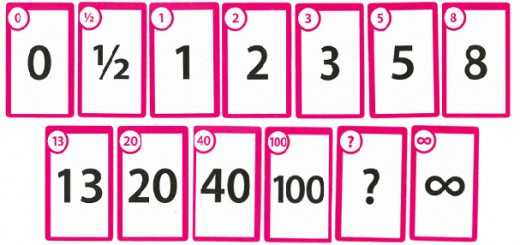
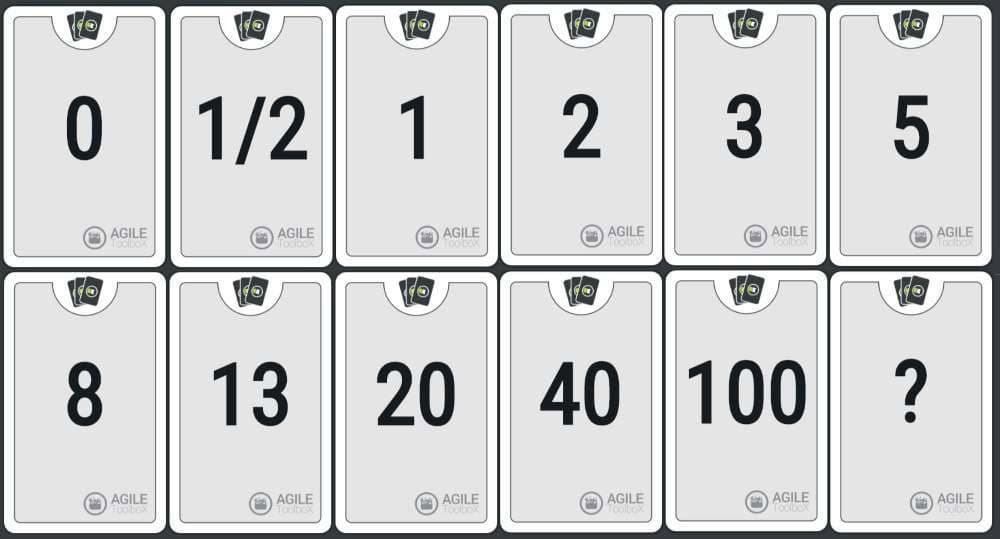
In Planning Poker, each estimator uses a personal deck of cards whose values follow a predefined scale—commonly the Fibonacci sequence, T‑shirt sizes, powers of two, or a modified Fibonacci set. The Fibonacci progression is widely recommended because it maps naturally to story points and helps teams express relative effort and uncertainty across small and large items.
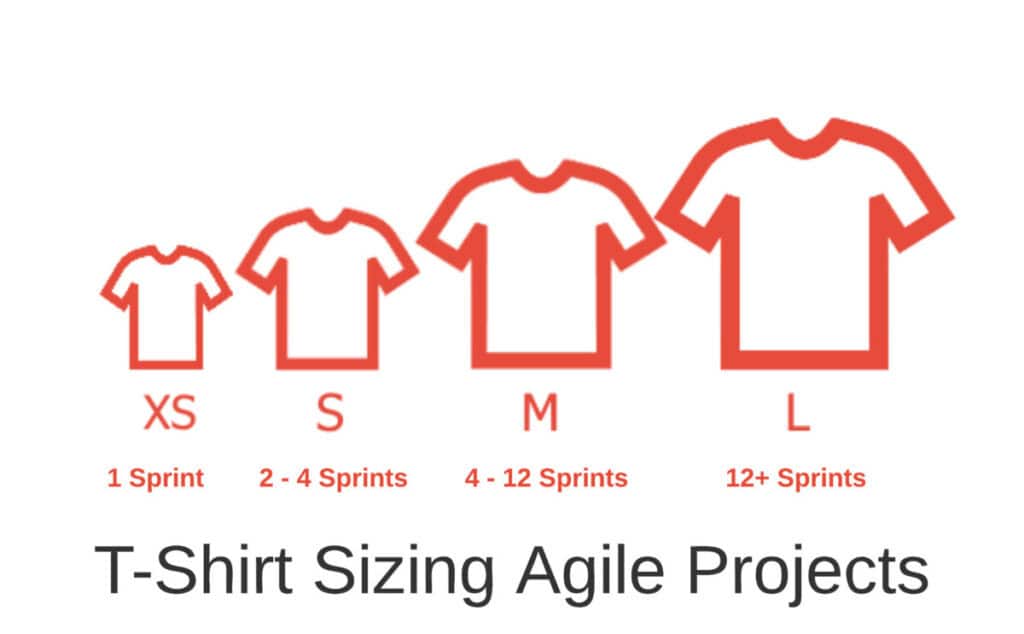
If estimates differ, the team discusses the reasons and then runs another round of estimation. If, after the second round, the group still cannot reach consensus, the highest estimate is recorded for the story until further clarification can be obtained.
Why Use the Fibonacci Sequence in Planning Poker?
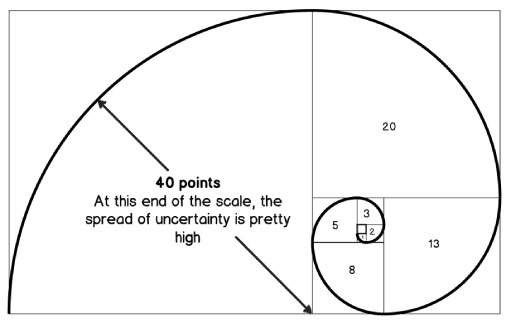
The Fibonacci Sequence is formed by adding the two previous numbers to get the next value: 0, 1, 1, 2, 3, 5, 8, 13, 21, and so on. Teams commonly use this series in Planning Poker because it helps express relative effort and uncertainty. Key reasons to use the Fibonacci sequence include:
- Non-Linear Values Reduce Over-Analysis: Because the steps between numbers grow as the values increase, the sequence discourages breaking large tasks into overly precise comparisons. The non-linear progression prevents treating tasks as nearly equal and reduces time spent on minor distinctions, keeping estimates pragmatic.
- Exponential Scaling: The sequence grows approximately exponentially, which provides fine-grained distinctions for small tasks while deliberately increasing uncertainty for larger, more complex tasks. This encourages teams to gather necessary details for small items and accept broader estimates for big items, improving estimation efficiency.
- Forces Decision-Making: The discrete, non-continuous values reduce the temptation to pick between numbers. That forces teammates to choose a clear estimate, which highlights real differences in perceived effort and accelerates convergence to a consensus.
Benefits of Planning Poker
Planning Poker consistently produces more accurate estimates than many other techniques because it combines diverse expertise, structured discussion, and a bias-reducing process. Below are the main benefits teams gain from using Planning Poker.
- Improved Estimate Accuracy: Planning Poker brings together subject-matter experts from different disciplines (developers, QA, designers, product owners) so estimates reflect real technical and functional insight rather than a single viewpoint.
- Better Shared Understanding: The discussion around each card forces the team to clarify requirements, assumptions, and acceptance criteria, reducing ambiguity and preventing rework later.
- Uncovers Hidden Risks and Gaps: When estimators justify their choices, unknowns and missing information often surface—prompting follow-up research or scope adjustments before work begins.
- Reduced Anchoring and Groupthink: Private selection and simultaneous reveal of cards minimize influence from dominant voices, so individual judgments are preserved and the final estimate represents genuine consensus.
- Faster Convergence on Consensus: The structured rounds (estimate, discuss, re-estimate) focus the team on the most important disagreements and accelerate agreement on a single story-point value.
- Improved Team Engagement and Accountability: Inviting everyone to participate and explain their rationale increases ownership of estimates and fosters better collaboration across functional roles.
- Supports Prioritization and Planning Decisions: Reliable relative estimates make sprint planning, release forecasting, and backlog prioritization more predictable and data-driven.
- Encourages Continuous Learning: Repeated use of Planning Poker lets teams calibrate their estimates over time, improving velocity predictability and estimation skills.
These benefits help teams deliver higher-quality plans, reduce surprises during development, and improve collaboration across the product lifecycle.
Our Favorite Top Custom Planning Poker Cards
Keep it Simple

Pretty in Pink Custom Scrum Cards
Easy to Print Planning Poker Cards
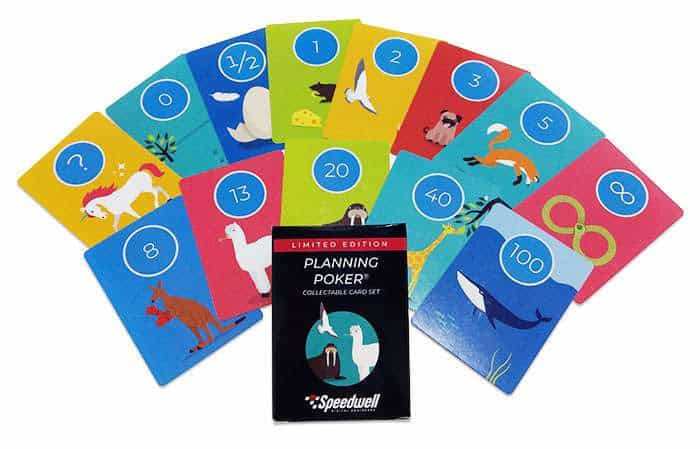
Unicorn vs a Whale Planning Poker Cards
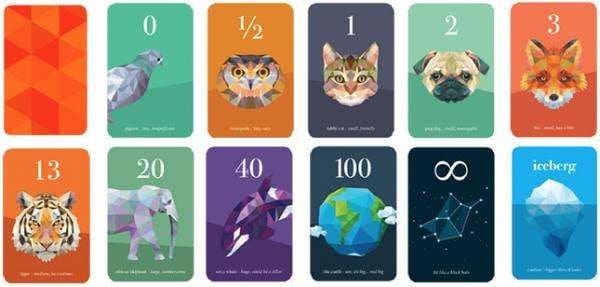
Everything is Relative Agile Estimating Cards
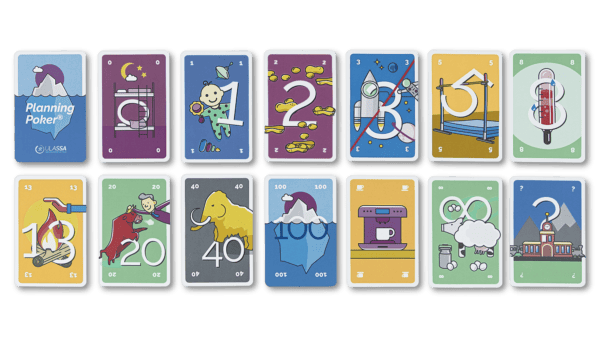
Stay Calm Planning Poker Cards
T-Shirt Sizing Custom Planning Poker Cards

Planning Poker Apps
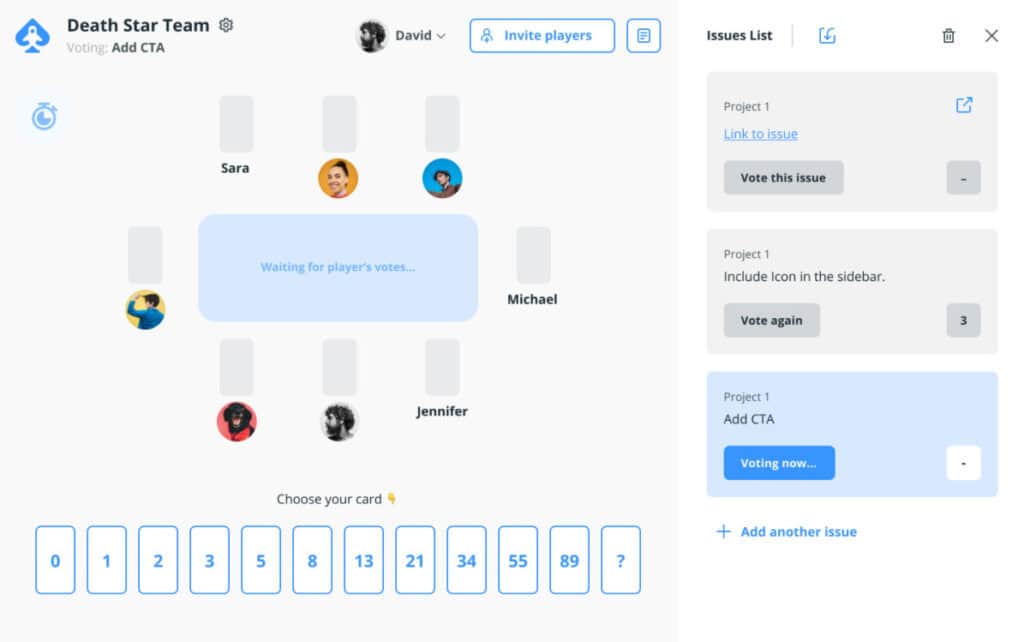
Choosing the best way to run a Planning Poker session matters. There are several approaches your development team can use to participate effectively. Mountain Goat Software offers physical Planning Poker cards and licenses for creating custom sets tailored to your team. In addition, several apps provide a streamlined, remote-friendly experience with animated card reveals and integrated scoring to record story-point estimates. Below is a curated list of five reputable external Planning Poker tools:
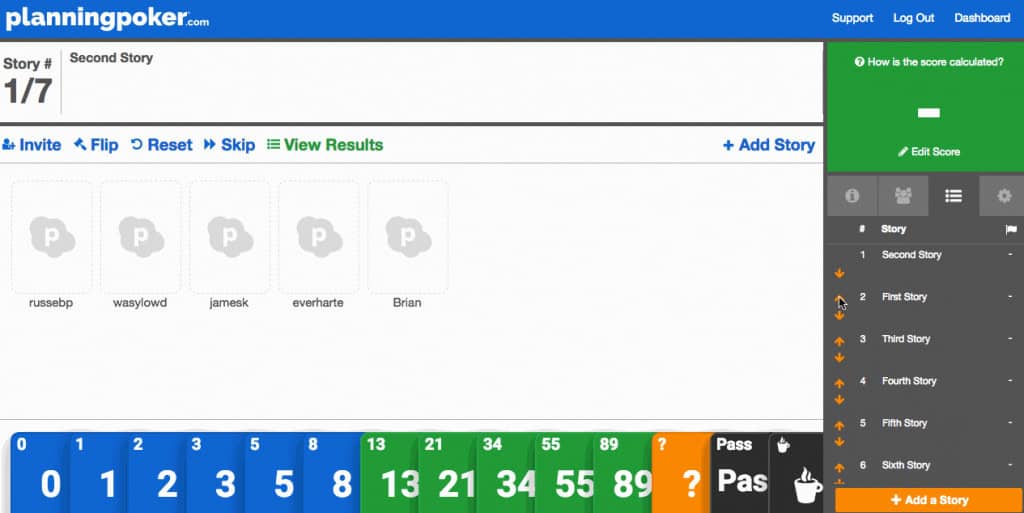
- Planning Poker: This is a secure way for your agile team to have a guide for sprint planning and create an accurate consensus. Paid plans allow for Agile Scrum Planning Poker for Jira.
- Scrum Poker: Provides a means for the scrum master to create a planning poker session and invite their team members to join the session. It is a free tool that doesn’t require a login to use. Scrum Poker also has an option to input a Jira plugin.
- Planning Poker Online: While it doesn’t offer the capability for Jira integration, this online platform allows you to invite your team and start a session through the platform.
- Scrum Poker Cards: This is an app that your team can download on their phones and join a planning session.

- Plan It Poker: This is a free, web-based platform that enables distributed teams to join estimation sessions from any location. It supports multiple estimation scales — including Fibonacci, Scrum (powers of two), and T‑shirt sizing — and is suitable for both synchronous and asynchronous workflows.

Conclusion
Planning Poker transforms estimation from a guessing game into a collaborative decision-making process. By combining independent judgment with focused discussion, teams reduce bias, reveal hidden risks, and arrive at more reliable story-point estimates. Custom, themed cards keep sessions engaging and encourage participation across roles, improving shared understanding and commitment to delivery outcomes.
Practical use of Planning Poker—whether with physical decks or digital apps—speeds consensus, supports prioritization, and helps teams calibrate velocity over time. Adopt a consistent scale, pause when details are missing, and iterate on your approach. Over time, this structured, gamified practice leads to smarter planning, fewer surprises in development, and stronger team alignment around product goals.
FAQs
What is Planning Poker?
Planning Poker is a consensus-based estimation technique used by agile teams. Participants privately pick cards representing effort values, reveal them simultaneously, discuss differences, and re-estimate until consensus. This reduces anchoring, uncovers assumptions, and yields more accurate relative estimates for user stories.
Why use custom Planning Poker cards?
Custom cards make sessions more engaging and memorable, boosting participation and focus. Themes or tailored scales can reflect team culture, clarify estimation units (Fibonacci, T‑shirt sizes), and help teams stay motivated—especially during long planning meetings or distributed sessions.
When should we pause estimation?
Pause when requirements are unclear, acceptance criteria are missing, or reviewers identify unknown technical risks. Stopping to gather more information prevents inaccurate estimates and rework. Return to estimation once the team has adequate details to make informed, reliable judgments.
Which scale should we use?
Common scales include Fibonacci, modified Fibonacci, powers of two, and T‑shirt sizes. Fibonacci is favored because its non-linear growth reflects increasing uncertainty for larger items. Choose a scale your team understands and use it consistently to improve calibration over time.
Are digital apps better than physical cards?
Digital apps excel for distributed teams, offering anonymity, record-keeping, and integrations (e.g., Jira). Physical cards work well for co-located teams and foster face-to-face interaction. Pick the format that matches your team’s setup and collaboration needs.
How often should teams calibrate estimates?
Calibrate regularly—every few sprints or after major process changes. Review velocity, compare estimates to actuals, and discuss discrepancies. Frequent calibration helps teams refine judgment, align on complexity expectations, and improve planning accuracy over time.
Suggested articles:
- 12 Agile Collaboration Games for Team Building
- 3 T-Shirt Sizing Agile Methods for Better Team Estimates
- Ultimate List of 100+ Agile Tools and Techniques

Shane Drumm, holding certifications in PMP®, PMI-ACP®, CSM, and LPM, is the author behind numerous articles featured here. Hailing from County Cork, Ireland, his expertise lies in implementing Agile methodologies with geographically dispersed teams for software development projects. In his leisure, he dedicates time to web development and Ironman triathlon training. Find out more about Shane on shanedrumm.com and please reach out and connect with Shane on LinkedIn.