

In project management, there is often confusion between test plans and test strategies, though a clear distinction exists between the two. The debate typically centers on scope and level of detail. A test plan is a comprehensive document that outlines the scope, approach, resources, and schedule of a testing effort. It also defines the test team’s roles and responsibilities, providing specific operational details. A test strategy, conversely, is a high-level document that describes the overall testing approach for a project.
While a test plan focuses on the tactical details of the testing effort, a test strategy addresses the strategic direction and overarching methodology. Consequently, test plans are typically more detailed and granular than test strategies. To better understand these differences, let’s explore the various types of test plans and strategies used in project management and why they matter.
Types of Test Plan
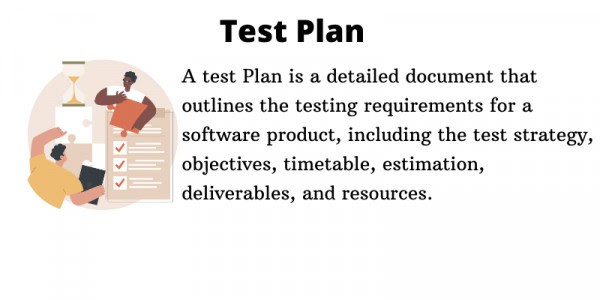
A test plan template is a comprehensive document that serves as the foundation for all testing activities throughout a project’s lifecycle. It outlines the following critical components:
- Scope: Defines the boundaries of what will and will not be tested, including specific features, functionalities, and system components that fall within the testing effort.
- Objectives: Establish clear, measurable goals for the testing process, such as identifying defects, validating requirements, ensuring system reliability, and verifying that the application meets quality standards.
- Approach: Details the methodology and techniques that will be employed for testing a software application, including the types of testing to be performed (functional, integration, system, acceptance, etc.) and the sequence in which they will be executed.
The test plan is used to define the overall testing strategy for a project and provides a detailed roadmap for carrying out testing activities. It serves as a communication tool among stakeholders, ensures alignment between the testing team and project objectives, and acts as a reference point throughout the testing lifecycle. Additionally, it helps identify required resources, establish timelines, allocate responsibilities, and set clear criteria for test completion and success.
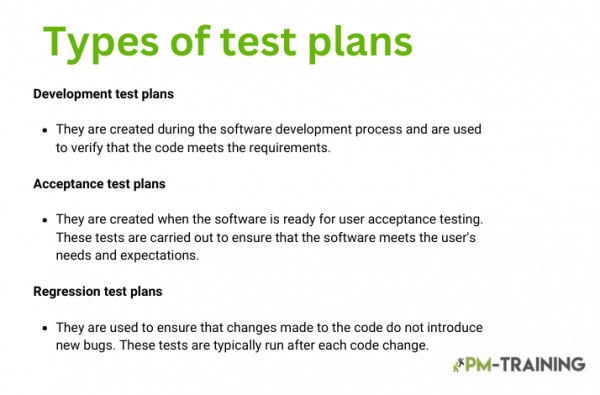
In IT, for example, we can find that there are typically three types of test plans, each serving a distinct purpose in the software development lifecycle:
- Development Test Plan: This plan focuses on the early stages of software creation and is primarily executed by developers and QA engineers during the coding phase. It encompasses unit testing, integration testing, and component testing to verify that individual modules and their interactions function correctly. The development test plan helps identify and resolve defects early in the development cycle, reducing costs and time associated with fixing issues discovered later.
- Acceptance Test Plan: Also known as User Acceptance Testing (UAT), this plan validates whether the software meets business requirements and is ready for deployment to end-users. It involves stakeholders, business analysts, and actual users who test the application in real-world scenarios to ensure it satisfies their needs and expectations. The acceptance test plan bridges the gap between technical implementation and business objectives, confirming that the delivered solution aligns with the original project vision.
- Regression Test Plan: This plan ensures that new code changes, bug fixes, or enhancements have not adversely affected existing functionality. Regression testing is performed after modifications to verify that previously working features continue to operate correctly. It often involves automated test scripts that can be repeatedly executed throughout the project lifecycle, providing confidence that the system maintains its integrity as it evolves.
On the other hand, in a more traditional Project Management approach, we can typically find four test plans in project management, each addressing different aspects of project validation and system readiness:
- Feasibility Study Test Plan: This plan evaluates whether the proposed project is technically, economically, and operationally viable before major resources are invested. It assesses if the system can be built with available technology, will work within the organization’s environment, is cost-effective, and can be completed within the required timeframes. This helps stakeholders make informed go/no-go decisions early in the project lifecycle.
- Functional Test Plan: This plan verifies that all functional requirements and specifications are correctly implemented. It focuses on testing business processes, user workflows, data handling, and feature completeness to ensure the system performs its intended functions accurately. Test cases are mapped to specific requirements to provide full traceability.
- Operational Test Plan: This plan examines how the system will function in its actual operating environment, testing deployment procedures, backup and recovery processes, system maintenance, and user training effectiveness. It ensures the system can be successfully operated and maintained by organizational staff after implementation, including disaster recovery and failover scenarios.
- Performance Test Plan: This plan evaluates the system’s behavior under various conditions, measuring response times, throughput, resource utilization, and scalability. It includes stress testing, load testing, and endurance testing to establish baseline metrics and identify potential bottlenecks that could impact user experience or system reliability in production.

What Does a Test Strategy Consist Of?
A test strategy is a comprehensive framework that defines the testing objectives, methodologies, and approaches for a software application. It is typically developed during the initial project phases, when requirements are being defined and refined. The test strategy serves as a foundation for the test plan, which is a more granular document detailing the specific testing activities, procedures, and test cases.
An effective test strategy should be customized to align with the project’s unique characteristics, including its scope, complexity, timeline, and associated risk factors. This tailored approach ensures that testing efforts are appropriately scaled and focused on the most critical areas, maximizing resource efficiency while minimizing potential project risks.
Developing a clear, comprehensive test strategy is essential for the success of any software project. Without one, teams risk overlooking critical risks and defects that can cause costly delays and rework. A well-crafted test strategy ensures that testing efforts are focused, consistent, and aligned with project objectives. Typically authored by the project manager or test lead, it defines testing goals, scope, responsibilities, and the approaches to be used.
The test strategy should be a living document: reviewed and updated periodically as the project evolves, and shared with all relevant stakeholders to ensure transparency and coordinated execution.
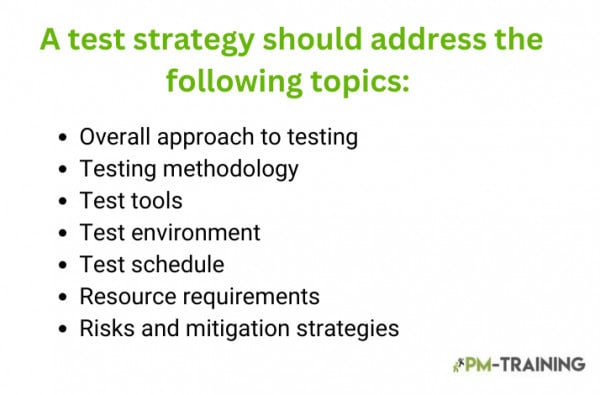
Some of the key decisions that need to be made in a test strategy include:
- What types of testing will be conducted? This defines the scope of quality assurance. Beyond functional testing, the strategy should specify whether performance, load, stress, security, usability, accessibility, regression, and compatibility testing are required. Each type serves a different risk area, so the decision should be driven by business impact, user expectations, and regulatory or security requirements—not guesswork.
- Who will be responsible for conducting each type of test? Clear ownership prevents gaps and finger-pointing. The strategy should state whether testing is handled by dedicated QA engineers, developers, third-party specialists, or a hybrid approach. It should also define review and approval responsibilities to ensure accountability and consistency.
- What tools and resources will be needed for testing? This includes test management tools, automation frameworks, performance and security scanners, test data, environments, and hardware. The strategy should justify tool choices, outline licensing needs, and confirm that the team has the skills to use them effectively.
- How will the testing be structured? Testing should follow a defined structure—phases, iterations, or milestones aligned with the development lifecycle. This may include unit testing, integration testing, system testing, and user acceptance testing, with clear entry and exit criteria for each stage.
- When will testing be performed? Timing is critical. The strategy should specify whether testing is continuous during development, concentrated at key milestones, or extended post-release through monitoring and regression cycles. Earlier testing reduces cost and risk; late testing increases both.
Types of Test Strategies
Various types of test strategies can be used to assess the quality, reliability, and readiness of a software system. Each strategy targets a specific risk area and helps ensure the product behaves as expected under real-world conditions. The choice of strategy depends on the system’s purpose, user expectations, and potential failure impact.
Some of the most common types of test strategies include:
- Functional Testing: Functional testing verifies that the system works according to defined requirements and business rules. It focuses on features, workflows, inputs, and outputs to ensure every function performs as intended. This type of testing answers a simple question: Does the software do what it is supposed to do?
- Load Testing: Load testing evaluates how the system behaves under expected user loads. It measures response times, throughput, and stability when multiple users access the system simultaneously. This helps identify bottlenecks and capacity limits before real users experience slowdowns or failures.
- Performance Testing: Performance testing examines the system’s speed, responsiveness, and resource usage under various conditions, including peak and extended usage. Unlike load testing, it looks beyond user volume to assess overall efficiency, scalability, and long-term stability.
- Security Testing: Security testing identifies vulnerabilities that could be exploited by attackers. It focuses on data protection, authentication, authorization, and resistance to threats such as injection attacks, data breaches, and unauthorized access. This strategy is critical for protecting sensitive information and maintaining user trust.
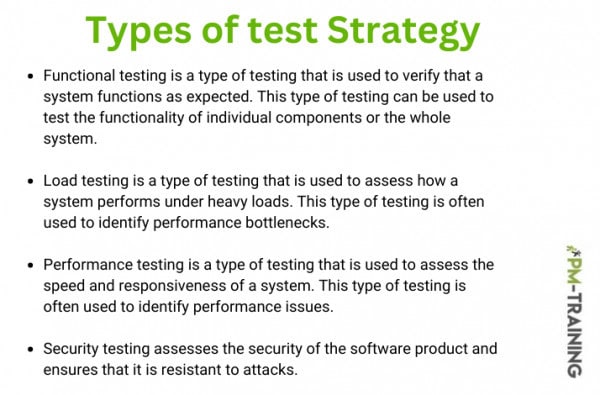
No single test strategy is likely to find all defects in a software product. Which test strategy is used depends on the individual software product and the resources available.
Examples of Test Plans and Test Strategies
There are many different ways to approach software testing, and the strategy selected should align with the specific goals, risks, and constraints of the project. Factors such as system complexity, user impact, timelines, and regulatory requirements all influence how testing should be planned and executed. A test strategy defines the overall testing approach, while a test plan documents how that strategy will be applied in a particular project.
Together, they provide structure, clarity, and consistency, helping teams manage risk and ensure quality throughout the development lifecycle. Training resources such as PM Training often provide practical examples of test plans and test strategies that teams can adapt for their own projects instead of building everything from the ground up.
Some common examples of test plan strategies include:
- Black-Box Testing: The system under test is treated as a “black box,” meaning testers do not know its internal workings. Testing is based on inputs and expected outputs, with emphasis on validating functionality, user workflows, and external behavior.
- White-Box Testing: Testers have full visibility into the system’s internal logic, code, and structure. This enables targeted testing of specific execution paths, conditions, and potential vulnerabilities, resulting in more thorough coverage.
Test Plan vs Test Strategy
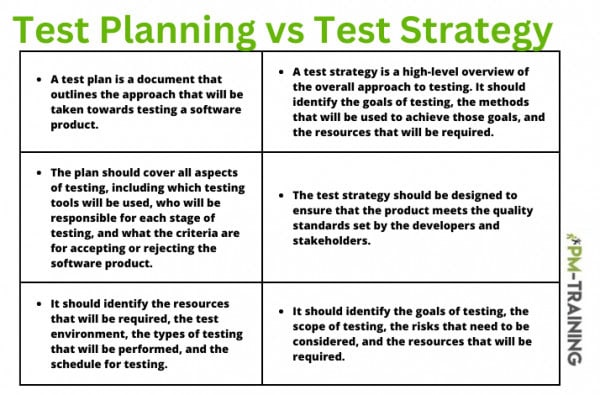
Although the terms test plan and test strategy are often used interchangeably, they serve very different purposes in software testing. Understanding the distinction is critical for setting clear expectations, assigning responsibility, and maintaining consistency across projects. One operates at the project level, while the other defines the broader direction for how testing is approached within an organization.
| Aspect | Test Plan | Test Strategy |
|---|---|---|
| Purpose | Describes how testing will be carried out for a specific project | Defines the overall testing approach for the organization |
| Scope | Project-specific | Organization-wide or program-level |
| Ownership | Created by the project manager or lead tester | Created by the head of the software development or QA organization |
| Level of Detail | Detailed and tactical | High-level and strategic |
| Focus | What to test, how to test, who tests, and when | Testing standards, principles, and long-term direction |
| Change Frequency | May change as the project evolves | Changes infrequently and remains stable over time |
Video About Test Strategy vs Test Plan
Below is a short video that clearly explains the differences between a test strategy and a test plan, when to use each, and how they work together during a project. Watch to see practical examples and tips for applying these concepts in real-world testing scenarios.
Conclusion
In summary, a test strategy defines the high-level approach and objectives for ensuring quality across an organization or program, while a test plan translates that strategy into project-specific, actionable steps—what to test, who does it, when, and how. Both documents are essential: the strategy ensures consistency, risk focus, and tool choices, while the plan provides the tactical roadmap, timelines, and acceptance criteria needed for execution.
Together, they reduce risk, improve communication, and increase testing efficiency. Keep the strategy stable and reusable, and tailor test plans to each project’s scope and constraints. Regular reviews and updates ensure both remain aligned with changing requirements, technology, and stakeholder expectations.
FAQs
What is a test plan?
A test plan is a document that outlines the testing strategy for a software product. It includes a list of the features to be tested, the testing approach to be used, the resources required, and the schedule for testing.
What is a test strategy?
A test strategy is a high-level plan that defines how testing will be conducted for a project. It consists of a series of decisions that need to be made in order to ensure that testing is carried out effectively and efficiently.
Why are test strategy and test planning important?
Test strategy and test planning are important for a number of reasons. They help ensure that your testing is efficient and effective and that you are testing the right things. A good test strategy will also help you to avoid overlooking any important aspects of your product.
What are the main differences between a test plan and a test strategy?
A test plan is a document that outlines the scope, approach, resources, and schedule of a software testing effort. A test strategy, on the other hand, is a high-level document that provides an overall direction for testing. It should answer the question of why you are testing, what you are testing, and how you are testing.
Suggested articles:
- Mastering Modern Software Delivery: The Essential Guide to CI/CD Pipelines
- Mastering the Testing Pyramid and Software Testing Phases
- Discovery Workshops for Software Projects: From Idea to Validated Roadmap in 5–10 Days

Shane Drumm, holding certifications in PMP®, PMI-ACP®, CSM, and LPM, is the author behind numerous articles featured here. Hailing from County Cork, Ireland, his expertise lies in implementing Agile methodologies with geographically dispersed teams for software development projects. In his leisure, he dedicates time to web development and Ironman triathlon training. Find out more about Shane on shanedrumm.com and please reach out and connect with Shane on LinkedIn.