
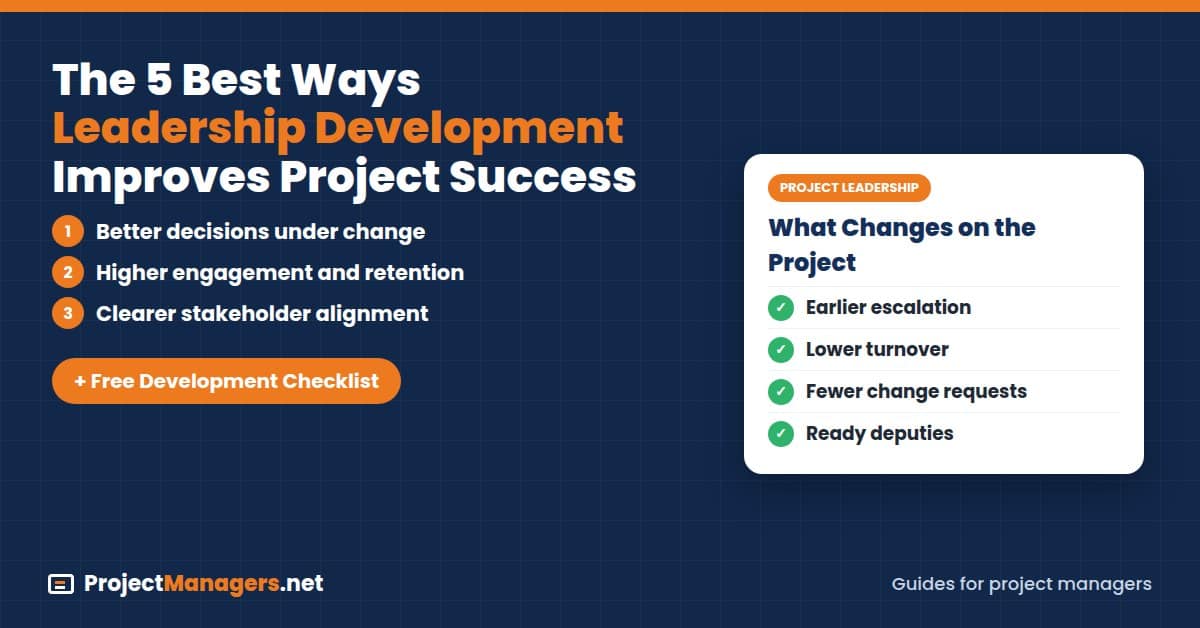
A software rollout slips three weeks, and the post-mortem blames the vendor, the scope, and the test window. The meeting notes reveal a different story, however: no one challenged an optimistic estimate, two team leads had stopped communicating, and the sponsor learned of the delay last. These are leadership gaps, not planning gaps. Better templates rarely close them, but deliberate leadership development usually does.
- Leadership Is a Delivery Skill: How a project lead decides, communicates, and handles tension determines whether a sound plan survives changing requirements, tight budgets, and difficult stakeholders.
- Engagement Follows the Manager: Gallup estimates managers drive at least 70% of the variance in team engagement, so developing project leads lifts output and keeps experienced people on the team.
- Practice on Live Work: Training that never changes how meetings, reviews, and escalations run fades within weeks, so tie every new skill to a real project event.
- Grow the Next Leaders on Purpose: Deputies, stretch assignments, and mentoring build a bench, so one resignation or promotion never stalls a workstream.
John Maxwell has spent decades repeating one line to leaders: everything rises and falls on leadership. On a project, that rise or fall shows up in the schedule, the budget, and the mood of the team long before the final report. This guide explains five concrete ways leadership development improves project success, then adds a practical plan, the mistakes to avoid, and a checklist.
1. Better Decisions When the Plan Changes
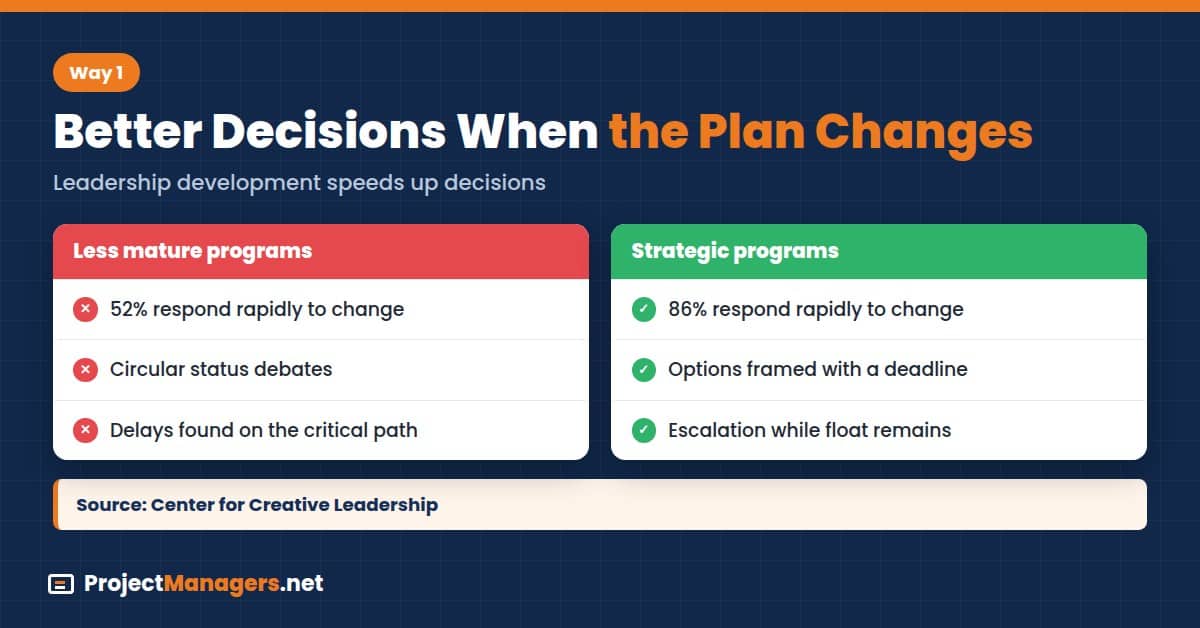
Projects rarely fail on the day the plan is written. They fail weeks later, when an assumption breaks, and someone has to decide fast with incomplete facts. Leadership development trains project leads to frame options and commit on time. The Center for Creative Leadership reports that 86% of companies with strategic leadership development programs respond rapidly to sudden change, compared with 52% of less mature ones. Development builds that speed through:
- Decision Framing: Leads learn to state the decision, the options, the deadline, and the decision owner before debate starts, which ends circular status meetings.
- Risk Judgment: Coaching on past calls helps leads separate reversible choices that can move fast from irreversible ones that need sponsor approval.
- Escalation Timing: Developed leaders raise a slipping milestone while float remains to recover it, not after the critical path has absorbed the delay.
- Calm under Pressure: Rehearsing hard scenarios in workshops makes a real crisis feel familiar, and the team takes its cue from a steady project manager.
Real-Life Example: A hardware integration team lost its main component supplier six weeks before launch. The project manager, fresh from a decision-making workshop, set a 48-hour deadline, laid out three sourcing options with cost and schedule impact, and named the sponsor as the decision owner. The team switched suppliers within two days and launched one week late instead of the month the risk register predicted.
2. Higher Team Engagement and Retention

People disengage under weak managers long before they resign. Gallup estimates that managers account for at least 70% of the variance in engagement across business units. Its State of the Global Workplace 2026 report found engagement fell to 20% in 2025, while manager engagement slid from 27% to 22%. On a project, that slide means slower work and costly turnover in the middle of delivery. Development reverses it through:
- Regular One-on-Ones: Leads learn to hold short, structured check-ins that surface workload and morale problems before they become resignation letters.
- Specific Recognition: Trained managers tie praise to concrete project contributions, such as a defect caught before release or a risk raised early.
- Growth Conversations: Developed leads map each person’s next stretch assignment, which gives strong performers a reason to stay through the next phase.
- Workload Visibility: Leadership training covers capacity planning, so leads spot burnout signals in the resource plan rather than in an exit interview.
Real-Life Example: A data platform program lost four engineers in one quarter, and each departure cost weeks of knowledge transfer. The program director enrolled every team lead in a coaching track focused on one-on-ones and career conversations. Over the next two quarters, voluntary turnover on the program fell to one person, and leads began spotting overload early enough to rebalance sprint commitments.
3. Clearer Stakeholder Communication and Alignment

Technical plans fail quietly when sponsors, users, and team members hold different pictures of success. PMI’s Pulse of the Profession research on power skills names communication, leadership, and strategic thinking as capabilities that increasingly separate successful project professionals. Development turns those labels into habits, so the project manager explains scope, risk, and trade-offs to each audience before a misunderstanding becomes a change request. The core habits are:
- Audience-First Updates: Executives get decisions and risks, the team gets priorities, and end users hear what changes in their working day.
- Bad News Early: Developed leaders share a schedule threat together with a recovery option, which keeps sponsor trust intact through a difficult phase.
- Active Listening: Structured listening practice helps leads hear the real concern behind a stakeholder’s objection instead of defending the plan.
- Influence without Authority: Matrix projects depend on people the project manager does not manage, so training covers negotiating priorities with functional managers.
Real-Life Example: A clinical scheduling-system project kept stalling at sign-off, because nurses saw the new screens as extra clicks during busy shifts. After a stakeholder communication course, the project manager replaced slide decks with ten-minute walk-throughs on the ward, framed around time saved per shift. Sign-off arrived within two weeks, and the backlog of change requests shrank to a handful.
4. Faster Conflict Resolution and Safer Teams
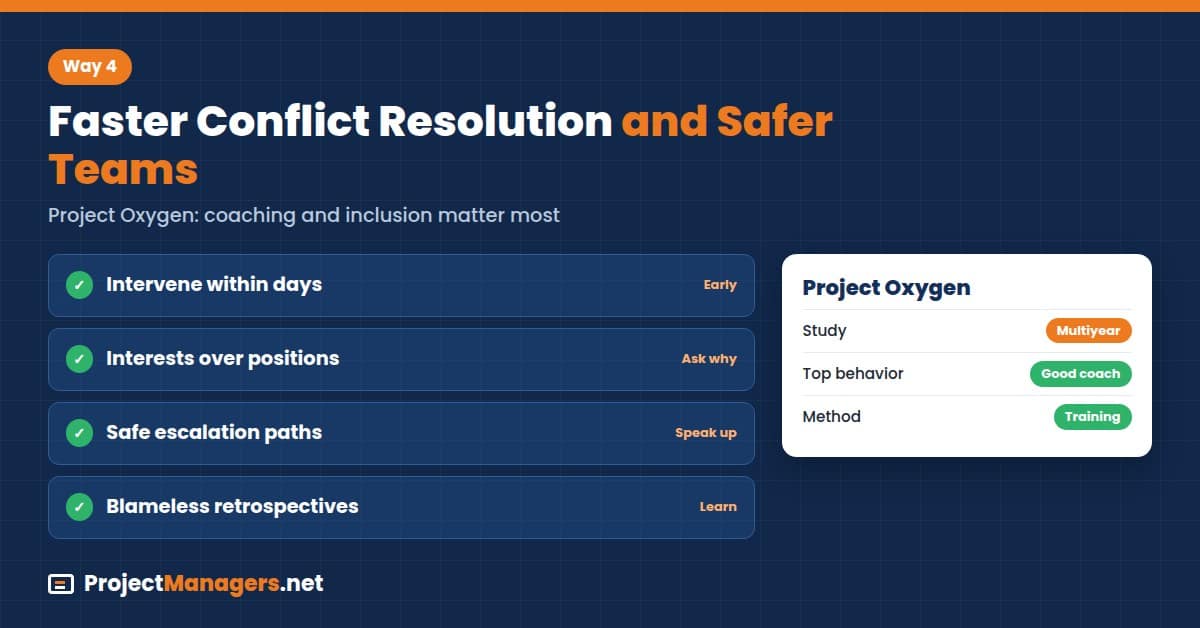
Disagreement helps a project until it turns personal or goes underground. Harvard Business Review’s account of Google’s Project Oxygen describes a multiyear study that pinpointed specific, measurable manager behaviors, such as coaching, and then built them through training. Leadership development teaches project leads to handle tension early and make raising problems feel safe. Key practices include:
- Early Intervention: Developed leads address friction between two contributors within days, in private, before it splits the wider team into camps.
- Interests over Positions: Leads learn to ask what each side needs from a decision, which often reveals an option neither had proposed.
- Safe Escalation Paths: Team members know exactly how to flag a quality or ethics concern without being labeled difficult or slowing their careers.
- Blameless Retrospectives: Trained facilitators focus reviews on process gaps, so people admit mistakes while there is still time to fix them.
Real-Life Example: Two senior developers on a payments project disagreed about the API design and stopped reviewing each other’s code. The project manager, coached in conflict conversations, met each one separately, then held a joint session built around the two shared requirements: speed and auditability. They agreed on a hybrid design within a week, and code reviews resumed before the release candidate was cut.
5. A Bench of Future Project Leaders
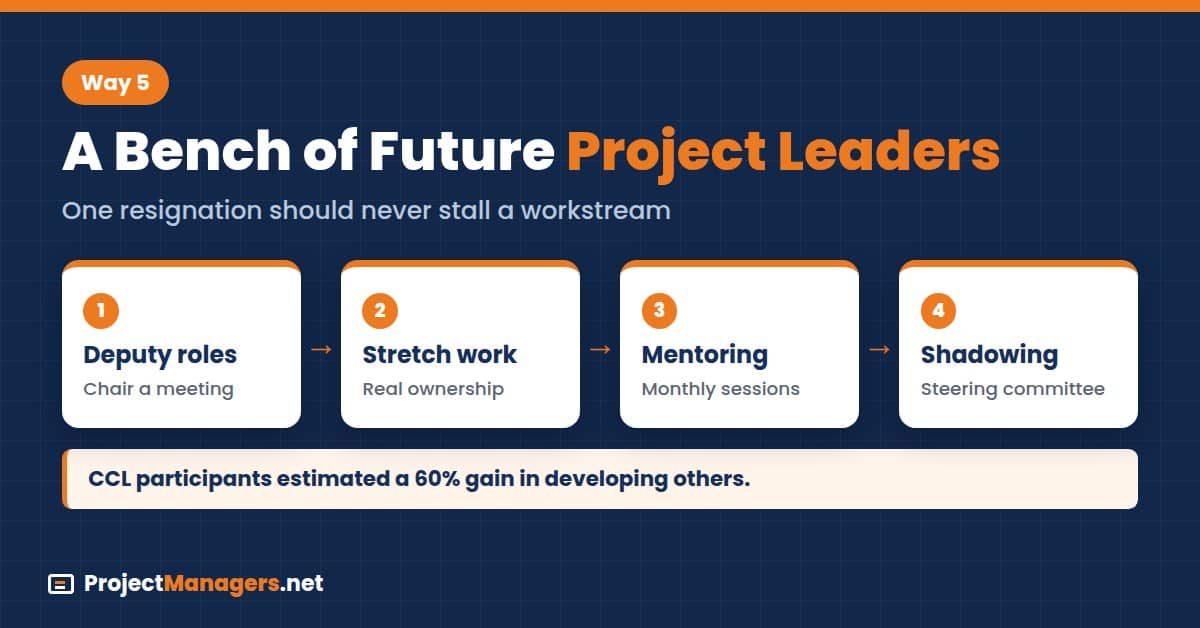
A project that depends on one strong leader is one resignation away from trouble. Leadership development spreads that capability, so deputies can run a workstream, chair a review, or take over a phase. In the same CCL research, more than 13,000 program participants estimated a 60% improvement in developing others two months after their program. A deliberate bench usually rests on four practices:
- Deputy Roles: Name a deputy for every workstream and let them chair one status meeting a month with the project manager in the room.
- Stretch Assignments: Give emerging leads a contained piece of real responsibility, such as a vendor evaluation or a pilot rollout, with a clear finish line.
- Mentoring Pairs: Match each emerging lead with an experienced project manager, and use proven career moves into a leadership role as the agenda for their sessions.
- Steering Committee Shadowing: Bring deputies into sponsor meetings as observers, so they learn how executives weigh cost, risk, and timing.
Real-Life Example: A construction firm’s project director planned to retire next year, and three active jobs depended on that one person. The director named a deputy on each job, rotated them through budget reviews and client meetings, and paired each with a mentor. At the handover, all three deputies stepped up without a single schedule reset, and two of them now run their own projects.
How to Build a Leadership Development Plan for Your Project Team
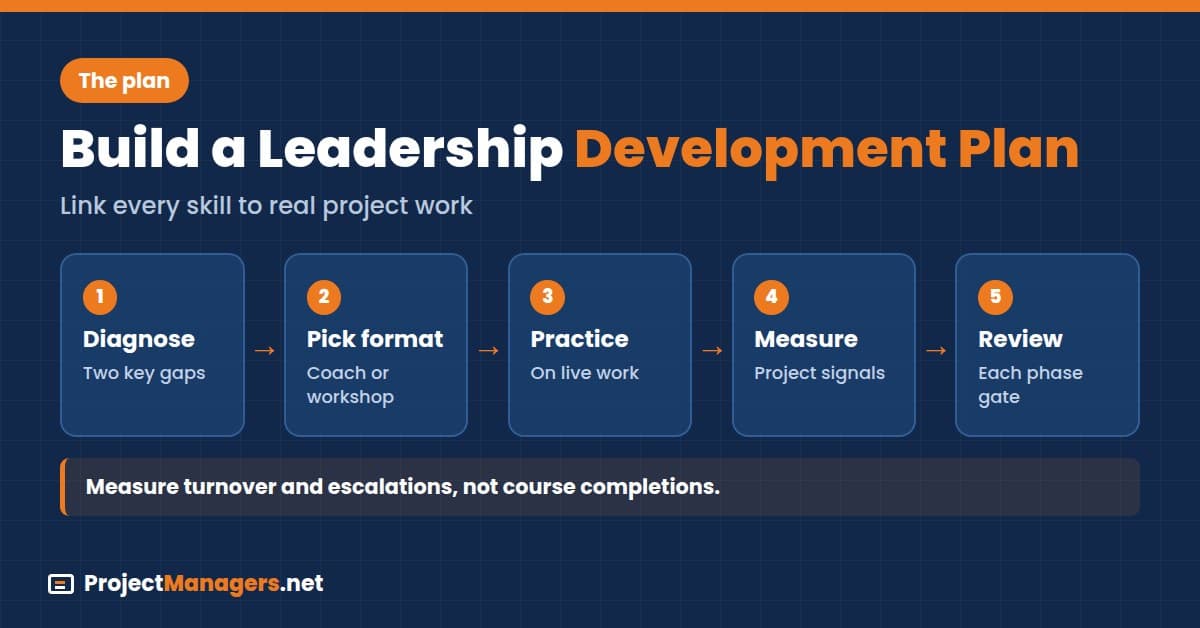
Most programs fail for a simple reason: people return from training to a project system that still rewards the old behavior. Harvard Business Review research on why leadership training fails notes that companies spent some $356 billion on training worldwide in 2015 without a good return. A project-level plan avoids that trap by linking every skill to real work and real project measures. Follow these five steps:
- Diagnose the Gap: Use retrospectives, engagement pulse results, and stakeholder feedback to pick the two leadership behaviors costing the project the most.
- Pick the Format: Match each gap to coaching, a short workshop, mentoring, a stretch assignment, or a certified external leadership program.
- Practice on Live Work: Attach each skill to a real event in the next month, such as a steering meeting, a scope decision, or a difficult conversation.
- Measure Project Signals: Track turnover, escalation timing, change requests, and stakeholder satisfaction instead of course completions.
- Review at Each Phase Gate: Check progress with the sponsor at every gate and reset the next development goals for the following phase.
Leadership Development Formats Compared
| Format | Best For | Typical Time | Project Fit |
|---|---|---|---|
| One-on-One Coaching | Specific behaviors such as delegation or executive presence | 1 hour every 2 weeks | Fits mid-project without pulling anyone off delivery |
| Short Workshops | Shared skills such as decision framing or conflict conversations | Half a day to 2 days | Schedule between phases or sprints |
| Mentoring | Career growth and judgment for emerging leads | 1 hour a month | Pairs well with deputy roles |
| Stretch Assignments | Building confidence with real responsibility | Weeks to a full phase | Use contained scopes with a clear finish line |
| Formal Programs | Broad leadership foundations and certification | Several weeks to months | Plan around major milestones |
Real-Life Example: A digital agency ran a two-day leadership course for its project leads, then saw no change in client escalations. The next year it reversed the order: each lead first picked one recurring meeting to improve, then joined monthly coaching tied to that meeting. Within two quarters, client escalations dropped by a third, and sponsors began asking for the same leads by name.
Common Leadership Development Mistakes on Projects

Even well-funded leadership efforts stall when they sit apart from the work. The pattern is familiar to anyone who has watched a team return from an offsite energized, then slip back into old habits by the next status meeting. These five mistakes cause most of that drift, and each one is easier to prevent at the planning stage than to correct midway through a project:
- Treating Development as an Event: A single workshop without follow-up practice rarely changes how a project lead runs the next difficult meeting.
- Leaving Out Workstream Leads: Workstream leads and senior specialists shape daily team climate, so leaving them out wastes most of the investment.
- Measuring Attendance: Course completions say nothing about delivery, while turnover, escalation timing, and stakeholder feedback do.
- Leaving the Sponsor Out: Without sponsor support, new habits such as early bad news can feel risky, so people quietly abandon them.
- Copying a Generic Program: A curriculum built for sales managers misses project realities like matrix authority, phase gates, and vendor disputes.
Leadership Development Checklist for Project Managers

Use this checklist at project kickoff and again at each phase gate. It keeps leadership growth visible in the same reviews that track scope, schedule, and budget, rather than leaving it to an annual performance cycle. Tick an item only when there is evidence behind it, such as a scheduled session, a named deputy, or a measure already in the status report:
- The two leadership behaviors that most affect this project are named and agreed with the sponsor.
- Each project lead has one development format chosen, with dates in the calendar.
- Every new skill is attached to a real meeting, decision, or review within the next month.
- Every workstream has a named deputy who chairs at least one meeting a month.
- Turnover, escalation timing, change requests, and stakeholder satisfaction appear in the status report.
- Leadership progress is reviewed at every phase gate, and next goals are set.
Video: How to Build a Manager Development Program
This Big Think+ session from March 2026 walks through building a manager development program from scratch, from choosing the first skills to teach to keeping new managers practicing them on the job. It runs about 20 minutes. Watch it before you draft the plan above, then adapt its steps to the phases, deputies, and sponsors of your own project.
How to Build a Manager Development Program from Scratch (Big Think+, 20:07)
A practical walkthrough of designing manager development that sticks, with lessons that translate directly to project lead roles.
Leadership Development and Project Success FAQs
Leadership Development and Project Success FAQs
How Does Leadership Development Improve Project Success?
It improves the decisions, communication, and team climate that a plan depends on. Developed project leads frame choices faster, raise risks earlier, keep people engaged, and resolve conflict before it slows delivery.
Which Leadership Skills Matter Most for Project Managers?
Decision-making under uncertainty, stakeholder communication, conflict resolution, coaching, and influence without authority matter most, because project managers often lead people they do not manage directly.
How Long Does Leadership Development Take to Show Results on a Project?
Small behavior changes, such as better one-on-ones or earlier escalation, often show within one or two months when they are practiced on live work. Broader capability, such as a ready bench of deputies, usually takes a full project phase or longer.
Is Coaching or Training Better for Project Leaders?
Training builds shared language across a team, while coaching changes individual behavior. Most project teams get the best return by combining a short workshop with regular coaching tied to real meetings and decisions.
How Do You Measure the Return on Leadership Development?
Track project signals rather than course completions: voluntary turnover, escalation timing, change request volume, stakeholder satisfaction, and how often milestones are met. Compare them before and after the development work.
Should Team Members Who Are Not Managers Get Leadership Development?
Yes. Workstream leads, senior specialists, and deputies shape daily decisions and team climate, and developing them builds the bench that keeps projects moving when a leader leaves.
Can Small Project Teams Afford Leadership Development?
Yes. Mentoring, deputy roles, stretch assignments, and structured retrospectives cost little beyond time, and many external coaches offer short engagements sized for small teams.
Conclusion
Return to the rollout that slipped three weeks. A stronger plan would not have saved it, but a project manager trained to challenge estimates, repair a broken working relationship, and warn the sponsor early probably would have. That is the real case for leadership development on projects: it upgrades the people who carry the plan through every surprise it meets after kickoff.
Start small and stay close to the work. Pick the two leadership behaviors costing your current project the most, attach each one to a real meeting this month, and name a deputy for every workstream. Review the results at the next phase gate, and the gains will show up in your status report long before the annual review.
Suggested Articles:
- Why Stronger Managers Decide Project Outcomes
- How Project Managers Can Prepare for Executive Leadership Opportunities
- How New Project Leads Build Strong Core Skills Fast

Peter Kanai is a Google-certified freelance writer with over a decade of experience crafting high-quality content for business websites, blogs, and SEO & email marketing campaigns. His on-demand writing services are all about helping businesses expand their online presence and achieve their objectives. With a proven track record in delivering results-driven content, Peter is the go-to freelance writer for business owners seeking a strategic partner to help them grow their brand online.