
Every team wants one place where tasks, deadlines, and conversations line up, and monday.com has now become a popular answer to that need for growing businesses. Its colorful boards, automations, and AI tools promise to turn scattered work across several apps into one clear, shared picture. The real question is whether the platform fits your team, your budget, and the way your people already work.
Monday.com now calls itself an AI work platform where people and agents share one workspace, which adds new capability and new cost questions. If you feel Monday’s pricing is too high for your budget, consider looking at AceProject. Rather than charging per user, AceProject bases its pricing on a per-project model, which translates into meaningful cost savings for growing teams. Below, you will find the current pros, cons, features, use cases, and pricing, plus common mistakes to avoid, so you can judge the overall fit before committing.
Monday.com Work Management Software for Project Teams
Monday.com is a work management platform where teams plan, run, and track projects on customizable boards, and now sells it alongside CRM, dev, campaigns, and service products. Work management remains the core product, with dashboards, automations, integrations, forms, and Docs built around the board. That breadth explains both its popularity and its learning curve.
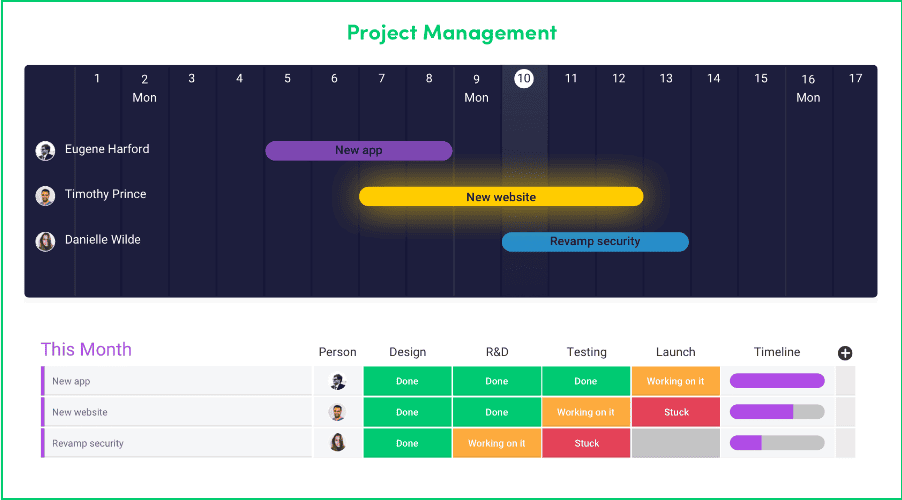
The work management product is built around these core building blocks:
- Boards and Views: Boards hold items in rows and attributes in columns, with more than 30 column types for status, dates, owners, and numbers. Multiple views present the same data as a table, Kanban, timeline, or Gantt chart.
- Automations and Integrations: No-code automations handle routine updates, while integrations connect tools such as Slack, Salesforce, Jira, and Google Calendar. Monthly action limits rise by plan, from 250 on Standard to 25,000 on Pro.
- Dashboards and Reporting: Dashboards combine data from several boards into charts and summaries for managers. Advanced reporting and extra connected boards arrive on higher plans, so check your tier before planning portfolio-level views.
- AI Tools, Docs, and Forms: AI assistant tools, Docs, and Forms sit alongside boards. Monthly AI credits are capped, from 1,000 on Basic to 3,000 on Pro, and some reviewers say the credits run out quickly.
Real-Life Example: A 15-person marketing agency manages client campaigns on a single monday.com board, with each row representing a deliverable such as a blog post, ad creative, or email campaign. Status columns track whether work is in draft, under review, or approved, while owner columns assign responsibility to specific team members. The team switches between the Kanban view for daily standups and the timeline view when presenting launch schedules to clients. When a status changes to “Approved,” an automation notifies the account manager and updates a shared dashboard that pulls data from all active client boards, giving leadership a real-time view of workload across the agency without anyone manually compiling a status report.
The Pros or Advantages of Monday.com
Although not suitable for every situation, many teams prefer Monday.com because it combines visual boards, flexible views, and automation in one workspace. Capterra reviewers praise its customization most often, followed by ease of use and automations that cut manual follow-ups. Those strengths show up quickly in teams that coordinate work across several people or departments.
Teams that choose the platform usually point to these strengths:
- Flexible Visual Boards: Color-coded status columns and more than 30 column types let each team shape a board around its own workflow, making it easy to use. Most teams can build a working board within a day, according to reviewers.
- Multiple Project Views: The same board can appear as a table, Kanban, calendar, timeline, or Gantt chart, so each person works in a format that suits them. Timeline, Gantt, and calendar views start on the Standard plan.
- No-Code Automations: Rules handle status changes, reminders, and notifications without developer help, which cuts manual follow-ups. Standard includes 250 actions monthly, and Pro raises the allowance to 25,000.
- Solid Integration Options: Hundreds of integrations connect Slack, Gmail, Microsoft Teams, Zoom, Salesforce, and Jira, and an open API supports custom builds. Conversations and files stay attached to the work instead of scattered across apps.
- Cross-Board Dashboards: Dashboards pull data from multiple boards into charts and summaries that managers can scan quickly. The number of connected boards rises with each plan tier, from one on Free to fifty on Enterprise.
- Free Plan and Free Viewers: The Free plan has no time limit, and Basic and higher plans include unlimited free viewers. Stakeholders can follow progress without taking up a paid seat.
- Ready-Made Templates: More than 200 templates cover marketing calendars, sprint boards, client onboarding, and more. Teams skip blank-board setup and start from a proven structure they can adjust gradually.
- Audited Security Credentials: The trust center lists SOC 2 Type II and ISO/IEC 27001:2022, and the site states customer data is never used to train AI models. A HIPAA Business Associate Agreement is also available.
The Cons or Disadvantages of Monday.com
While most users of Monday.com are satisfied with the software, a few recurring complaints deserve attention before you sign up. Reviewers most often raise cost, the number of options on offer, and shallow reporting in specific scenarios. None of these problems ends a purchase decision alone, but each can create friction for the wrong team or budget.
Here are the drawbacks that buyers and independent reviewers report most often:
- Per-User Pricing and Seat Minimums: Paid plans start at three seats and bill per user, so a seven-person team can end up paying for ten. Costs climb quickly as users grow, and Enterprise requires a quote.
- Features Gated by Plan Tier: Gantt and timeline views begin on Standard, while time tracking, workload view, and private boards begin on Pro. Teams that buy Basic expecting full project planning tools are often disappointed.
- Steep Learning Curve: Reviewers describe the volume of columns, views, and settings as overwhelming. Complex boards can bury key information, so most teams do better starting with default layouts and adding customization gradually.
- Action Caps on Automations and Integrations: Standard allows 250 automation actions monthly, and rules relying on connected tools can become complex without API skills. One way to overcome this limitation is by integrating Monday with Google Sheets using tools like Superjoin.
- Thin Reporting for Complex Portfolios: One reviewer reports no native support for overhead allocation or earned value management, and advanced portfolio features sit on Enterprise. Teams with heavy cost tracking often add a separate finance tool.
- AI Credits and Output Limits: Monthly credits can run out quickly, and some reviewers find AI output generic or inconsistent. Treat AI features as drafting aids rather than finished work, and monitor usage before relying on them across teams.
Monday.com Key Features
Monday.com bundles planning, tracking, and automation tools around a single board, and the right features depend on your plan. This overview focuses on capabilities listed on the official site and pricing page, so you can see what each tier unlocks before you spend money on seats or add-on products. Use the list as a quick reference.
These are the main features most teams rely on daily:
- Boards and Columns: Items sit in rows with columns for status, owner, dates, numbers, and files. The Free plan offers eight column types, while paid plans widen the choice considerably.
- Project Views: Table, Kanban, calendar, timeline, and Gantt views let teams see the same work from different angles. Availability depends on your plan. Gantt supports drag-and-drop editing, dependencies, baselines, and milestones.
- Workflow Automations: No-code rules move items between statuses, notify owners, and create recurring tasks. Workflow counts rise from three on Standard to twenty on Pro and 250 on Enterprise.
- Integrations and API: Connect Slack, Zoom, GitHub, and Zapier, link assistants such as Claude, ChatGPT, and Copilot through MCP, or build custom apps through the API. Daily API calls climb from 1,000 on Standard to 25,000 on Enterprise.
- Dashboards and Reporting: Charts, workload views, and portfolio summaries combine data from several boards. Larger portfolios need higher tiers for full coverage. Advanced reporting and larger board connections require Pro or Enterprise plans.
- Docs and Forms: Collaborative Docs, intake forms, and whiteboards feed information straight into boards. The Free plan includes three Docs, which suits light documentation but not a full knowledge base.
- AI Tools: The platform offers an agent builder, an AI assistant, a notetaker, and AI workflows, all drawing on monthly credits. Allowances run from 1,000 on Basic to 3,000 on Pro, with custom credits on Enterprise.
- Access and Agent Controls: Private boards and Docs start on Pro, guest access on Standard, and multi-level permissions on Enterprise. Admins also control what agents can read or edit, and an activity log records every agent action.
Monday.com Use Cases
Monday.com is used by teams across marketing, project management, operations, sales, product, IT, HR, and legal, and its homepage states that over 60% of the Fortune 500 trust it. Because boards are flexible, the same platform can serve a freelancer’s task list or a company-wide project management office. Each example below pairs a common workflow with the features that support it.
These use cases show where the platform tends to work well:
- Daily Tasks and Ongoing Project Management: Teams use boards as a living to-do list where every task has an owner, a due date, and a status. Recurring work can be automated, and managers scan a dashboard instead of asking for updates.
- Communication Tracking: Each item carries its own thread of comments, files, and mentions, so decisions stay attached to the work they affect. Integrations with Slack, Gmail, and Outlook pull conversations into the same place.
- Creative Project Management: Design, video, and marketing teams track briefs, drafts, and approvals on a single board. Status columns show which assets wait for review, while timeline and calendar views reveal deadline clashes early.
- Real Estate Property and Client Tracking: Agents list each property as an item, then add columns for price, viewing dates, documents, and the client involved. Automations send reminders before inspections or lease renewals.
- Client Work Tracking: Agencies give each client a board or group with deliverables, owners, and deadlines visible at a glance. Guest access on Standard lets clients follow progress without seeing internal work.
- HR and Operations Workflows: Onboarding checklists, request forms, and approval flows run on boards with automated reminders. Forms collect requests in a consistent format, which keeps small administrative tasks from getting lost.
Is Monday.com Secure? (Security and Privacy)
Security depends on the controls you switch on as much as on the vendor’s audits. CISA encourages organizations to turn on multifactor authentication wherever it is available, and monday.com publishes a trust center listing independent audits, including SOC 2 Type II and ISO/IEC 27001:2022. Several controls below depend on your plan, so confirm availability first.
Security and privacy controls worth reviewing before rollout include these:
- SOC 2 Type II Compliance: Independent auditors test monday.com’s controls over a period of time, and the trust center lists SOC 1 Type II, SOC 2 Type II, and SOC 3 reports alongside ISO/IEC 27001:2022 certification for the platform.
- Two-Factor Authentication: Users can add a second verification step at login, so a stolen password alone does not unlock an account. Enable it for every member, and confirm any enforcement options available on your plan with monday.com.
- Private Boards and Docs: Private boards and Docs limit visibility to invited members only, which suits HR, finance, or client-sensitive work. According to the pricing page, private boards and Docs begin on the Pro plan.
- Google Authentication: Members can sign in with their Google accounts, which removes a separate password to manage and brings Google’s login protections to the workspace. It also speeds up onboarding for teams already using Google Workspace.
- Single Sign-On: Larger organizations can connect an identity provider such as Okta, so staff sign in with company credentials. Central control means removing a departing employee from the identity provider also cuts access to every board.
- HIPAA Compliance: monday.com offers a HIPAA Business Associate Agreement, which healthcare teams need before storing protected health information on the platform. The trust center lists the agreement rather than a certification, so confirm eligibility with sales.
- Integration Permissions: Admins can manage which integrations and apps members connect, which limits the risk of data flowing to unapproved tools. Review connected apps periodically, because each integration extends access beyond the board itself.
- IP Restrictions: Organizations can limit logins to approved IP addresses, such as an office network or VPN. This control is aimed at enterprise accounts, so verify availability for your plan before relying on it.
- Content Directory: Admins get a central view of boards, Docs, and dashboards across the account, which helps locate sensitive content and remove stale data. Enterprise customers typically use it for audits and cleanup.
Monday.com Pricing
Pricing is the first filter for most buyers, so here are the current rates from monday.com. Prices are per seat per month on annual billing, exclude tax, and can vary by billing country. Read our Pricing Guide for Monday.com or read the official Monday.com Pricing Page before you decide. Always confirm every figure there before committing.
Current work management plans, billed annually, are priced as follows:
| Plan | Price (Per Seat, Billed Annually) | Key Limits | Best For |
|---|---|---|---|
| Free | $0 | Up to 2 seats, 3 boards, 3 Docs, 8 column types | Solo users testing the interface |
| Basic | $9 | Unlimited items and free viewers, 1,000 AI credits monthly | Small teams needing simple boards |
| Standard | $12 | Timeline, Gantt, and calendar views, guest access, 250 automation actions monthly | Growing teams planning schedules |
| Pro | $19 | Private boards, time tracking, 25,000 actions monthly, 20 workflows | Teams managing several concurrent projects |
| Enterprise | Custom quote | 250 workflows, portfolio management, multi-level permissions, 99.9% uptime SLA | Large organizations with governance needs |
Keep these pricing details in mind when you build a budget:
- Seat Minimums: Paid plans start at three users, and the Free plan covers only two. Organizations with more than 40 users should request a custom quote. Plan ahead for procurement.
- Separate Product Pricing: CRM, dev, and service products carry their own price lists. Confirm which product your team needs before comparing totals, because work management pricing covers only that product.
- Time-Sensitive Figures: Plans, credits, and limits change, and monthly billing is not discounted. Confirm every figure on the official pricing page before purchase. Check again before every renewal or upgrade decision.
How to Decide if Monday.com Fits Your Team
Fit depends less on feature lists than on team size, process maturity, and budget. PMI research shows organizations must pair tools with skill building because technology works only when people can use it well. Run a short pilot with real work, and judge the platform on how your team actually behaves. Treat the trial period as a test of people, not only features.
Use these questions to judge whether the platform suits your situation:
- Team Size and Seats: Teams of three to forty users fit standard pricing best, since larger groups need a quote. Tiny teams may find the minimum seat count costly, while large organizations should expect a custom Enterprise quote.
- Process Complexity: Visual workflows, handoffs, and recurring tasks suit the platform well. Heavy dependency management, critical path analysis, and deep software development workflows are weaker than in specialized tools such as Jira.
- Reporting Needs: Standard dashboards cover most status reporting. Teams needing earned value, overhead allocation, or advanced portfolio management should test those requirements during the trial before committing.
- Budget and Alternatives: Compare the total annual seat cost at your tier against alternatives. Free viewers, template use, and annual billing all change the final figure, so calculate it with your actual headcount.
Conclusion
Monday.com is a top contender for project management, offering collaboration and visibility tools. Its visual boards, flexible views, and automations suit teams that coordinate many moving parts, and independent reviewers consistently praise its customization and ease of use. Those strengths sit alongside real trade-offs in seat-based pricing, plan-gated features, and a busy interface for new users.
No single project management product can solve every possible problem, so the right choice depends on team size, process complexity, and budget. Match the plan to the work you actually do, test automation and reporting needs during a trial, and review security settings before inviting sensitive data. A focused pilot will tell you more than any feature list ever could.
Frequently Asked Questions About Monday.com
Is monday.com free to use?
Yes, monday.com offers a Free plan with no time limit and no credit card required. It supports up to two seats, three boards, and three Docs, plus more than 200 templates and mobile apps. Automations, integrations, and advanced views require a paid plan, so growing teams usually move to Standard or Pro after testing the free tier.
How much does monday.com cost per user?
Work management plans cost $9 per seat monthly on Basic, $12 on Standard, and $19 on Pro, all billed annually. Enterprise uses custom pricing. Paid plans start at three users, taxes are extra, and prices can vary by billing country. Always confirm current rates on the official pricing page before budgeting for a team, because they can change.
Does monday.com have a Gantt chart?
Yes, monday.com includes Gantt charts, along with timeline and calendar views, starting on the Standard plan. The Gantt view supports drag-and-drop editing, task dependencies, and milestones. Basic plan users do not get these views, which makes Standard the lowest tier that works for teams planning schedules with dependencies or tracking deadlines across projects. Check your plan before promising schedules.
Is monday.com secure enough for sensitive data?
Monday.com publishes SOC 2 Type II and ISO/IEC 27001:2022 audit reports through its trust center and offers a HIPAA Business Associate Agreement. Private boards begin on Pro, and enterprise controls such as multi-level permissions suit larger organizations. Review your plan’s security features and enable multifactor authentication before storing confidential information. Verify details with sales. Request audit reports directly.
Is monday.com good for small teams?
Monday.com works well for small teams that want visual boards and quick setup, and reviewers say most teams build a working board within a day. The three-seat minimum on paid plans and per-seat pricing can feel costly for tiny groups. Start with the Free plan or a trial to test the fit. Compare costs at your actual headcount.
Suggested articles:
- The Pros and Cons of Using Asana Software
- The Pros and Cons of Using Airtable Software
- The Pros and Cons of Using Slack Software

Daniel Raymond, a project manager with over 20 years of experience, is the former CEO of a successful software company called Websystems. With a strong background in managing complex projects, he applied his expertise to develop AceProject.com and Bridge24.com, innovative project management tools designed to streamline processes and improve productivity. Throughout his career, Daniel has consistently demonstrated a commitment to excellence and a passion for empowering teams to achieve their goals.